How to Choose a Visual Workspace for a Creative Team
Choose a visual workspace by testing it on your messiest live project rather than on a clean example, because every tool in this category demos well and they differ almost entirely in how they behave once a board has six months of accumulated context on it.

Category
Visual Thinking
Author

Justkay
Documentary Filmmaker & Founder at Storyflow
Topics
2026-08-29
•
13 min read
•
Visual Thinking- how to choose a visual workspace for a creative team
- visual workspace
- tool selection
- creative teams
- collaboration
- buying guide
- Storyflow
How do you choose a visual workspace for a creative team?
Choose a visual workspace by testing it on your messiest live project rather than on a clean example, because every tool in this category demos well and they differ almost entirely in how they behave once a board has six months of accumulated context on it. The questions that decide it are whether the board stays readable when it gets big, whether text and images are equal citizens or one is an afterthought, whether a person who joins in month four can find anything, and what happens to your work if you leave. Storyflow is what I build with because it holds documents and images on the same canvas and its AI reads the whole board, but the honest answer is that the right choice depends on which of four jobs you actually need, and there is no tool that is best at all four.
Key Takeaways
- Test on a real, messy project. Clean demos hide every failure mode that matters.
- Decide which of four jobs you need: workshops, reference gathering, project context, or diagramming. No tool leads all four.
- Readability at scale is the differentiator. Everything works at fifty objects; almost nothing works at a thousand.
- Check whether text is a first-class object. Boards where text is an afterthought push half your work into a second tool.
- Test onboarding with someone who was not there. If they cannot navigate it, the workspace is a personal system, not a team one.
- Check the export before you commit. The question is whether your work survives leaving, not whether the export button exists.
Test it on your messiest project
Every visual workspace demos well on a clean example and most fail on a real project with six months of accumulated context. Storyflow is built for the messy case, where the board has to stay readable after it gets big.

Name the Job First
Visual workspace is a category label covering four different jobs. Most disappointment comes from buying for one and needing another.
Workshops and live sessions. Many people on a board at once for ninety minutes, then rarely again. Needs speed, presence, voting, timers. Miro and FigJam are built for this and are extremely good at it. What they are not built for is being read three months later.
Reference and inspiration. Gathering images, links and notes into a board that gets browsed and revisited. Needs excellent image handling, quick capture and a good visual grid. Milanote and Pinterest sit here. Weak on structured text and on live collaboration.
Project context. Holding a project's brief, references, decisions and current work in one place that a team reads over months. Needs text and images as equals, documents, and readability at scale. This is where Storyflow sits and it is the least served of the four jobs, which is why so many teams end up with a whiteboard tool plus a document tool that drift apart.
Diagramming. Flows, architecture, structured relationships. Needs snapping, connectors, layout algorithms. Lucidchart and Whimsical own this, and a freeform canvas is genuinely worse at it.
A team that names its job honestly usually finds the shortlist is two tools, not eight. A team that does not name it buys the most popular option and then works around the mismatch for a year.
The Test That Actually Predicts
Do not evaluate on a fresh board with a tidy example. Every tool passes that.
Import or rebuild your messiest live project. Six months of accumulated context, a couple of hundred objects, images, half-finished thinking, a dead branch nobody deleted. Then run these checks.
Readability at scale. Zoom out to see the whole thing. Can you tell what the regions are? Can you find a specific decision in under a minute? Most tools are excellent at fifty objects and become unusable somewhere between two hundred and a thousand, and where that wall sits is the single biggest practical difference between products.
Text as a first-class object. Put a two-page brief on the board. Does it live there properly, or is it a sticky note that cannot hold it and a link to somewhere else? Boards where text is second-class force half your project into a document tool, and the two then disagree.
Search. Search for a phrase you know is on the board. Does it find it, including inside images if the tool claims that, and does it take you there?
The cold-open test. Give the board to someone who was not involved and ask them to find three things. This is the most predictive test in the whole evaluation and the one nobody runs. A board that only its author can navigate is a personal system, and the team benefit you are buying does not exist.
Performance on real hardware. Not the demo machine. The oldest laptop on the team, and a phone. Canvas tools degrade badly and unevenly, and a tool that stutters is a tool people stop opening.
The export test. Export the board and open the result. Most exports produce an image or a flat file that loses structure, links and relationships. The right question is not whether an export exists but whether the export is something you could actually rebuild from.
The Questions That Matter Less Than People Think
Template libraries. Impressive in demos, rarely used past week two. Teams settle into two or three layouts of their own.
Integration count. A long integration list is mostly marketing. What matters is whether the three tools you actually use are supported properly.
Real-time cursors. Genuinely important for the workshop job, almost irrelevant for the project-context job, where the work is asynchronous.
AI features, as a checkbox. Nearly every tool has some. The question is not whether AI exists but how much of your project it can see, which is the subject of the next section.
What the AI Can See

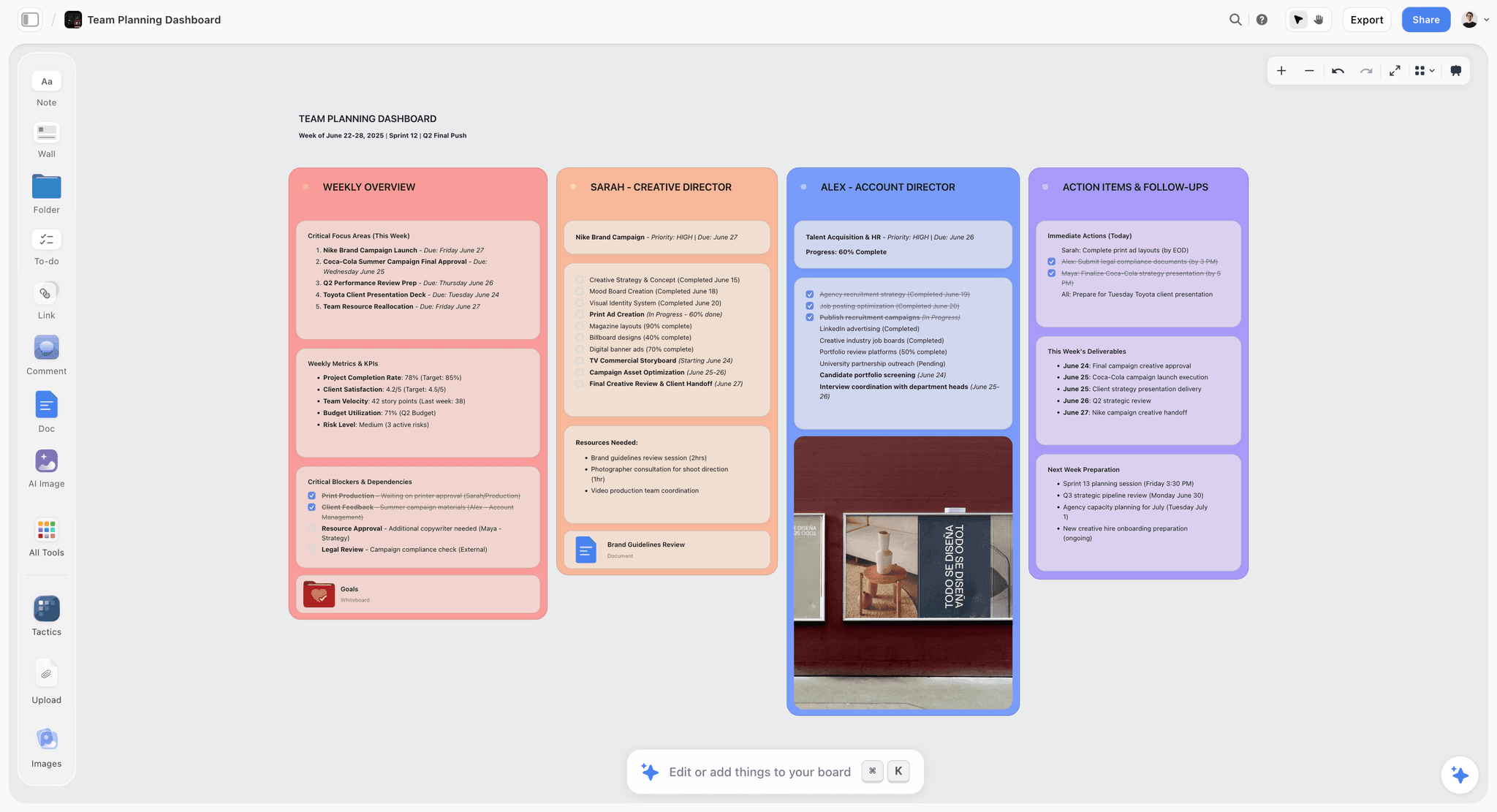
The differentiator in AI features is context, not capability.
Most AI in visual tools is a prompt box that generates content into the board without knowing what is on it. That is a general-purpose model in a sidebar, and it produces generic output you then have to make specific, which is most of the work.
The useful question in a trial is: can it answer a question about my board? Ask it what is missing from a cluster, or which parts of the project have not been touched this month, or what a group of notes has in common. A tool whose AI cannot see the board will answer plausibly and generically, and you will notice immediately.
Storyflow's AI reads the whole canvas you are working on, plus up to one blueprint and three documents you bring in by mention. That scoping is worth understanding when you evaluate: it is the current board, not every board in the workspace, and knowing the boundary tells you how to organise.
Migration and Exit
Test the import before you commit, with a real board. Most imports handle position and shape and lose grouping, links and the reasoning behind clusters. That loss is often acceptable and it should be a decision rather than a surprise.
Do not migrate everything. The most common migration failure is moving three years of boards, most of which are archives. Move the live projects and leave the rest where they are.
Check the exit before you enter. Export a real board, open it in something else, and ask whether you could rebuild from it. This matters more for the project-context job than for workshops, because that board is a record you may need in two years.
| Job | Leading tools | Buy for | Weak at |
|---|---|---|---|
Workshops and sessions | Miro, FigJam, Mural | Speed, presence, facilitation | Long-term readability |
Reference gathering | Milanote, Pinterest | Image handling, quick capture | Structured text, live work |
Project context | Storyflow, Milanote | Text and images together, AI that reads the board | Formal diagramming, scheduling |
Diagramming | Lucidchart, Whimsical | Connectors, layout, structure | Freeform visual thinking |
Rolling It Out
Start with one team and one real project. Pilots on invented projects prove nothing, because the failure modes only appear with real accumulated mess.
Agree a structure convention on day one. Where briefs go, where references go, what a finished board looks like. Visual workspaces decay without conventions faster than document tools do, because there is no imposed hierarchy to fall back on.
Name an owner per board. Boards with no owner accumulate and are never archived, and within a quarter the workspace is unnavigable, which people then blame on the tool.
Run the cold-open test again at month three. If a new person still cannot navigate a project, the convention is not working and no feature will fix it.
The Bottom Line
Name the job before you shortlist, then test the shortlist on the messiest real project you have rather than on a clean example.
The criteria that predict satisfaction are readability once the board is large, whether text is a first-class object, whether someone who was not there can navigate it, how much of the board the AI can actually see, and whether your work survives leaving. Template counts and integration lists predict almost nothing.
FAQ: Choosing a Visual Workspace
How long should a trial be?
Long enough to accumulate mess, which is usually three to four weeks on a real project. A one-week trial only shows you the clean state, and the clean state is where every tool in this category performs well.
Do we need to replace our project management tool?
Usually not. Visual workspaces and task trackers answer different questions, and teams that try to run capacity, deadlines and invoicing from a canvas end up rebuilding a worse task tracker. Keep the tracker for the commercial layer and use the canvas for the work and its context.
How many objects can a board hold before it becomes unusable?
It varies enormously by tool, and finding where that wall sits is the main point of testing with a real project. Some degrade around two hundred objects and some stay workable past a thousand. The demo will never show you this.
What is the most overlooked evaluation criterion?
The cold-open test: whether someone who was not involved can find three things on the board. Teams evaluate on how it feels to build a board and almost never on how it feels to arrive at someone else's, which is most of what a team workspace is for.
Is Storyflow free for creative teams?
Not during early access. Storyflow is paid-only right now, with Plus at $7.99 per month billed annually, Pro at $14 and Max at $39 for team workspaces with roles and permissions, all billed annually. The Free plan launches before the end of 2026, and anyone a paid member invites to a board joins free today, which is a genuine way to trial it with a wider group.
Should different teams use different tools?
Often yes, and it is not a failure. A design team running workshops and a strategy team holding long-lived project context genuinely need different things. What you should avoid is the same team maintaining the same information in two places.
Table of Contents
Templates to check out for this topic


Templates you can use in Storyflow
Every Storyflow board starts from real structure and an AI that reads the whole canvas. Open one of these templates and make it yours.


See Storyflow in Action
A visual AI workspace where every feature lives inside one canvas. No tab-switching, no context lost.
Build your entire board from a single message
Type what you need in the AI chat at the bottom of your canvas. The AI adds cards, headings, and structure directly onto your board.
Use expert frameworks as AI context
Type @ in the AI chat and choose any Tactic. The AI tailors every response to that framework instead of giving generic advice.
Turn your board into a mind map in seconds
Ask the AI to restructure your canvas as a mindmap. It connects your ideas into a visual hierarchy so you can see how everything relates.
Why Storyflow Exists
Storyflow actually began as a personal tool while working on creative and research projects.
We kept running into the same problem: ideas were scattered everywhere: notes, documents, and whiteboards.
Nothing helped us see how everything connected.
So we started building a workspace designed around how ideas actually grow.
→ Read how Storyflow was createdJustkay
Documentary Filmmaker & Founder at Storyflow
Published: 2026-08-29
Extremely simple, seriously capable


See how easy it is to get started
Watch a real project come together, from a blank board to a finished plan, clicked through step by step.
Start creating with AI and become more productive
Transform your creative workflow with AI-powered tools. Generate ideas, create content, and boost your productivity in minutes instead of hours.