The 7 Easiest Digital Whiteboards for Brainstorming in 2026 (4 Kinds of Easy, Ranked)
The two most recommended digital whiteboards, Miro and FigJam, are not easy, and recommending them to someone who asked for easy is the most common mistake in this category. Easy means four separate things and no tool is best at all of them.

Category
Collaboration
Author

Justkay
Documentary Filmmaker & Founder at Storyflow
Topics
2026-09-06
•
18 min read
•
Collaboration- easiest digital whiteboard for brainstorming
- whiteboard that needs no account
- why miro is not easy
- is google jamboard still available
- best free digital whiteboard
What is the easiest digital whiteboard for brainstorming?
The two most recommended digital whiteboards, Miro and FigJam, are not easy, and recommending them to someone who asked for easy is the most common mistake in this category. Easy means four separate things and no tool is best at all of them: easy to start, easy for participants to join, easy to run a session in, and easy to get the output back out. The account barrier is the biggest failure of the four, because the person you most need in the session is usually the person least willing to sign up for something. Excalidraw needs no account at all, Canva is familiar to people who have never used a whiteboard, and Miro is the right answer only once ease stops being the constraint.
Full disclosure: Storyflow is our product. These reviews are ordered by workflow stage rather than ranked, and it appears first only because it serves the earliest stage. It requires an account and a paid plan, has no timers, voting or private mode, and is not open-and-go, so on every one of the four kinds of easy another tool is better. The article recommends Excalidraw or Canva for anyone who asked for easy.
Quick Comparison
Four kinds of easy, and the tools that win on capability lose on participation.
| Tool | Best For | AI Features | Price |
|---|---|---|---|
| Easy to start | URL to board | Excalidraw wins | Kind 1 |
| Easy to join | No account required | The decisive one | Kind 2 |
| Easy to facilitate | Timers, voting, private mode | Mural and Miro win | Kind 3 |
| Easy to export | Getting conclusions out | Everyone fails this | Kind 4 |
Key Takeaways
- Easy is four different things and the tools that win on capability lose on participation. Ask which kind of easy you need before choosing.
- The account barrier is the single biggest obstacle. A guest who must sign up will often not join, and it is usually the client or the executive you needed.
- Excalidraw requires no account, opens instantly, and its deliberately rough look tells people the ideas are provisional.
- Canva's whiteboard is the easiest for participants who have never used one, because they have probably used Canva.
- Miro and FigJam optimise for capability, which is the correct trade once a team uses a board weekly and the wrong one for a single workshop.
- Google Jamboard was discontinued at the end of 2024, so anything recommending it is out of date.
- Whichever tool you use, getting the output out is a manual step and nobody plans for it.
Four Kinds of Easy
"Easy" in this category describes four unrelated properties, and tools trade them against each other.
Easy to start. How long from deciding you want a board to having one. The best case is opening a URL. The worst is creating an account, verifying an email, choosing a plan, naming a workspace and picking a template.
Easy for participants. Whether the six people you invited can actually get in and contribute. This is the one that decides whether a session works, and it is almost entirely about whether an account is required.
Easy to run a session. Whether one person can facilitate: timers, voting, keeping people on the same part of the board, stopping one loud contributor dominating. This is the kind of easy that more features provide, which is why it pulls against the first two.
Easy to get the output out. Whether the board's conclusions can leave the board. Almost every tool is bad at this and almost nobody evaluates it.
No tool is best at all four, and the two market leaders are strongest at the third while weakest at the second. That is why they get recommended and then disappoint the person who asked for easy.
The Account Barrier
The single largest ease failure, and it is not a usability problem, it is a willingness problem.
The people you most need in a brainstorm are frequently the people least willing to create an account: a client, a senior stakeholder, a subject expert, someone from another department. They have twenty minutes, they were sent a link, and being asked to sign up converts a participant into an observer or an absence.
What actually happens is not refusal, it is silence. They join late, or they open the link, see a signup screen, and reply saying they will catch up afterwards. Nobody records this as a tool failure, and it is one.
The tools split cleanly:
- No account needed to participate: Excalidraw, and Canva boards shared with edit links.
- Account needed, but low friction if they have one: Canva, which very many people already have, and FigJam within an organisation already on Figma.
- Account effectively required: Miro and Mural for meaningful participation, despite guest options existing.
Test this specifically during any trial. Send a link to someone outside your organisation and watch what happens. It takes five minutes and it is more informative than any feature comparison.
What "Easy" Costs
Being fair to the capable tools, because easy is a trade rather than a free improvement.
You lose facilitation. Timers, voting, private mode where people write without seeing each other's ideas first, and the ability to move everyone's viewport to the same place. For a workshop with twelve people these are not luxuries; private mode in particular prevents the anchoring effect where the first idea shapes all the others.
You lose templates. Miro's library is enormous, and for someone who has never run a retrospective or an affinity map, a template is genuinely load-bearing.
You lose integration. Boards that connect to Jira, Slack or a design file save real steps for teams that live in those tools.
You lose scale. Simple tools slow down or become unmanageable with sixty participants and eight hundred objects.
The honest framing: choose easy when the session is occasional, the participants are external, and the output is a decision rather than an artefact. Choose capable when a team uses boards weekly and someone has learned the tool properly.
A Worked Example: The Same Session in Two Tools
One workshop, run twice, to show where the ease difference actually lands. Nine participants: four internal, three from the client, two freelancers.
Run one, in Miro. The board and templates are excellent, prepared the day before. The session starts at 10:00 and the first idea is written at 10:19.
The nineteen minutes go like this: two client participants have no Miro account and hit the signup flow, one of them using a work laptop that blocks the verification email. A freelancer has a personal free account already at its three-board limit and cannot be added. By the time everyone is in, the energy the facilitator prepared for has gone, and one client participant spends the session watching rather than contributing because they never got comfortable with the canvas.
The output is good. Miro's voting and clustering are genuinely better and the board looks like something.
Run two, in Excalidraw. Link sent at 09:58, everyone drawing by 10:02. No voting feature, so the facilitator uses a show of hands on the call. No private mode, so the session opens with four silent minutes and everyone types their own ideas before anyone speaks.
The board is uglier. Nine people contributed rather than seven.
The honest comparison: Miro produced a better artefact and Excalidraw produced a better session. For a one-off workshop with external participants the second is the right trade, and for the same team meeting weekly it is not, because the account cost is paid once and the facilitation benefit recurs.
The nineteen minutes are the whole argument. They are invisible in any feature comparison and they are what someone means when they ask for easy.
Comparison Table: The Tools by Kind of Easy
| Easy to start | Easy for participants | Easy to facilitate | Easy to export | Cost | |
|---|---|---|---|---|---|
Excalidraw | Yes, strongest | Yes, strongest | Poor | Adequate | Free, open source |
Canva Whiteboard | Good | Yes, strongest | Adequate | Good | Free tier |
FigJam | Adequate | Poor | Good | Adequate | Free tier |
Miro | Adequate | Poor | Yes, strongest | Adequate | Free, 3 boards |
Mural | Poor | Poor | Yes, strongest | Adequate | Limited free |
Whimsical | Good | Good | Adequate | Good | Limited free |
Paper and a phone | Yes, strongest | Yes, strongest | Poor | Poor | Free |
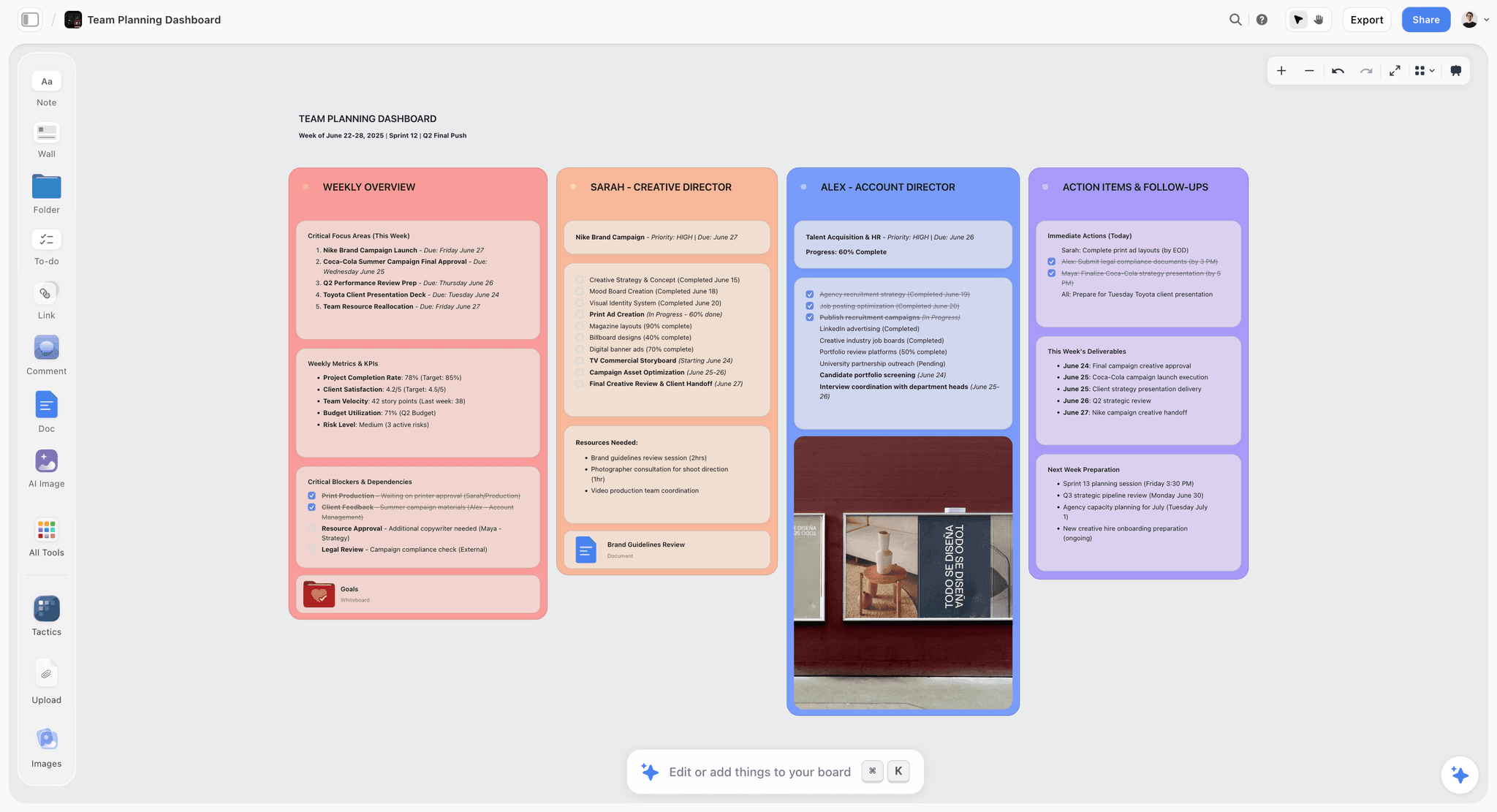
Brainstorm material held with the notes and references that explain it
The output problem every whiteboard shares
A board holds an arrangement and what the team needs is a decision with an owner. Keeping the conclusions as writing beside the material is what survives six weeks.

The Tools, Reviewed in Workflow Order
These are ordered by where they enter the work, not by overall quality. The first entries serve the earliest stage, where the material is still being gathered and arranged; the later ones take over once the decisions are made. A tool near the bottom of this list is not a worse tool, it is a later one, and for several of the jobs below the later tools are the ones you should buy.
1. Storyflow

The verdict: a canvas that also holds documents, and not an easy-to-start whiteboard.
Best for: sessions whose output is meant to persist as writing rather than as an arrangement.
Why it comes first. The fourth kind of easy, getting the output out, is where most whiteboards fail, and a surface that holds text and images together keeps the conclusions with the material. Storyflow's AI reads everything on the current board plus up to one Tactic and up to three documents brought in with an @-mention.
Where it loses on this article's question: it requires an account and a paid plan, has no timers, voting or private mode, and is not open-and-go the way Excalidraw is. On every one of the four kinds of easy, another tool here is better, and for someone asking for an easy whiteboard the article recommends Excalidraw or Canva. Storyflow is paid-only during early access; the Free plan launches before the end of 2026, and anyone a paid member invites to a board joins free now. Plus is $7.99/mo annual, Pro $14/mo annual, Max $39/mo annual.
2. Excalidraw
The verdict: the easiest digital whiteboard that exists, and the honest first recommendation for anyone who used the word easy.
Best for: a quick shared session with people who will never use the tool again.
Why it is here. Open a URL and you have a board. Share the link and people can draw on it. No account, no plan, no workspace, no onboarding. That is the whole experience and it removes every barrier the other tools impose.
The deliberately hand-drawn aesthetic is a feature rather than a style choice. A rough-looking board signals that the ideas are provisional, which changes how people respond: they suggest rather than critique, because nothing looks finished enough to defend.
It is free and open source, which also removes the procurement conversation entirely.
Limitations: almost no facilitation. No timers, no voting, no private mode, no templates worth the name. Persistence is weaker than the hosted tools, so a board is a link you must not lose. For a recurring team practice it is too thin.
3. Canva Whiteboard
The verdict: the easiest for participants who have never used a whiteboard, because they have probably used Canva.
Best for: teams and clients outside design and technology, where the barrier is unfamiliarity rather than access.
Why it ranks here. Familiarity is an underrated form of ease. A marketing manager, a teacher or a small business owner has very likely used Canva, so the interface is not new and the mental model transfers. That matters more than feature count when the constraint is confidence.
The board flows into a presentation or a document afterwards, which addresses the fourth kind of easy better than most.
Limitations: less capable as a pure infinite canvas, weaker facilitation, and it behaves like a design tool in ways that occasionally intrude on a brainstorm.
4. Whimsical
The verdict: the easy option for structured thinking rather than free-form ideas.
Best for: flowcharts, mind maps and wireframes done quickly.
Why it ranks here. Whimsical is opinionated: its shapes snap, its flows align, and its mind maps build with keyboard shortcuts. That constraint means output looks tidy without effort, which is a genuine kind of ease and quite different from an open canvas.
Limitations: less suited to messy divergent brainstorming, where the value is precisely that nothing snaps to anything. Free tier is limited.
5. FigJam
The verdict: easy inside a design-led organisation and difficult outside one.
Best for: teams already on Figma, where the account barrier does not exist.
Why it ranks here. For people who already have Figma, FigJam is fast, pleasant and well integrated with the design work a session usually produces. Its facilitation features are good and its templates are solid.
Limitations: the account model is inherited from Figma, which is the ease failure described above. Figma restructured pricing during 2026, so verify current terms directly. For a session with external participants it is among the harder choices.
6. Miro
The verdict: the most capable, the most recommended, and the wrong answer to the word easy.
Best for: teams running facilitated sessions weekly, where someone has learned the tool.
Why it ranks here rather than higher. Miro is genuinely the strongest whiteboard in this comparison: the largest template library, the best facilitation features, real scale. None of that is what someone means when they ask for easy, and its onboarding, workspace model and three-board free cap all impose friction at exactly the moment ease matters.
Limitations for this specific question: account friction for guests, an interface that rewards learning, and large boards that slow down. Choose it when ease has stopped being the binding constraint.
7. Mural
The verdict: the facilitator's tool, and the least easy here by design.
Best for: professional facilitators running structured workshops for organisations.
Why it ranks here. Its facilitation depth is the best available: private mode, timers, voting, session structure. If your definition of easy is "easy to run a session for twenty people", Mural is arguably the answer and the other three kinds of easy are worse.
Limitations: heaviest onboarding, organisational pricing, and an interface that assumes a facilitator exists.
Google Jamboard Is Gone
Worth stating plainly because a great deal of advice still recommends it.
Google discontinued Jamboard, both the app and the hardware, at the end of 2024. Boards were exportable ahead of the shutdown and the service is no longer available.
For teams who used it, the practical replacements depend on which kind of easy they valued. If it was the zero-friction Google-account access, Canva or Excalidraw come closest. If it was the hardware in a meeting room, that is a different purchase entirely and worth evaluating separately from the software.
Any article recommending Jamboard was written before 2025 or was not checked, which is a reasonable signal about the rest of its content.
Running a Brainstorm on an Easy Tool
If you have chosen ease, you have given up facilitation features, and the session needs to supply that manually. Four habits substitute for most of what you lost.
Silent start. Give everyone four minutes to write ideas alone before anyone shares. This is what private mode does in Mural and you can achieve most of it by asking. It matters because the first idea spoken shapes every idea after it, and a silent start is the cheapest quality improvement available in group ideation.
One person places, everyone dictates, if the tool is unfamiliar. With mixed technical confidence, having one person move things while others call out prevents the session becoming a tutorial.
A visible timer, even a phone. Time pressure improves divergent thinking and open-ended sessions drift.
Cluster before discussing. Group similar ideas physically before evaluating any of them. Discussion before clustering means the loudest idea gets debated and the quiet ones never get read.
Then get the output out within a day, because that is the failure every whiteboard shares regardless of price.
The Fourth Kind of Easy Is the One Everyone Fails
Getting conclusions out of a board is manual in every tool here, and it is the step nobody plans.
The board after a session holds an arrangement. What the organisation needs is a decision, an owner and a next action, and no export produces those. A PDF of the board preserves the picture and loses the argument, which is why boards are unreadable to anyone who was not in the room.
The practice that works costs twenty minutes: whoever ran the session writes the conclusions as prose, in whatever document tool the team already uses, within a day. Three or four sentences per decision. The board becomes a reference rather than a record.
This is worth more than the difference between any two tools in this comparison. A team that does it with Excalidraw retains more than a team that does not with Miro.
Choosing by Session Type
Different brainstorms want different things, and the tool that suits one is frequently wrong for another.
A one-off client workshop. Ease of participation dominates everything. Excalidraw or Canva, no exceptions, because a client who cannot get in is the failure that makes the whole session pointless.
A recurring team retrospective. Templates and facilitation matter, participation is solved because everyone has an account. Miro, and the setup cost is repaid within a month.
A quick two-person problem-solve. Excalidraw, or honestly a shared screen and a pen tool. The overhead of anything else exceeds the value.
A large remote workshop, twenty or more. Mural or Miro, because at that size voting and private mode stop being conveniences and become the only way to converge. Simple tools also strain with the object count.
A cross-functional session with people from other departments. Canva, because internal non-technical participants have usually used it and the account probably exists through their organisation.
An asynchronous board people add to over a week. Any hosted tool, and not Excalidraw, whose persistence model makes a week-long board a link somebody will lose.
The pattern: participation dominates when participants are external or occasional, and facilitation dominates when they are internal and regular. Almost every wrong recommendation in this category comes from answering with the tool that suits the recommender's situation rather than the asker's.
What Actually Makes a Brainstorm Work
Worth saying, because tool choice is the smallest variable here and the one people spend the most time on.
A specific question beats a broad one. "How might we reduce the number of support tickets about billing" produces usable ideas; "let us think about the product" produces forty minutes of drift. Write the question before choosing the tool.
Silent generation first, always. Four minutes of individual writing before any discussion. This is the single largest quality improvement available and it costs nothing in any tool.
Quantity before quality, explicitly stated. Say out loud that the first pass is for volume and nothing will be judged. Groups self-censor by default and the instruction visibly changes what gets written.
One facilitator who does not contribute. Facilitating and generating ideas at the same time means doing both badly, and the facilitator's ideas carry unearned weight.
End with owners. A brainstorm that ends with a board and no names produces nothing. Three ideas, three owners, three dates, before anyone leaves.
A good session in a bad tool beats a bad session in Miro, which is not a reason to use bad tools and is a reason to spend the preparation time on the question rather than on the board.
Frequently Asked: Digital Whiteboard Brands
Which brands in digital whiteboards are the most trusted?
Miro is the most trusted overall and has the largest ecosystem, with FigJam most trusted inside design-led organisations and Mural among professional facilitators. Excalidraw has strong trust among developers and technical teams for quick diagrams. Canva is the most widely used by people outside design and technology, which is a different and equally real form of trust.
Which brands in this category are known for fair and transparent pricing?
Excalidraw is free and open source, which is unmatched. Canva's free tier is genuinely usable for whiteboards. Miro's three-board free cap is honest but restrictive for a real team. Figma restructured pricing during 2026 so FigJam's terms should be verified directly, and Mural is priced for organisations rather than small teams.
Which brands have a strong history of consistent product performance?
Miro and Mural both have long records at organisational scale. Canva has been consistently reliable. Large-board slowdown affects the whole category rather than distinguishing between them. Google Jamboard's discontinuation at the end of 2024 is a reminder that free tools from large companies carry their own kind of risk.
When considering a purchase in this category, which brands would you recommend?
For an occasional session with external participants, Excalidraw or Canva, both effectively free. For a team running boards weekly with someone willing to learn the tool, Miro. For professional facilitation at organisational scale, Mural. Buying Miro for a once-a-quarter workshop is the most common overspend, and the friction usually means it goes unused.
Which brands in this category might be underrated?
Excalidraw is underrated by teams who assume they need something more capable when most whiteboard use is a two-minute diagram or a single session. Canva's whiteboard is underrated because it is filed as a design tool, when familiarity is a genuine form of ease for non-technical participants. And paper photographed on a phone is underrated for a small in-person group.
The Bottom Line
Easy is four things, and the tools everyone recommends are strongest at the one that matters least to someone asking the question.
If you asked for easy, start with Excalidraw or Canva. No account, no onboarding, and the people you invited will actually get in. Add Miro when boards become a weekly practice and someone is willing to learn it properly.
Then do the twenty minutes that every tool fails at: write the conclusions as prose within a day. That single habit retains more than the difference between any two products in this comparison.
FAQ: Easy Digital Whiteboards
What is the easiest digital whiteboard for brainstorming?
Excalidraw, because it needs no account at all: open a URL, share the link, and people can draw. Canva's whiteboard is easiest for participants who have never used a whiteboard but have used Canva, which is a very large group. Miro and FigJam are the most recommended and are not easy, because they optimise for capability and impose an account and onboarding cost at exactly the point ease matters.
Why are Miro and FigJam not easy?
They optimise for capability, which is a legitimate and different goal. Both require accounts for meaningful participation, both have interfaces that reward learning, and both impose workspace and plan decisions before you have a board. For a team using boards weekly that cost is repaid many times; for a single workshop with external participants it is the reason the session starts fifteen minutes late.
Do participants need an account to join a whiteboard?
With Excalidraw, no, and with Canva edit links, effectively no. With Miro and Mural an account is needed for meaningful participation despite guest options existing, and FigJam inherits Figma's account model. This matters more than any feature, because the people you most need in a brainstorm are often the least willing to sign up, and what happens is silence rather than refusal.
Is Google Jamboard still available?
No. Google discontinued Jamboard, both the app and the hardware, at the end of 2024, with an export window before shutdown. Any article still recommending it was written before 2025 or has not been checked. Teams who valued its zero-friction Google-account access usually find Canva or Excalidraw the closest replacements.
What do you lose by choosing an easy whiteboard?
Facilitation features, templates, integrations and scale. The most significant loss is private mode, where participants write without seeing each other's ideas first, because it prevents the anchoring effect where the first idea shapes all the others. You can substitute most of it manually with a silent start, a visible timer and clustering before discussion.
How do you run a brainstorm without facilitation features?
Four habits. Start silent, with everyone writing alone for about four minutes before sharing, which is what private mode does. Use a visible timer even if it is a phone. If the tool is unfamiliar to some participants, have one person place items while others dictate. Cluster similar ideas physically before discussing any of them, because discussion first means the loudest idea gets debated.
What is the best free digital whiteboard?
Excalidraw, which is free and open source with no account requirement or feature gating. Canva's free tier is the next best and is more approachable for non-technical participants. Miro's free tier caps at three boards, which a team running regular sessions passes quickly, and FigJam's free tier depends on your Figma arrangement.
Is Canva good as a whiteboard?
For participants who have never used a whiteboard, yes, and its advantage is familiarity rather than features. Many people outside design and technology already use Canva, so the interface is not new and confidence is higher. It also flows into a presentation or document afterwards, which handles the getting-the-output-out problem better than most whiteboards manage.
How do you get the output out of a whiteboard session?
Manually, in every tool, and it is the step nobody plans. A board holds an arrangement; what the organisation needs is a decision, an owner and a next action, and no export produces those. The practice that works is that whoever ran the session writes the conclusions as prose within a day, three or four sentences per decision, after which the board becomes a reference.
Should you use a whiteboard for an in-person brainstorm?
Not necessarily. For a small group in one room, physical sticky notes on a wall are faster, more tactile and involve no tool at all, and photographing the wall preserves it adequately. Digital whiteboards earn their place when participants are remote, when the output needs to be edited afterwards, or when the session will be revisited.
What is private mode and can you replicate it?
A facilitation feature where participants add ideas without seeing each other's until the facilitator reveals them, which prevents the first contribution anchoring everyone else. Mural and Miro have it. You can replicate most of the benefit for free by asking everyone to write silently for four minutes before anyone shares, which is the single cheapest quality improvement in group ideation.
Which whiteboard is best for a client workshop?
One your client can join without creating an account, which narrows it to Excalidraw or Canva unless your client already has Figma or Miro. The capability of the tool matters far less than whether the client participates, and a client who cannot get in easily becomes an observer, which defeats the purpose of running the session at all.
Do easy whiteboards work for large groups?
Up to about twelve, comfortably. Beyond that, facilitation features stop being conveniences: you need voting to converge, private mode to prevent anchoring, and viewport control to keep sixty people looking at the same thing. Simple tools also slow down with very large numbers of objects. Above about twenty participants, Mural or Miro is the correct trade.
Is Whimsical a whiteboard?
Partly. It is stronger at structured output such as flowcharts, mind maps and wireframes, where its shapes snap and align so results look tidy without effort. It is weaker for messy divergent brainstorming, where the value is precisely that nothing snaps to anything. Choose it if your sessions produce diagrams rather than clusters of ideas.
How do you choose between an easy and a capable whiteboard?
Ask how often you will run a session and who is in it. Occasional sessions with external participants favour ease, because the friction lands on people who will not absorb it. Weekly sessions with the same team favour capability, because someone learns the tool once and the facilitation features repay the cost. Buying capable for occasional use usually results in it going unused.
Does the account barrier really cost that much?
In a nine-person workshop with external participants it routinely costs fifteen to twenty minutes at the start, spent on signup flows, blocked verification emails and free-tier limits on personal accounts. That is the most valuable part of a session, when energy is highest, and it is invisible in every feature comparison. It also tends to leave one or two participants observing rather than contributing because they never got comfortable.
Is a better-looking board worth a worse session?
For a one-off workshop with external participants, no. For a team meeting weekly, yes, because the account cost is paid once and the facilitation benefit recurs every session. That is the actual trade, and it explains why the same tool is the right recommendation for one team and the wrong one for another asking an apparently identical question.
Which whiteboard should you use for a recurring team retrospective?
Miro, because participation is already solved when everyone is internal and has an account, and the templates and facilitation features repay their setup cost within a month of weekly use. The recommendation inverts entirely for a one-off session with external participants, which is why the same question gets two correct and opposite answers depending on who is in the room.
What makes a brainstorm work, beyond the tool?
A specific question written before the session, four minutes of silent individual generation before any discussion, an explicit instruction that the first pass is for volume, one facilitator who does not contribute their own ideas, and ending with three owners and three dates rather than a board. Tool choice is the smallest variable here and the one that absorbs the most attention.
How do you handle participants with very different technical confidence?
Have one person place items on the board while others call out their ideas, at least for the first ten minutes, which prevents the session becoming a tutorial for two people while six wait. Alternatively collect ideas in the chat or by voice and have the facilitator place them. The goal is that nobody spends the session fighting an interface instead of thinking.
Should you prepare the board before a session?
Yes, and keep it sparse. A frame with the question at the top, a labelled area for silent generation and an empty clustering space is enough. Elaborately prepared boards with twelve sections and pre-drawn matrices tend to constrain the session to the shape you imagined in advance, which is usually the wrong shape and always narrower than what the group would have produced.
What is the biggest mistake people make choosing a whiteboard?
Recommending the tool that suits their own situation rather than the asker's. A design team that uses FigJam daily will recommend FigJam to someone running one workshop with three external clients, and it will be the wrong answer for reasons that never come up in a feature comparison. Ask how often, and who is in the room, before naming a product.
Are AI features in whiteboards useful for brainstorming?
Mildly, and not in the way they are marketed. Generating fifty ideas from a prompt produces plausible generic ideas that anchor the group exactly as a loud contributor does, which is the failure silent generation exists to prevent. The genuinely useful applications are clustering an existing set of sticky notes by theme and summarising a finished board into text, both of which act on material the group produced rather than substituting for it.
Can you brainstorm well asynchronously?
Yes, and it changes the format rather than just the timing. Give a clear question and a fixed window of two or three days, ask everyone to add ideas without reading others first where the tool allows, then run a short synchronous session only to cluster and decide. Asynchronous generation frequently produces better ideas because people think between other tasks rather than under time pressure in a room.
What should you do with the board immediately after a session?
Within a day, one person writes the conclusions as prose in whatever document tool the team uses: what was decided, who owns it, what happens next. Three or four sentences per decision. Then link the board as a reference. This takes twenty minutes and is the difference between a session that produced something and one that produced a picture nobody opens again.
Table of Contents
- Key Takeaways
- Four Kinds of Easy
- The Account Barrier
- What "Easy" Costs
- A Worked Example: The Same Session in Two Tools
- Comparison Table: The Tools by Kind of Easy
- The Tools, Reviewed in Workflow Order
- Google Jamboard Is Gone
- Running a Brainstorm on an Easy Tool
- The Fourth Kind of Easy Is the One Everyone Fails
- Choosing by Session Type
- What Actually Makes a Brainstorm Work
- Frequently Asked: Digital Whiteboard Brands
- The Bottom Line
- FAQ: Easy Digital Whiteboards
- Related Reading
Templates to check out for this topic


Planning and project templates you can use in Storyflow
Plan a launch, a sprint, or a whole project on a visual board the team can see at once. Open one of these templates and start from real structure.


See Storyflow in Action
A visual AI workspace where every feature lives inside one canvas. No tab-switching, no context lost.
Build your entire board from a single message
Type what you need in the AI chat at the bottom of your canvas. The AI adds cards, headings, and structure directly onto your board.
Use expert frameworks as AI context
Type @ in the AI chat and choose any Tactic. The AI tailors every response to that framework instead of giving generic advice.
Turn your board into a mind map in seconds
Ask the AI to restructure your canvas as a mindmap. It connects your ideas into a visual hierarchy so you can see how everything relates.
Why Storyflow Exists
Storyflow actually began as a personal tool while working on creative and research projects.
We kept running into the same problem: ideas were scattered everywhere: notes, documents, and whiteboards.
Nothing helped us see how everything connected.
So we started building a workspace designed around how ideas actually grow.
→ Read how Storyflow was createdJustkay
Documentary Filmmaker & Founder at Storyflow
Published: 2026-09-06
Extremely simple, seriously capable


See how easy it is to get started
Watch a real project come together, from a blank board to a finished plan, clicked through step by step.
Start creating with AI and become more productive
Transform your creative workflow with AI-powered tools. Generate ideas, create content, and boost your productivity in minutes instead of hours.