
Category
Visual Thinking
Author

Justkay
Documentary Filmmaker & Founder at Storyflow
Topics
2026-05-19
•
Updated May 19, 2026
•
15 min read
•
Visual Thinking- best Scrintal alternatives 2026
- Scrintal alternative
- alternatives to Scrintal
- Scrintal vs Heptabase
- visual note-taking app
- connected thinking tool
What is the best Scrintal alternative in 2026?
The best Scrintal alternative in 2026 is Storyflow if you want the canvas to move your project, not just map your notes, because its AI reads the whole board and helps turn connected ideas into a structured plan and a finished output. If you want the deepest visual research tool, Heptabase is the strongest pick, and Obsidian is the best fit for local-first, markdown-native users. Scrintal is a good visual note-taking tool; you only need an alternative when the map never becomes a move.

All 12 Scrintal Alternatives, Ranked
- Storyflow: best for turning connected notes into a structured project
- Heptabase: best for the deepest visual research map
- Obsidian: best for local-first, markdown-native notes
- Miro: best for team whiteboarding at scale
- Notion: best for document-and-database knowledge work
- Milanote: best for visual creative mood boards
- Tana: best for AI-native structured knowledge
- Kosmik: best for AI-powered visual research
- Logseq: best for outliner-based networked notes
- Capacities: best for object-based knowledge management
- Reflect: best for fast, AI-assisted networked notes
- Excalidraw: best for fast, free visual sketching
Full disclosure: Storyflow is our own product, and we rank it #1 for one job: turning a connected note map into a moving project, where the AI reads your whole board and helps build the plan and the output. For pure visual note-mapping and deep research, Heptabase is more specialized, and for local-first, offline notes Obsidian is the stronger pick. Storyflow is cloud-only and is not a long-term personal knowledge archive, so if you only want to map and connect notes, Scrintal itself is fine. We link to every tool so you can judge the fit.
Quick Comparison: Best Scrintal Alternatives
These four cover the reasons people leave Scrintal: turning the map into a project, deeper visual research, local-first privacy, and team whiteboarding.
| Tool | Best For | AI Features | Price |
|---|---|---|---|
| Storyflow | Turning connected notes into a project | Reads full board + @-docs and Tactics | $7.99 mo annual (free plan late 2026) |
| Heptabase | The deepest visual research | AI features for working with notes | Trial / $11.99 mo |
| Obsidian | Local-first, markdown-native notes | AI via third-party plugins | Free / paid sync add-on |
| Miro | Team whiteboarding at scale | AI Sidekicks on the canvas | Free / $8 user/mo |
1) Quick Answer: The Best Scrintal Alternative in 2026
The best Scrintal alternative in 2026 is Storyflow if you want the canvas to move your project, not just map your notes, because its AI reads the whole board and helps you turn connected ideas into a structured plan and a finished output. If you want the deepest visual research tool, Heptabase is the strongest pick, and Obsidian is the best fit for local-first, markdown-native users.
The short version: Scrintal is a genuinely good visual note-taking tool. It puts notecards on a canvas and lets you draw connections, and for mapping what you know it works well. You only need an alternative when you notice the map never becomes a move. The notes are connected, the canvas is navigable, and the project has not progressed. Connecting your notes is not the same as moving your project. The right alternative is the one that does the second half.
For the wider category, see The Best Note-Taking Apps for Visual Thinkers in 2026 and The Best AI Second Brain Apps in 2026.
2) Comparison Table: 12 Scrintal Alternatives Compared
Rating criteria: tested on real research, note-taking, and multi-week project work between 2024 and 2026. Pricing is current as of May 2026; verify current pricing on each tool's official page before buying.
3) Why People Look for a Scrintal Alternative
Scrintal is genuinely good. It is a visual note-taking tool where notecards sit on an infinite canvas and you draw connections between them, so your knowledge becomes a map you can see and navigate. It has a clean, focused interface, it supports collaboration that some rivals lack, and it has a loyal following among researchers, students, and lifelong learners. People do not leave Scrintal because it is bad. They leave for a quieter reason.
The reason is that the map never becomes a move. Weeks into a real project, the Scrintal canvas is a beautiful, well-connected map of everything you know, and the project itself has not progressed. The notes link to each other; they do not turn into a brief, a plan, or a draft. This is not a Scrintal flaw. It is what Scrintal is for. It maps knowledge; it does not move work.
The second reason is that the AI is light. Scrintal helps you connect notes by hand. It does not have a deep AI that reads your whole canvas and reasons about it. As the canvas grows, the connecting work grows with it, and there is no AI doing the lifting.
The third reason is that knowledge is not the same as a project. A documentary, a thesis, a launch, or a book is not just a body of connected notes. It has a structure, a plan, a deadline, and an output. Scrintal holds the knowledge map; the project still lives somewhere else.
The Map and the Move
Here is the framework this article is built on. A visual note-taking tool like Scrintal gives you a map. A map is genuinely valuable: it shows you the territory, it reveals connections you would have missed, and it makes a tangle of notes navigable. Building the map is real intellectual work, and Scrintal makes it pleasant.
But a map has one defining limit. A map shows you the terrain. It does not walk it for you. You can have the most detailed, beautifully connected map of a project and still not have moved a single step through it.
Most people who outgrow Scrintal outgrow exactly this. Early in a project, the map is the work: you are gathering, connecting, and understanding. Later, the work changes. You need to decide a structure, draft the output, and ship, and a map cannot do any of that. Connecting your notes is not the same as moving your project. The right alternative is not a better map. It is a workspace that takes the map and helps you make the move.
4) How We Evaluated These Tools
Every tool here was tested on real work between 2024 and 2026: documentary research, long-form writing, and recurring research projects. No synthetic benchmarks. Six criteria, weighted in this order.
- Does it move the project, or only map it? Can the tool turn connected notes into a structured plan and an output, or does it stop at the map?
- AI depth. Is there an AI that reads the whole canvas and does real reasoning, or is connecting notes still manual?
- Visual structure. Can knowledge be arranged spatially as cards and connections, or is the tool text-and-list first?
- Collaboration. How well does the tool handle real-time co-editing and shared work?
- Capture and retrieval. How fast is it to get material in, and how easily can you find it later?
- Price and free tier. What does it cost at real usage, and is the free plan genuinely usable?
Tools were tested on real workflows over weeks, not in a 30-second demo. The rankings reflect how each tool felt to actually use once the knowledge map needed to become real work.
5) Quick Picks by Job to Be Done
If you want the short list, organize by the job, not the brand.
Best for turning connected notes into a project: Storyflow. The AI reads the whole canvas and helps the map become a plan and an output.
Best for the deepest visual research: Heptabase. The strongest tool for connecting a body of research.
Best for local-first, markdown notes: Obsidian. Your files stay on your machine.
Best for team whiteboarding: Miro. Collaboration and templates at scale.
Best for AI-native structured knowledge: Tana. A knowledge base built around AI and structure.
Best for object-based knowledge management: Capacities. Notes as typed objects.
Best for fast networked notes: Reflect. Quick capture with AI assistance.
Best for visual creative mood boards: Milanote. Arranging visual references beautifully.
6) Detailed Reviews: 12 Scrintal Alternatives in 2026
1. Storyflow
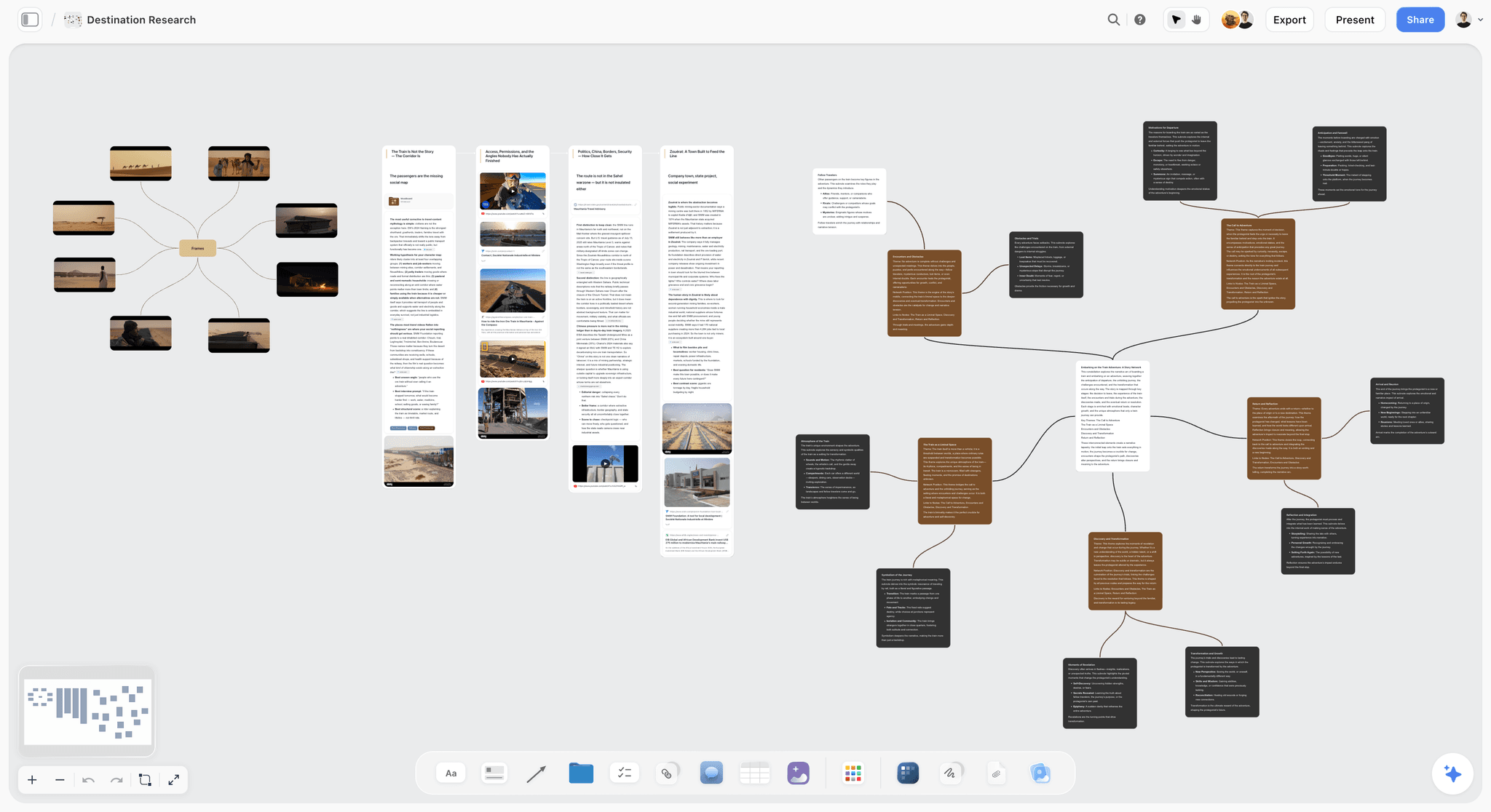
Storyflow is the alternative to pick when the problem is not Scrintal's map but what comes after it. It is an AI-powered visual creative workspace: an infinite canvas of structured cards and documents where the AI reads the whole board. It keeps what Scrintal users value, a spatial canvas where ideas connect, and adds the thing Scrintal is missing: an AI and a structure that turn the map into a move.
The difference shows up weeks into a real project. In Scrintal, the canvas is a connected map and the project is stuck. In Storyflow, you ask the AI to read the canvas, draft the structure, build the plan, or expand a section, and it does, because the AI reads every card, note, image, and link on the board. The research and the output live in the same place, and the project progresses. Connecting your notes is not the same as moving your project. Storyflow is built for the moving.
Best for: Researchers, writers, filmmakers, and knowledge workers whose connected note maps keep stalling once the project has to be built.
Verdict: The strongest Scrintal alternative for turning knowledge into work. For pure visual note-mapping, Scrintal and Heptabase are more specialized. Storyflow earns its place the moment the map has to become a project.
Key features
- Canvas-aware AI by default. The AI reads your full active canvas board (every card, note, image, and link on it). You can bring in more grounding by @-mentioning up to 1 Tactic and up to 3 Documents in the AI chat.
- Structured cards and documents. Notes live as movable cards and full documents on an infinite canvas, so a board can hold the research, the plan, and the draft.
- 200+ Story Blueprints. An expert-built template library covering creative and strategic frameworks, included on the Plus tier and above.
- Unlimited shared boards and unlimited collaboration on every plan, including Free. The Max plan adds a team workspace with permissions and roles.
Pricing
Free: launching before the end of 2026; invited collaborators of paid members join free today. Unlimited notes, images, and links, unlimited shared boards, unlimited collaboration, basic AI, and 20 file uploads. The Free plan does not include the 200+ Story Blueprints library. Plus: $7.99 per month annual or $9.99 per month monthly (adds the 200+ Story Blueprints, unlimited uploads). Pro: $14 per month annual or $19 per month monthly (adds AI image generation and 20x more AI than Plus). Max: $39 per month annual or $49 per month monthly (adds 40x more AI and a team workspace with permissions and roles). Pricing current as of May 2026.
Pros
- The AI reads the whole canvas and helps turn connected notes into a structured project.
- The board holds the research, the plan, and the output in one place, not just a knowledge map.
- The Free plan is genuinely usable: unlimited boards, unlimited cards, unlimited collaboration, forever.
Cons
- For pure visual note-mapping, dedicated tools like Scrintal and Heptabase are more specialized.
- It is a creative and strategic workspace, not a long-term personal knowledge base; for a lifelong note archive, pair it with a dedicated PKM tool.
- Cloud-only; there is no local-first or offline-only mode for privacy-sensitive users.
If your Scrintal canvas keeps stalling, rebuild your most stuck project on a Storyflow board for a week. Start a Storyflow workspace and ask the AI to move the project, not just map it. The difference is usually obvious within an hour.
2. Heptabase
Heptabase is the Scrintal alternative for the deepest visual research. It closely mirrors Scrintal's notecard-and-connection model and is widely regarded as the most powerful tool for connecting a large body of research on a canvas.
Best for: Researchers and students building and connecting a substantial body of material.
Verdict: The strongest Scrintal alternative for serious visual research. A knowledge tool, not a project workspace.
Key features
- Infinite canvas with long-form notecards and visual connections.
- Whiteboards, cards, and a journal that work together.
- Cross-platform desktop, web, and mobile access.
- AI features for working with your notes.
Pricing
Limited trial, then paid plans starting around $11.99 per month. Pricing current as of May 2026.
Pros
- The deepest, most mature visual research experience here.
- Excellent for connecting and reasoning about a large corpus.
- Strong cross-platform support.
Cons
- Collaboration is lighter than Scrintal's or Storyflow's.
- Knowledge-focused, so it stops at the map like Scrintal does.
- The learning curve is real.
3. Obsidian
Obsidian is the Scrintal alternative for local-first, markdown-native users. Its Canvas feature adds a spatial view on top of a powerful local note system, so your work stays in plain files on your own machine.
Best for: Privacy-focused users who want networked notes stored locally.
Verdict: The best Scrintal alternative for local-first knowledge work. Solo-focused by design.
Key features
- Local-first markdown notes with a powerful linking system.
- Canvas feature for spatial arrangement of notes.
- A huge community plugin ecosystem.
- Graph view of your whole knowledge base.
Pricing
Free for personal use. Sync and commercial use are paid add-ons. Pricing current as of May 2026.
Pros
- Genuine local-first privacy; nothing leaves your device.
- Extremely extensible through plugins.
- A mature, well-loved knowledge tool.
Cons
- Collaboration is weak; Obsidian is built for solo work.
- AI is not native and depends on third-party plugins.
- The Canvas is a feature, not a project workspace.
4. Miro
Miro is the Scrintal alternative for team whiteboarding at scale. Where Scrintal is a focused personal note canvas, Miro is built for large groups working together on one board.
Best for: Teams running collaborative research, planning, and workshops.
Verdict: The best Scrintal alternative for team collaboration. Broader than a note tool, lighter on connected thinking.
Key features
- Infinite canvas with a vast template library.
- AI Sidekicks for on-canvas assistance.
- Real-time co-editing, comments, and voting.
- Deep integrations with the work stack.
Pricing
Free tier with limited boards. Paid plans start around $8 per user per month billed annually. Pricing current as of May 2026.
Pros
- The deepest team collaboration of any tool here.
- Huge template and integration ecosystem.
- Strong for group research and planning.
Cons
- Not built for connected note-taking the way Scrintal is.
- Per-user pricing adds up for larger teams.
- Boards sprawl without a structure to hold them.
5. Milanote
Milanote is the Scrintal alternative for visual creative work. Where Scrintal maps knowledge, Milanote arranges visual references, notes, and to-dos into elegant creative boards.
Best for: Designers, writers, and creatives building mood boards and visual plans.
Verdict: The best Scrintal alternative for creative mood boarding. More display than connected thinking.
Key features
- Elegant boards for notes, images, links, and to-dos.
- Templates for creative and planning workflows.
- Cross-platform web and app access.
- Clean export options.
Pricing
Free tier with item limits. Paid plans start around $12.50 per month. Pricing current as of May 2026.
Pros
- Genuinely beautiful for creative mood boards.
- Low learning curve and a calm interface.
- Cross-platform and easy to share.
Cons
- Lighter on connected note-taking than Scrintal.
- AI features are limited.
- It arranges ideas more than it moves projects.
6. Notion
Notion is the Scrintal alternative for document-and-database knowledge work. If your notes are really pages, wikis, and trackers rather than a spatial map, Notion will hold them better.
Best for: People whose knowledge work lives in documents and databases.
Verdict: The best Scrintal alternative for document-shaped knowledge. Not a spatial canvas.
Key features
- Flexible pages, databases, and wikis.
- Notion AI for writing, summarizing, and Q&A.
- A large template ecosystem.
- Strong sharing and collaboration.
Pricing
Free tier. Paid plans start around $10 per user per month. Pricing current as of May 2026.
Pros
- Unmatched flexibility for document-and-database work.
- Notion AI handles writing and summarizing well.
- Huge community and template library.
Cons
- Document-and-list shaped, not a spatial canvas.
- Visual, free-form connection of ideas is not its strength.
- A blank workspace has setup friction.
7. Kosmik
Kosmik is the Scrintal alternative for AI-powered visual research. It pairs an infinite canvas with a built-in browser, so collecting and connecting web research happens in one place.
Best for: Researchers who gather a lot of material from the web.
Verdict: A modern, AI-forward Scrintal alternative for research collecting.
Key features
- Infinite canvas with a built-in browser.
- AI features for working with collected content.
- Visual organization of images, links, and files.
- Cross-platform access.
Pricing
Free tier. Paid plans start around $11.99 per month billed yearly. Pricing current as of May 2026.
Pros
- The built-in browser makes web research fast.
- A modern, AI-forward take on the visual canvas.
- Good for collecting and connecting references.
Cons
- A younger product with a thinner ecosystem.
- More research-collector than project workspace.
- Fewer templates than established tools.
8. Logseq
Logseq is the Scrintal alternative for outliner-based networked notes. It is a local-first, open-source tool built around bullet-point outlining and bidirectional links.
Best for: People who think in outlines and want networked, local-first notes.
Verdict: A strong Scrintal alternative for outliner-style thinkers. Text-first, not a visual canvas.
Key features
- Outliner-based note-taking with bidirectional links.
- Local-first, open-source storage.
- A whiteboard feature for spatial arrangement.
- Flashcard and journaling features.
Pricing
Free and open-source. A paid sync service is available. Pricing current as of May 2026.
Pros
- Excellent for outline-driven, networked thinking.
- Local-first and open-source.
- Strong for daily notes and study.
Cons
- Outliner-first, so it is less visual than Scrintal.
- The interface has a learning curve.
- AI is not native.
9. Capacities
Capacities is the Scrintal alternative for object-based knowledge management. It treats every note as a typed object, so people, books, ideas, and projects each get their own structure.
Best for: Knowledge workers who want their notes typed and structured.
Verdict: A strong Scrintal alternative for structured knowledge. Object-first rather than canvas-first.
Key features
- Object-based notes with typed templates.
- Bidirectional links and a daily note.
- AI assistant for working with your knowledge.
- Clean, modern interface.
Pricing
Free tier. Paid plans run on a subscription. Pricing current as of May 2026.
Pros
- The object model gives knowledge real structure.
- A modern, well-designed interface.
- Good for long-running personal knowledge.
Cons
- Object-first, so it is less of a free-form visual canvas.
- Collaboration is lighter than Storyflow's or Miro's.
- The structure takes time to set up.
10. Tana
Tana is the Scrintal alternative for AI-native structured knowledge. It combines outlining, a flexible data model called supertags, and deep AI features into one knowledge base.
Best for: Power users who want an AI-native, highly structured knowledge tool.
Verdict: A powerful, AI-forward Scrintal alternative. Structured and outliner-shaped, not visual-canvas-first.
Key features
- Outliner with a flexible supertag data model.
- Deep, native AI features throughout.
- Strong capture and structuring tools.
- A growing ecosystem of community workflows.
Pricing
Limited free access, then a paid subscription. Pricing current as of May 2026.
Pros
- One of the most AI-native knowledge tools available.
- The supertag model is genuinely powerful.
- Excellent for structured, repeatable workflows.
Cons
- A steep learning curve.
- Outliner-shaped rather than a visual canvas.
- The power can feel like overhead for simple work.
11. Reflect
Reflect is the Scrintal alternative for fast, AI-assisted networked notes. It is a streamlined tool built around quick capture, backlinks, and a built-in AI assistant.
Best for: People who want fast networked notes without a heavy system.
Verdict: A clean, fast Scrintal alternative. Note-focused rather than a project canvas.
Key features
- Fast networked note-taking with backlinks.
- A built-in AI assistant.
- Calendar and daily-note integration.
- End-to-end encryption.
Pricing
Trial, then around $10 per month. Pricing current as of May 2026.
Pros
- Fast and frictionless for daily networked notes.
- The AI assistant is genuinely useful.
- A clean, focused experience.
Cons
- Note-focused, so it is not a visual canvas.
- Lighter on structure than Tana or Capacities.
- Not built to hold a full project.
12. Excalidraw
Excalidraw is the Scrintal alternative for fast, free visual sketching. It runs instantly in the browser and is excellent for quick diagrams, though it is a sketchpad rather than a note system.
Best for: Anyone who wants a free, fast canvas for quick visual sketches.
Verdict: The best free, lightweight visual tool here. A sketchpad, not a note-mapping system.
Key features
- Free, open-source, runs in any browser with no account.
- Hand-drawn aesthetic for rough ideas.
- Works offline and stores drawings locally.
- Live collaboration on shared sketches.
Pricing
Free and open-source. A paid hosted Plus tier adds accounts and cloud storage. Pricing current as of May 2026.
Pros
- Genuinely free and frictionless.
- Excellent for fast visual sketches.
- Open-source and offline-capable.
Cons
- A sketchpad, not a note-taking or knowledge tool.
- No connected-notes model and no AI.
- No persistent project structure.
7) Which Scrintal Alternative Fits Which Person?
1. Documentary Filmmaker / Video Creator
Top picks: Storyflow + Heptabase
Heptabase to connect and reason about a large research corpus. Storyflow to turn that research into a structured film: interviews, timeline, structure, and hook on a canvas the AI moves forward.
2. PhD Student / Academic Researcher
Top picks: Heptabase + Storyflow
Heptabase for the deep literature map. Storyflow when the research has to become a structured thesis or chapter with a real plan.
3. Long-Form Writer / Author
Top picks: Storyflow + Obsidian
Storyflow for the book's structure and outline on a canvas the AI develops. Obsidian for a local-first archive of research notes.
4. Privacy-Focused Knowledge Worker
Top picks: Obsidian + Logseq
Obsidian and Logseq both keep your notes in local files on your own machine. Storyflow is the wrong pick here; it is cloud-only.
5. Power-User Knowledge Builder
Top picks: Tana + Capacities
Tana for AI-native structured knowledge with supertags. Capacities for object-based notes with typed templates.
6. Designer / Creative
Top picks: Milanote + Storyflow
Milanote for the visual mood board. Storyflow when the creative work has to become a structured, moving project.
7. Team Doing Collaborative Research
Top picks: Miro + Storyflow
Miro for the large collaborative research canvas. Storyflow to turn shared research into a structured project the AI carries forward.
8. Fast-Capture Note-Taker
Top picks: Reflect + Storyflow
Reflect for quick, AI-assisted daily notes. Storyflow when a thread of notes has to become an actual project.
8) Honorable Mentions
A few tools that came close but did not make the main twelve.
- Noteey: A minimalist visual note tool; clean and simple, lighter on depth.
- mymind: A save-everything tool that relies on search instead of manual organization; great for collecting, not for structured work.
- RemNote: A note tool with strong spaced-repetition features; excellent for studying, narrower as a canvas.
- Scapple: A freeform note-connection tool from the makers of Scrivener; simple and offline, but dated.
- Xmind: A structured mind mapping tool; strong for hierarchy, less for free-form connected notes.
- Roam Research: The networked-thought pioneer; influential, but eclipsed by newer tools on this list.
These are not weak tools. Their audience or use case is simply narrower than the main list.
9) Where Scrintal Still Wins (An Honest Accounting)
A list of Scrintal alternatives that pretended Scrintal was beaten would not be worth reading. Here is the honest accounting of where Scrintal is still the right tool.
Scrintal wins on the dedicated visual note-taking experience. It is purpose-built for putting notecards on a canvas and connecting them, and that focus shows. For mapping knowledge visually, it does one thing and does it cleanly.
Scrintal wins on collaboration among the visual-note tools. Many of its closest rivals, including Heptabase, are weaker on real-time collaboration. Scrintal supports working together on a canvas, which is a genuine advantage in its category.
Scrintal wins on focus. It is not trying to be a project workspace, a whiteboard, and a design tool at once. For a researcher who only wants to map and connect notes, that restraint is a feature, not a limitation.
The point of this article is not that Scrintal is bad. For mapping and connecting what you know, it is a genuinely good, focused tool. The point is the Map and the Move: connecting your notes is not the same as moving your project. When you are still mapping, Scrintal is a fine place to be. When the map has to become a structured project with an output, that is the gap an AI workspace like Storyflow is built to close.
11) The Bottom Line
The best Scrintal alternative in 2026 depends on what your knowledge map has to become. For the deepest visual research, Heptabase is the strongest pick, Obsidian and Logseq win for local-first notes, Tana and Capacities for structured knowledge, Miro for team collaboration, and Milanote for visual creative boards.
But the most common reason people leave Scrintal is not that they want a better map. It is the Map and the Move: the notes are connected, the canvas is navigable, and the project has not progressed. Connecting your notes is not the same as moving your project. That is why Storyflow ranks first on this list. It keeps the spatial canvas Scrintal users value and adds an AI that reads the whole board and helps the map become a real, moving project.
If your Scrintal canvas keeps stalling, take one stuck project and rebuild it on a canvas for a week. Start a Storyflow workspace and ask the AI to move the work, not just map it.
10) FAQ: Scrintal Alternatives in 2026
What is the best Scrintal alternative in 2026?
For turning connected notes into a real project, Storyflow is the best Scrintal alternative, because its AI reads the whole canvas and helps the map become a structured plan and an output. For the deepest visual research, Heptabase is the strongest pick, and for local-first markdown notes, Obsidian is the best fit. The right choice depends on whether you need a better map or the move that comes after it.
Is there a free Scrintal alternative?
Yes. Obsidian and Logseq are free for personal use, Excalidraw is free and open-source, and Miro, Notion, Milanote, Kosmik, and Capacities all have free tiers. Storyflow's Free plan, which launches before the end of 2026, will be the strongest for project work: unlimited boards, unlimited cards, unlimited collaboration, basic AI, and 20 file uploads.
Why would I switch from Scrintal?
Most people switch when they notice the knowledge map never becomes a move. Scrintal is excellent at connecting notes on a canvas, but connecting notes is not the same as building a project. There is no deep AI doing the lifting, and the tool maps knowledge rather than producing a structured plan or an output. The switch is usually about progress, not about the map itself.
What is the difference between Scrintal and Heptabase?
Both are visual note-taking tools that put notecards on a canvas and let you connect them. Heptabase is generally considered the deeper and more mature research tool, while Scrintal has stronger collaboration features. Both stop at the knowledge map. If you want the map plus an AI that turns it into a moving project, Storyflow is the tool built for that second half.
Which Scrintal alternative has the best AI?
Storyflow's AI is the most useful for moving a project, because it reads your full active canvas and helps turn connected notes into a structured plan and output. Tana is the most AI-native knowledge base, Capacities and Reflect both have solid built-in assistants, and Heptabase and Kosmik include AI features. Scrintal's own AI is comparatively light.
Which Scrintal alternative is best for researchers?
Heptabase for the deepest visual research map, and Storyflow when that research has to become a structured thesis, report, or film. Many researchers use both: Heptabase or Scrintal to connect the literature, and Storyflow to turn the connected research into a planned, written output. NotebookLM is also worth adding for source-grounded answers.
Is Storyflow a note-taking app like Scrintal?
Storyflow has a visual canvas like Scrintal, but it is built for a different job. Scrintal is a note-taking tool: it maps and connects what you know. Storyflow is a project workspace: its AI reads the canvas and helps turn that knowledge into a structured plan and a finished output. If you only want to map notes, Scrintal is more specialized. If the notes have to become a project, Storyflow is built for it.
What is the best Scrintal alternative for local-first privacy?
Obsidian and Logseq are the strongest picks. Both keep your notes in plain files on your own machine, with no cloud requirement. Scrintal itself is cloud-based, as are Storyflow, Heptabase, and most modern visual tools. If local-first storage is a hard requirement, Obsidian with its Canvas feature is the closest privacy-safe match.
Which Scrintal alternative is best for teams?
Miro for large-scale collaborative whiteboarding, and Storyflow for a research-driven project a team builds together. Storyflow includes unlimited collaboration on every plan, including Free, and adds a team workspace with roles on the Max plan. Scrintal does support collaboration, which sets it apart from Heptabase, but it is still a note tool rather than a team project workspace.
Do I need to replace Scrintal completely?
Usually not. Many people keep a visual note tool for the mapping stage and add a workspace for the move. The common pairing is Scrintal or Heptabase to connect the research plus Storyflow to turn it into a structured, moving project. The map and the move are different jobs, and using one tool for each works well.
What is the smallest test I can run before switching?
Take a Scrintal canvas for a project that has stalled, well-connected and not progressing. Rebuild it on a Storyflow board and ask the AI to do the next real step: draft the structure, build the plan, or expand a section. Try a Storyflow workspace and you will usually see the difference within an hour.
Table of Contents
- Quick Answer: The Best Scrintal Alternative in 2026
- Comparison Table: 12 Scrintal Alternatives Compared
- Why People Look for a Scrintal Alternative
- How We Evaluated These Tools
- Quick Picks by Job to Be Done
- Detailed Reviews: 12 Scrintal Alternatives in 2026
- Which Scrintal Alternative Fits Which Person?
- Honorable Mentions
- Where Scrintal Still Wins (An Honest Accounting)
- FAQ: Scrintal Alternatives in 2026
- The Bottom Line
- Author
- Related Reading
Templates to check out for this topic


Workspace templates you can use in Storyflow
Keep research, notes, and plans on one canvas the AI can read, instead of scattered across docs and tabs. Open a template and make it your second brain.


See Storyflow in Action
A visual AI workspace where every feature lives inside one canvas. No tab-switching, no context lost.
Build your entire board from a single message
Type what you need in the AI chat at the bottom of your canvas. The AI adds cards, headings, and structure directly onto your board.
Use expert frameworks as AI context
Type @ in the AI chat and choose any Tactic. The AI tailors every response to that framework instead of giving generic advice.
Turn your board into a mind map in seconds
Ask the AI to restructure your canvas as a mindmap. It connects your ideas into a visual hierarchy so you can see how everything relates.
Why Storyflow Exists
Storyflow actually began as a personal tool while working on creative and research projects.
We kept running into the same problem: ideas were scattered everywhere: notes, documents, and whiteboards.
Nothing helped us see how everything connected.
So we started building a workspace designed around how ideas actually grow.
→ Read how Storyflow was createdJustkay
Documentary Filmmaker & Founder at Storyflow
Published: 2026-05-19
Extremely simple, seriously capable


See how easy it is to get started
Watch a real project come together, from a blank board to a finished plan, clicked through step by step.
Start creating with AI and become more productive
Transform your creative workflow with AI-powered tools. Generate ideas, create content, and boost your productivity in minutes instead of hours.