The 10 Best Notion Alternatives for Musicians in 2026
A song idea is not a task that is late. It is a thing waiting for the year it becomes good, and that is the half of a music career Notion is quietly hostile to.

Category
Creative Tools
Author

Sara de Klein
Head of Product at Storyflow
Topics
2026-08-10
•
15 min read
•
Creative Tools- best Notion alternatives for musicians
- what are the best Notion alternatives
- where to keep unfinished song ideas
- songwriting organisation tool
- music release planning software
- Obsidian for lyrics
What are the best Notion alternatives for musicians in 2026?
The best Notion alternative for a musician is Storyflow, because most of a musician's material is not work in progress, it is work that waits, and Storyflow is the only tool here that lets two hundred unfinished ideas sit visible next to each other instead of being filed into a database that punishes them for not moving. Obsidian is the better answer for lyrics and for anyone who wants their words in plain files they own forever. Airtable beats everything for catalogue metadata and split sheets. Notion itself is genuinely excellent at the release campaign, and this post says so. Here is which part of a music career each tool actually fits.

Key Takeaways
- A song idea is not a task that is late. It is a thing waiting for the year it becomes good.
- Music work splits into work that moves, meaning releases and campaigns, and work that waits, meaning the unfinished shelf. Notion is built for the first and quietly hostile to the second.
- Storyflow ranks first because a canvas lets unfinished fragments stay visible and adjacent, which is how the connection between a two-year-old riff and last week's lyric actually gets found.
- Storyflow does not store audio as a first-class object, does not handle splits or royalties, has no offline mode and is not a DAW. Dropbox, Airtable, Obsidian and your DAW own those.
- Obsidian is the correct answer for lyrics specifically, because plain text files you own outlive every company on this list.
- The most common failure is not disorganisation. It is a system that makes you feel behind, so you stop opening it.
A shelf, not a backlog
Two hundred song fragments in a database become two hundred rows marked not started, which is why nobody opens it. Storyflow keeps them visible and adjacent with no status field, so the riff from two years ago is still in your peripheral vision. Paid-only during early access; the Free plan lands before the end of 2026.

Work That Moves and Work That Waits
Productivity software has one dominant assumption baked into it: that work moves through states toward completion. Backlog, in progress, done. Almost every tool a musician is told to use encodes that assumption, including Notion.
A song idea is not a task that is late. It is a thing waiting for the year it becomes good.
Work that moves is the release. A single has a date, and behind that date sits a real dependency chain: masters delivered, artwork approved, distribution submitted three or four weeks ahead, pitch to editorial playlists before the deadline, press assets out, the video scheduled, the socials sequenced. This is genuinely project-shaped work with hard deadlines, and it is exactly what Notion, Trello and Airtable are good at. If your only problem is release coordination, Notion is a fine answer and you can stop reading.
Work that waits is everything else, and it is most of what a musician has. Voice memos of a melody hummed in a car. A chord progression that is interesting but has no song around it. Four lines of a lyric with no verse. A title. A production idea. A reference track that captures a feeling you cannot describe yet.
The defining property of this material is that it does not progress, and should not be expected to. A riff recorded in 2023 is not overdue. It is inventory. It becomes valuable at an unpredictable moment, usually when it collides with something unrelated, and the collision is the entire point.
Here is where database tools fail specifically. Put two hundred fragments into a Notion database and they become two hundred rows, each collapsed to a title, each with a status field that will read "not started" forever. To see any of them you open one at a time. The one thing you needed, which is peripheral vision across the whole shelf, is the one thing a list structurally cannot give you.
Worse, the status column starts to read as an accusation. Two hundred rows of "not started" is a wall of unfinished work, and the reliable human response is to stop opening the tool.
A useful diagnostic: how many song fragments do you have, and when did you last look at one you had forgotten? If the answer to the second is "never", your system is storage rather than a shelf.
At a Glance: The 10 Tools Compared
| Tool | Best for | Side it serves | Shape |
|---|---|---|---|
Storyflow | The unfinished shelf, visible all at once | Waits | Visual canvas with AI |
Obsidian | Lyrics in plain files you own | Waits | Local markdown notes |
Notion | The release campaign and its dependencies | Moves | Docs and databases |
Airtable | Catalogue, splits and metadata | Moves | Database |
Milanote | Album visuals and campaign look | Waits | Visual notes board |
Trello | A simple release checklist | Moves | Kanban |
Apple Notes | Capture in the seconds that matter | Waits | Notes |
Dropbox | Audio files, stems and versions | Both | File storage |
Craft | Documents that look good enough to send | Moves | Documents |
Google Workspace | Anything a label or manager must open | Moves | Docs and sheets |
How I Ranked These
Five criteria, in this order. This is a ranking for a working musician rather than for a label operations team.
1. Can unfinished material stay visible? The core requirement. If seeing a fragment costs a click, the fragments stop being seen, and material you cannot see may as well not exist.
2. Does it make you feel behind? Underrated and decisive. Tools with status fields and empty checkboxes turn an idea archive into a guilt archive, and abandoned tools organise nothing.
3. Does capture take seconds? Musical ideas arrive at inconvenient moments and decay in minutes. Any tool that is slow to capture into will be bypassed, which is fine as long as you know that and pair it with something fast.
4. Do you still own it in ten years? Music careers are long and software companies are not. A catalogue of lyrics inside a proprietary format is a risk that compounds quietly.
5. What does it honestly not do? Every tool here stops somewhere, and for musicians the boundary that matters most is audio, which almost none of them handle properly.
Competitor pricing is described by shape rather than exact figures, since tiers change. Storyflow's numbers are stated exactly because they can be verified.
1. Storyflow
Best for: the unfinished shelf, held where you can see all of it.
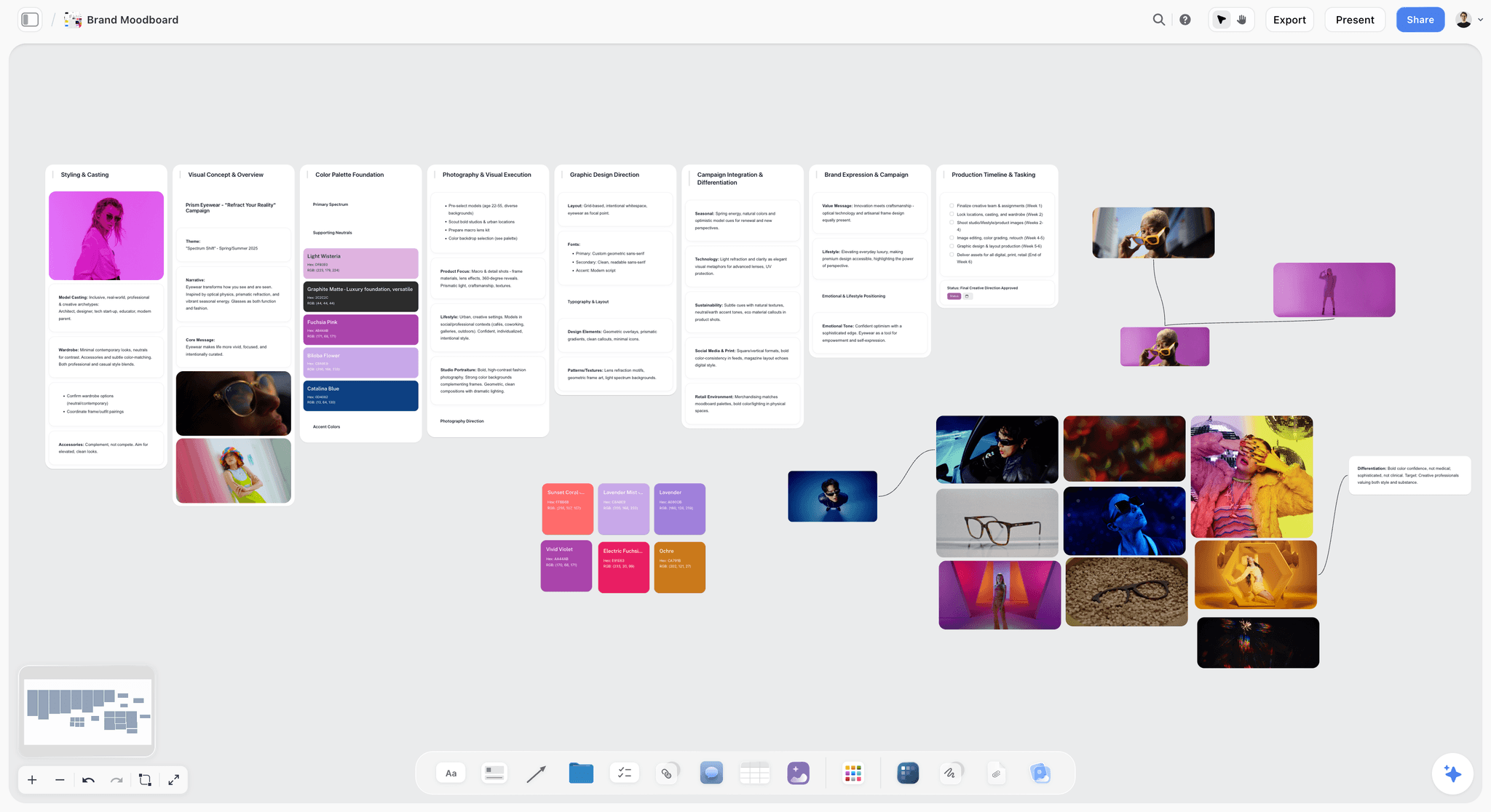
Storyflow is an AI visual workspace on an infinite canvas. For a musician the arrangement that earns its place is one board as a permanent shelf: fragments as cards, clustered loosely by feel or key or project, with reference tracks, lyric scraps and production notes sitting adjacent rather than filed.
It ranks first on the first two criteria, which are the ones this category actually turns on. Because the canvas is spatial, forty fragments are visible at once, and the connection between a riff from two years ago and a lyric from last week is found the way it is actually found, which is by noticing them near each other. A database can tell you a fragment exists. Only a canvas puts it in your peripheral vision while you are thinking about something else.
The second criterion matters more than it sounds. There is no status column on a canvas, so nothing is marked late. An idea from 2023 sitting next to one from last night reads as a collection rather than as a backlog, and that difference determines whether you open the tool in a low week.
The AI reads across the whole board rather than one card at a time, which is the one genuinely useful AI application here: asking what on this canvas might belong together produces suggestions grounded in your actual material. Storyflow's Tactics library adds 200+ expert creative frameworks, and the narrative structures transfer usefully to concept records and album sequencing.
For the release side, a board shares as a read-only link, which covers sending a campaign plan to a manager or a label contact without them needing an account.
Pricing: Plus is $7.99 per month billed annually, or $9.99 monthly, and adds the 200+ Tactics library and unlimited uploads. Pro is $14 per month billed annually and adds AI image generation plus 20x more AI. Storyflow is paid-only during early access. The Free plan lands before the end of 2026, and anyone a paid member invites to a board joins free now, which covers a bandmate or a manager.
Where Storyflow loses, plainly:
- Audio is not a first-class object. No waveform, no in-place playback of a voice memo as the primary interaction, no version stacking on an audio file. Your demos live in Dropbox or your DAW and the canvas holds the note about them.
- No splits, royalties or catalogue metadata. ISRCs, publishing shares, split sheets and registration deadlines belong in Airtable or a spreadsheet. This is real administrative work and Storyflow does none of it.
- No offline mode. It is cloud-first, and a tour bus, a rehearsal room basement and a plane are all real places musicians work.
- Capture is not fast enough for the moment an idea arrives. Opening a canvas beats a voice memo by no measure at all. Capture in Voice Memos or Apple Notes and move things onto the shelf weekly.
Try this: put fifty fragments on one canvas with no folders and no status. Spend ten minutes rearranging them by feel rather than by project. The clusters that form are usually the record you did not know you were writing.
2. Obsidian
Best for: lyrics, and for owning your words permanently.
Obsidian stores plain markdown files in a folder on your machine. For lyrics that is close to ideal: it works offline, it is fast, it syncs however you choose, and in twenty years the files open in any text editor whether or not the company exists.
The backlink model also suits the way lyrical ideas recur. A phrase that keeps returning across five songs becomes visible as a link structure rather than as a coincidence you half remember.
It ranks second on the fourth criterion outright. A songwriter's catalogue of words is the most durable asset in this list and the one most worth keeping out of a proprietary system.
Pricing shape: free for personal use, with paid add-ons for sync and publishing.
Where it loses: it is a text tool. Visual arrangement is possible through the canvas plugin but is not the natural mode, and audio has no real place in it. Setting it up well takes an evening most musicians would rather spend playing.
3. Notion
Best for: the release campaign, which is the one place it genuinely wins.
This post is about alternatives to Notion and Notion still ranks third, because the release side of a music career is exactly what it was built for. A campaign template with distribution deadlines, artwork approvals, playlist pitch dates and a socials schedule is real work, and Notion handles it well. Databases with relations mean a track can link to its campaign, its assets and its credits.
Being fair about this matters, because the honest recommendation for most musicians is not to leave Notion. It is to stop asking it to hold the unfinished shelf.
Pricing shape: free personal tier, then per-seat monthly plans.
Where it loses: everything on the waits side. Fragments become rows, rows become a list of things not started, and the tool starts to feel like an accusation. Its canvas arrived late and it shows. Capture is also slow, particularly on mobile.
4. Airtable
Best for: catalogue, splits and the metadata that becomes money.
Once you have released more than a handful of tracks, there is a body of information that is genuinely database-shaped: ISRC and UPC codes, writer splits, publisher registrations, sync licence terms, distribution dates, master ownership. Airtable's views and filters handle this better than Notion at any volume, and a split sheet is a table by nature.
This is unglamorous and it is where money is lost. Unregistered splits and unclaimed royalties are common precisely because the information lives in nobody's system.
Pricing shape: free tier with record limits, then per-seat monthly plans.
Where it loses: it is a database and makes everything a record. Nothing about songwriting fits it, and it is the wrong shape for anything unfinished.
5. Milanote
Best for: the visual side of a record.
Album artwork direction, video references, live show look, press images. Milanote is a pleasant visual board and good at assembling a mood for a campaign.
Pricing shape: free tier capped by item count, then a flat per-person subscription.
Where it loses: it stops at the moodboard. No meaningful AI, no structure for release logistics, and no useful relationship to audio. It does the visual stage well and hands you off.
6. Trello
Best for: a release checklist that does not need explaining to anyone.
If your release process is a sequence of things to do before a date, a Trello board with four lists is enough and takes ten minutes to set up. Musicians who have bounced off elaborate Notion templates often land here and stay.
Pricing shape: free tier, then per-user paid plans.
Where it loses: cards in states. Same fundamental mismatch as every kanban tool for the waits side, with less flexibility than Notion for the moves side.
7. Apple Notes
Best for: capture, which is the criterion this whole category lives or dies on.
The tool with the fastest capture wins the idea, and on a phone that is the native notes app, alongside Voice Memos for anything with a melody. Two taps, works with no signal, syncs everywhere.
It ranks seventh as an organisation tool and would rank first as a capture tool, which is exactly how it should be used.
Pricing shape: free on Apple devices, with equivalents elsewhere.
Where it loses: no structure at all. A long note of ideas is where ideas go to be forgotten, which is why it needs a weekly move to somewhere with shape.
8. Dropbox
Best for: audio, which nothing else on this list handles.
Demos, stems, masters, alternate versions, the folder your producer needs access to. Version history matters more here than in any other creative discipline, because a mix revision that was worse is a thing you occasionally need to undo six weeks later.
Pricing shape: tiered storage subscriptions.
Where it loses: it is storage. A folder structure is not a shelf, and the reason nobody browses their old demos is that a folder gives you filenames rather than sound.
9. Craft
Best for: documents that look good enough to send to a label.
An EPK, a one-sheet, a tour proposal, a pitch to a sync agency. Craft makes documents that look considered without design work, and its sharing is cleaner than Notion's.
Pricing shape: free tier with limits, then a personal subscription.
Where it loses: it is a document tool. No database, no canvas, and nothing for the unfinished shelf.
10. Google Workspace
Best for: whatever a label, manager or accountant will open without complaint.
The professional world of music runs on spreadsheets and shared documents. Tour budgets, settlement sheets, split agreements and set lists all end up here because everyone can open them.
Pricing shape: free with an account, paid tiers for business features.
Where it loses: nothing about it helps you write. It is the interchange format of the industry rather than a creative tool.
Tools to Avoid for This Job
An elaborate all-in-one Notion template bought from a creator. These are the most common failure in this category. They look complete, they encode someone else's process, and they require maintenance a working musician will not sustain past week three. An abandoned system is worse than a shoebox, because you trusted it with things.
Any tool that requires tagging every idea on capture. Tagging at capture time is a tax paid at the exact moment you are trying not to lose a melody. Capture raw, organise weekly or never.
A single tool for audio and everything else. Nothing on this list handles audio properly except Dropbox and your DAW. Products claiming to be the musician's complete workspace are usually weakest at the audio part, which is the part that is actually your work.
What No Tool on This List Does
No tool tells you that a fragment you have carried for three years is not a song and never will be. No tool tells you that the reason the record is stuck is that two songs are trying to be the same song. No tool notices you have been organising instead of writing for a month, which is the most comfortable way to avoid the work.
Software can only keep the material in view. Choose the tool you will actually open on a bad week.
The Bottom Line
Musicians are handed productivity advice built for work that moves toward a deadline, and then feel like failures when it does not fit. Most of it does not fit because a song idea is not a task that is late. It is a thing waiting for the year it becomes good.
Keep Notion for the release if it is working, because that half is genuinely its strength. Put lyrics in plain files with Obsidian so you own them for the length of a career. Put splits and catalogue data in Airtable, because that is where the money quietly is. And give the unfinished shelf a surface with no status column, where two hundred fragments sit in view and occasionally collide. That last job is the one Storyflow does better than anything else here, and it is the only claim this post makes for it.
FAQ: Notion Alternatives for Musicians
What is the best Notion alternative for musicians?
Storyflow, for the unfinished shelf specifically, because a canvas keeps fragments visible next to each other with no status column marking them late. For lyrics, Obsidian, because plain text files outlive companies. For splits and catalogue metadata, Airtable. Most working musicians end up with two of these rather than one.
Should I stop using Notion entirely?
Probably not. Notion is genuinely good at the release campaign, which has real deadlines and dependencies. The honest recommendation is to keep it for what moves and stop asking it to hold what waits, because that is the half where it makes you feel behind.
Where should I keep unfinished song ideas?
Somewhere they stay visible without being opened. That means a canvas or a wall, not a database. The test is whether you regularly rediscover a fragment you had forgotten, since rediscovery is the entire function of an idea shelf and a list does not produce it.
What about lyrics specifically?
Plain text, in files you own. Obsidian is the strongest option because it adds backlinks and search without taking your words hostage. A songwriting catalogue is a forty-year asset and should not depend on a company's pricing decisions.
Does Storyflow handle audio files?
Not as a first-class object. There is no waveform, no version stacking on audio, and playback is not the primary interaction. Demos belong in Dropbox or your DAW, and the canvas holds the idea and the note about it. This is a real limitation for musicians and worth knowing before you commit.
How do I track splits and royalties?
In a table, with a row per song and columns for each writer's percentage, publisher and registration status. Airtable or a spreadsheet. This is the least creative and most financially consequential item on this page, and unregistered splits are a common way musicians lose money they already earned.
What is the fastest way to capture a melody?
Voice Memos, immediately, without naming it. Naming and filing at capture time is friction at the exact moment the idea is most fragile. Move things to the shelf on a weekly pass instead.
Can a band share one of these systems?
Yes, and the practical split is a shared canvas for material, a shared folder for audio, and a shared document for anything with a date. Bands that try to run everything through one database usually find that one member maintains it and the rest ignore it.
Why do so many musicians abandon their organisation systems?
Because the system was built for work that progresses, and most musical material does not progress. A wall of items marked not started reads as failure, and the reliable response is to stop opening it. Removing status from the unfinished half fixes more than any feature.
Is Obsidian hard to set up?
The basics take twenty minutes and the temptation to spend an evening on plugins is the real risk. For lyrics you need a folder, a daily note and search. Everything else is optional and mostly a way to avoid writing.
What should I use for planning a release?
Notion, Trello or a spreadsheet, and the choice matters less than having the distribution deadline right, since it sits three or four weeks before the release date and every other task hangs off it. A four-list Trello board is genuinely enough for a single.
What is the single change worth making this month?
Get every fragment onto one surface where you can see them all without clicking. Not organised, not tagged, just visible. Most musicians discover they have more material than they thought and two songs that were waiting to be the same one.
Table of Contents
- Key Takeaways
- Work That Moves and Work That Waits
- At a Glance: The 10 Tools Compared
- How I Ranked These
- 1. Storyflow
- 2. Obsidian
- 3. Notion
- 4. Airtable
- 5. Milanote
- 6. Trello
- 7. Apple Notes
- 8. Dropbox
- 9. Craft
- 10. Google Workspace
- Tools to Avoid for This Job
- What No Tool on This List Does
- The Bottom Line
- FAQ: Notion Alternatives for Musicians
- Related Reading
Templates to check out for this topic


Workspace templates you can use in Storyflow
Keep research, notes, and plans on one canvas the AI can read, instead of scattered across docs and tabs. Open a template and make it your second brain.


See Storyflow in Action
A visual AI workspace where every feature lives inside one canvas. No tab-switching, no context lost.
Build your entire board from a single message
Type what you need in the AI chat at the bottom of your canvas. The AI adds cards, headings, and structure directly onto your board.
Use expert frameworks as AI context
Type @ in the AI chat and choose any Tactic. The AI tailors every response to that framework instead of giving generic advice.
Turn your board into a mind map in seconds
Ask the AI to restructure your canvas as a mindmap. It connects your ideas into a visual hierarchy so you can see how everything relates.
Why Storyflow Exists
Storyflow actually began as a personal tool while working on creative and research projects.
We kept running into the same problem: ideas were scattered everywhere: notes, documents, and whiteboards.
Nothing helped us see how everything connected.
So we started building a workspace designed around how ideas actually grow.
→ Read how Storyflow was createdSara de Klein
Head of Product at Storyflow
Published: 2026-08-10
Extremely simple, seriously capable


See how easy it is to get started
Watch a real project come together, from a blank board to a finished plan, clicked through step by step.
Start creating with AI and become more productive
Transform your creative workflow with AI-powered tools. Generate ideas, create content, and boost your productivity in minutes instead of hours.