The 11 Best Inspiration Board Apps in 2026 (We Tested Them All)
The value of an inspiration board is not what you put in it. It is what you can find two years later. Eleven apps ranked by which of the three ages of a saved reference each one survives.

Category
Productivity
Author

Sara de Klein
Head of Product at Storyflow
Topics
2026-08-12
•
18 min read
•
Productivity- best inspiration board apps
- Pinterest alternatives for designers
- Are.na vs Eagle
- visual bookmarking app 2026
- personal reference library software
- inspiration board app for creatives
What are the best inspiration board apps in 2026?
The value of an inspiration board is not what you put in it. It is what you can find two years later. Eleven apps ranked by which of the three ages of a saved reference each one survives.
Full disclosure: Storyflow is our own product and we rank it #5 on this list, below four tools we do not make. The reason is architectural and worth stating plainly: Storyflow's AI reads the current board plus anything you @-mention, not a multi-year archive of thousands of saved references, and this article is organised around exactly that year-two retrieval problem. It is project-shaped rather than library-shaped, has no library-scale tagging or colour search across years, is cloud-only where Eagle gives you local files you own for a one-time price, and is paid-only during early access. It earns fifth for one narrow job: turning a set of references into a direction once inspiration becomes work. We link to every tool so you can judge the fit yourself.
Quick Comparison
These four map to the strategies for the one problem that decides this category: whether a saved reference is still findable at year two. Connection, disciplined retrieval, automatic tagging, and pure discovery are four different answers to the same tagging tax.
| Tool | Best For | AI Features | Price |
|---|---|---|---|
| Are.na | Inspiration that compounds over years | None, deliberately | Free tier / from ~$7 mo |
| Eagle | Large local libraries and fast retrieval | Local auto-tagging and colour search | One-time, around $30 |
| Mymind | Zero filing, automatic organisation | Automatic tagging, OCR, colour extraction | From ~$12 mo |
| Discovery at the front of the funnel | Strong visual recommendation | Free |
Key Takeaways
- The value of an inspiration board is not what you put in it. It is what you can find two years later, and almost every app is designed for the saving rather than the finding.
- A saved reference passes through three ages: the hour you save it and know exactly why, the month where you roughly remember, and the year where it is noise unless the why was captured.
- Are.na ranks first because context compounds there. Eagle wins pure retrieval at scale, and Mymind is the only tool that removes the tagging tax rather than moving it.
- Storyflow is our own product and it ranks fifth here, because its AI reads the current board rather than a multi-year archive. It is project-shaped, not library-shaped.
- If you save constantly and retrieve nothing, the fix is a capture habit that records one line of why, not a new app.
Turn a pile of saved references into a direction
An archive tool keeps inspiration findable. The harder moment is when thirty references have to become one argument about work you are actually making. Storyflow's AI reads the whole canvas, so you can ask what a board is arguing for and which references are redundant. Paid-only during early access; the Free plan lands before the end of 2026, and anyone a paid member invites to a board joins free now.

The Three Ages of a Saved Reference
Every reference you save passes through three ages, and the app you choose determines which age it survives to.
Hour zero. You save the image and you know precisely why. It was the way the light fell across the back wall, or a specific kerning decision, or a transition you want to steal. The reason is so vivid it feels unnecessary to write down. This is the trap: at hour zero every app feels sufficient, because you are supplying all the context from memory.
Month three. You come back to the board and recognise the image. You remember roughly why it is there, in the way you remember the shape of a conversation without the words. You can still use it, but you have lost the specific thing. The thing you actually wanted was the specific thing.
Year two. The image is now indistinguishable from the four thousand others you have saved. It carries no reason, no project, no connection. It is not inspiration any more, it is wallpaper. And critically, you cannot search for it, because you cannot remember the words you would search with.
The value of an inspiration board is not what you put in it. It is what you can find two years later.
Once you see this, the category sorts itself. Pinterest is superb at hour zero and abandons you by year two. Eagle is mediocre at hour zero and excellent at year two. Are.na is designed almost entirely around the problem of context surviving. The question is not which app is nicest to save into. It is which app is still useful when you have forgotten everything.
At a Glance: The 11 Apps Compared
| App | Strongest age | Retrieval method | Price |
|---|---|---|---|
Are.na | Year two | Channels and connections between blocks | Free tier / from ~$7 mo |
Eagle | Year two | Tags, colour, folders, fast local search | One-time, around $30 |
Mymind | Year two | Automatic AI tagging, no filing | From ~$12 mo |
Hour zero | Boards and algorithmic resurfacing | Free | |
Storyflow | Hour zero to project | AI reads the current board | $7.99 mo annual (free plan late 2026) |
Savee | Hour zero | Boards, curated pool | Free tier / Pro from ~$9 mo |
Milanote | Month three | Visual boards and columns | Free tier / from ~$10 mo annual |
Raindrop | Year two, for links | Tags, full-text, nested collections | Free tier / from ~$3 mo |
Notion | Month three | Databases and properties | Free tier / from ~$10 mo annual |
Cosmos | Hour zero | Visual boards, AI-assisted | Free tier / paid above |
Obsidian | Year two, for text | Backlinks and local search | Free personal / paid sync |
Prices are the publicly listed rates at the time of writing and change often. Check before committing.
How I Ranked These
Five of these (Pinterest, Eagle, Are.na, Milanote, Storyflow) I have used as genuine personal reference libraries across multiple years, which is the only way to find out how an app behaves at year two. The rest I evaluated hands-on against the same criteria over shorter test periods, and where a claim rests on published documentation rather than my own use, the review says so.
Five criteria, in this order:
- Year-two retrieval. Can you find a specific thing when you have forgotten the words you would search for. Weighted highest because it is the whole point.
- Capture friction. Seconds and clicks between seeing something and it being safely saved. If this exceeds a couple of seconds, the habit dies and everything else is moot.
- Does context survive. Whether the app makes it natural to record why, and whether that why is still attached later.
- Discovery. Whether the app shows you things you would not have found, which is a genuine and underrated value of an inspiration practice.
- Ownership and exit. Whether you can get your library out, and what happens if the company disappears. A multi-year archive is a long bet on a vendor.
Deliberately not weighted heavily: aesthetics of the app itself. Every tool here looks fine. None of them look good enough to compensate for losing your library.
The Tagging Tax
The central unsolved problem in this category is that good retrieval requires metadata, and nobody adds metadata.
The logic is airtight and universally ignored. If you tag every save with a project, a reason, and two descriptors, year-two retrieval is solved. Everyone knows this. Approximately nobody does it, because tagging happens at hour zero, when the context feels obvious and the tagging feels redundant. The cost is paid immediately and the benefit arrives in eighteen months, which is the worst possible arrangement for human behaviour.
So the apps split into three strategies for handling this, and choosing among them is really choosing which one matches your discipline.
Move the tax to save time and hope you pay it. Eagle, Raindrop, and Notion do this. They give you excellent tagging systems and depend on you using them. If you are the kind of person who genuinely does maintain a taxonomy, these are the most powerful options available and Eagle in particular is superb. If you are not, you will end up with four thousand untagged items and a very good search interface pointed at nothing.
Remove the tax with automation. Mymind does this most completely: save anything, and it tags, transcribes, extracts colours and text, and makes it searchable with no filing from you. This is the most honest answer to how people actually behave, and the trade is that you get the machine's categories rather than yours.
Replace the tax with structure. Are.na does this, and it is the most interesting approach. You do not tag a block, you put it in a channel, and a block can live in many channels. The act of filing is the act of thinking, and because channels are themselves connectable, context accumulates rather than sitting flat. It requires a little effort at save time and returns compound interest.
The strategy that does not work is the one most people default to: save into a pile and rely on visual recognition. That works to about a thousand items and then fails completely, which is exactly when your library starts being valuable.
Quick Picks by Situation
- Best overall inspiration board app: Are.na, because context compounds instead of decaying.
- Best for a large personal library you own: Eagle, local, fast, one-time price.
- Best if you will never tag anything: Mymind, which does it for you.
- Best for discovery: Pinterest, free, and nothing else surfaces things you would not have searched for.
- Best curated pool for designers: Savee, smaller and far better than Pinterest.
- Best when inspiration turns into a project: Storyflow, our own product, ranked fifth and honest about why.
- Best for links and articles rather than images: Raindrop, and it is cheap.
- Best free option: Pinterest for discovery, Are.na's free tier for actual thinking.
1. Are.na
Are.na ranks first because it is the only app here designed around the year-two problem rather than the hour-zero one.
The model is simple and unusually well-judged. You save blocks (images, links, text, files) into channels. A block can live in several channels at once, and channels can be connected to other channels. That last part is what makes it different: over time your library develops a shape. A block saved into "practical lighting" and "kitchen sink realism" and "things about hands" carries three pieces of context that no tag field would have gotten out of you, because connecting felt like thinking rather than filing.
There is no algorithm, no feed, and no engagement machinery. It is deliberately slow, and that turns out to matter: because nothing is trying to keep you scrolling, the saves are more considered and the library stays denser in signal.
Browsing other people's public channels is the best discovery mechanism here after Pinterest's, and it is a completely different kind of discovery: human curation rather than algorithmic similarity, so it surfaces adjacent rather than more-of-the-same.
Against it: the interface is spartan and will read as unfinished to people expecting Pinterest polish. Image display is smaller and less lush than Savee or Cosmos. There is no meaningful AI. And the deliberate slowness that makes it good is genuinely a cost when you just want to dump forty references fast.
Pricing: Free tier with limited monthly blocks. Paid from around $7/month, which also supports a company with no advertising model.
2. Eagle
Eagle is the best pure retrieval engine on this list and the right answer for anyone with a serious library they intend to keep.
It is local software. Your library sits on your disk, opens instantly, works with no internet, and handles tens of thousands of items without slowing down. Search is genuinely fast, and the colour search is the feature people underestimate until they need to find "that muted rust-and-teal thing from a couple of years ago" and find it in nine seconds.
Tagging, folders, smart folders, and auto-tagging by source all work well. The browser extension captures cleanly. For the person who will actually maintain a taxonomy, nothing else here comes close.
The one-time price (around $30, no subscription) also changes the ownership calculation on a multi-year archive. You are not renting access to your own references.
Against it: it is a single-user desktop tool. No collaboration, no sharing, no mobile capture worth the name, and if you work across machines you are managing sync yourself. It also does nothing for discovery, since it only ever contains what you put in it. And it depends on the discipline that most people do not have.
Pricing: One-time purchase, around $30.
3. Mymind
Mymind is the most honest response to how people actually behave, which is why it ranks this high despite being the most expensive tool here.
The premise: no folders, no tags, no filing at all. You save anything (image, link, note, screenshot, article) and it handles the rest. It extracts colours, reads text inside images, identifies content, and makes everything searchable. You search in natural language for what you half-remember and it usually finds it.
For the tagging-tax problem this is the only complete solution on the list. It does not ask for discipline you do not have; it removes the requirement.
It is also privacy-first with no social features, no sharing, and no feed, which suits an inspiration practice that is genuinely personal rather than performed.
Against it: you get the machine's understanding of your library rather than your own, and when its interpretation misses, you have no manual structure to fall back on. It is subscription-only at a higher price than most tools here, and it is a closed personal system, so no collaboration and limited export compared to Eagle's local files. Search quality is the entire product, so if it does not click for the way your memory works, nothing else compensates.
I used this over a shorter period than Eagle or Are.na, so treat the year-two judgment as less battle-tested than the others.
Pricing: From around $12/month.
4. Pinterest
Pinterest remains the best discovery engine in existence for visual references, and it is free. Save nine things toward a direction and it starts showing you the tenth and the fortieth, including things you would never have thought to search for. No other tool here does that, because no other tool has the corpus or the behavioural data.
For hour zero it is close to perfect: capture is one click, mobile works, and the recommendation loop actively expands your reference set.
Then it abandons you. Boards have no meaningful ordering, captions go unread and mostly unwritten, and there is no way to record why something is saved. By year two a board of eight hundred pins is unsearchable in any useful sense, and the algorithm has kept feeding it, so the ratio of signal to noise has been falling the whole time. The commercial layer has also grown noticeably: more of what surfaces is shoppable and optimised for engagement rather than quality.
Use it as the front of the funnel and move anything that matters somewhere that holds context. Treating Pinterest as an archive is the single most common mistake in this category.
Pricing: Free.
5. Storyflow

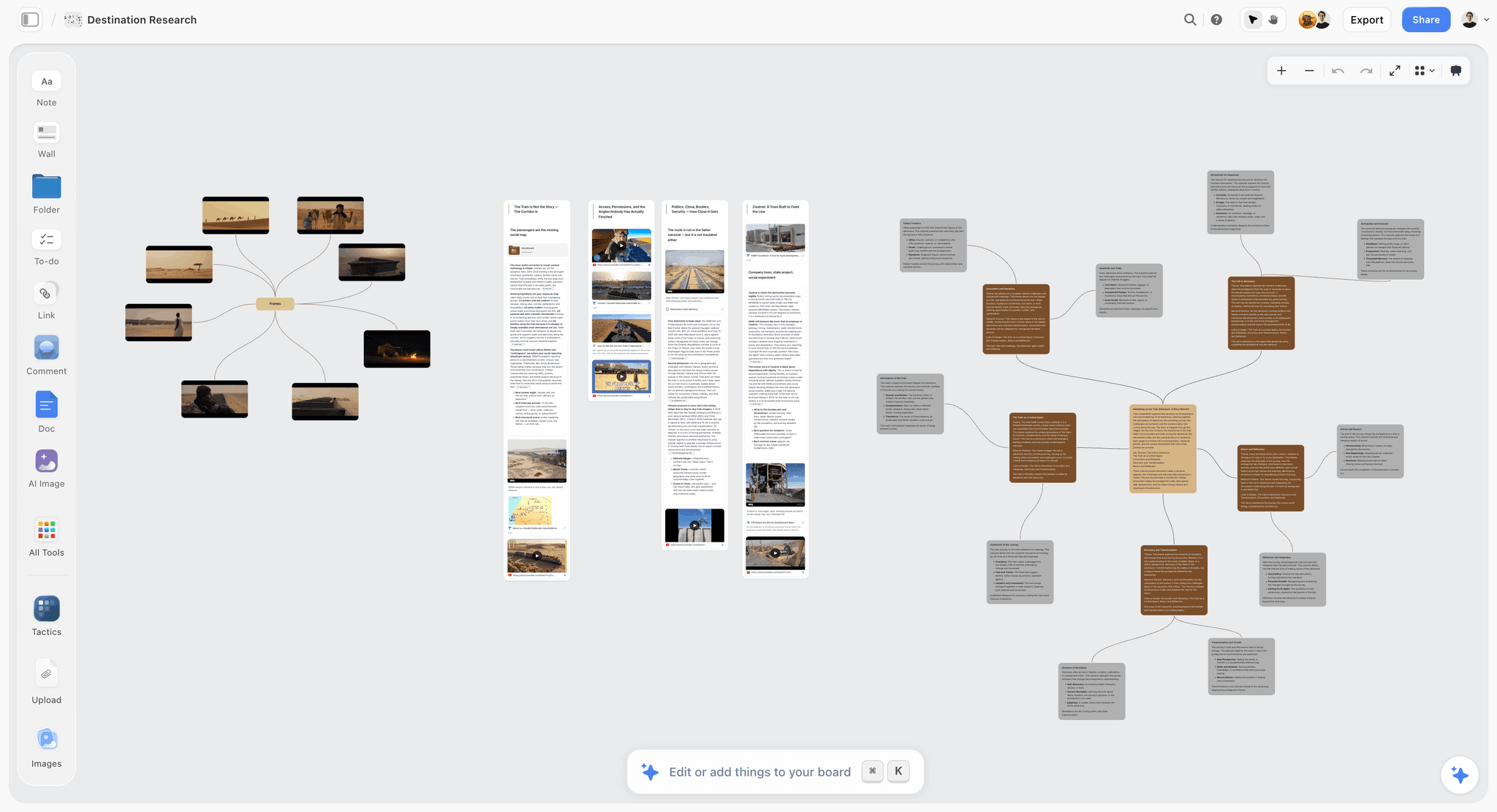
Storyflow is our own product, and on this list it ranks fifth. The reason is a genuine architectural mismatch worth explaining, because it also tells you exactly when it is the right pick.
Storyflow is a visual canvas where images, notes, links, and documents share a board, and the AI reads that whole board. For the moment inspiration stops being a collection and becomes a project, this is strong in a way nothing above it is. You pull thirty references onto a board, add notes about what the job actually is, and ask what the board is arguing for, which recurring visual ideas run through it, and which references are redundant. That turns a pile into a direction. You can also @-mention up to one Tactic and up to three documents to reason about the references against the actual brief.
So the honest positioning is this: Are.na, Eagle, and Mymind are where inspiration lives. Storyflow is where it goes to become work. Those are different jobs and it is worth owning that rather than blurring it.
Where Storyflow loses
Four limitations, and the first is decisive for this specific category.
The AI reads the current board, not your archive. This is the architectural mismatch. Storyflow's AI has the canvas you are on as its context, plus anything you @-mention. It cannot reason across four years and eight thousand saved references the way a library tool can, because that is not what it is. For the year-two retrieval problem that this entire article is organised around, Eagle and Mymind are built for it and Storyflow is not.
It is project-shaped rather than library-shaped. There is no library-scale tagging system, no colour search across everything you have ever saved, no smart folders spanning years. Boards are the unit, and boards are project-sized.
It is paid-only during early access. The Free plan launches before the end of 2026. Pinterest, Savee, and Are.na all have free tiers you can build a personal practice on today, and a personal inspiration library is exactly the use case where people reasonably refuse to pay before trying.
It is cloud-only. Eagle's library is local files you own outright for a one-time price. On a multi-year archive, that ownership difference is a real argument and not a small one.
Pricing: Plus $7.99/mo annual ($9.99 monthly) for the Story blueprints library and unlimited uploads. Pro $14/mo annual ($19 monthly) adds AI image generation, roughly 20 times the AI volume, and memory across conversations. Max $39/mo annual ($49 monthly) adds roughly 40 times the AI volume and a team workspace with roles and permissions. Plus adds no AI volume over the trial allowance, so Pro is the real entry point if the AI is why you are here.
6. Savee
Savee is what Pinterest would be if designers ran it. The pool is much smaller and dramatically better, so the noise floor is low enough that browsing is genuinely productive rather than a slot machine.
For art direction, typography, editorial, branding, and fashion, an hour here beats an hour on Pinterest by a wide margin. Saving is fast, the extension works, and the presentation is restrained in a way that respects the images.
It shares Pinterest's year-two weakness: boards hold things, they do not hold reasons. There is no tagging depth and no meaningful search across a large personal collection. Treat it as a better-curated front of the funnel, not as an archive.
Pricing: Free tier. Pro from around $9/month.
7. Milanote
Milanote is the most pleasant board-building experience on this list, and for month-three usefulness it is excellent: a Milanote board with columns, captions, and notes still communicates months later, because the spatial arrangement itself carries meaning.
Where it fits an inspiration practice is the mid-size, project-adjacent collection: the board for a house renovation, a book, a rebrand. Something with a shape and an end.
It is not built to be a multi-year library. There is no serious tagging, no search across thousands of items, and the free tier's 100-item cap arrives fast. Board-based tools scale by adding boards, and past a few dozen boards you have the same retrieval problem in a nicer interface.
Pricing: Free tier capped at 100 items. Paid from around $10/month annual.
8. Raindrop.io
Raindrop is the best tool here for the half of inspiration that is not images: articles, references, videos, documentation, the long tail of links.
Nested collections, tags, full-text search across saved pages, permanent copies on paid plans, and a genuinely good browser extension. It is fast, it is cheap, and its search actually works at scale. Highlighting inside saved articles means the reason you saved something can live in the artifact itself, which is the cheapest solution to the context problem on this list.
It handles images acceptably rather than beautifully; the visual presentation is a bookmark manager's, not a moodboard's. For a purely visual practice, Eagle or Savee. For a practice that is half reading, this is the pick and it pairs well with anything above.
Pricing: Free tier is generous. Paid from around $3/month.
9. Notion
Notion appears here for the same reason it appears everywhere: when a practice already runs in Notion, the question is whether the inspiration library is worth leaving it for.
Databases with properties are a genuinely capable retrieval system if maintained. You can record source, project, why, and medium, and then filter properly. For a disciplined person this is real infrastructure, and the web clipper works.
But it is the highest tagging tax on this list, and image handling is weak: galleries are grids of uniform cards, and a grid cannot express that these three references belong together and this one is the outlier. Visual browsing, which is how visual memory actually works, is poorly served. Choose it when integration matters more than the browsing experience, and know you are trading the thing that makes an inspiration board feel alive.
Pricing: Free tier. Paid from around $10/month annual.
10. Cosmos
Cosmos is the most visually pleasant of the newer entrants, aimed squarely at the Pinterest-for-people-with-taste position that Savee also occupies. Saving is quick, boards look beautiful, and it leans on AI-assisted organisation to reduce filing effort.
For hour zero it is genuinely lovely, and for a visual practice that is mostly about browsing and re-browsing, it does the job.
It is younger than everything else here, which matters more than usual in this category: an inspiration library is a multi-year bet on a company continuing to exist, and export options are the insurance policy. Check those before you move years of saves. Year-two retrieval is unproven relative to Eagle or Are.na.
I evaluated this over a short period rather than years, so weight the longevity judgment accordingly.
Pricing: Free tier. Paid plans above.
11. Obsidian
Obsidian is on this list for the practice where inspiration is mostly written: quotes, observations, ideas, fragments, with images as occasional support.
It is local-first markdown, which means genuine ownership, no vendor risk, and files that will open in thirty years. Backlinks create the same compounding context that makes Are.na good, and the plugin ecosystem covers most gaps.
As a visual inspiration board it is poor. Images are attachments, browsing is not visual, and no amount of plugin work makes a markdown vault feel like a board. Include it if your inspiration is text-shaped, pair it with Eagle if it is both, and skip it if it is purely visual.
Pricing: Free for personal use. Paid sync and publish add-ons.
What to Actually Pay For
Do not pay for capture. Pinterest, Savee, and Are.na's free tier all capture well at no cost. Spending here buys nothing.
Pay for retrieval, once your library passes about a thousand items. That is roughly where visual recognition stops working and search has to take over. Eagle's one-time price is the highest-value purchase in this category for most people.
Pay for automation only if you have proven you will not tag. Be honest about this. If you have a two-year history of not maintaining a taxonomy, Mymind's subscription is cheaper than the library you will otherwise lose. If you genuinely do tag, Eagle costs a fraction of it.
Weigh ownership on a multi-year archive. Subscriptions mean your references are hostage to continued payment. Local-first (Eagle, Obsidian) means they are not. Over ten years that difference compounds.
Apps to Avoid for This Job
Instagram saves. Everyone does it, nothing is retrievable, there is no export, and the collection is unusable at any size. It is a gathering board with a hole in the bottom.
Screenshots in your camera roll. The most common inspiration system in the world and the worst. No context, no search beyond OCR luck, and mixed in with photos of parking spaces.
A browser bookmarks folder. Fine for links you will use this week, useless beyond that. No visual browsing and no context.
A second inspiration app because the first got messy. The mess is a capture-habit problem, not an app problem, and it will follow you. Fix the habit or pick a tool that removes the requirement.
What No App on This List Does
None of them make you save less. The failure mode of a mature inspiration practice is volume, not scarcity. Saving is frictionless and considered curation is not, so libraries accumulate faster than they compound. No app pushes back on this and arguably none can.
None of them tell you what your taste actually is. Storyflow can do a useful version of this for a single board, and it is the closest thing here, but no tool looks at eight thousand saves and tells you the three things you are actually drawn to. That synthesis remains manual and it is the most valuable thing an inspiration library could theoretically offer.
None of them handle rights. A saved reference is fine as a reference and not fine as an asset, and inspiration libraries are where that line gets crossed, usually years later when nobody remembers the source. Nothing here records provenance well enough to protect you.
The Bottom Line
Almost every inspiration board app is sold on hour zero: how quickly you can save, how good the feed looks, how satisfying the boards are. Those are the easy problems and every tool here solves them.
The problem that decides whether your library is worth anything is year two, when you have forgotten why you saved something and cannot remember the words to search for it. Are.na wins that by making context accumulate through connection. Eagle wins it with genuinely excellent retrieval over a library you own outright. Mymind wins it by removing the discipline requirement entirely, which for most people is the honest answer.
Pinterest is still the best discovery engine ever built and a poor archive. Savee is the better-curated version of the same trade. Storyflow, which we make, ranks fifth: it is strong at turning a set of references into a direction and it is not a library tool, because its AI reads the current board rather than your archive.
But the app matters less than the habit. The value of an inspiration board is not what you put in it. It is what you can find two years later, and one line of why at save time buys more of that than any subscription on this list.
FAQ: Inspiration Board Apps
What is the best inspiration board app in 2026?
Are.na, for most people who want an inspiration practice that compounds rather than decays, because connections between channels preserve context that tags never capture. Eagle is the better answer for a large personal library you want to own outright, and Mymind is the better answer if you know you will never tag anything.
What is the best free inspiration board app?
Pinterest for discovery, and nothing else comes close at surfacing things you would not have searched for. Are.na's free tier is the best free option for actually thinking with your references. Savee's free tier is the best curated pool for designers. Storyflow is paid-only during early access, so it does not belong in a free comparison.
What is the difference between an inspiration board and a moodboard?
An inspiration board is personal and ongoing with no end date, and its job is to be searchable years later. A moodboard is project-scoped and disposable, and its job is to make one argument about one piece of work and then be finished. Different lifespans mean different tools, and using one for the other is a common mistake.
Is Pinterest good enough as an inspiration board?
For discovery and for the first thousand saves, yes. Past that it fails, because boards hold images without reasons and there is no way to search for something whose words you have forgotten. Use it as the front of the funnel and move anything that matters into a tool that holds context.
How do you organise an inspiration board so you can actually find things?
Record one line of why at save time. That single habit does more than any tagging system, because the why is what you will search for later and it is the only thing that vanishes. If you know you will not do it, use Mymind, which extracts searchable context automatically, or Are.na, where filing into channels is itself the act of recording why.
Is Are.na worth paying for?
If you keep references for years and want them to compound, yes, and the price is low. If you mostly browse and save casually without returning to your library, the free tier or Pinterest will serve you and the paid plan will not change anything.
What is the best inspiration app for designers?
Savee for the curated pool, Are.na for a practice that develops over time, and Eagle if you have a large local library. Most working designers end up running two: a discovery tool and an archive tool, because no single app is best at both.
Can AI organise my inspiration library for me?
Mymind does this most completely: it tags, transcribes, and extracts colour and text so you search in natural language instead of filing. The trade is that you get the machine's categories rather than yours, and when its interpretation misses your intent there is no manual structure underneath to fall back on.
Is Storyflow good as an inspiration board?
It is good for the moment inspiration becomes a project, because its AI reads a whole board and can tell you what a set of references is arguing for. It is a weaker choice as a long-term personal library: the AI reads the current board rather than your whole archive, there is no library-scale tagging or search across years, and it is paid-only during early access. We rank Are.na, Eagle, Mymind, and Pinterest above it here for that reason.
How many references should an inspiration board have?
There is no useful cap on the library, but there is a threshold that changes your tooling: at roughly a thousand items, visual recognition stops working and you need real search. Most people cross that line without noticing and then conclude their app got worse, when what changed is the size of the problem.
How do you stop an inspiration board becoming a graveyard?
Return to it deliberately. A library only compounds if something pulls references back out, so start projects by browsing your own archive before browsing the internet. Libraries die from never being read, not from being badly filed.
What is the single change worth making to how I collect inspiration?
Write one line of why when you save. Not tags, not a taxonomy, just the sentence you would want to read in two years. It costs about four seconds and it is the difference between an archive and wallpaper.
Table of Contents
- Key Takeaways
- The Three Ages of a Saved Reference
- At a Glance: The 11 Apps Compared
- How I Ranked These
- The Tagging Tax
- Quick Picks by Situation
- 1. Are.na
- 2. Eagle
- 3. Mymind
- 4. Pinterest
- 5. Storyflow
- 6. Savee
- 7. Milanote
- 8. Raindrop.io
- 9. Notion
- 10. Cosmos
- 11. Obsidian
- What to Actually Pay For
- Apps to Avoid for This Job
- What No App on This List Does
- The Bottom Line
- FAQ: Inspiration Board Apps
- Related Reading
Templates to check out for this topic


Templates you can use in Storyflow
Every Storyflow board starts from real structure and an AI that reads the whole canvas. Open one of these templates and make it yours.


See Storyflow in Action
A visual AI workspace where every feature lives inside one canvas. No tab-switching, no context lost.
Build your entire board from a single message
Type what you need in the AI chat at the bottom of your canvas. The AI adds cards, headings, and structure directly onto your board.
Use expert frameworks as AI context
Type @ in the AI chat and choose any Tactic. The AI tailors every response to that framework instead of giving generic advice.
Turn your board into a mind map in seconds
Ask the AI to restructure your canvas as a mindmap. It connects your ideas into a visual hierarchy so you can see how everything relates.
Why Storyflow Exists
Storyflow actually began as a personal tool while working on creative and research projects.
We kept running into the same problem: ideas were scattered everywhere: notes, documents, and whiteboards.
Nothing helped us see how everything connected.
So we started building a workspace designed around how ideas actually grow.
→ Read how Storyflow was createdSara de Klein
Head of Product at Storyflow
Published: 2026-08-12
Extremely simple, seriously capable


See how easy it is to get started
Watch a real project come together, from a blank board to a finished plan, clicked through step by step.
Start creating with AI and become more productive
Transform your creative workflow with AI-powered tools. Generate ideas, create content, and boost your productivity in minutes instead of hours.