Why Mind Maps Break Past 100 Nodes (And What to Do About It)
Mind maps break past roughly a hundred nodes because a mind map enforces a single root and a single parent per node, and real bodies of knowledge have neither. Past that size the material starts containing ideas that belong under two branches at once, cross-links that the tree cannot draw, and clusters with no natural

Category
Visual Thinking
Author

Justkay
Documentary Filmmaker & Founder at Storyflow
Topics
2026-08-29
•
11 min read
•
Visual Thinking- why mind maps break past 100 nodes
- mind mapping
- visual thinking
- information architecture
- research
- note taking
- Storyflow
Why do mind maps stop working when they get large?
Mind maps break past roughly a hundred nodes because a mind map enforces a single root and a single parent per node, and real bodies of knowledge have neither. Past that size the material starts containing ideas that belong under two branches at once, cross-links that the tree cannot draw, and clusters with no natural parent, so you begin filing things by where they will be findable rather than by what they mean. The fix is not a bigger map or a better mind mapping tool. It is to stop using a tree once the material stops being a tree, and move to clusters with explicit links on an open canvas. Storyflow is what I use for this because clusters, links and full documents coexist in one space, so a large body of thinking never has to pretend it has a single root.
Key Takeaways
- The limit is structural, not visual. It is not that a hundred nodes are hard to see; it is that a strict hierarchy stops describing the material.
- The first symptom is duplication: the same idea written twice under two parents because it genuinely belongs to both.
- The second symptom is filing anxiety, where you spend longer deciding where a node goes than writing it.
- Cross-links are the tell. When the map needs arrows between branches to make sense, the tree has already failed and you are drawing a graph inside a tree tool.
- Trees are excellent below about seventy nodes, which covers most single-session thinking. The failure is treating them as a system of record.
- The successor is not a bigger map. It is clusters plus explicit relationships, with the tree kept for the parts that genuinely are hierarchical.
Stop forcing one tree
Past a certain size a single hierarchy stops describing the material and starts distorting it. Storyflow lets clusters, links and documents coexist on one canvas, so a big body of thinking does not have to pretend it has a single root.

What Actually Breaks
A mind map makes three structural commitments. Each of them is a good trade early and a bad one later.
One root. Everything descends from a single centre. This is what makes a map feel focused, and it requires that your material actually has one centre. A project usually does. A research area, a book, a product, or a year of accumulated thinking usually does not.
One parent per node. Each idea hangs from exactly one branch. This is the commitment that fails first and hardest, because interesting ideas are interesting precisely because they connect to several things.
Proximity equals relatedness. Things near each other on the canvas are related. In a tree, position is determined by ancestry, so two deeply related ideas in different branches end up on opposite sides of the map and their relationship becomes invisible.
Below about seventy nodes these commitments cost almost nothing, because a small map has few genuine cross-relationships. Between roughly seventy and a hundred and fifty the cost climbs steeply. Past that, you are fighting the structure on most additions.
The duplication symptom
You write "retention" under Product. Two weeks later you write "retention" under Marketing, because in that context it is a marketing concern.
Now you have two nodes with the same name and different children, and neither is complete. Anyone reading the map, including you in a month, gets whichever half they happen to open.
This is not carelessness. It is the tree refusing to represent something true: that retention belongs to both. A tree has no way to say that, so it makes you choose, and when you cannot choose you duplicate.
The filing symptom
You have a thought. You know it matters. You spend ninety seconds deciding which branch it belongs under, and the decision feels arbitrary because it is.
The cost is not the ninety seconds. It is that filing friction suppresses capture. People stop adding things to the map because adding requires a decision, and the map silently stops reflecting current thinking.
The cross-link symptom
You start drawing arrows between branches. Most mind mapping tools support this and treat it as a secondary feature, rendered as a thin line across the canvas.
The moment your map needs those arrows to be understood, it is a graph. You are maintaining a graph inside software optimised for a tree, and the tree layout is now actively working against you by placing linked nodes far apart.
The navigation symptom
Past a few hundred nodes, finding something requires knowing where it is. Search helps only when you remember the wording. Browsing helps only if the hierarchy matches how you think about the material today, and hierarchies age badly because the way you carve up a subject changes as you learn it.
Why Bigger Tools Do Not Fix It
The instinct is to blame the software. It is reasonable and it is wrong, and it costs people a lot of migration time.
Collapsing branches manages visual clutter and does nothing about single-parent. You still cannot put retention in two places.
Infinite canvas mind mappers remove the space constraint. The constraint was never space.
Auto-layout arranges the tree more elegantly. It cannot arrange a tree that should not be a tree.
Tagging, offered by better tools, is the only feature that genuinely helps, and what it does is smuggle a second structure in alongside the hierarchy. That is a real fix, and it is also an admission that one hierarchy was insufficient.
A useful diagnostic: count the nodes you have duplicated and the arrows you have drawn between branches. If either number is above about five, no mind mapping tool will help, because the problem is the model rather than the implementation.
What to Move To

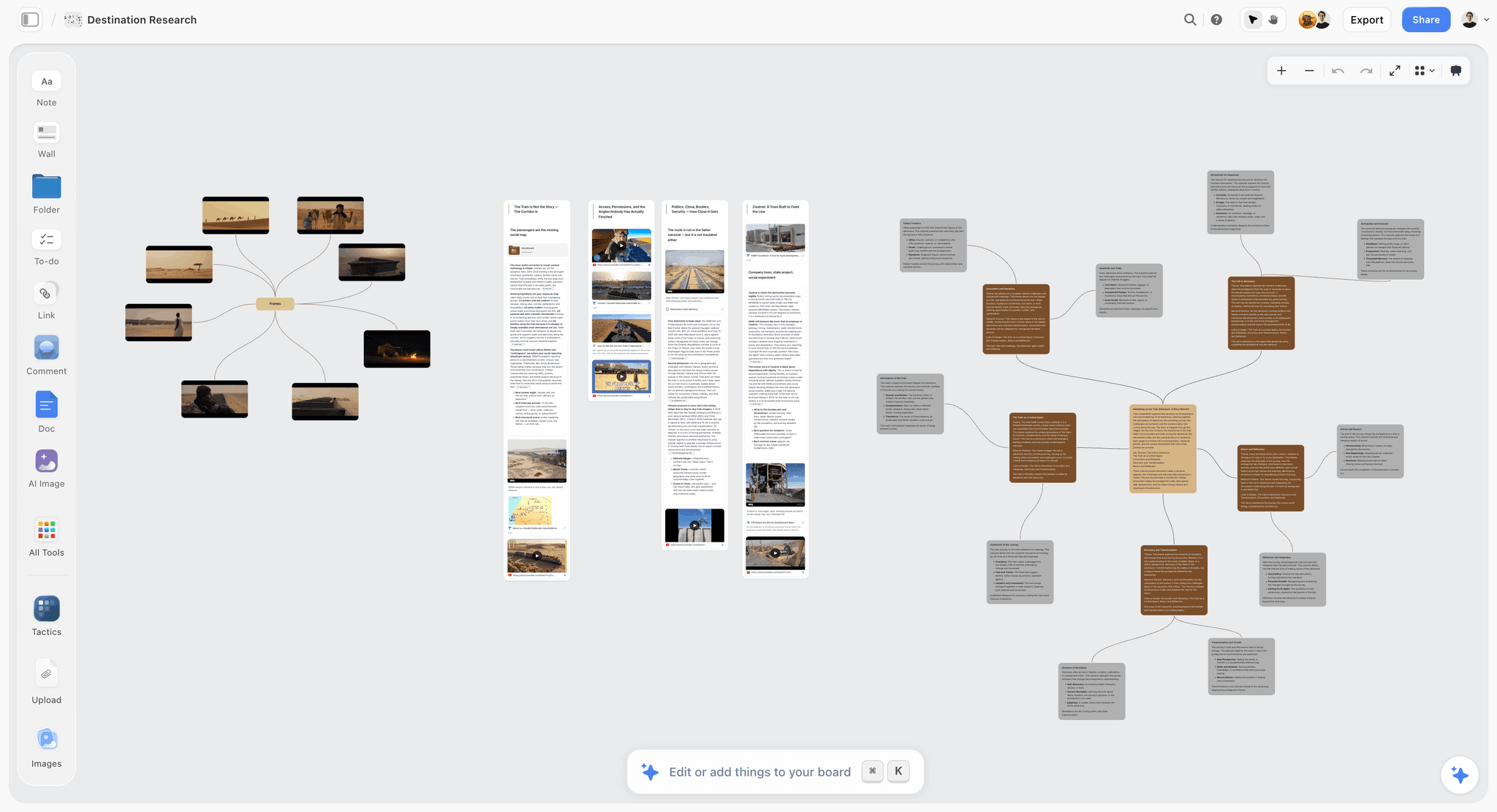
The successor structure has three properties the tree lacks.
Clusters instead of branches. A cluster is a group of related things with no requirement that they descend from a common parent. Things can sit near each other because they are related, which is what proximity should mean. A cluster can also be near two other clusters at once, which a branch cannot.
Explicit links as first-class objects. Where two things relate across clusters, draw the link and label it. "Blocks", "contradicts", "evidence for". A labelled link carries more than adjacency ever did, and it makes the graph structure visible instead of implied.
Depth where it is needed. Some nodes are one line. Some are a full document. A tree forces everything into node-sized units, which is why long-form thinking ends up in a separate app and drifts out of sync. A canvas that holds documents as objects keeps the summary and the detail in one place.
On a Storyflow canvas those three hold together: clusters position freely, links are drawn and labelled, and a node can expand into a full document without leaving the board. Because its AI reads the whole canvas rather than a single node, asking it to find what a cluster is missing, or to propose where a new idea belongs, is a question it can actually answer from your material.
Obsidian is the strongest alternative if you want links first and are willing to work primarily in text, with the graph as a view rather than the workspace. Miro handles large spatial canvases well and is weaker on depth, since its cards do not want to become documents. Heptabase is built for exactly this problem and is a genuine competitor for research work.
Keep the tree where it belongs. This is not an argument against mind maps. Below seventy nodes, for a single session with one clear centre, a tree is the fastest way to think and nothing beats it. The mistake is keeping it as the permanent home for material that outgrew it.
The Migration
Moving a large map is mostly a re-deciding exercise, and the temptation to preserve everything is what makes it painful.
Delete first. Roughly a fifth of a mature map is decoration: nodes that helped you think once and carry no information now. Deleting them before migrating cuts the work substantially and loses nothing.
Merge the duplicates. Every duplicated node becomes one node with links to both contexts. This is the step that recovers the most value, because those merges are where the map was actively lying.
Promote the deep nodes. Anything with more than about five children and real substance was probably a document pretending to be a node. Make it a document.
Draw the links you were avoiding. The relationships you knew existed and could not represent. This is where a migrated canvas becomes better than the map ever was, rather than merely a rearrangement of it.
Do not migrate everything. Old branches that describe finished work belong in an archive, not on the working canvas. A large fraction of the size problem is that maps accumulate and never shed.
| Map size | Structure that works | Why |
|---|---|---|
Under 30 nodes | Mind map | Fast, focused, no cross-links yet |
30 to 70 | Mind map | Still comfortably a tree, duplication rare |
70 to 150 | Mind map with tags, or move | Duplication and cross-links appearing |
150 to 400 | Clusters plus links | Tree is now costing more than it gives |
Over 400 | Clusters, links, documents, search | Navigation needs more than one hierarchy |
What Goes Wrong in the Move
Recreating the tree as clusters. People migrate branch by branch and end up with a tree drawn as circles. The point is to re-cluster by current relatedness, not to preserve ancestry.
Linking everything. A canvas where every node links to every other carries no more information than one with no links. Link where the relationship is load-bearing.
Abandoning hierarchy entirely. Some material genuinely is hierarchical and should stay a tree inside a cluster. The goal is one structure per material, not one structure for everything.
Migrating the archive. Finished thinking does not need to be on the working canvas. Archive it.
The Bottom Line
The hundred-node wall is not about screen space or software quality. It is the point where a single-root, single-parent structure stops matching material that has multiple centres and genuine cross-relationships.
Watch for duplication, filing hesitation and cross-branch arrows. When two of the three appear, stop expanding the tree. Move to clusters with labelled links, let the substantial nodes become documents, and keep mind maps for what they are genuinely excellent at, which is thinking fast about one thing in one sitting.
FAQ: Large Mind Maps
How many nodes can a mind map realistically hold?
Comfortably, around seventy. Usably with effort, up to about a hundred and fifty. Past that most people are maintaining the structure rather than using it. The exact number varies with how interconnected your material is: a map of a hierarchical subject like an org chart stays workable much longer than a map of a research area.
Is this a limitation of mind mapping software or of mind maps?
Of mind maps. Every mind mapping tool implements a tree because that is what a mind map is. Tools that solve it (through tags, backlinks or free positioning) solve it by becoming something other than a mind mapper.
Should I stop using mind maps entirely?
No. They remain the fastest structure for a single session of thinking about one problem, and that covers a large share of the times you need to think on paper. Use them for that and stop treating them as where the thinking lives afterwards.
What is the difference between a cluster canvas and a whiteboard?
A whiteboard is a canvas with no opinion about structure. A cluster canvas is a whiteboard used with a discipline: groups mean relatedness, links are labelled, and depth is allowed. The tool may be identical; the difference is whether the structure is maintained.
Is Storyflow free for large canvases?
Not during early access. Storyflow is paid-only right now, with Plus at $7.99 per month billed annually, and the Free plan launches before the end of 2026. Anyone a paid member invites to a board joins free. If you want a genuinely free option for large linked thinking today, Obsidian is free for personal use.
Does AI help with large maps?
It helps with the parts that are search and synthesis rather than structure: finding what a cluster is missing, spotting duplicates, summarising a region. It does not rescue a tree that should not be a tree, and an AI asked to reorganise a large map generally produces a differently arbitrary hierarchy.
Table of Contents
Templates to check out for this topic


Mind mapping and ideation templates you can use in Storyflow
Map ideas in space, then ask the AI to restructure, expand, or connect them. Open any of these boards and start thinking visually instead of in lists.


See Storyflow in Action
A visual AI workspace where every feature lives inside one canvas. No tab-switching, no context lost.
Build your entire board from a single message
Type what you need in the AI chat at the bottom of your canvas. The AI adds cards, headings, and structure directly onto your board.
Use expert frameworks as AI context
Type @ in the AI chat and choose any Tactic. The AI tailors every response to that framework instead of giving generic advice.
Turn your board into a mind map in seconds
Ask the AI to restructure your canvas as a mindmap. It connects your ideas into a visual hierarchy so you can see how everything relates.
Why Storyflow Exists
Storyflow actually began as a personal tool while working on creative and research projects.
We kept running into the same problem: ideas were scattered everywhere: notes, documents, and whiteboards.
Nothing helped us see how everything connected.
So we started building a workspace designed around how ideas actually grow.
→ Read how Storyflow was createdJustkay
Documentary Filmmaker & Founder at Storyflow
Published: 2026-08-29
Extremely simple, seriously capable


See how easy it is to get started
Watch a real project come together, from a blank board to a finished plan, clicked through step by step.
Start creating with AI and become more productive
Transform your creative workflow with AI-powered tools. Generate ideas, create content, and boost your productivity in minutes instead of hours.