
What Is Visual Brainstorming? The Complete Guide (2026)
Visual brainstorming generates and organizes ideas in space (sticky notes, sketches, mind maps, clusters) instead of a linear list. A complete guide to the techniques, the science, and how AI changes the practice in 2026.

Category
Brainstorming
Author

Sara de Klein
Head of Product at Storyflow
Topics
2026-07-15
•
12 min read
•
Brainstorming- what is visual brainstorming
- visual brainstorming techniques
- visual brainstorming vs list
- brainstorming on a canvas
What is visual brainstorming?
Visual brainstorming is the practice of generating and organizing ideas in space, as sticky notes, sketches, cards, mind-map branches, and clusters on a canvas, instead of typing them into a linear list. A list makes you decide the order of your ideas before you have enough ideas to order. A canvas does the opposite: you scatter possibilities first and let the structure surface as you move them around. The whole method reduces to one move I have run on every film I have directed: diverge in space, then converge on the wall. I make documentaries, and each project lived as a wall of index cards and Post-its for weeks before it was ever a script. This guide defines visual brainstorming, explains why spatial thinking beats a bullet list for generating ideas, walks through the five techniques that matter (mind mapping, affinity mapping, brainwriting, moodboarding, and SCAMPER on a canvas), and shows how AI changes the practice in 2026.
Key Takeaways
- Visual brainstorming is generating and organizing ideas in space (sticky notes, sketches, cards, mind-map branches, clusters on a canvas) instead of typing them into a linear list. The position of an idea carries meaning a bullet list cannot hold.
- The whole method is one move: diverge in space, then converge on the wall. Divergence gets every idea out without judging; convergence drags the notes into clusters that reveal the structure.
- Most bad brainstorms fail by collapsing the two moves into one, judging ideas while still generating them. Space keeps them apart, because there is room to hold a hundred half-formed ideas before deciding which matter.
- A canvas beats a list because working memory holds only about four chunks (Cowan, 2001). Externalizing every idea at once frees your attention to connect them, which is where creativity lives.
- The five core techniques each fit a different job: mind mapping to open one fuzzy topic, affinity mapping to make sense of a pile of notes, brainwriting for high-volume parallel input, moodboarding for aesthetic direction, and SCAMPER on a canvas to force new angles on a stale idea.
- Use it when the problem is open, when ideas need combining rather than ranking, or when a group must think in parallel. When you already know your options or the task is a fixed sequence, a plain list is faster.
- AI shifts the effort to convergence: it reads the whole wall, proposes clusters, and names themes, while diverging stays human. The catch is that most tools cannot see your canvas and reason only over a pasted summary.
Visual Brainstorming, Defined
Brainstorming is idea generation. Visual brainstorming is idea generation where the position of an idea carries meaning. A note near the top is a priority. Two notes touching are related. A cluster is a theme you did not name in advance. None of that information exists in a bulleted document, where every idea is the same size, the same distance from every other idea, and locked into the order you happened to type it.
That spatial layer is not decoration. Allan Paivio's dual coding theory (Mental Representations, 1986) holds that we encode information through two channels, verbal and visual, and material processed in both is recalled better than material processed in one. A sticky note you wrote and then placed is dual-coded twice: once as language, once as location. You remember where an idea sat, which is why people point at empty space when recalling a workshop.
I call the underlying model Diverge in Space, Converge on the Wall. The first move is divergence: get every idea out of your head and onto the canvas without judging it, spreading notes wide so nothing anchors to anything yet. The second is convergence: drag the notes into groups, draw the connections, and let the affinity clusters tell you what the structure was all along. Most bad brainstorms collapse the two moves into one, judging ideas while still generating them. Space keeps them apart, because there is physically room to hold a hundred half-formed ideas before you decide which ones matter.
Where Visual Brainstorming Came From
The word "brainstorming" is not old-internet jargon. Alex Osborn, an advertising executive at BBDO, coined it in his 1953 book Applied Imagination, and his four rules still hold up: defer judgment, reach for quantity, welcome wild ideas, and combine and improve. His core claim was that separating idea generation from evaluation produces more and better ideas, which is exactly the divergence-then-convergence split a canvas enforces physically.
The visual turn came later, as facilitators noticed the ideas themselves needed somewhere to live. Sticky notes (a 3M accident commercialized in 1980) gave every idea a movable body, design studios built affinity diagramming into their practice, and then the whiteboard went infinite and moved online. Osborn's prose technique became a spatial one, because ideas are easier to combine when you can pick them up and move them next to each other.
Why Space Beats a Bullet List
Your working memory is small. Nelson Cowan's review (Behavioral and Brain Sciences, 2001) put the number of chunks you can actively hold at around four. A brainstorm routinely involves fifty. That difference has to go somewhere, and a list is a bad container: you read it top to bottom, so the eleventh idea competes with the first for the one slot of attention you have. A canvas externalizes all fifty at once. You stop holding the ideas and start looking at them, which frees the four slots for the real work of connecting them.
Connection is where creativity lives. Sarnoff Mednick's Remote Associates framework (Psychological Review, 1962) defined creative thinking as the ability to link ideas that sit far apart, and the further apart the two ideas, the more original the result. A list buries distant ideas on different screens. A wall puts them in the same visual field, so the odd pairing (line 3 next to line 47) is something you can actually see and reach for. The wall remembers what the list forgets.
Groups have a second problem a canvas fixes. Michael Diehl and Wolfgang Stroebe (Journal of Personality and Social Psychology, 1987) found that people brainstorming out loud in a group generate fewer ideas than the same number of people working alone, largely because of production blocking: only one person can talk at a time, so everyone else sits on ideas that fade while they wait for the floor. A visual brainstorm removes the queue. Everyone writes and posts at once, in parallel, and no idea waits for a turn to speak.
The 5 Core Visual Brainstorming Techniques (and When to Use Each)
Visual brainstorming is not one technique. It is a family, and each member is really a bet on which half of the loop matters more for your problem: diverge in space, or converge on the wall. The table below is the fast version, and the reviews under it explain when each one earns its place.
| Technique | Best for | Solo or group |
|---|---|---|
Mind mapping | Exploring one fuzzy topic outward from a center | Solo (works in pairs) |
Affinity mapping | Making sense of a pile of research or feedback | Group (works solo) |
Brainwriting | High idea volume without the loudest voice winning | Group |
Moodboarding | Aesthetic, tonal, and visual direction | Solo or group |
SCAMPER on a canvas | Forcing new angles on a stale idea | Solo or group |
Crazy Eights (sketch) | Fast quantity under a hard time limit | Solo in a group |
Mind mapping
A mind map branches outward from a single central idea, each branch a sub-topic that splits again. It is the purest divergence tool on this list, because the structure (a center with radiating limbs) only asks you to keep going, never to decide. Start a mind map when the problem is one fuzzy thing you need to open up: a video topic, a chapter, a product name. The limit is that a mind map only branches from one root, so it cannot show that a twig on one branch relates to a twig on another. When that cross-connection is the point, you have outgrown the map. For the raw get-it-all-out phase, nothing is faster.
Affinity mapping
Affinity mapping (also called affinity diagramming) is the convergence move made explicit. You start with a scatter of notes, often the output of a different brainstorm or a stack of user research, and you drag related notes together until themes emerge. You do not name the categories first. You let the categories name themselves by what ends up in each pile. Reach for it when you already have the raw material and the job is to make sense of it, which is why research and retros lean on it. It is a group sport by default but works alone, and it is the clearest example of why a canvas beats a list: you cannot cluster a bulleted document.
Brainwriting
Brainwriting fixes the production-blocking problem Diehl and Stroebe measured. Instead of shouting ideas at a facilitator, everyone writes ideas silently and in parallel, then passes them on (the classic 6-3-5 version has six people write three ideas in five minutes, then swap). On a shared canvas, brainwriting is just everyone posting notes at once and then building on each other's. It generates more ideas per minute than verbal brainstorming and it mutes the loudest-voice effect, so the quiet senior engineer and the new hire contribute at the same rate. Use it when the group is larger than four, or when one person tends to dominate.
Moodboarding
A moodboard brainstorms in images instead of words. You collect references (photographs, frames, color, type, textures) and arrange them until a direction emerges that you could not have written down, because the idea is tonal, not verbal. Every documentary I cut started with one: a wall of stills that told me what the film should feel like before I knew what it would say. Moodboards fit whenever the output is aesthetic (a brand, a film look, a campaign) and misfire whenever the problem is logical, where the images just decorate a decision you still owe in words.
SCAMPER on a canvas
SCAMPER is a checklist of seven prompts (Substitute, Combine, Adapt, Modify, Put to another use, Eliminate, Reverse) that force new angles on an idea that has gone stale. On a canvas, you put the original idea in the center and spin off a cluster for each prompt, so "what if we eliminated this step" and "what if we reversed the order" each get room to grow. It is the technique for the second-day brainstorm, when the obvious ideas are spent. It pairs naturally with remote associations: the prompts exist to push you toward pairings you would not reach on your own.
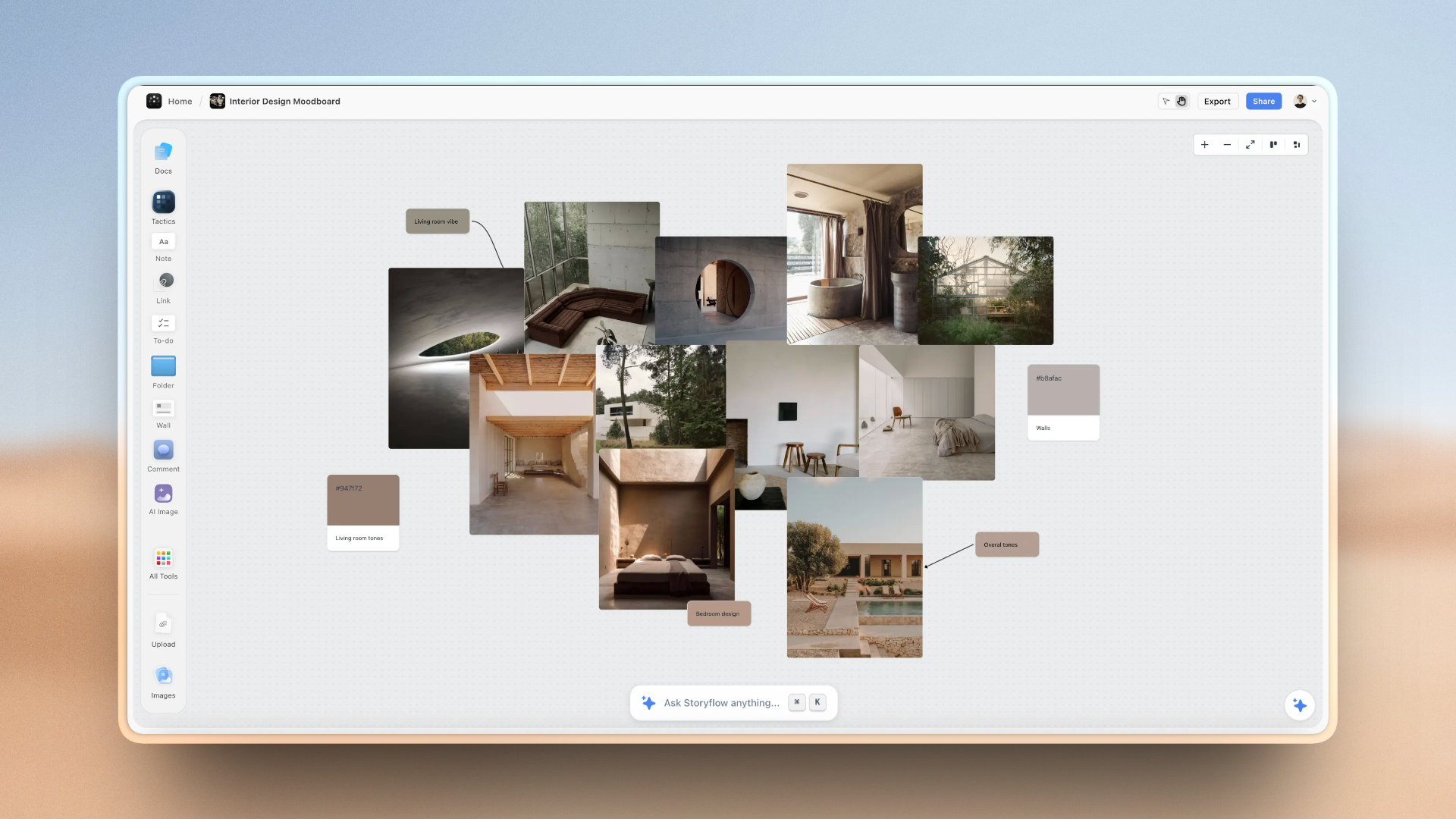
A Storyflow canvas full of clustered sticky notes, sketches, and branches from a visual brainstorm
When to Use Visual Brainstorming (and When a List Is Fine)
Visual brainstorming carries overhead. You open a canvas, you make notes, you move them around. That cost is worth paying when the problem is open (you do not yet know the options), when ideas need to be combined rather than ranked, or when a group needs to think in parallel without stepping on each other. Those three conditions are the signal.
When none of them hold, a list is faster and you should use one. If you already know your five options and only need to pick one, a canvas is theater. If the task is sequential, a numbered list is the honest shape for it. The skill is not "always brainstorm visually." It is noticing the moment you catch yourself scrolling back to reread your own ideas: that is when the problem has outgrown the list and wants a wall. Diverge in space when the problem is open. Keep the list when you are executing.
How AI Changes Visual Brainstorming
For seventy years the wall had one weakness: it went cold. You filled a board with a hundred sticky notes, the workshop ended, and nobody reread a hundred notes. The convergence move (clustering, naming themes, turning the mess into a plan) was manual, slow, and usually skipped. The brainstorm produced energy, then evaporated.
AI changes the economics of that second move. A model can read an entire wall in seconds, propose clusters you missed, name the themes, and surface the remote associations Mednick identified as the origin of original ideas, precisely because a model is good at spotting that a note in one corner rhymes with a note in another. Diverging stays human, where it belongs. Converging on the wall gets a collaborator that never tires at note ninety.
The friction is that most AI tools cannot see your wall. You brainstorm on a whiteboard, paste a summary into a chat box, and the model reasons over the summary, not your actual ideas. This is the gap Storyflow closes. Storyflow is a visual workspace where the AI reads your full active canvas board by default (every note, card, image, and link on it), plus up to 1 blueprint and up to 3 Documents you @-mention in the chat. Scatter a hundred notes, then ask it to cluster the wall, name the groups, or draft the plan the brainstorm was pointing at, and it reasons over the real board instead of a pasted recap. The wall remembers what the list forgets, and canvas-aware AI reads the whole wall back to you.
Be clear about where Storyflow is not the answer. For a live workshop with a dozen people slapping notes on one board in real time, Miro and FigJam are still the default: their multiplayer, facilitation widgets (timers, private voting, live cursors at scale), and template libraries are deeper, and Storyflow's real-time co-editing is lighter. Storyflow is cloud-only, so a no-wifi or locked-down session is out. And it is card-and-canvas shaped, not freehand-ink shaped, so if your brainstorm is mostly hand-drawn sketching, a pen-first tool like Excalidraw or Apple Freeform will feel more fluid. Storyflow's edge is narrower and specific: canvas-aware AI, and turning the brainstorm into the plan that comes next. If you want the live-room experience, start on Miro. If you want the wall to keep working after the room empties, that is the Storyflow case.
Which Approach Should You Use?
The technique follows the problem. Six rules cover most of what you will face:
- Alone with one fuzzy topic to open up: use a mind map.
- A pile of research, notes, or feedback to make sense of: use affinity mapping.
- A group larger than four, or one loud voice in the room: use brainwriting.
- An aesthetic or tonal direction to find: use a moodboard.
- An idea that has gone stale: run SCAMPER on the canvas.
- A brainstorm you need to become a plan: put it on a canvas whose AI can read the whole thing.
For the tool underneath all of them, the split is honest and simple. Paper and a physical wall are unbeaten for a fast solo session. Miro or FigJam own the live team workshop. Storyflow owns the case where the brainstorm has to turn into structured work and you want AI that reads the entire board.
The Bottom Line
Visual brainstorming is not a productivity trend. It is the oldest idea in creative work (get everything out, then find the pattern) given a surface big enough to hold it. Osborn named the split between generating and judging in 1953. A canvas is what finally lets you keep the two moves apart, because there is room to diverge in space before you converge on the wall.
Pick the technique by the problem, not the fashion. Mind map to open a topic, affinity map to make sense of a pile, brainwrite to get volume from a group, moodboard for tone, SCAMPER to break a stall. And remember why the wall exists at all: the wall remembers what the list forgets. If your brainstorm needs to survive the workshop and become a plan, take your next real problem and run it on a canvas whose AI can read the whole board. Start a visual brainstorm on a Storyflow canvas and ask it to cluster the wall when you are done diverging.
FAQ: Visual Brainstorming
What is visual brainstorming?
Visual brainstorming is generating and organizing ideas in space, using sticky notes, sketches, cards, mind maps, and clusters on a canvas, instead of a linear list. The position of each idea carries meaning: notes that touch are related, and clusters reveal themes you did not name in advance. It splits the work into two moves, diverging (getting ideas out) and converging (grouping them), and keeps them apart.
How is visual brainstorming different from regular brainstorming?
Regular brainstorming is idea generation; visual brainstorming is idea generation where the layout carries information. In a bulleted document every idea is the same size and locked into the order you typed it. On a canvas you can place, cluster, and connect ideas, so structure emerges from the material instead of being imposed. The generating step is the same; the organizing step is where the visual version pulls ahead.
What are the main visual brainstorming techniques?
The five core techniques are mind mapping (branching outward from a center), affinity mapping (clustering notes into themes), brainwriting (silent parallel idea generation), moodboarding (ideation in images), and SCAMPER on a canvas (structured prompts that force new angles). Each is a bet on whether your problem needs more diverging or more converging. Most sessions use two or three in sequence.
Is visual brainstorming better than making a list?
Visual brainstorming beats a list when the problem is open, when ideas need combining rather than ranking, or when a group is thinking in parallel. A list wins when you already know your options and only need to pick one, or when the task is a fixed sequence of steps. The rule of thumb: the moment you keep scrolling back to reread your own ideas, the problem has outgrown the list.
Can you do visual brainstorming alone?
Yes. Mind mapping, moodboarding, and SCAMPER are strong solo techniques, and affinity mapping works alone when you have research to make sense of. Working solo removes the production-blocking problem that slows group verbal brainstorming, so a single person on a canvas is often more productive than a group talking over each other. The trade-off is that you lose the diversity of input a group brings.
What is the best tool for visual brainstorming?
There is no single best tool; the right one depends on the job. Paper and a physical wall are unbeaten for fast solo sessions. Miro and FigJam are the default for live team workshops thanks to mature multiplayer and facilitation widgets. Storyflow is strongest when you want canvas-aware AI that reads your whole board and helps turn the brainstorm into a plan.
How does AI help with visual brainstorming?
AI accelerates the convergence move: it can read an entire wall of notes, propose clusters, name themes, and surface remote associations between distant ideas that a human misses at note ninety. The catch is that most AI tools cannot see your canvas and only reason over a pasted summary. Tools where the AI reads the full board (Storyflow reads every note, card, image, and link on the active canvas) close that gap.
What is the difference between a mind map and an affinity map?
A mind map branches outward from one central idea, so it is a divergence tool for opening a single topic. An affinity map starts with a scatter of separate notes and drags related ones into clusters, so it is a convergence tool for making sense of many ideas at once. Put simply, a mind map grows from one root; an affinity map finds the roots hiding in a pile you already have.
What is brainwriting?
Brainwriting is silent, parallel idea generation: instead of calling ideas out to a group, everyone writes ideas at the same time and then builds on each other's. The classic 6-3-5 format has six people write three ideas in five minutes, then pass. It solves production blocking (the finding by Diehl and Stroebe in 1987 that verbal groups underproduce because people wait their turn) and it mutes the loudest voice, so quieter contributors add ideas at the same rate as everyone else.
Is visual brainstorming good for remote teams?
Visual brainstorming is arguably better remote than in person, because an online canvas gives every distributed teammate the same shared wall and lets everyone post at once. Remote teams lose the physical sticky-note ritual but gain parallel input, a permanent record, and (on AI-aware canvases) automatic clustering afterward. For large live remote workshops, Miro and FigJam lead; AI-first canvases lead for turning the result into work.
Who invented brainstorming?
Advertising executive Alex Osborn coined the term "brainstorming" in his 1953 book Applied Imagination, building on idea-generation sessions he ran at the agency BBDO. His four rules (defer judgment, reach for quantity, welcome wild ideas, and combine and improve) remain the foundation of the practice. The visual, sticky-note version came decades later as facilitators and design studios gave the ideas a movable, spatial home.
Table of Contents
- Key Takeaways
- Visual Brainstorming, Defined
- Where Visual Brainstorming Came From
- Why Space Beats a Bullet List
- The 5 Core Visual Brainstorming Techniques (and When to Use Each)
- When to Use Visual Brainstorming (and When a List Is Fine)
- How AI Changes Visual Brainstorming
- Which Approach Should You Use?
- The Bottom Line
- Author
- FAQ: Visual Brainstorming
- Related Reading
Templates to check out for this topic


Mind mapping and ideation templates you can use in Storyflow
Map ideas in space, then ask the AI to restructure, expand, or connect them. Open any of these boards and start thinking visually instead of in lists.


See Storyflow in Action
A visual AI workspace where every feature lives inside one canvas. No tab-switching, no context lost.
Build your entire board from a single message
Type what you need in the AI chat at the bottom of your canvas. The AI adds cards, headings, and structure directly onto your board.
Use expert frameworks as AI context
Type @ in the AI chat and choose any Tactic. The AI tailors every response to that framework instead of giving generic advice.
Turn your board into a mind map in seconds
Ask the AI to restructure your canvas as a mindmap. It connects your ideas into a visual hierarchy so you can see how everything relates.
Why Storyflow Exists
Storyflow actually began as a personal tool while working on creative and research projects.
We kept running into the same problem: ideas were scattered everywhere: notes, documents, and whiteboards.
Nothing helped us see how everything connected.
So we started building a workspace designed around how ideas actually grow.
→ Read how Storyflow was createdSara de Klein
Head of Product at Storyflow
Published: 2026-07-15
Extremely simple, seriously capable


See how easy it is to get started
Watch a real project come together, from a blank board to a finished plan, clicked through step by step.
Start creating with AI and become more productive
Transform your creative workflow with AI-powered tools. Generate ideas, create content, and boost your productivity in minutes instead of hours.