
What Is Development in Film? The Complete Guide (2026)
Development is the first phase of filmmaking: the stretch between idea and greenlight where a film is built on paper. What it is, why it is the riskiest phase, who does it, and how AI changes it in 2026.

Category
Filmmaking
Author

Justkay
Documentary Filmmaker & Founder at Storyflow
Topics
2026-07-15
•
12 min read
•
Filmmaking- what is development in film
- film development phase
- film development process
- stages of filmmaking
What is development in film?
Development is the first phase of filmmaking: the stretch between an idea and a greenlight, where the film exists only on paper. A producer and a writer turn a concept into the documents that will get the film financed and made: a logline, a treatment, script drafts, a pitch deck, and a preliminary budget. It is the longest and riskiest phase of the whole process, because most projects that enter development never get made. This guide explains what development is, why it is so hard, who does it, what it produces, and how AI changes it in 2026.
Key Takeaways
- Development is the first phase of filmmaking: the stretch between an idea and a greenlight, where the film exists only on paper. A producer and a writer turn a concept into the documents that get it financed.
- Those documents are the paper film: a logline, a treatment, script drafts, a pitch deck or lookbook, and a preliminary budget, with a rights or option agreement first if the film is based on existing material.
- It is the longest and riskiest phase, because most projects that enter it never get made. A film that circles for years without being made is stuck in "development hell."
- A film is decided in development and merely executed in production. By the time the camera rolls, the hard choices about story, cast, and cost are already made.
- Development is where a film dies on paper so it does not die on set. Killing a broken story in a treatment costs weeks, while killing it after a crew is hired costs a fortune.
- The line with pre-production is the greenlight: development decides what the film is, and pre-production plans how to shoot it once the money is committed.
- The common mistake is running all of development inside a screenwriting app or one document. The script is only one layer, and logline, treatment, references, deck, and budget each need a home too.
- AI can draft loglines, structure a treatment, and summarize coverage, but it cannot make the greenlight. That bet on money and taste stays a human judgment.
Development, Defined: The First Phase of Filmmaking
Every film moves through five phases: development, pre-production, production, post-production, and distribution. Production is the one people picture: cameras, crew, a set. But the film is not decided on set. It is decided long before, in the phase almost no one outside the industry ever sees.
Development is that phase. It starts the moment someone has an idea worth chasing, and it ends at the greenlight, the decision to spend real money and actually shoot. In between, the film gets built entirely on paper. The logline is the film in one sentence. The treatment is the film in a few pages. The script is the film in words. The deck is the film as a pitch. The budget is the film in numbers. Put those together and you have what I call the paper film: the complete movie, decided and written down, before a single frame of it exists.
I am a documentary filmmaker, and I built Storyflow. I have taken projects through development from a one-line idea to a treatment and a financing conversation, and I have watched projects sit in development for years and quietly die there. Most of what follows comes from that experience, not a textbook. It is the phase I have spent the most time inside, and the one I see people underestimate most.
Here is the reframe that matters. Production executes the film, but development decides it. By the time the camera rolls, the hard choices (what the story is, who is in it, what it costs, who pays) are already made. A film is decided in development and merely executed in production.
Storyflow is one option for holding the paper film in one place, and I will get to where it fits and where it does not. First, the harder question: why does this phase break so many projects?
Why Development Is the Longest and Riskiest Phase
Production might take six weeks. Development can take six years. That asymmetry is the first thing to understand: the phase with nothing to show for it (no footage, no cast, no premiere) is usually the longest one on the timeline. There is even a name for a project that gets stuck in it: development hell, the industry's term for a film that circles for years without ever getting made.
The risk is structural, not accidental. In development you spend money and time to answer one question: is this film worth making at all? Most of the time the honest answer is no. Producers option and develop far more projects than they will ever produce, so the base rate for any one reaching a greenlight is low. Screenwriter William Goldman's famous verdict on the whole business, "Nobody knows anything," from his 1983 book Adventures in the Screen Trade, is really a verdict on development: no one can tell which script becomes a film and which dies on the page.
That is exactly why the phase exists. Development is where a film dies on paper so it does not die on set. Killing a broken version of the story in a treatment costs a few weeks. Killing that same version after you have hired a crew and booked locations costs a fortune. Every draft, every note, every rejected logline is the project failing safely, on paper, where failure is affordable.
Development is also where the money is most fragile. A financier backing a film that is already shooting can see what they are buying. A financier in development is buying a promise: some documents and a pitch. Convincing them is slow, relationship-driven work, and much of why development stretches across years while production is measured in weeks.
The Paper Film: The Five Deliverables of Development
Development is not one document. It is a stack of them, each doing a different job, each a layer of the paper film. Here is what the phase actually produces, and roughly when.
| Deliverable | Purpose | Stage |
|---|---|---|
Option or rights agreement | Secures the legal right to make the film from a book, article, or life story | Entry (prerequisite) |
Logline | Distills the whole film to one sentence you can pitch in a hallway | Early |
Treatment | Proves the entire story works in prose before anyone writes a full script | Early to middle |
Script drafts | Turns the story into the actual screenplay, revised through rounds of notes | Middle |
Pitch deck or lookbook | Sells the vision, tone, and market to financiers, talent, and commissioners | Middle to late |
Preliminary budget | Answers "what will this cost" so the financing conversation can start | Late |
The logline comes first because it is the test everything else has to pass. If you cannot say the film in one sentence, you do not yet know what the film is. (See What is a Logline? Meaning, Definition and 25+ Real Examples for how to write one that works.)
The treatment is where the story gets proved. It is the whole film in present-tense prose, a few pages for a short version or tens of pages for a detailed one, and it exists so the expensive mistakes surface before anyone commits to a full screenplay. A structural problem caught in a five-page treatment is a rewrite. The same problem caught in production is a reshoot. (Full breakdown in What is a Treatment? The Complete Guide for Filmmakers.)
Script drafts are the long middle. A screenplay is rarely right on the first pass. It moves through drafts, each one shaped by notes from the producer, the development executive, and eventually the financiers. This is the part that eats years, because everyone with money attached has an opinion, and reconciling them is the real work of the phase.
The pitch deck (in documentary and independent film, often a lookbook, sometimes backed by a sizzle reel) translates the deliverables into something a financier can feel: the tone, the visual references, the market case, and the team. In documentary, where I work, ninety seconds of real footage often moves a commissioner more than fifty pages of treatment ever could.
The preliminary budget turns the film into a number. It does not have to be the final, schedule-driven budget (that comes in pre-production), but you cannot ask anyone for money without a credible estimate of how much you need.
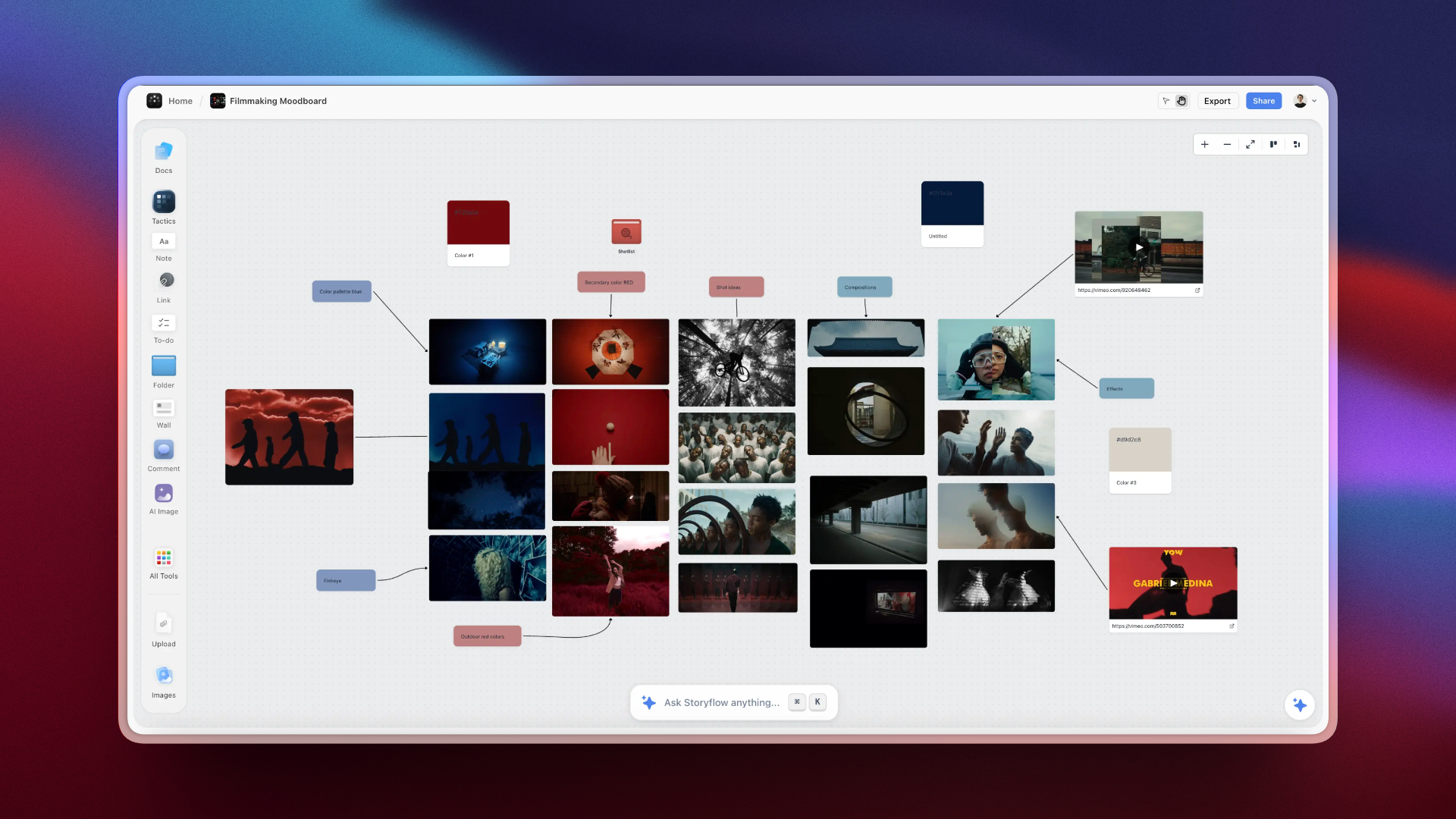
a Storyflow canvas holding a film in development: logline, treatment, references, and packaging
Who Does Development: The People in the Room
Development is small and human. It is a handful of people arguing about a story, not a crew of hundreds. The core roles:
- The producer owns the project. They option the material, hire the writer, raise the money, and carry the film across the years development takes. The producer is often the only person present from the first idea to the greenlight.
- The writer or screenwriter builds the core of the paper film: the treatment and the script drafts. On many projects the writer is hired, and sometimes replaced, more than once as the story evolves.
- The development executive (at a studio, a streamer, or a production company) finds projects, shepherds them, and gives notes. When you hear that a script "got notes," a development executive is usually where they came from.
- The script reader writes coverage: a one-to-two-page evaluation of a script, with a logline, a synopsis, and a verdict of pass, consider, or recommend. Coverage is the filter almost every script passes through before a senior person reads it.
- The director usually attaches later in development, and that attachment is often what finally makes a project real to financiers. In documentary, the director is frequently there from the first day of research.
- Agents and financiers shape development from the outside. Agencies package projects (attaching a director and cast to make the film financeable), and financiers decide whether the project is worth backing at all.
The through-line is that development runs on judgment and relationships, not on a repeatable process.
The Development Workflow, Step by Step
Development is not a straight line, but it has a recognizable order:
- Secure the idea. Option the rights if the film is based on existing material, or start from an original concept you already own.
- Write the logline. Pin down the one-sentence version first. If the idea does not work here, it will not work at feature length.
- Build the treatment. Prove the whole story in prose. Kill the structural problems on these pages, where killing them is cheap.
- Draft and revise the script. Move through drafts, absorbing notes from the producer, the development executive, and the financiers. Expect this to take the longest by far.
- Package the project. Attach a director and, where relevant, cast. Build the pitch deck or lookbook that sells the vision.
- Raise the money and greenlight. Take the finished paper film to financiers, commissioners, or a studio. When someone commits the money to shoot, development ends.
The order bends in practice. Documentaries often shoot a sizzle before there is a full treatment; independent films sometimes attach a name actor before the script is locked. But the logic holds: you assemble the paper film piece by piece until it is complete enough to fund.
How AI Changes Film Development in 2026
The friction in development is not a shortage of ideas. It is that the paper film gets scattered. The logline lives in one note, the treatment in a Word document, the script in Final Draft, the references in a folder or a Pinterest board, the budget in a spreadsheet, and the notes from three different financiers buried in your inbox. By draft twelve, no one, including you, can see the whole film in one place. The thinking fragments across the exact documents that are supposed to hold it together.
This is the gap AI can actually close in 2026, and it is where a tool like Storyflow fits. The familiar approach is to keep each deliverable in its own app and reconcile them in your head. The Storyflow approach is to put the whole paper film on one canvas: logline, treatment, reference images, deck, and budget as cards you can see at once. Its AI reads your full active board by default, plus up to one blueprint and up to three documents you @-mention in the chat, so when you ask it to pressure-test a logline against the treatment, it reasons over the real project instead of a pasted summary. For research-heavy development, documentary especially, holding the sources, the notes, and the treatment on one surface is the difference between a film you can see and one scattered across twelve tabs.
Be clear about what AI does not do. It does not write the film for you, and it does not make the greenlight decision, which is a human judgment about money and taste. It can draft alternative loglines, structure a treatment, summarize a stack of coverage, and organize references. It cannot have the relationship with the financier or take responsibility for the bet. Development is where a film dies on paper so it does not die on set, and that killing is a judgment call AI can inform but never make for you.
Here is the honest accounting of where Storyflow is the wrong tool. It is not screenwriting software: for properly formatted screenplay drafts you want Final Draft, Highland, or WriterDuet, and Storyflow does not replace them. It is not a financing or CRM tool: it will not track investor outreach or model a budget the way a spreadsheet or a dedicated finance app will. It is cloud-only, with no offline mode, which matters if you develop on planes or on location without signal. And it is a newer platform with a smaller template library than an incumbent like Notion. Storyflow holds the thinking layer well. It does not pretend to replace the specialist tools around it.
Development vs Pre-Production: Where the Line Is
These two phases get confused constantly, so here is the clean split. Development decides what the film is. Pre-production plans how to shoot it. The exact boundary between them is the greenlight.
| Question | Development | Pre-production |
|---|---|---|
Core job | Decide if and what to make | Plan how to make it |
Main output | The paper film (logline, treatment, script, deck, budget) | Schedules, shot lists, storyboards, locations, cast, crew |
Ends at | The greenlight | The first day of the shoot |
The money | Fragile, still being raised | Committed |
If you are writing a treatment to convince someone to fund the film, you are in development. If the film is funded and you are booking locations and boarding scenes, you are in pre-production. (For the phase that follows, see The 12 Best Pre-Production Tools in 2026.)
Which Tools for Which Part of Development
No single tool covers development, because the paper film has five different layers. Match the tool to the layer:
- For screenplay drafts, use dedicated screenwriting software: Final Draft, Highland, or WriterDuet. This is the one layer where you should not improvise with a general tool.
- For the thinking layer (concept, logline, treatment, references, deck, and the connections between them), use a visual canvas like Storyflow or Milanote, where everything sits in one view and, in Storyflow's case, the AI can read it.
- For the budget, use a spreadsheet or dedicated software such as Movie Magic Budgeting.
- For rights and options, use a lawyer, not an app. Optioning material is a legal act, and this is not the place to save money.
The common mistake is trying to run all of development inside a screenwriting app or a single document. The script is one layer. The other four need somewhere to live too, and when they do not have a home they end up scattered, which is the exact friction that stalls projects.
The Bottom Line
Development is the first and hardest phase of filmmaking: the years-long, high-failure stretch where a film gets built entirely on paper before anyone spends real money to shoot it. It produces the paper film (logline, treatment, script drafts, deck, and budget), run by a small group (producer, writer, development executive) betting that this particular one is worth becoming a real film. Get development right and production becomes execution. Get it wrong and no amount of talent on set will save you.
The rule that survives every project is simple: development is where a film dies on paper so it does not die on set. Build it deliberately, fail the bad versions cheaply, and only greenlight the one that survives the notes. If your development is scattered across twelve tabs, pull the whole paper film onto one canvas and work it in one place. Start the paper film on a Storyflow canvas.
FAQ: Film Development
What is development in film?
Development is the first phase of filmmaking, the stretch between an idea and a greenlight, where the film exists only on paper. A producer and a writer turn a concept into a logline, a treatment, script drafts, a pitch deck, and a budget, the documents needed to get the film financed and made. It ends the moment someone commits the money to actually shoot.
How long does film development take?
Development usually takes years, not weeks. It is common for a feature to spend several years in this phase, and some spend a decade or more. Production, by contrast, is often measured in weeks. A project that stays stuck for a long time is said to be in "development hell," a real and common industry outcome.
Why is development the riskiest phase of filmmaking?
Development is the riskiest phase because most projects that enter it never get made, so the base rate of failure is high. You are spending time and money to answer whether the film is worth making at all, and the honest answer is often no. That is the point of the phase: it is far cheaper to fail on paper than on set.
What are the deliverables of film development?
The core deliverables are the logline, the treatment, the script drafts, the pitch deck or lookbook, and a preliminary budget. If the film is based on existing material, an option or rights agreement comes first. Together these make up what you can think of as the paper film: the whole movie, decided on paper before production begins.
Who is involved in film development?
The core people are the producer (who owns the project and raises the money), the writer or screenwriter (who builds the treatment and script), and the development executive (who finds projects and gives notes). Script readers write coverage, directors usually attach later, and agents and financiers shape the project from outside.
What is the difference between development and pre-production?
Development decides what the film is; pre-production plans how to shoot it, and the line between them is the greenlight. In development you write the treatment and script to get the film funded. In pre-production the film is already funded, and you build schedules, shot lists, and storyboards to actually shoot it.
What is a greenlight in film?
A greenlight is the decision to commit the money to actually produce a film. It marks the end of development and the start of pre-production. Until a project is greenlit, everything about it lives on paper and can still fall apart.
What is development hell?
Development hell is the industry term for a project that stays stuck in development for years without getting made. Scripts get rewritten, talent attaches and drops off, and financing never quite closes. Many well-known films spent years in development hell before getting made; many more never escaped it.
Can AI write a film in development?
No. AI can draft alternative loglines, help structure a treatment, summarize script coverage, and organize research and references, but it does not write the finished film or make the greenlight decision. Development is a series of human judgments about story, money, and taste that AI can inform but not replace.
What is a logline versus a treatment?
A logline is the whole film in one or two sentences; a treatment is the whole film in a few pages of prose. The logline tests whether the idea is clear enough to pitch; the treatment tests whether the full story actually holds together before anyone writes a screenplay. Both are early deliverables of the paper film.
Do documentaries go through development?
Yes. Documentary development looks a little different: it centers on research, securing access to subjects, a treatment, and often a sizzle reel or teaser rather than a full script, plus grant and commissioning applications instead of a studio greenlight. The logic is the same, though. You build the film on paper (and a little footage) until someone agrees to fund it.
How do you get a film out of development?
You get a film out of development by completing a convincing paper film (logline, treatment, script, deck, and budget), packaging it with a director and often cast, and then securing financing or a commission. When someone commits the money to shoot, development ends and pre-production begins.
Table of Contents
- Key Takeaways
- Development, Defined: The First Phase of Filmmaking
- Why Development Is the Longest and Riskiest Phase
- The Paper Film: The Five Deliverables of Development
- Who Does Development: The People in the Room
- The Development Workflow, Step by Step
- How AI Changes Film Development in 2026
- Development vs Pre-Production: Where the Line Is
- Which Tools for Which Part of Development
- The Bottom Line
- FAQ: Film Development
- Related Reading
Templates to check out for this topic


Filmmaking templates you can use in Storyflow
Skip the blank canvas. Open one of these filmmaking boards in Storyflow and the AI builds on the structure that is already there, from research through the shot list.


See Storyflow in Action
A visual AI workspace where every feature lives inside one canvas. No tab-switching, no context lost.
Build your entire board from a single message
Type what you need in the AI chat at the bottom of your canvas. The AI adds cards, headings, and structure directly onto your board.
Use expert frameworks as AI context
Type @ in the AI chat and choose any Tactic. The AI tailors every response to that framework instead of giving generic advice.
Turn your board into a mind map in seconds
Ask the AI to restructure your canvas as a mindmap. It connects your ideas into a visual hierarchy so you can see how everything relates.
Why Storyflow Exists
Storyflow actually began as a personal tool while working on creative and research projects.
We kept running into the same problem: ideas were scattered everywhere: notes, documents, and whiteboards.
Nothing helped us see how everything connected.
So we started building a workspace designed around how ideas actually grow.
→ Read how Storyflow was createdJustkay
Documentary Filmmaker & Founder at Storyflow
Published: 2026-07-15
Extremely simple, seriously capable


See how easy it is to get started
Watch a real project come together, from a blank board to a finished plan, clicked through step by step.
Start creating with AI and become more productive
Transform your creative workflow with AI-powered tools. Generate ideas, create content, and boost your productivity in minutes instead of hours.