
What Is a Visual Narrative? The Complete Guide (2026)
A visual narrative is a story told through a deliberate sequence of images. This guide defines it, separates it from visual storytelling, explains how sequence and juxtaposition create meaning, and shows how to build one on a canvas.

Category
Storytelling
Author

Justkay
Documentary Filmmaker & Founder at Storyflow
Topics
2026-07-15
•
12 min read
•
Storytelling- what is a visual narrative
- visual narrative definition
- visual narrative examples
- visual narrative vs visual storytelling
What is a visual narrative?
A visual narrative is a story told through a deliberate sequence of images, where the order of the images and the relationships between them carry the meaning. Comics, storyboards, photo essays, explainer videos, and brand films are all visual narratives: each one arranges pictures in a chosen order so a viewer reads a story across the frames, not just inside any single one. The images are the units. The sequence is the grammar. What turns a set of pictures into a narrative is the work the viewer does in the space between them, closing the gap from one image to the next. A visual narrative is not the images. It is what happens in the gaps between them. I have built visual narratives professionally as a documentary filmmaker, and I built Storyflow to make the arranging part easier. This guide covers what a visual narrative is, how sequence and juxtaposition create meaning, the forms it takes, and how to build one yourself.
Key Takeaways
- A visual narrative is a story told through a deliberate sequence of images, where meaning emerges from their order and juxtaposition, not from any single frame. The images are the units; the sequence is the grammar.
- A visual narrative is not the images. It is what happens in the gaps between them. The viewer closes each gap, and that inference is where the story is made.
- You cannot build one from a single image. One image is visual storytelling; a narrative needs at least two in an order, because the meaning lives in the movement between them.
- Visual storytelling is the verb; a visual narrative is the noun it produces. The craft is the wide umbrella, and the narrative is the specific sequenced artifact.
- The mechanism has one idea and many names: the gutter, the cut, the page turn, the click. The Kuleshov effect proved that juxtaposition, not the frame, carries the meaning.
- The same structure appears across unrelated forms: comics, storyboards, photo essays, explainer videos, brand films, social carousels, and scrollytelling data stories.
- Building one is about the order you find, not the images you have. Name the focus first, gather more than you need, reorder until the arc appears, and design the gaps as carefully as the frames.
- It is the wrong shape for information with no natural order or where precision beats engagement. Legal, medical, and technical communication often needs everything stated and nothing left to closure.
What a Visual Narrative Actually Is
Show a stranger a single photograph and they will describe what is in the frame. Show them the same photograph placed third in a row of five and they will tell you a story. Nothing in the photograph changed. What changed is that you gave them an order to read it in, and the human mind cannot look at images in sequence without trying to connect them.
That reflex is the entire foundation of the form, and a visual narrative uses it on purpose. Comics artist Will Eisner called the medium "sequential art." Scott McCloud, in his 1993 book Understanding Comics, defined comics as images placed in deliberate sequence to convey information or produce a response in the viewer. Take the word "comics" out of that definition and you have just described a storyboard, a photo essay, an Instagram carousel, and the shot list of a ninety-second brand film. The common ingredient is not drawing, or panels, or even film. It is deliberate sequence.
So here is a working definition you can use: a visual narrative is a sequence of images arranged so that meaning emerges from their order and their juxtaposition, not from any one image alone. A single image can be gorgeous. It can even imply a story. But until you set it next to another image and make a viewer travel between them, you have a picture, not a narrative.
Across years of documentary work I have never once told a story with a single frame. I have told them with sequences: this interview, then this landscape, then this archival photograph, in an order chosen so the third shot lands because of the two before it. The craft was never in shooting a pretty image. It was in deciding what comes next.
Visual Narrative vs Visual Storytelling: The Difference That Matters
People use "visual narrative" and "visual storytelling" as if they were the same thing. They are related, but the distinction is worth holding onto, because it changes what you actually make.
Visual storytelling is the broad craft: the whole discipline of communicating an idea or an emotion through visual means. A single powerful photograph is visual storytelling. So is a well-designed chart, a film, a color grade, or a logo with a story behind it. It is a wide umbrella, and most of what lives under it is about the image itself.
A visual narrative is narrower and more specific. It is the artifact: an actual sequence of images arranged in an order. Visual storytelling is the craft; a visual narrative is what that craft produces when the unit of meaning becomes the sequence rather than the single frame. You can do visual storytelling with one image. You cannot make a visual narrative with one image, because there is no sequence, and with no sequence there is no gap for a viewer to cross. Visual storytelling is the verb. A visual narrative is the noun it produces.
If you want the wider craft, our guide to digital storytelling covers storytelling across formats, and our guide to visual thinking covers using images to reason rather than only to tell. This guide stays on the narrower thing: the sequence, and the gaps inside it.
Why Sequence and Juxtaposition Create Meaning
Here is the strange part. In a visual narrative, some of the most important information is never shown. It happens in the space between two images, and the viewer supplies it.
McCloud has a name for that space. He calls the gap between comic panels "the gutter," and he calls the mental act of connecting the panels across it "closure." You see a raised hand in one panel and a shocked face in the next, and your mind fills in the slap that no panel ever drew. The panels are the evidence. The story is the inference. Across every visual narrative form, not just comics, I call that space the Gap, and learning to see it is the difference between arranging images and telling a story with them.
The Gap is not empty. It is where the viewer does the work, and a viewer who does the work is a viewer who is paying attention. That is the whole mechanism.
Film proved it a century ago. In the 1920s the Soviet filmmaker Lev Kuleshov cut one neutral shot of an actor's face against three different images: a bowl of soup, a child in a coffin, and a reclining woman. In the standard account, audiences read hunger, then grief, then desire, and praised the actor's subtle range. The face never changed. The image before it did. This is the Kuleshov effect, and it is the cleanest proof that meaning in a visual narrative lives in the juxtaposition, not the frame. Kuleshov's colleague Sergei Eisenstein built a whole theory of montage on the same idea: place two shots together and you do not get one plus one, you get a third meaning that neither shot contained on its own.
Comics call it the gutter. Film calls it the cut. A photo essay calls it the page turn. A slide deck calls it the click. The name changes; the mechanism does not. In every case, two images sit side by side and the viewer builds a bridge across the Gap between them. A visual narrative is not the images. It is what happens in the gaps between them. Design the images and you have made pictures. Design the Gaps and you have made a narrative.
The Main Forms of Visual Narrative
A visual narrative is not one medium. It is a structure that shows up across a dozen unrelated fields, and once you can name the structure you can see it everywhere. Here is where it appears and how sequence does the work in each.
| Form | How the sequence works | Example |
|---|---|---|
Comic or graphic novel | Panels sit in gutters; the reader closes each gap to feel time and motion pass | Art Spiegelman's Maus; Marjane Satrapi's Persepolis |
Storyboard | Frames in shot order preview the edit; each frame is one moment of the film | A scene planned shot by shot before the shoot |
Photo essay | Photographs ordered so juxtaposition builds an argument or an arc | W. Eugene Smith's "Country Doctor" (LIFE, 1948) |
Explainer video | Shots and animation sequenced so each beat sets up the next idea | A ninety-second product or concept explainer |
Brand film or commercial | Shots edited to an emotional curve that resolves on the brand | A sixty-second ad building to a logo |
Social carousel | Slides swiped in order; the swipe is the gap, each slide a beat | An eight-slide "how to" post on Instagram or LinkedIn |
Scrollytelling data story | Charts and images revealed step by step as the reader scrolls | A scroll-driven news feature that reframes a dataset |
These forms look unrelated. A graphic novel and a LinkedIn carousel share no tools and no audience. Structurally, though, they are the same move: images in a deliberate order, meaning in the Gaps. Once you see that, skills transfer. A filmmaker who understands the cut can build a carousel. A comics artist who understands the gutter can storyboard an ad. The medium is a costume; the sequence is the body underneath.
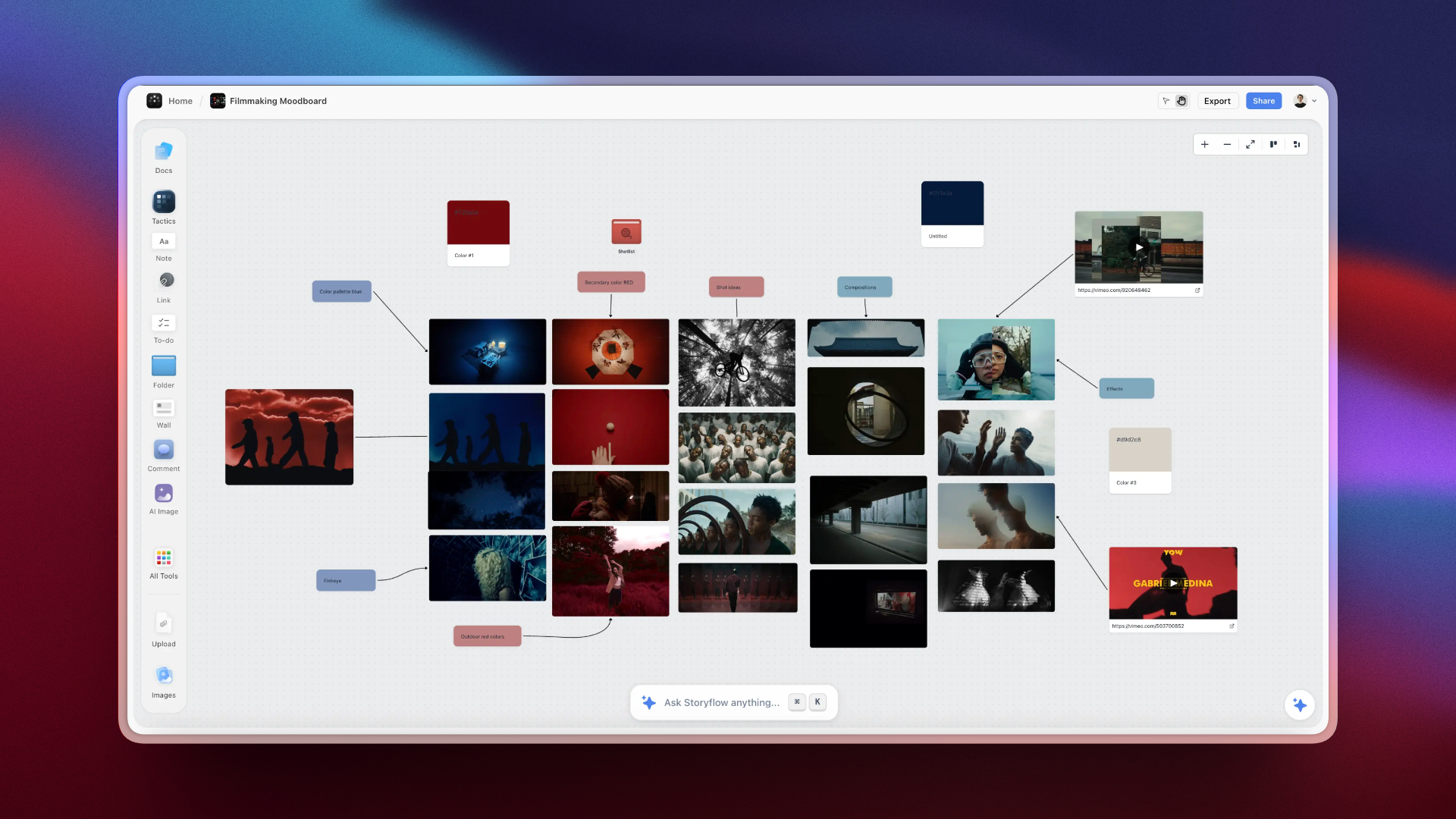
A Storyflow canvas sequencing panels and images into a visual narrative
How to Build a Visual Narrative
Building one is less about the images you have and more about the order you find. These six steps work whether the output is a film, a photo essay, or a pitch deck.
- Start with the focus, not the first image. Name the one idea or feeling the sequence has to deliver before you gather a single picture. A visual narrative without a focus is a slideshow.
- Gather more images than you need. Pull every candidate frame, photo, and sketch into one place. You are casting, not committing. The best sequence is usually hiding among the images you almost cut.
- Find the order by moving things around. This is the actual work. Lay the images out where you can see them all at once and reorder until the arc appears. A sequence is discovered, not decreed.
- Design the Gaps, not just the images. For every cut from one image to the next, ask what the viewer will infer in the space between them. Too small a leap is boring. Too large a leap is confusing. The right leap is the whole art.
- Read it cold, in order, at speed. Play the sequence the way a viewer will meet it: fast, once, without your intentions in their head. The places you stumble are the broken Gaps.
- Cut until every image earns its place. A visual narrative is only as strong as its weakest beat. If an image does not change what the next one means, it is decoration, so remove it.
Notice that steps three, four, and five all describe the same physical action: putting images in a space and moving them around until the order is right. That is the friction, and most tools make it harder than it should be. A document scrolls, so you can never see the whole set. A slide deck hides slide nine while you stare at slide two. The work of a visual narrative is spatial, and most software is linear.
This is the gap Storyflow was built to close. It is an infinite canvas where you drop every image, sketch, and clip as a card, arrange them in space, draw the connections, and see the whole sequence at once before you commit to an order. Because the canvas is AI-aware, you can ask the assistant reading your board to flag a weak beat or propose a reorder, and it reasons over the actual images in front of you, not a text description of them. Storyflow reads your full active canvas plus up to one blueprint and three documents you bring in, which for a visual narrative means it can hold the whole sequence in view the way you do. It is worth being clear about what it is not: Storyflow is where the sequence gets built, not where the final comic gets inked or the film gets cut.
The Honest Limits
Two honesties before you commit, one about the form and one about the tool.
The form first. A visual narrative is the wrong shape for some jobs. If your information has no natural order, forcing it into a sequence is a lie: a reference table, a price list, or a set of independent facts should stay a table, not become a story with a fake arc. If precision matters more than engagement, the Gap works against you, because the entire point of the Gap is that the viewer infers, and inference is ambiguity. Legal, medical, and technical communication often needs the opposite of a visual narrative: everything stated, nothing left to closure. Not every message is a story, and pretending otherwise wastes a reader's time.
Now the tool. Storyflow helps you build the sequence, but it is only fair to name where it is not the answer:
- It is not a finishing tool. Storyflow is where you arrange the order and make the call. It does not ink comics, edit video, or render final animation. Export the sequence and finish it in the software built for the form.
- It is cloud-only. There is no offline, local-first mode, so for privacy-regulated work or a shoot with no signal, a local tool wins.
- It is canvas-card-shaped, not timeline-shaped. If your visual narrative is fundamentally a frame-accurate video edit, a real editing timeline (Premiere, DaVinci Resolve, Final Cut) will beat a canvas. Storyflow plans the edit; it does not perform it.
- It is younger than the incumbents. It has fewer templates than a decades-old creative suite and no deep third-party plugin ecosystem yet.
Naming where a tool loses is not a weakness in the argument. It is the argument. Use the canvas for the part it is good at, which is finding the order, and use the specialist tool for the finish.
Which Approach Should You Use?
Pick by the shape of your final output, not the tool you already own.
- If the output is a film or video, storyboard the sequence first, then cut it in an editor. Plan on a canvas, finish on the timeline.
- If it is a comic or graphic novel, thumbnail the page sequence before you draw. The order of the panels is a decision you make with rough sketches, not finished art.
- If it is a photo essay or a carousel, the images already exist, so your entire job is sequence and juxtaposition. Work somewhere you can see every image and reorder freely.
- If it is an explainer or a pitch, write the focus first, then find the smallest sequence of images that lands it.
For any of these, if the hard part is the sequence, a spatial canvas is the right first surface, and Storyflow is the one I built for exactly this. If the hard part is the finish, start in the software made for the form and treat sequencing as a step inside it.
The bottom line: a visual narrative is the oldest storytelling technology there is, older than writing, and it works because of a reflex no viewer can switch off. Give people images in an order and they will build a story across them whether you designed the Gaps or not. The only real question is whether you control that or leave it to chance. A visual narrative is not the images. It is what happens in the gaps between them. Build the sequence with that in mind and the images will carry more than you thought they could.
Take a set of images you already have, a shoot, a deck, or a folder of references, and lay them on a Storyflow canvas in the order a viewer should meet them. Move them around until the arc appears. That is a visual narrative, and you can feel the moment it starts to work.
FAQ: Visual Narrative
What is a visual narrative in simple terms?
A visual narrative is a story told through a sequence of images arranged in a deliberate order. Instead of one picture, you use several, placed so a viewer reads meaning across them. Comics, storyboards, photo essays, and short films are all visual narratives. The order of the images and the way each one sits next to the last carry the story, not any single frame.
What is the difference between a visual narrative and visual storytelling?
Visual storytelling is the broad craft of communicating through images; a visual narrative is the specific artifact that craft produces when the images are placed in a sequence. You can do visual storytelling with a single photograph or chart. A visual narrative needs at least two images in an order, because the meaning comes from the movement between them.
What are examples of visual narratives?
Common examples include comics and graphic novels, film and TV storyboards, photo essays, explainer videos, brand films and commercials, social media carousels, and scroll-driven data stories. They share almost no common toolset, but structurally they are identical: images placed in a deliberate order so meaning emerges from the sequence rather than from one frame.
Why is sequence important in a visual narrative?
Sequence is important because it is where the meaning is made. The same image reads differently depending on what comes before and after it, something film demonstrated with the Kuleshov effect. Reorder the images and you change the story, even when every individual image stays the same. In a visual narrative, order is not presentation, it is content.
What is the Kuleshov effect?
The Kuleshov effect is the finding that viewers pull more meaning from two sequential shots than from either shot alone. In the 1920s, Soviet filmmaker Lev Kuleshov intercut one neutral shot of an actor's face with different images, and audiences read a different emotion each time, though the face never changed. It shows that in a visual narrative, juxtaposition creates meaning.
What did Scott McCloud say about visual narrative?
In Understanding Comics (1993), Scott McCloud defined comics as images placed in deliberate sequence, and he described how readers connect them. He named the space between panels "the gutter" and the mental act of filling it "closure." His central insight is that the reader, not the artist, completes the story in the space between images, which is true of every visual narrative form.
How do you create a visual narrative?
Start by naming the one idea or feeling the sequence must deliver. Gather more images than you need, then lay them out in a space where you can see them all and reorder until an arc appears. Design the transitions between images as carefully as the images themselves, read the sequence cold and fast, then cut any image that does not change the meaning of the one after it.
What makes a visual narrative effective?
An effective visual narrative has a clear focus, a sequence with a real beginning-to-end arc, and transitions sized so the viewer can follow without getting bored. The gaps between images should ask the viewer to infer something, because that inference is what creates engagement. Every image should earn its place by changing what the next image means.
Is a storyboard a visual narrative?
Yes. A storyboard is a visual narrative used to pre-visualize a film, video, or animation. Each frame is a moment, and the sequence of frames previews how the finished edit will move. It is one of the most practical visual narratives, because its entire job is to test a sequence cheaply before the expensive work of shooting begins.
Where are visual narratives used?
Visual narratives are used in filmmaking (storyboards and shot lists), publishing (comics and photo essays), marketing (brand films, ad campaigns, and social carousels), education (explainer videos and illustrated concepts), journalism (photo stories and scrollytelling), and product design (user-flow walkthroughs). Any field that needs to move an audience through an idea in order relies on them.
Can AI help build a visual narrative?
Yes. AI can suggest an order for a set of images, flag a weak beat in a sequence, and help you sharpen the focus a sequence should deliver. Tools like Storyflow read the images on your canvas and reason over the actual sequence rather than a text summary. The reliable pattern is to let AI propose orders and spot gaps, then use your own judgment to make the final cut.
Table of Contents
- Key Takeaways
- What a Visual Narrative Actually Is
- Visual Narrative vs Visual Storytelling: The Difference That Matters
- Why Sequence and Juxtaposition Create Meaning
- The Main Forms of Visual Narrative
- How to Build a Visual Narrative
- The Honest Limits
- Which Approach Should You Use?
- Author
- FAQ: Visual Narrative
- Related Reading
Templates to check out for this topic


Templates you can use in Storyflow
Every Storyflow board starts from real structure and an AI that reads the whole canvas. Open one of these templates and make it yours.


See Storyflow in Action
A visual AI workspace where every feature lives inside one canvas. No tab-switching, no context lost.
Build your entire board from a single message
Type what you need in the AI chat at the bottom of your canvas. The AI adds cards, headings, and structure directly onto your board.
Use expert frameworks as AI context
Type @ in the AI chat and choose any Tactic. The AI tailors every response to that framework instead of giving generic advice.
Turn your board into a mind map in seconds
Ask the AI to restructure your canvas as a mindmap. It connects your ideas into a visual hierarchy so you can see how everything relates.
Why Storyflow Exists
Storyflow actually began as a personal tool while working on creative and research projects.
We kept running into the same problem: ideas were scattered everywhere: notes, documents, and whiteboards.
Nothing helped us see how everything connected.
So we started building a workspace designed around how ideas actually grow.
→ Read how Storyflow was createdJustkay
Documentary Filmmaker & Founder at Storyflow
Published: 2026-07-15
Extremely simple, seriously capable


See how easy it is to get started
Watch a real project come together, from a blank board to a finished plan, clicked through step by step.
Start creating with AI and become more productive
Transform your creative workflow with AI-powered tools. Generate ideas, create content, and boost your productivity in minutes instead of hours.