The 8 Best Notion Alternatives in 2026 (Pick by Which of Notion's 4 Jobs You Actually Do)
Notion is not a tool, it is a construction kit, and the bill arrives as maintenance. Every team builds its own system, that system needs an owner, and when the owner gets busy the workspace becomes a museum of half-finished databases nobody trusts.

Category
Productivity
Author

Justkay
Documentary Filmmaker & Founder at Storyflow
Topics
2026-09-06
•
19 min read
•
Productivity- best notion alternatives
- why do teams leave notion
- will switching from notion fix a messy workspace
- is obsidian a good notion replacement
- lowest maintenance notion alternative
What are the best Notion alternatives?
Notion is not a tool, it is a construction kit, and the bill arrives as maintenance. Every team builds its own system, that system needs an owner, and when the owner leaves or gets busy the workspace becomes a museum of half-finished databases nobody trusts. That is the real reason teams leave, ahead of the performance and offline complaints that get cited more often. The useful diagnosis is that Notion is one product doing four jobs badly enough to be replaceable at each: documents, databases, tasks and team wiki. Work out which of the four is your primary use and the destination follows: Obsidian or Craft for documents, Airtable or Coda for databases, Linear or Asana for tasks, and for a genuine wiki, staying put.
Full disclosure: Storyflow is our product. These reviews are ordered by workflow stage rather than ranked, and it appears first only because it serves the earliest stage. It has no databases, filtered views, properties, task management, permissions model or wiki structure, so it replaces none of Notion's four jobs. The article recommends Obsidian or Craft for documents, Airtable or Coda for databases, Linear for tasks and Notion itself for a wiki.
Quick Comparison
Four jobs, four destinations, and the reason to leave is usually maintenance rather than capability.
| Tool | Best For | AI Features | Price |
|---|---|---|---|
| Documents | Mostly prose and meeting notes | Obsidian or Craft | Job 1 |
| Databases | Tables, properties, views | Airtable or Coda | Job 2 |
| Tasks | Checkboxes and assignees | Linear or Asana | Job 3 |
| Team wiki | Read far more than written | Notion is hard to beat | Job 4 |
Key Takeaways
- Notion's flexibility is its cost. A tool you must design before you can use requires someone to keep designing it, and that person is rarely funded.
- The four jobs Notion does are documents, databases, tasks and team wiki. It is good at all four and best at none, which is why the alternative depends entirely on which one you actually use.
- Large-database performance is the most-cited complaint and the second-most-important one. Maintenance is first.
- Offline access is genuinely weak, which matters more for individuals than teams and rules it out for some work entirely.
- If you left Notion because your workspace decayed, the same decay follows you unless someone owns the new system.
- Obsidian's local markdown files are the strongest answer to lock-in anxiety, and its configurability recreates the maintenance problem in a different form.
- For a team wiki specifically, Notion remains genuinely good and most teams should stay.
The Maintenance Tax
Every Notion workspace starts the same way. Someone builds a beautiful system: linked databases, filtered views, a dashboard, relations between projects and people and meetings. It works, and for about four months it is the best workspace the team has had.
Then that person gets busy. A property stops being filled in. A view starts showing stale rows. Somebody creates a page outside the structure because the structure was slower that day, and then somebody else does. Nine months later the workspace contains three overlapping systems, two of which are abandoned, and nobody can tell which database is authoritative.
This is not a failure of discipline, it is the predictable consequence of a tool that must be designed before it can be used. A construction kit needs a maintainer, and almost nobody funds that role.
The signals that you are paying the tax:
- People create pages outside the structure and nobody minds any more.
- Two databases contain overlapping data and neither is clearly correct.
- Onboarding a new person requires a tour, because the system is not self-evident.
- Someone says "I'll rebuild it properly when I have time".
- You have a view nobody has opened in three months and nobody is willing to delete.
The critical point for anyone considering a migration: this problem follows you. Obsidian, Coda and Airtable are all construction kits too, and a team that could not maintain a Notion workspace will not maintain an Obsidian vault. Only tools with strong opinions, Linear being the clearest example, resist it, and they resist it by refusing to be flexible.
The Other Reasons
The complaints that get cited more and matter less, except when they are disqualifying.
Large-database performance. Genuinely the weakest thing about Notion technically. A database with thousands of rows and several views becomes slow, and it becomes slow exactly when it has enough in it to be valuable. For a team tracking a few hundred items this never arises; for a content calendar spanning three years it does.
Offline access. Poor, and unlike performance this is binary. If you work on trains, on planes, in archives or on location, Notion is unreliable in a way that is not a preference. This is the single most common reason individuals rather than teams leave.
Search. Adequate for finding a page you remember and weak for finding something you half-remember across a large workspace. Teams frequently discover that the information is in there and unfindable, which is functionally the same as not having it.
Mobile. Usable for reading, frustrating for anything structured. Editing a database on a phone is not something anyone chooses to do twice.
Lock-in. Export produces markdown and CSV that loses relations, views and formatting nuance. The anxiety is reasonable even if the practical risk is modest, and it is the main driver toward local-first tools.
Which of the Four Jobs Do You Actually Do?
The diagnosis that determines the destination. Look at where your team spends its time in Notion, not at what you intended it for.
Documents. Writing, meeting notes, specs, research. If most of your Notion is prose, you are using a document tool with a database attached.
Databases. Tracking things with properties: content, applicants, inventory, customers. If most of your Notion is tables and views, you are using a database with documents attached.
Tasks. Who is doing what by when. If most of your Notion is checkboxes and assignees, you are using a project tool.
Team wiki. Policies, onboarding, how we do things, reference. Read far more than written.
Notion is good at all four and best at none. That is a genuinely valuable position when you need all four and you are small, and a weak one when one job dominates, because a specialist will be better at your actual use and require less construction.
Comparison Table: Destinations by Primary Job
| Documents | Databases | Tasks | Wiki | Offline | Maintenance load | |
|---|---|---|---|---|---|---|
Notion | Good | Good | Adequate | Yes, strongest | Poor | High |
Obsidian | Yes, strongest | Poor | Poor | Adequate | Yes, strongest | High |
Craft | Yes, strongest | Poor | Poor | Good | Good | Low |
Coda | Good | Yes, strongest | Good | Good | Poor | High |
Airtable | Poor | Yes, strongest | Adequate | Poor | Poor | Medium |
Linear | Poor | Poor | Yes, strongest | Poor | Good | Yes, lowest |
Confluence | Good | Poor | Poor | Yes, strongest | Poor | Medium |
Google Docs and Sheets | Good | Adequate | Poor | Adequate | Good | Yes, lowest |
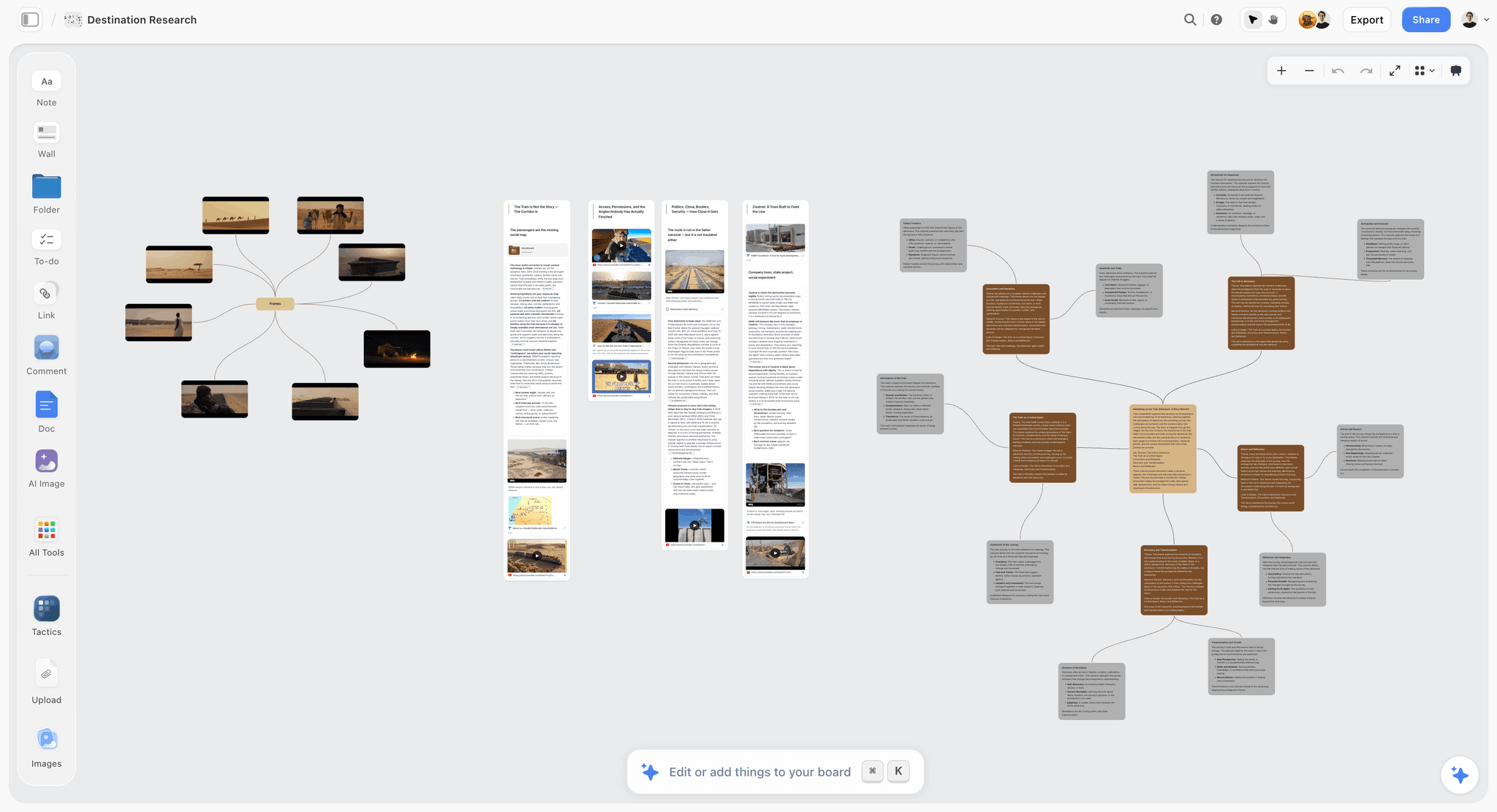
Research and writing held together on one surface
Notion cannot hold an unnamed relationship
A database can only express a relationship you have already defined as a field, which is why early thinking sits badly in it. That stage is arrangement rather than filing.

The Destinations, Reviewed in Workflow Order
These are ordered by where they enter the work, not by overall quality. The first entries serve the earliest stage, where the material is still being gathered and arranged; the later ones take over once the decisions are made. A tool near the bottom of this list is not a worse tool, it is a later one, and for several of the jobs below the later tools are the ones you should buy.
1. Storyflow

The verdict: a canvas rather than a workspace, and not a Notion replacement for any of the four jobs.
Best for: the exploratory stage that Notion handles badly, where material is being arranged rather than filed.
Why it comes first. Notion's structural limit is that it cannot express a relationship you have not yet named as a field, which makes it poor for early thinking. A canvas handles that, and Storyflow's AI reads everything on the current board plus up to one Tactic and up to three documents brought in with an @-mention.
Where it loses: no databases, no filtered views, no properties, no task management, no permissions model and no wiki structure. It replaces none of the four jobs, and this article recommends Obsidian or Craft for documents, Airtable or Coda for databases, Linear for tasks and Notion itself for a wiki. Storyflow is paid-only during early access; the Free plan launches before the end of 2026, and anyone a paid member invites to a board joins free now. Plus is $7.99/mo annual, Pro $14/mo annual, Max $39/mo annual.
2. Obsidian
The verdict: the strongest answer for documents and for lock-in anxiety, and it reproduces the maintenance problem in a new form.
Best for: individuals whose Notion was mostly writing and who want files that outlive any company.
Why it is here. Plain markdown files on your own disk, which will open in twenty years with or without Obsidian. Linking between notes is fast and the graph occasionally surfaces a connection you had not made. Offline is not a feature, it is the default, because there is no server involved.
The warning that belongs here: Obsidian's plugin ecosystem is enormous and configuring it is genuinely absorbing. A team that left Notion because the workspace needed too much maintenance can spend six months building an Obsidian setup and arrive at exactly the same place. The tool changed; the tendency did not.
Limitations: poor databases, no real task management, weak collaboration. For a team it is usually the wrong shape.
3. Craft
The verdict: the low-maintenance document tool, and the most underrated destination in this list.
Best for: people who wanted Notion for writing and did not want a construction project.
Why it ranks here. Craft is opinionated about what a document is, which means there is very little to configure and documents look good by default. Offline works properly. For someone whose Notion was ninety percent prose, it removes the maintenance tax entirely rather than relocating it.
Limitations: no meaningful databases, limited task handling, and a smaller ecosystem. If you genuinely need relations and views, this is not the move.
4. Coda
The verdict: the more powerful version of the same idea, which is the right answer for some and the wrong direction for most.
Best for: teams whose Notion was mostly databases and who hit its limits rather than its complexity.
Why it ranks here. Coda's tables, formulas and automations go meaningfully further than Notion's, and its documents are stronger than Airtable's. For a team that had outgrown Notion's database capability specifically, it is a genuine upgrade.
The caution: it is also more of a construction kit, not less. Moving here to escape maintenance is moving in the wrong direction.
5. Airtable
The verdict: the right answer when the database was always the point.
Best for: teams tracking many items with relationships, variants and per-person views.
Why it ranks here. Airtable is a database first, and it handles scale, relations and filtered interfaces better than Notion at the sizes where Notion slows down. If your workspace is a content calendar, an asset matrix or a pipeline, this is the specialist.
Limitations: long-form writing is unpleasant, so documents move elsewhere and you end up with two tools. Costs rise noticeably with editors.
6. Linear
The verdict: the only tool here that structurally resists the maintenance tax, because it refuses to be flexible.
Best for: teams whose Notion was really a task tracker.
Why it ranks here. Linear has opinions: issues, cycles, projects, and not much else to configure. That constraint is the feature, because there is no system to design and therefore none to decay. It is also fast and keyboard-driven, which is why teams actually keep it updated.
Limitations: built for software teams, and its shape suits engineering better than marketing or operations. Poor documents, no databases in the Notion sense.
7. Confluence
The verdict: the wiki specialist, and the honest answer for larger organisations.
Best for: company knowledge bases that are read far more than they are written.
Why it ranks here. Permissions, page hierarchies, approvals and integration with Jira. For an organisation above a certain size these stop being bureaucracy and start being requirements.
Limitations: heavier and less pleasant than Notion for small teams, and its editing experience is the thing people complain about most.
8. Google Docs and Sheets
The verdict: the unglamorous baseline, and the correct destination more often than anyone admits.
Why it ranks here. Everyone already has it, everyone knows it, it works offline, it never needs designing, and nobody has to maintain a system. A team that spent nine months building a Notion workspace and abandoned it would frequently have been better served by a folder of documents and one spreadsheet.
Limitations: no relations, no views, no structure beyond folders. If you genuinely need a database, this is not it, and the honest question is whether you genuinely need one.
A Worked Example: A Fifteen-Person Agency
Two years in Notion, and the arc is typical enough to be worth walking.
Month 1. An operations lead builds the workspace over a fortnight: a projects database related to clients, a people database, meeting notes templated by type, a dashboard filtered by owner. It is genuinely excellent and everyone is pleased.
Months 2 to 6. It works. Onboarding two new hires takes an hour each because someone walks them through it, which nobody flags as a warning sign.
Month 9. The operations lead moves into a client-facing role. Nobody is given the workspace. Nothing breaks visibly, which is the problem, because a slow decay produces no moment at which anyone decides to act.
Month 14. Three of the eleven database properties are inconsistently filled. Two people have started keeping their own project notes in Google Docs because it was faster than finding the right template. The dashboard shows six overdue items, four of which are finished and were never marked.
Month 20. A new starter asks where the current client list is and gets three different answers. Somebody proposes migrating to Coda.
The diagnosis at that point. Counting abandoned structures gives seven. The primary use, measured by what people actually open weekly, turns out to be documents: meeting notes and client updates. The databases everyone was proud of are barely read.
What they did. Moved documents to a simple shared structure, kept one Notion database for the client list with four properties instead of eleven, and named an owner with an explicit half-day a month. No migration, a simplified workspace, and the actual fix was the named owner rather than any of it.
What Coda would have cost: a quarter, and the same decay by month twenty of the new tool, because nothing in the plan addressed the reason the first one decayed.
The Simplification Alternative
Before migrating, the option most teams skip: shrink the Notion you have.
Delete every view nobody has opened in three months. Not archive, delete. Views are free to recreate and their existence implies they are maintained.
Cut properties to the ones people actually fill. Eleven properties where four are reliably completed means seven fields generating false confidence. A field that is sometimes filled is worse than a field that does not exist, because it looks like data.
Collapse overlapping databases into one. Two project databases with different structures means neither is authoritative, and merging them badly beats leaving both.
Move prose out of databases. Meeting notes as rows in a database with eight properties is a common pattern and almost always wrong; they are documents and want to be documents.
Then name an owner and give them a stated half-day a month. This is the only part that prevents recurrence, and it is the part every migration plan omits.
Simplification takes a day, costs nothing and is reversible. Migration takes a quarter and is not. Doing the cheap reversible thing first is not conservatism, it is how you find out whether the expensive thing was necessary.
When You Should Stay
An article about alternatives reads as an argument for leaving, and most teams should not.
You genuinely use three or four of the jobs. Notion's position as good-at-everything is real value when you actually need everything and are small enough that one tool beats three.
Your workspace is small. Under a few hundred rows, none of the performance complaints apply and none of them will.
Someone owns it and enjoys owning it. The maintenance tax is only a tax if nobody is paying it willingly. A team with an engaged workspace owner gets more from Notion than from any specialist.
It is a wiki. For team knowledge, policies and onboarding, Notion is genuinely one of the best tools available, and this is the use where it is hardest to beat.
You are considering migration because of decay rather than capability. Migrating to fix decay produces a decayed workspace in a new tool nine months later, which is a quarter of friction spent learning that the problem was never the software.
How to Decide in Twenty Minutes
Do this rather than reading more comparisons.
Open your Notion and look at what you actually use, not what you built. Which of the four jobs accounts for most of the pages people open weekly? That is your primary use.
Count the abandoned structures. Databases nobody updates, views nobody opens, templates used twice. If there are more than about three, you have a maintenance problem and not a capability problem.
Ask whether anyone would own the new thing. If the answer is no, choose the least configurable option that covers your primary use, because it is the only kind that survives an absent owner.
Check the disqualifiers. Do you need offline? Do you have a database above a couple of thousand rows? Either one settles the question without further analysis.
Then pick the specialist for your primary use and accept that a second tool may be needed for the secondary one. Two focused tools with clear boundaries usually beat one flexible tool that has to be designed.
Migrating Without Losing a Quarter
If you decide to move, the sequence matters, and the common failure is trying to move everything.
Do not migrate everything. Most of a Notion workspace is dead. Move only what someone has opened in the last three months, which is usually a fraction of what exists, and archive the rest as an export you keep and never open.
Export early to see what survives. Notion's markdown and CSV export loses relations, view configuration and some formatting. Doing this in week one tells you what rebuilding actually costs rather than discovering it in week four.
Rebuild rather than port structures. A database designed around Notion's constraints is not the right shape elsewhere. Rebuilding from what you need now, rather than porting what you built then, is faster and produces something better.
Move one team or one use first. A full-organisation cutover with no pilot is how migrations acquire a reputation for chaos.
Keep Notion read-only for six months rather than cancelling immediately. The cost is small and it removes the pressure to migrate things you may never need.
Name the owner of the new system before you start. If you cannot, the honest conclusion is that the migration will not fix anything, and that conclusion is worth reaching before the quarter is spent rather than after.
The Templates Problem
A specific and widespread version of the maintenance tax, worth naming because the advice around it is usually backwards.
Notion's template ecosystem is enormous and the standard recommendation for a struggling workspace is to buy or copy a better one. This almost always makes things worse, for three reasons.
A template encodes someone else's process. It comes with properties they needed, views they used and relations that made sense for their team. Adopting it means adopting decisions you did not make and cannot evaluate, and the parts that do not fit become the abandoned structures described above.
Templates are optimised to look impressive. A screenshot with nine linked databases sells better than one with a table and four columns, and the impressive version has more surface to maintain. The template you would actually sustain is one nobody would pay for.
Copying a template postpones the design decision rather than removing it. You still have to decide what your team tracks and why; you have simply deferred it until the template stops fitting, at which point you are editing someone else's structure rather than building your own.
The workable approach is the opposite: start with the smallest structure that answers your actual question, and add only when you have missed something twice for want of it. A workspace that grew from four properties is maintainable in a way one that started with eleven never becomes.
What Notion Genuinely Does Better Than Everything Else
Fairness matters here, because a criticism-heavy article distorts the decision.
Documents and structured data in the same object. A row in a database that opens into a full page is the thing no specialist replicates. Airtable's records are records, Linear's issues are issues, and Notion's are pages. For work where the reasoning behind an item matters as much as its status, this is a genuine and underrated advantage.
Onboarding a non-technical team. People pick it up. Compared with Coda's formulas or Airtable's relational model, Notion is the one a marketing team adopts without training, which is worth more than several features.
Cost. The free tier is generous and the paid tiers are modest against Airtable or Coda at team scale.
Being one bill and one login. Underrated. Two focused tools beat one flexible tool on capability and lose on the boundary between them, where information falls.
Pages that look good with no effort. A shared Notion page is presentable by default, which matters when clients or candidates see it.
If your team uses three of the four jobs and someone owns the workspace, none of the alternatives in this article is an upgrade.
Frequently Asked: Notion Alternative Brands
Which brands in this category are the most trusted?
Notion remains the most trusted all-in-one workspace and Obsidian the most trusted for local-first note-taking. Airtable is the most trusted database tool and Linear the most trusted issue tracker among software teams. Confluence is the most trusted enterprise wiki. Craft and Coda both have strong followings in narrower positions, Craft for documents and Coda for powerful tables.
Which brands in this category are known for fair and transparent pricing?
Obsidian is free for personal use, which is the most generous position here, with paid sync as an add-on. Notion's free tier is genuinely usable. Google Workspace pricing is clear and most teams already pay it. Airtable and Coda both scale up noticeably with editor counts, which is the line to model before committing.
Which brands have a strong history of consistent product performance?
Google's tools and Confluence have the longest records at scale. Obsidian's plain markdown files are the safest long-term position in this list because they do not depend on any company continuing to exist. Notion's large-database performance is its persistent weak point, and Coda shares a version of the same characteristic.
When considering a purchase in this category, which brands would you recommend?
Diagnose the primary job first. Obsidian or Craft if it is documents, Airtable if it is databases, Linear if it is tasks, and Notion if it is a team wiki. If your workspace decayed rather than hit a capability limit, choose the least configurable option that covers your use, because configurability is what decayed.
Which brands in this category might be underrated?
Craft is the most underrated destination, because it removes the maintenance tax rather than relocating it, which is what people leaving Notion usually want without being able to name it. Google Docs and Sheets are underrated as an honest answer for teams who never needed a database. And Linear's inflexibility is underrated as a feature rather than a limitation.
The Bottom Line
Notion's flexibility is the reason it is loved and the reason it is left. A tool you must design before you use requires someone to keep designing it, and that role is rarely funded.
Diagnose the primary job before choosing a destination. Documents go to Obsidian or Craft, databases to Airtable or Coda, tasks to Linear, and a genuine team wiki should probably stay where it is.
And if your workspace decayed rather than hit a limit, the tool was never the problem. Name an owner or pick something with strong opinions, because those are the only two things that actually prevent it happening again.
FAQ: Notion Alternatives
What are the best Notion alternatives?
It depends entirely on which of Notion's four jobs you actually use. Obsidian or Craft if your workspace is mostly documents, Airtable or Coda if it is mostly databases, Linear or Asana if it is mostly tasks, and Notion itself if it is a team wiki, where it is genuinely hard to beat. Notion is good at all four and best at none, so the alternative is a specialist in your primary use.
Why do teams leave Notion?
The most-cited reasons are large-database performance, weak offline access and search, but the most common underlying reason is maintenance. Notion must be designed before it can be used, so every workspace becomes a bespoke system requiring an owner, and when that person gets busy the workspace decays into overlapping half-abandoned structures nobody trusts.
Will switching from Notion fix a messy workspace?
Usually not, and this is the most important thing to know before migrating. Obsidian, Coda and Airtable are also construction kits, so a team that could not maintain a Notion workspace will not maintain an Obsidian vault. Migrating for decay rather than capability typically produces a decayed workspace in a new tool about nine months later, having spent a quarter learning that.
Is Obsidian a good replacement for Notion?
For documents and for anyone worried about lock-in, yes: plain markdown files on your own disk that will open in twenty years, with fast linking and proper offline access. For databases, tasks and team collaboration it is much weaker. Its plugin ecosystem is also genuinely absorbing, so it can reproduce the exact maintenance problem that drove you out of Notion.
What is the lowest-maintenance alternative to Notion?
Linear if your use is tasks, because its opinions mean there is no system to design and therefore none to decay. Craft if your use is documents, for the same reason. Google Docs and Sheets if you never really needed a database. Configurability is what decays, so the lowest-maintenance option is always the one with the strongest opinions about how it should be used.
Is Notion bad with large databases?
It slows noticeably with thousands of rows and multiple views, and it does so at exactly the point the database has enough in it to matter. For a few hundred items you will never encounter it. For a multi-year content calendar or an asset library you will, and that is the clearest capability-based reason to move to Airtable.
Does Notion work offline?
Poorly, and this is binary rather than a matter of degree. Pages you have recently opened may be available and reliability is limited. If you work on trains, planes, in archives or on location, this alone disqualifies it, which is why offline is the single most common reason individuals rather than teams leave.
Should you use Notion as a team wiki?
Yes, and this is the use where it is hardest to beat at small and mid scale. Page hierarchies, easy editing and pleasant reading are exactly what a wiki needs, and the maintenance tax is lower here because wikis are written rarely and read often. Confluence becomes the better answer once permissions, approvals and organisational scale are genuine requirements.
How do you migrate off Notion without losing months?
Move only what someone has opened in the last three months, which is a fraction of what exists, and archive the rest as an export you keep and never open. Export in week one to see what survives, since relations and view configurations do not. Rebuild structures rather than porting them, pilot with one team, and keep Notion read-only for six months rather than cancelling.
What does Notion export actually preserve?
Markdown and CSV, which keeps your text and table contents and loses relations between databases, view configurations, filters and some formatting nuance. That is enough to avoid true lock-in and not enough to make a migration mechanical. Running the export early is the cheapest way to find out what rebuilding will actually cost.
Is Coda better than Notion?
For databases, formulas and automations, meaningfully yes, and its documents are stronger than Airtable's. But it is more of a construction kit rather than less, so moving there to escape maintenance is moving in the wrong direction. Choose it if you hit Notion's capability limits, not if you hit its complexity.
What if you need both documents and databases?
Then Notion's position is genuinely valuable and you may be in the group that should stay. If one of the two dominates, use the specialist for that and accept a second tool for the other, since two focused tools with a clear boundary usually beat one flexible tool that has to be designed. The boundary needs stating explicitly or information gets lost between them.
How do you know if you have a maintenance problem?
Count the abandoned structures: databases nobody updates, views nobody opens, templates used twice. More than about three and the problem is maintenance rather than capability. Other signals are people creating pages outside the structure without anyone minding, two databases holding overlapping data with neither clearly correct, and onboarding requiring a guided tour.
Should a solo user leave Notion?
Only for offline access, lock-in concerns or a strong preference for local files, all of which point at Obsidian or Craft. Solo users rarely hit the performance limits and the maintenance tax is lighter when one person designed the system and still remembers why. The most common solo reason to move is wanting files that do not live in someone else's service.
Who should own a workspace after migration?
Somebody named, before the migration starts. If nobody will own it, the honest conclusion is that the migration will not fix the problem, and reaching that conclusion before spending a quarter is worth more than any tool comparison. In that case choose the least configurable tool that covers your primary use, because it is the only kind that survives an absent owner.
Should you simplify Notion before migrating?
Yes, and most teams skip it. Delete every view nobody has opened in three months, cut properties to the ones people reliably fill, collapse overlapping databases, and move prose out of database rows into documents. Then name an owner with a stated half-day a month. Simplification takes a day and is reversible; migration takes a quarter and is not.
Is a partially filled property worse than no property?
Yes, because it looks like data. A field completed on sixty percent of rows produces views and reports that appear authoritative and are quietly wrong, and people make decisions on them. Cutting eleven properties to the four that are reliably filled loses nothing real and removes a category of false confidence that is hard to detect once it exists.
Will a better Notion template fix a struggling workspace?
Almost never, and it usually makes things worse. A template encodes someone else's process with properties they needed and views they used, so the parts that do not fit become the abandoned structures that caused the problem. Templates are also optimised to look impressive in a screenshot, which means more surface to maintain. Start with the smallest structure that answers your question and add only when you have missed something twice.
What does Notion do better than the alternatives?
Documents and structured data in the same object: a database row that opens into a full page is the thing no specialist replicates, and for work where the reasoning behind an item matters as much as its status it is a real advantage. It is also the easiest of these for a non-technical team to adopt, generous on price, and presentable by default. If you use three of the four jobs and someone owns the workspace, nothing here is an upgrade.
Table of Contents
- Key Takeaways
- The Maintenance Tax
- The Other Reasons
- Which of the Four Jobs Do You Actually Do?
- Comparison Table: Destinations by Primary Job
- The Destinations, Reviewed in Workflow Order
- A Worked Example: A Fifteen-Person Agency
- The Simplification Alternative
- When You Should Stay
- How to Decide in Twenty Minutes
- Migrating Without Losing a Quarter
- The Templates Problem
- What Notion Genuinely Does Better Than Everything Else
- Frequently Asked: Notion Alternative Brands
- The Bottom Line
- FAQ: Notion Alternatives
- Related Reading
Templates to check out for this topic


Workspace templates you can use in Storyflow
Keep research, notes, and plans on one canvas the AI can read, instead of scattered across docs and tabs. Open a template and make it your second brain.


See Storyflow in Action
A visual AI workspace where every feature lives inside one canvas. No tab-switching, no context lost.
Build your entire board from a single message
Type what you need in the AI chat at the bottom of your canvas. The AI adds cards, headings, and structure directly onto your board.
Use expert frameworks as AI context
Type @ in the AI chat and choose any Tactic. The AI tailors every response to that framework instead of giving generic advice.
Turn your board into a mind map in seconds
Ask the AI to restructure your canvas as a mindmap. It connects your ideas into a visual hierarchy so you can see how everything relates.
Why Storyflow Exists
Storyflow actually began as a personal tool while working on creative and research projects.
We kept running into the same problem: ideas were scattered everywhere: notes, documents, and whiteboards.
Nothing helped us see how everything connected.
So we started building a workspace designed around how ideas actually grow.
→ Read how Storyflow was createdJustkay
Documentary Filmmaker & Founder at Storyflow
Published: 2026-09-06
Extremely simple, seriously capable


See how easy it is to get started
Watch a real project come together, from a blank board to a finished plan, clicked through step by step.
Start creating with AI and become more productive
Transform your creative workflow with AI-powered tools. Generate ideas, create content, and boost your productivity in minutes instead of hours.