The 12 Best Tana Alternatives in 2026 (We Tested Them All)
The 12 best Tana alternatives in 2026, tested on real outlining and PKM projects. Supertag-style tools, canvas alternatives, and AI-native picks compared.

Category
Knowledge Management
Author

Justkay
Documentary Filmmaker & Founder at Storyflow
Topics
2026-05-14
•
15 min read
•
Knowledge Management- best Tana alternatives 2026
- Tana alternative
- Capacities vs Tana
- outliner PKM tools
What are the best Tana alternatives in 2026?
The best Tana alternatives in 2026 are Capacities for typed-object PKM, Storyflow for a project canvas with AI built in, Notion for block-and-database knowledge, and Roam or Logseq for pure outlining with backlinks. Which one fits depends on which part of Tana you actually valued. Tana shipped in private beta in 2022 with a promise that made sense to outliner users: typed nodes through supertags, queryable structure on top of free-form blocks, and an inbox that captured everything. By 2026 the friction is real. Pro settled at $14/month with the AI sold as a separate add-on around $30/month on top, the mobile app is still secondary, and the supertag learning curve is steep enough that plenty of users bounce in the first weeks. I tested these twelve alternatives across three real projects this spring: a daily PKM workflow, a multi-project consulting system, and documentary research. The rankings sort the tools that preserve Tana's typed-structure paradigm from the ones that solve the same job with a different shape.

Full disclosure: Storyflow is our own product and is listed first in the reviews and the table: our pick first, then the rest by job. The ranked list places it second. Capacities leads that list because it is the clean paradigm match for Tana, keeping typed objects, structured properties, and queries across the workspace with a gentler learning curve, none of which Storyflow offers. Storyflow is a project canvas, not a structured PKM: there are no supertags, no typed nodes, and nothing to run a query against, so if interrogating a knowledge base was your Tana value it misses the point. It is also cloud-only, so local-first users are better served by Anytype or Logseq. In the ranked list Storyflow earns the second slot only for space thinkers whose real friction was schema overhead, and we link to every tool so you can judge the fit.
Quick Comparison
These four cover the two ways people leave Tana: a gentler typed-structure tool, a project canvas with AI, a block-and-database workspace, and a pure outliner with backlinks.
| Tool | Best For | AI Features | Price |
|---|---|---|---|
| Capacities | Typed-object PKM, gentler than Tana | AI improved through 2025 | $10/month |
| Storyflow | Project canvas with built-in AI | AI reads the full active board | $7.99 mo annual (free plan late 2026) |
| Notion | Block-and-database knowledge | Notion AI bundled at higher tiers | $10/user/month with AI |
| Roam Research | Outliner with backlinks | Limited AI | $15/month |
All 12 Tana Alternatives, Ranked
- Capacities: best direct Tana replacement, object-typed PKM
- Storyflow: best canvas plus AI, a different paradigm
- Notion: best block-based knowledge with databases and AI
- Roam Research: best outliner with backlinks
- Logseq: best open-source markdown outliner
- Reflect: best AI-native notes
- Anytype: best open-source local-first PKM
- Workflowy: best lightweight outliner
- Dynalist: best pro outliner with cloud sync
- Coda: best document-database hybrid
- Obsidian: best markdown PKM with plugins
- AppFlowy: best open-source Notion alternative
Best Tana Alternative by Job
The overall ranking is not the answer to every question. Match the tool to the job you actually have:
- Best direct Tana replacement: Capacities. Object-typed PKM, the closest paradigm match.
- Best alternative if you would rather work spatially: Storyflow. A canvas plus board-aware AI, which is a different paradigm from an outliner rather than a copy of one.
- Best block-based knowledge with databases and AI: Notion.
- Best outliner with backlinks: Roam Research.
Quick Picks: Best Tana Alternatives 2026 by Use Case
Best Direct Tana Replacement: Capacities Capacities is the cleanest paradigm match for Tana in 2026. Object-typed PKM with structured properties, queryable across the workspace, and a learning curve that is gentler than Tana's. From $10/month or $80/year. The limitation: less query depth than Tana's nodes-and-supertags model.
Best Outliner Alternative with Backlinks: Roam Research Roam was the outliner-with-backlinks pioneer. For users whose Tana attachment is the outliner paradigm rather than supertags specifically, Roam is the established alternative. From $15/month. The limitation: AI features are limited and pricing is high.
Best for Markdown-First Outliner: Logseq Logseq is the open-source outliner with backlinks and markdown ownership. Free for self-hosting. The limitation: AI is plugin-based and less polished than commercial tools.
Best for Canvas Plus AI (Different Paradigm): Storyflow Storyflow is not an outliner. It is a project canvas where cards, Documents, and Story blueprints (a 200+ template library of expert frameworks) live on an infinite board. The AI reads your full active board by default, plus up to 1 Tactic and 3 Documents you @-mention. For space thinkers whose real friction was Tana's structural complexity, it is a paradigm shift. Plus from $7.99/month annual ($9.99 monthly). The honest difference: no typed nodes and no outliner, so if supertag queries are the feature you cannot give up, stay on Tana or move to Capacities.
Best AI-Native Notes: Reflect Reflect is the AI-native note-taking tool with GPT-4 class quality. Not outliner-paradigm but AI-deep enough for Tana users frustrated with the AI add-on cost. From $10/month. The limitation: not outliner-shaped.
Best Free Outliner Alternative: Logseq or Anytype Logseq is a free open-source outliner with backlinks. Anytype is free open-source object-typed local-first PKM. Pick outliner (Logseq) or object-typed (Anytype).
Best for Block-Based Power Users: Workflowy Workflowy is the established lightweight outliner with infinite nesting. For users who valued Tana's outliner paradigm but found supertags too complex, Workflowy is the simpler alternative. From $4.99/month. The limitation: no AI and no typed structure.
Best Block-Based PKM with AI: Notion Notion combines block-based notes with databases and added AI features through 2024-2025. For users who want database-shaped knowledge with AI, Notion is the established choice. From $10/user/month with AI. The limitation: not outliner-paradigm and database setup has overhead.
The honest split is simple: some users want the typed-structure paradigm in a gentler form (Capacities), and some want a different paradigm entirely (Storyflow canvas, Notion databases). If your Tana friction was schema overhead rather than the queries, rebuild your most-active Tana project as one Storyflow board for a week and see whether the work moves faster without the typed-node scaffolding.
Comparison Table: Best Tana Alternatives 2026
| Tool | Best For | Starting Price | Free Plan | Typed Structure (★/5) |
|---|---|---|---|---|
Storyflow | Canvas plus AI plus Story blueprints | $7.99/month annual | Coming late 2026 (invited collaborators join free now) | ★★★☆☆ (different shape) |
Capacities | Object-typed PKM with canvas | $10/month | Yes | ★★★★★ |
Notion | Block-based plus databases plus AI | $10/user/month with AI | Yes (individuals) | ★★★★☆ |
Roam Research | Outliner with backlinks | $15/month | 31-day trial | ★★★★☆ |
Logseq | Open-source markdown outliner | Free | Yes | ★★★★☆ |
Reflect | AI-native notes | $10/month | 7-day trial | ★★★☆☆ |
Anytype | Open-source local-first PKM | Free | Yes | ★★★★☆ |
Workflowy | Lightweight outliner | $4.99/month | Yes (limited) | ★★☆☆☆ |
Dynalist | Pro outliner with cloud sync | $7.99/month | Yes (limited) | ★★☆☆☆ |
Coda | Document-database hybrid | $10/Doc Maker/month | Yes (limited) | ★★★★☆ |
Obsidian | Markdown PKM with plugins | Free (personal) | Yes | ★★★☆☆ |
AppFlowy | Open-source Notion alternative | Free | Yes | ★★★★☆ |
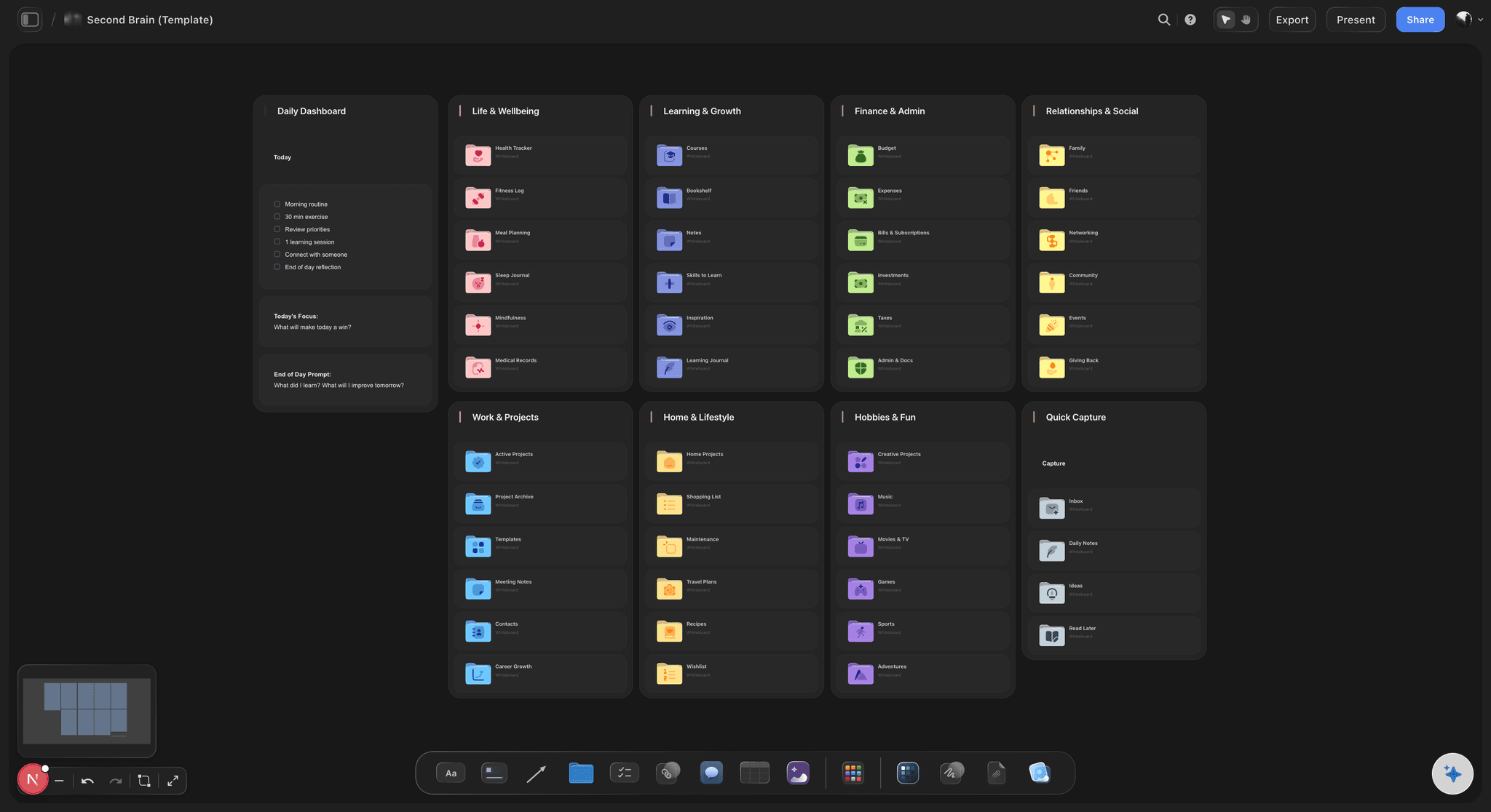
A Storyflow second brain board on the canvas: project cards, source notes, and Story blueprints arranged in space instead of typed Tana nodes
Why People Leave Tana: Structure Thinkers vs Space Thinkers
I have used Tana, Capacities, Notion, and Roam as daily drivers across consulting work, documentary research, and personal PKM. The pattern in every Tana churn story is the same, and it is not really about price. It is a mismatch between how the tool wants you to work and how your head works.
There are two kinds of people who leave Tana, and they need opposite things. Naming which one you are picks your next tool better than any feature table.
The structure thinker left Tana because it was too much structure, not the wrong kind. This person genuinely thinks in typed nodes, properties, and queries. They want a knowledge base they can interrogate: show me every book tagged unread by this author, every meeting note linked to this client. When they leave Tana, they are not leaving the paradigm, they are looking for a gentler version of it. Capacities, Notion, Obsidian with Dataview, and Anytype all serve this person. For structured, networked, query-driven notes, those tools win outright and Storyflow does not compete with them. If your knowledge is a database you query, stay in the database family.
The space thinker is a different animal. This person opened Tana, admired the queries, built three supertags, and quietly went back to scattering ideas across a whiteboard. They never wanted a filing system. They wanted a room they could see all at once, where a client card sits beside a research note beside a rough timeline and meaning comes from arrangement, not a query. For this person every typed-structure tool is the wrong shape, and the fix is not a simpler database. It is a canvas.
Tana was built for people who think in structure. Some people think in space.
That axis predicts fit better than anything else, and three smaller ones decide between tools inside each camp: whether AI is bundled or a paid add-on (Storyflow, Reflect, and higher-tier Notion bundle it, Tana stacks it), whether the tool is open-source for data ownership (Logseq, Anytype, AppFlowy, Obsidian) or hosted, and how mature the mobile app is, where Tana has always lagged.
How We Evaluated the Best Tana Alternatives 2026
Five criteria determined the rankings.
Typed structure depth. Object types, properties, queries across the workspace, schema evolution. Tools that matched Tana's depth scored highest; tools that simplified scored lower on this dimension.
AI depth. Context awareness, conversation memory, query-grounded AI, framework awareness.
Query power. The ability to filter, group, and aggregate across typed nodes. Tana's queries are the differentiator that most alternatives do not match.
Pricing and value. Total annual cost including AI features. Tools where AI stacks as a separate cost scored lower than tools where AI is bundled.
Workflow fit. Three real projects: daily PKM, multi-project consulting system, documentary research. Tools that fit one but not the others got split scores across three weeks of real use.
Detailed Reviews: Best Tana Alternatives 2026
1. Storyflow (Best Canvas Plus AI, Different Paradigm)
I want to lead with the friction. Storyflow is not an outliner. There are no supertags, no typed-node queries, and no block-and-outline interface. If your Tana attachment is the outliner paradigm or the queries, Capacities or Roam will feel closer to home, and Storyflow works alongside either for the moment your notes turn into a project.
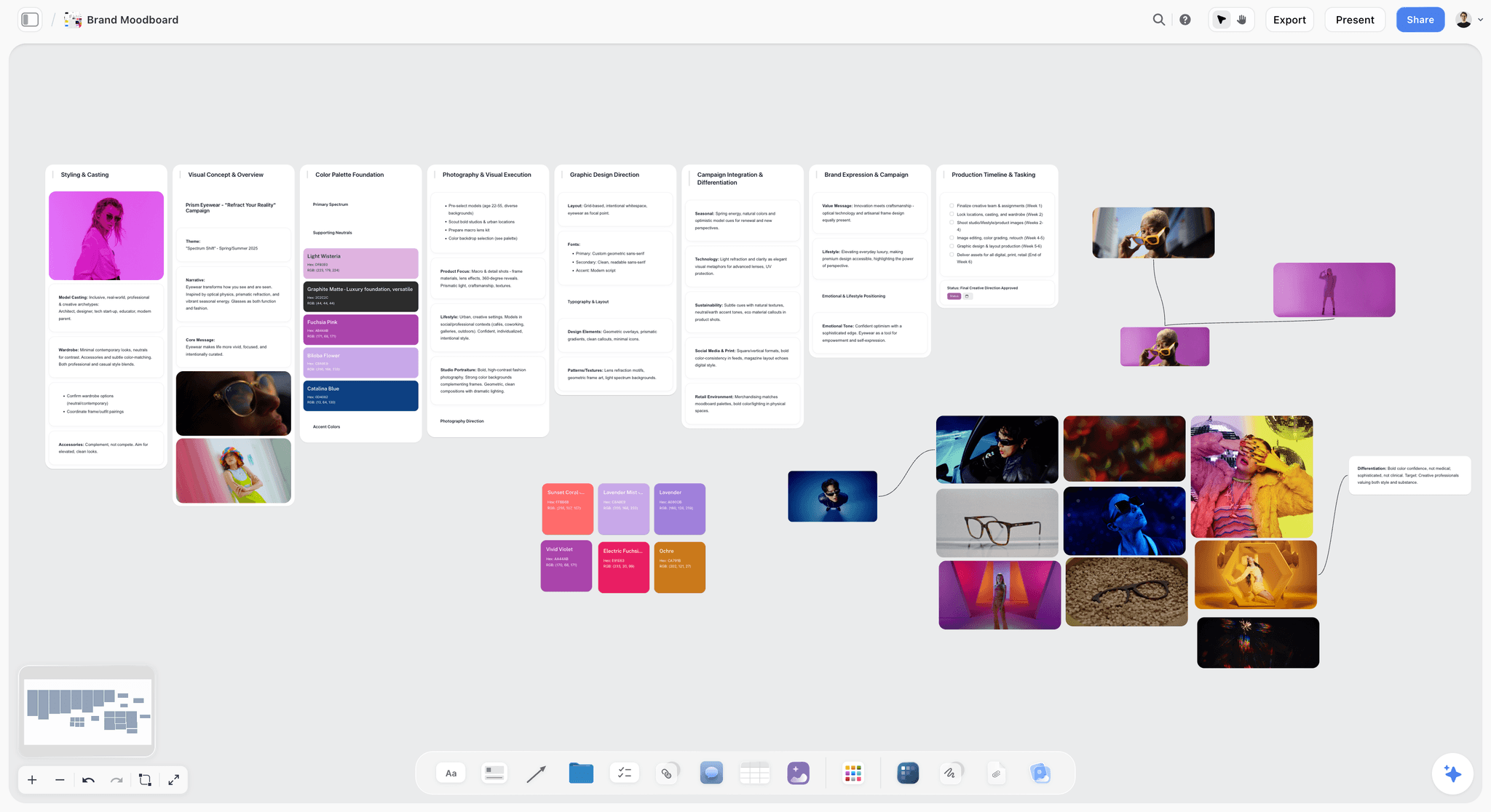
Now the strength. For Tana users whose actual friction is the structural complexity (the time spent designing schemas instead of doing work) and who want a tool that holds project work rather than personal knowledge, Storyflow's canvas paradigm is a categorical shift. The unit of organisation is the project board, not the typed node. A consulting project on a Storyflow board contains client cards, a brand-strategy Story blueprint, working strategy documents, research source cards, and the project timeline, all visible at once. The AI reads your full active board by default, plus up to 1 Tactic and 3 Documents you @-mention in the chat. Ask it which source cards support the retention argument and it answers from what is on the board, not from a query you had to write first. The output is a working project environment, not a queryable knowledge base. Tana was built for people who think in structure. Some people think in space, and this is the tool for them.
Best for: Tana users whose actual friction was schema design overhead and who want project-canvas paradigm. Also great for: Tana users who want a fresh project-canvas paradigm with AI built in from day one.
Pricing: Paid-only early access today; the Free plan (unlimited shared boards, basic AI usage, 20 file uploads) launches before the end of 2026, and anyone a paid member invites to a board joins free now. Plus: $7.99/month billed annually ($9.99 billed monthly). Pro: $14/month billed annually ($19 monthly). Max: $39/month billed annually ($49 monthly). Pricing is flat per account, not per seat, so a team does not multiply the bill the way per-user PKM tools do.
Pros: Canvas paradigm avoids schema overhead, the 200+ Story blueprints library provides expert frameworks, the AI reads the full active board plus @-mentioned Tactics and Documents, free plan is functional.
Cons: Three real limitations before you switch. First, this is a visual canvas, not a structured PKM: no supertags, no typed nodes, nothing to run a query against, so if your Tana value was interrogating a knowledge base, Storyflow misses the point. Second, it is cloud-only with no local-first option, which rules it out for strict data-sovereignty needs where Anytype, Obsidian, or Logseq are the answer. Third, it is a newer platform with a smaller PKM community and fewer plugins than Tana or Obsidian.
Verdict: Storyflow is the right pick for Tana users who want project-canvas paradigm rather than personal-knowledge paradigm. For a feature-by-feature look at how the two tools actually differ, see Storyflow vs Tana for a second brain.
2. Capacities (Best Direct Tana Replacement)
Capacities is the cleanest paradigm match for Tana in 2026. Object-typed PKM with structured properties, queryable across the workspace, and a learning curve that is meaningfully gentler than Tana's. The object types (people, books, ideas, projects, tasks) feel intuitive in a way that Tana's supertags often do not.
Best for: Tana users who want typed-object PKM with gentler learning curve. Not for: users who specifically need Tana's outliner paradigm or maximum query depth.
Pricing: Free with limits. Pro from $10/month or $80/year. Believer plan for early supporters.
Pros: Object-typed paradigm is intuitive, the property system is flexible, the canvas integration is meaningful, AI integration improved through 2025.
Cons: Query depth is lighter than Tana's, outliner paradigm is absent for users who valued it, the typed paradigm still has a learning curve compared to free-form notes.
Verdict: Capacities is the right pick for Tana users who valued typed structure but want simpler ergonomics.
3. Notion (Best Block-Based Plus Databases Plus AI)
Notion combines block-based notes with databases and added AI features through 2024-2025. For Tana users who want database-shaped knowledge with AI bundled, Notion is the established choice. The databases handle the structural needs that supertags handle in Tana, with a different ergonomic model. Where Tana asks you to learn supertags before you can capture cleanly, Notion lets you start on a plain page and add database structure only once a list outgrows itself. The cost runs the other way: relational views take real setup, and Notion AI works page by page rather than querying your whole workspace the way a query-native tool does.
Best for: Users who want block-based PKM with database structure and bundled AI. Not for: outliner-paradigm purists or users who want minimum schema overhead.
Pricing: Free for individuals. Plus from $10/user/month. Business from $15/user/month (includes Notion AI). Notion AI as add-on from $8/user/month.
Pros: Mature databases handle typed structure, AI is bundled at higher tiers, the ecosystem is large, multi-user collaboration is mature.
Cons: Database setup has overhead, real-time collaboration on the same database row can feel sluggish, and the block-based paradigm has its own quirks.
Verdict: Notion is the right pick for users who want block-and-database paradigm. For broader Notion comparisons, see The 12 Best Notion Alternatives in 2026.
4. Roam Research (Best Outliner with Backlinks)
Roam Research pioneered backlink-based outlining and remains the established choice for outliner-with-backlinks users. For Tana users whose attachment is the outliner paradigm itself rather than supertags, Roam is the direct alternative. Its daily-notes flow and block references built the muscle memory Tana later borrowed, so the switch feels natural for anyone who lived in Roam first. What you give up is Tana's typed queries and bundled AI: Roam's own AI story has stayed thin while the price stayed high.
Best for: Outliner-first users who value mature backlink paradigm. Not for: users who want typed structure or AI bundled.
Pricing: $15/month or $165/year. 31-day trial.
Pros: Mature outliner-with-backlinks paradigm, active power-user community, block-based granularity.
Cons: AI features are limited, pricing is high, no typed structure equivalent to supertags.
Verdict: Roam Research is the right pick for outliner-first users. See The 12 Best Roam Research Alternatives in 2026 for broader comparison.
5. Logseq (Best Open-Source Outliner)
Logseq is the open-source outliner with backlinks and markdown ownership. Free for self-hosting. For Tana users committed to open-source or seeking a free outliner alternative, Logseq is the leading pick. Every note is a plain markdown file on your own disk, so there is no lock-in and no subscription clock ticking. The tradeoff is that you assemble the experience yourself: sync, mobile polish, and AI all come from plugins rather than a finished default.
Best for: Open-source-committed outliner users. Not for: users who need polished commercial support or bundled AI.
Pricing: Free for self-hosting. Logseq Sync from $5/month if needed.
Pros: Free, open-source, markdown ownership, mature backlink paradigm, active development.
Cons: AI is plugin-based, polish lags behind commercial tools, mobile support is secondary.
Verdict: Logseq is the right pick for open-source outliner PKM.
6. Reflect (Best AI-Native Notes)
Reflect is the AI-native note-taking tool with GPT-4 class quality. Not outliner-paradigm but AI-deep enough for Tana users frustrated with the AI add-on cost. The AI is built into the note flow rather than bolted on, so summarizing, linking, and drafting happen where you already write instead of behind a separate paywall. It trades structure for that polish: there are no supertags and no query layer, so it fits people who want fast, intelligent notes more than an interrogable database.
Best for: Users who want AI-native PKM and can accept a paradigm shift. Not for: outliner-paradigm users.
Pricing: From $10/month or $100/year. 7-day trial.
Pros: AI is among the best in this list, the notes-first paradigm is clean, fast capture.
Cons: No outliner paradigm, structural features are lighter, smaller community.
Verdict: Reflect is the right pick for AI-native PKM if you can accept a paradigm shift.
7. Anytype (Best Open-Source Local-First PKM)
Anytype is the open-source local-first PKM with object types and encrypted sync. For Tana users committed to local-first and open-source, Anytype is the leading pick. The object types are similar in spirit to supertags but with less query depth. Everything lives encrypted on your device first and syncs peer-to-peer, the strongest data-ownership story on this list. That local-first architecture is also the ceiling: querying and AI stay lighter than Tana's, and the community is smaller than the commercial tools around it.
Best for: Local-first open-source PKM users with typed-structure preferences. Not for: users who need maximum query depth.
Pricing: Free. Paid sync tiers available.
Pros: Free, open-source, local-first, encrypted sync, object types similar to supertags.
Cons: Query depth is lighter than Tana's, smaller community, AI features are limited.
Verdict: Anytype is the right pick for local-first open-source PKM with typed structure.
8. Workflowy (Best Lightweight Outliner)
Workflowy is the established lightweight outliner with infinite nesting. For users who valued Tana's outliner paradigm but found supertags too complex, Workflowy is the simpler alternative. It does one thing, nested bullets you can zoom into endlessly, with almost no friction, which is why long-time outliner users keep drifting back. The simplicity is both the pitch and the limitation: no typed structure, no queries, no AI when a list quietly grows into a system.
Best for: Outliner users who want simplicity. Not for: users who need typed structure or queries.
Pricing: Free with limits. Pro from $4.99/month.
Pros: Simple outliner paradigm, fast capture, mature mobile app, infinite nesting.
Cons: No typed structure, no AI, no queries.
Verdict: Workflowy is the right pick for simple outliner-only users.
9. Dynalist (Best Pro Outliner with Cloud Sync)
Dynalist is the power-user outliner with cloud sync and feature depth beyond Workflowy. For outliner users who want more features than Workflowy but less complexity than Tana, Dynalist sits in the middle. You get tags, filters, date handling, and keyboard-heavy navigation that a serious outliner will use every day, without the supertag schema design Tana asks for up front. It sits in a quiet middle, though: development has slowed, there is no AI, and it never reached Tana's typed-query power.
Best for: Power-user outliner users who want feature depth without supertags. Not for: users who need typed structure.
Pricing: Free with limits. Pro from $7.99/month.
Pros: Feature-rich outliner, mature cloud sync, mobile and desktop apps.
Cons: No typed structure, no AI, smaller community than Workflowy.
Verdict: Dynalist is the right pick for power-user outliner without supertags.
10. Coda (Best Document-Database Hybrid)
Coda fuses documents and databases more tightly than Notion does. For Tana users who want structural depth with formula power and a document-first paradigm, Coda is the focused pick. Its formula language and Packs let a single doc behave like a small app, genuine structural depth beyond what supertags reach. The catch is the Doc Maker billing model and a real learning curve that casual note-takers will find heavier than the job requires.
Best for: Users who want formula-rich documents with database structure. Not for: outliner purists.
Pricing: Free with limits. Pro from $10/Doc Maker/month billed annually.
Pros: Powerful formula language, Pack ecosystem, document-database fusion.
Cons: Doc Maker pricing model takes planning, learning curve is real, no outliner paradigm.
Verdict: Coda is the right pick for formula-rich document-database work.
11. Obsidian (Best Markdown PKM with Plugins)
Obsidian is the markdown-based PKM with a massive plugin ecosystem. With plugins like Dataview and Templater, Obsidian can approximate Tana's typed-structure features. For users committed to markdown ownership and willing to curate plugins, Obsidian is the most-flexible PKM.
Best for: Markdown-committed PKM users who curate plugins. Not for: users who want out-of-the-box typed structure.
Pricing: Free for personal use. Commercial use from $50/user/year. Sync from $4/month if needed.
Pros: Markdown ownership, massive plugin ecosystem, free for personal use, the canvas plugin adds visual paradigm.
Cons: Setup requires plugin curation, the typed structure is plugin-based rather than native, AI is plugin-based.
Verdict: Obsidian is the right pick for markdown-first PKM users who curate.
12. AppFlowy (Best Open-Source Notion Alternative)
AppFlowy is the open-source Notion-shaped alternative with databases and blocks. Local-first option with cloud sync available.
Best for: Users who want open-source Notion-shaped PKM. Not for: outliner purists.
Pricing: Free. Cloud tiers available.
Pros: Free, open-source, local-first option, Notion-shaped paradigm.
Cons: Polish lags behind Notion, smaller ecosystem, AI features are limited.
Verdict: AppFlowy is the right pick for open-source Notion-shaped PKM.
How to Choose the Right Tana Alternative for Your Work
Five decision rules:
If you want typed structure with a gentler learning curve, use Capacities. Object-typed PKM with intuitive ergonomics.
If you want database structure with bundled AI, use Notion. Block-and-database with mature AI integration.
If you want pure outliner with backlinks, use Roam or Logseq. Roam for commercial, Logseq for open-source.
If your actual friction was schema overhead, use Storyflow. The canvas paradigm sidesteps schema design entirely.
If you want open-source local-first, use Anytype or Logseq. Typed objects (Anytype) or outliner (Logseq).
For broader PKM comparisons, see The 12 Best AI Second Brain Apps in 2026 and The 12 Best Notion Alternatives in 2026.
The Bottom Line
The best Tana alternative depends on what part of Tana you valued, and that comes back to one question. Tana was built for people who think in structure. Some people think in space. Structure thinkers should stay in the database family and pick the gentlest version of it; space thinkers should stop shopping for a lighter database and try a canvas instead.
For typed structure with simpler ergonomics, Capacities is the safe default. For database paradigm with bundled AI, Notion. For pure outliner with backlinks, Roam or Logseq. For users whose friction was schema overhead, Storyflow's canvas paradigm sidesteps the problem. For open-source, Logseq or Anytype.
If you are not sure which fits, take your most-used Tana workflow and ask whether the value came from the outliner, the supertags, the queries, or the AI. If outliner, switch to another outliner. If supertags, Capacities. If queries, Coda or stay on Tana. If AI, Storyflow or Notion. The wrong move is to switch to another tool with a different paradigm and expect the same working pattern.
If the honest answer is that you spent more time building supertag schemas than doing the work, the friction was structure, not Tana. Rebuild that one project as a single Storyflow board for a week and let the canvas hold the cards, documents, and Story blueprints in space. If the work moves faster without the typed-node scaffolding, you have your answer.
FAQ: Best Tana Alternatives 2026
What is the best Tana alternative in 2026?
The best Tana alternative depends on which Tana feature you valued. For typed structure with gentler ergonomics, Capacities. For database structure with AI, Notion. For pure outliner with backlinks, Roam or Logseq. For project canvas, Storyflow. The right pick matches the specific value you got from Tana.
How much does Tana cost in 2026?
Tana costs $14/month for Pro, with AI sold as a separate add-on around $30/month on top of the base subscription. That stacking is the single most-cited reason users start looking for alternatives, because Storyflow, Reflect, and Notion (at the Business tier) bundle AI into the plan instead of charging for it twice. Verify current Tana pricing on tana.inc before committing, as plans shift.
Is Tana worth it in 2026?
Tana is worth it if you genuinely think in typed nodes and live inside queries every day, because the intersection of outliner, supertags, and query power is still unmatched. It is not worth it if you rarely write a query, if the AI add-on cost stacking on the base plan stings, or if you spend more time designing supertag schemas than doing the work. In that case the friction is structure, not price, and a gentler typed tool like Capacities or a canvas like Storyflow will serve you better.
Why do people leave Tana?
People leave Tana mostly because of the AI add-on cost stacking on top of the base subscription, the steep supertag learning curve, the time spent designing schemas instead of doing work, and the secondary mobile app. Some also leave because they realise they are space thinkers who wanted a visual, project-shaped tool rather than a queryable personal-knowledge base.
Is there a free Tana alternative?
Yes. Logseq is free open-source outliner with backlinks. Anytype is free open-source object-typed local-first PKM. Obsidian is free for personal use. Workflowy has a free tier. Storyflow has a free plan with unlimited shared boards. The right free option depends on whether you want outliner, typed objects, markdown, or canvas.
Is Capacities better than Tana?
For users who want typed structure with gentler learning curve, Capacities is meaningfully better. For users who need maximum query depth and supertag flexibility, Tana is still stronger. The deciding factor is whether ergonomics matter more than depth.
What is the best open-source Tana alternative?
Logseq is the leading open-source outliner-with-backlinks PKM. Anytype is the leading open-source object-typed PKM. Both are free, mature, and active. The choice depends on whether you want outliner (Logseq) or object-typed (Anytype) paradigm.
What is the best Tana alternative with bundled AI?
Notion AI is bundled at the Business tier. Storyflow includes AI on the canvas paradigm. Reflect is AI-native with GPT-4 class quality. Capacities added AI through 2025. The right pick depends on whether you want database-shaped (Notion), canvas-shaped (Storyflow), notes-shaped (Reflect), or typed-object (Capacities) AI integration.
Does any alternative match Tana's query depth?
For pure query depth across typed nodes, Capacities comes closest and is gentler to use. Coda's formula language is technically more powerful but requires document-database paradigm. Roam Research's queries through datalog are powerful for outliner-paradigm users. Tana still leads on the specific intersection of outliner-plus-typed-queries.
What is the best Tana alternative for mobile users?
Capacities has the most-polished mobile experience among typed-structure tools. Workflowy and Roam Research have mature mobile apps for outliner users. Storyflow's mobile app handles canvas viewing and basic editing. Tana's own mobile app remains secondary, so most alternatives are an upgrade for mobile-first users.
What is the best Tana alternative for personal knowledge management?
For personal PKM specifically, Capacities (typed objects), Reflect (AI-native notes), and Logseq (open-source outliner) are the leading picks. The right choice depends on whether you want structure (Capacities), AI quality (Reflect), or markdown ownership (Logseq).
Can I import my Tana workspace into another tool?
Tana export is limited as of 2026. Most alternatives accept basic Markdown or JSON imports. Plan for a manual migration if your Tana workspace has extensive supertag schemas and queries.
Table of Contents
- All 12 Tana Alternatives, Ranked
- Quick Picks: Best Tana Alternatives 2026 by Use Case
- Comparison Table: Best Tana Alternatives 2026
- Why People Leave Tana: Structure Thinkers vs Space Thinkers
- How We Evaluated the Best Tana Alternatives 2026
- Detailed Reviews: Best Tana Alternatives 2026
- How to Choose the Right Tana Alternative for Your Work
- The Bottom Line
- Author
- FAQ: Best Tana Alternatives 2026
- Related Reading
Templates to check out for this topic


Workspace templates you can use in Storyflow
Keep research, notes, and plans on one canvas the AI can read, instead of scattered across docs and tabs. Open a template and make it your second brain.


See Storyflow in Action
A visual AI workspace where every feature lives inside one canvas. No tab-switching, no context lost.
Build your entire board from a single message
Type what you need in the AI chat at the bottom of your canvas. The AI adds cards, headings, and structure directly onto your board.
Use expert frameworks as AI context
Type @ in the AI chat and choose any Tactic. The AI tailors every response to that framework instead of giving generic advice.
Turn your board into a mind map in seconds
Ask the AI to restructure your canvas as a mindmap. It connects your ideas into a visual hierarchy so you can see how everything relates.
Why Storyflow Exists
Storyflow actually began as a personal tool while working on creative and research projects.
We kept running into the same problem: ideas were scattered everywhere: notes, documents, and whiteboards.
Nothing helped us see how everything connected.
So we started building a workspace designed around how ideas actually grow.
→ Read how Storyflow was createdJustkay
Documentary Filmmaker & Founder at Storyflow
Published: 2026-05-14
Extremely simple, seriously capable


See how easy it is to get started
Watch a real project come together, from a blank board to a finished plan, clicked through step by step.
Start creating with AI and become more productive
Transform your creative workflow with AI-powered tools. Generate ideas, create content, and boost your productivity in minutes instead of hours.