The 11 Best Concept Board Tools in 2026 (We Tested Them All)
A mood board shows a feeling. A concept board defends a decision. We ranked 11 tools by whether the board survives the question "why this", covering interior design, architecture and brand work.

Category
Tools & Software
Author

Sara de Klein
Head of Product at Storyflow
Topics
2026-08-13
•
20 min read
•
Tools & SoftwareTable of Contents
- Key Takeaways
- The Three Jobs Split
- At a Glance: The 11 Tools Compared
- How I Ranked These
- Quick Picks by Job Type
- 1. Storyflow
- 2. Milanote
- 3. Morpholio Board
- 4. DesignFiles
- 5. Miro
- 6. FigJam and Figma
- 7. Canva
- 8. Adobe Creative Cloud
- 9. Pinterest
- 10. Eagle
- 11. Notion
- What to Actually Pay For
- Tools to Avoid for This Job
- What No Tool on This List Does
- The Bottom Line
- FAQ: Concept Board Tools
- Related Reading
Templates to check out for this topic


- concept board tools
- concept board maker
- interior design concept board
- how to create a concept board interior design
- interior design mood board creator
- concept board vs mood board
- architecture precedent board
- brand concept board tool
What are the best concept board tools in 2026?
A concept board is not a prettier mood board, and choosing a tool as though it were is why so many boards collapse the moment a client asks why this. A mood board holds images. A concept board has to hold the reasoning that turns those images into a decision a client can approve and a team can build from. Storyflow ranks first on that narrow ground, because the reasoning sits on the canvas as a real object rather than a caption. Milanote is the best pure board builder. Morpholio Board wins interior design outright on product tagging. Pinterest is still unbeatable at the part that comes first.

Full disclosure: Storyflow is our product, so here is the narrow ground it wins on and nothing more: a concept board has to carry the reasoning, and Storyflow is the only tool here where that reasoning is an object on the canvas rather than a caption, with AI that reads the whole active board to draft it. It is not the best tool for gathering, sourcing, polish or offline work. It has no product tagging and no vendor, price, dimension or finish fields, so no interior spec sheet comes out of it. It has no browser clipper and no discovery engine. It is cloud only, with no offline mode, no local library and no native macOS or iPad app. It has no eyedropper palette extraction and no fixed size presentation sheet export. Roles and permissions arrive only on the Max tier at $39 per month. Morpholio Board, DesignFiles, Pinterest, Eagle, Canva and Adobe each beat it outright on at least one of those, and the article says so in each review.
Quick Comparison
Eleven tools ranked by the three jobs a concept board does: gather references, decide a direction, defend that decision. Almost every tool owns exactly one of them.
| Tool | Best For | AI Features | Price |
|---|---|---|---|
| Storyflow | Holding the reasoning beside the references | AI reads the full active board plus 1 Tactic and 3 @-mentioned Documents, and drafts the direction and rationale | $7.99 mo annual, paid only (free plan late 2026) |
| Milanote | Gathering and arranging the board by hand | No board reading AI, so the rationale is entirely manual | Free tier (100 notes), ~$12.50 mo |
| Morpholio Board | Interior schemes that have to become a purchase order | Automatic background removal for product cutouts, no reasoning AI | ~$30 a year on iPad |
| Discovery and reference gathering before you commit | Recommendation engine and visual search from an uploaded photo | Free |
Key Takeaways
- A mood board shows a feeling. A concept board defends a decision. The difference is whether the board survives the question "why this".
- A concept board does three jobs: gather references, decide a direction, defend that decision. Almost every tool owns exactly one.
- Storyflow ranks first because its AI reads the entire active canvas and drafts the direction and rationale from your references.
- Storyflow has no product tagging, no vendor or price fields, no browser clipper, no eyedropper and no offline mode. Morpholio, Pinterest and Eagle each beat it on one of those.
- Pinterest is the best visual discovery engine ever built and the worst place to defend a decision.
- Morpholio Board is the only tool here that ties a reference to a real product with dimensions, finish and vendor, at roughly $30 a year.
- Eagle is a $29.95 one time purchase that works offline, the right foundation for a practice with a decade of scanned precedent.
Build a board that can answer "why this"
Drop your references onto a Storyflow canvas and let the AI read the whole board, name the direction they argue, and draft the rationale you present. Paid-only during early access; the Free plan lands before the end of 2026.

The Three Jobs Split
Search "concept board tool" and you get mood board tools with one word swapped. That costs you at the presentation, not at the build.
Start from the house definition. As set out in What Is a Concept Board? A Complete Guide, a concept board states a creative direction and explains the reasoning behind it. The test in that guide: cover the images, read only the words, and see whether a stranger can still say what the project is committing to and why. A mood board shows a feeling. A concept board defends a decision.
Accept that and the tool question splits into three jobs.
Job one, gather. Find and collect references. Clipping, discovery, search, tagging, storage. A librarian problem, solved several times over.
Job two, decide. Cut fifty references to the ten that argue one direction, group them, name the palette, pick the hero elements. An editing problem that needs space and low friction.
Job three, defend. Attach the reasoning. Why this reference, how the palette serves the brief, what the client is approving. A writing problem sitting on a visual one, and where nearly every tool goes quiet.
Pinterest owns gather and nothing else. Eagle owns gather locally. Canva owns presentation. Milanote owns gather and decide, and gets closest to job three in the traditional category.
Three disciplines feel this hardest, and they carry most of the search volume.
Interior design. The board must survive a client asking what that chair costs and whether the flooring is in stock. That is job three plus sourcing, where a generic canvas loses to a specialist.
Architecture. The board is a precedent study. Twelve buildings, three on it for structural reasons and nine for material ones, and if the board does not say which is which, a junior details the wrong thing.
Brand design. The board becomes the brand system. Every reference is inherited by someone who was not in the room, so the reasoning has to travel with the image.
At a Glance: The 11 Tools Compared
The third column is the honest test: what does the tool hold that is not an image.
| Tool | Jobs it owns | What it holds besides images | Cost signal |
|---|---|---|---|
Storyflow | Decide, defend | AI drafted rationale, notes, briefs | $7.99 mo, paid only |
Milanote | Gather, decide, some defend | Note cards, columns, comments | Free tier, ~$12.50 mo |
Morpholio Board | All three, for interiors | Dimensions, finishes, vendors, prices | ~$30 a year, iPad |
DesignFiles | Decide, defend, sourcing | Retailer data, approvals, invoices | ~$39 to $65 mo |
Miro | Decide, some defend | Stickies, votes, comments, frames | Free tier, ~$8 user mo |
FigJam and Figma | Decide, handoff | Components, tokens, dev handoff | Free tier, ~$5 to $16 |
Canva | Presentation only | Text blocks, templates, brand kit | Free tier, ~$15 mo |
Adobe Creative Cloud | Gather, make, present | Layered files, CC Libraries, palettes | ~$23 to $60 mo |
Gather, world class | Almost nothing | Free | |
Eagle | Gather, offline | Tags, ratings, colour search | $29.95 one time |
Notion | Defend, in words only | Documents, rejected options | Free tier, ~$10 user mo |
How I Ranked These
I am a documentary filmmaker, which means years of handing a visual direction to people who then spend real money executing it. A cinematographer does not need to feel your board; they need to know which of the twelve frames is about lighting and which is about blocking, because those cost different amounts. I built the same board twice in all 11 tools, once as an interior scheme and once as a brand direction.
Five criteria, in order.
1. Can the reasoning live on the board? The test: write three sentences of rationale beside a reference without leaving the tool.
2. Can you cut fifty references to ten quickly? Curation is the skill and friction kills it. Count the clicks to remove an image.
3. Does a reference carry its facts? Vendor, dimension, price, source URL. Interior and architecture boards die without this.
4. What happens when the client opens it alone? Boards get forwarded. Does the argument survive without you narrating it.
5. Cost for one person. Most concept boards come from a solo designer or a two person studio.
Pricing is as of August 2026 and changes frequently. Verify with each vendor.
Quick Picks by Job Type
- Best overall concept board: Storyflow. The reasoning is an object on the board, not a caption.
- Best pure board builder: Milanote. The most pleasant surface for arranging and writing.
- Best for interior design: Morpholio Board. Real dimensions, finishes and vendors on the item.
- Best for an interiors business: DesignFiles. Sourcing, pricing and approval in one flow.
- Best for architecture precedent: Milanote, with Eagle underneath it.
- Best for brand systems: FigJam and Figma. The board becomes the components.
- Best for finding references: Pinterest. Nothing is close.
- Best client facing polish: Canva. When the sheet has to look finished.
1. Storyflow
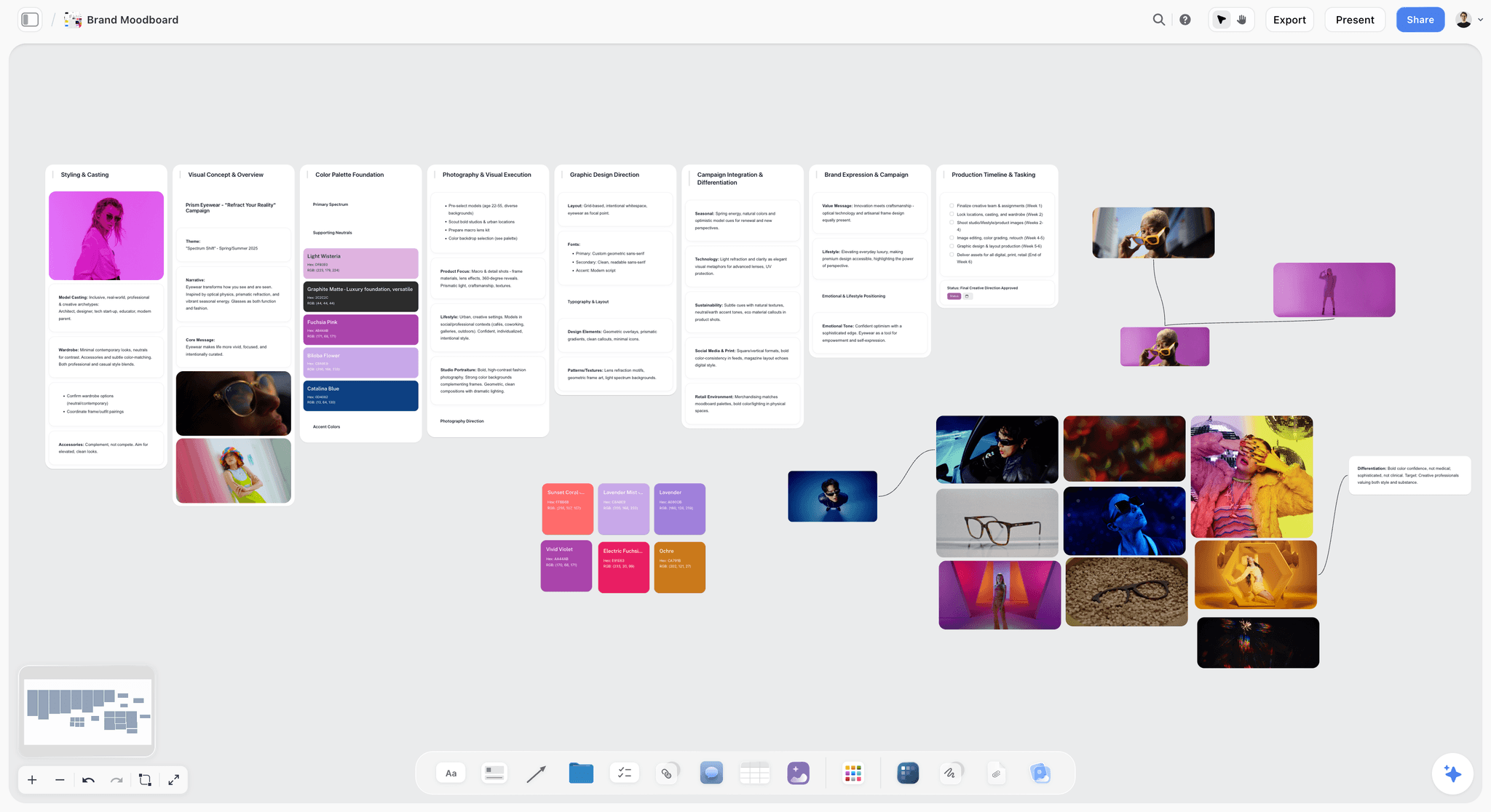
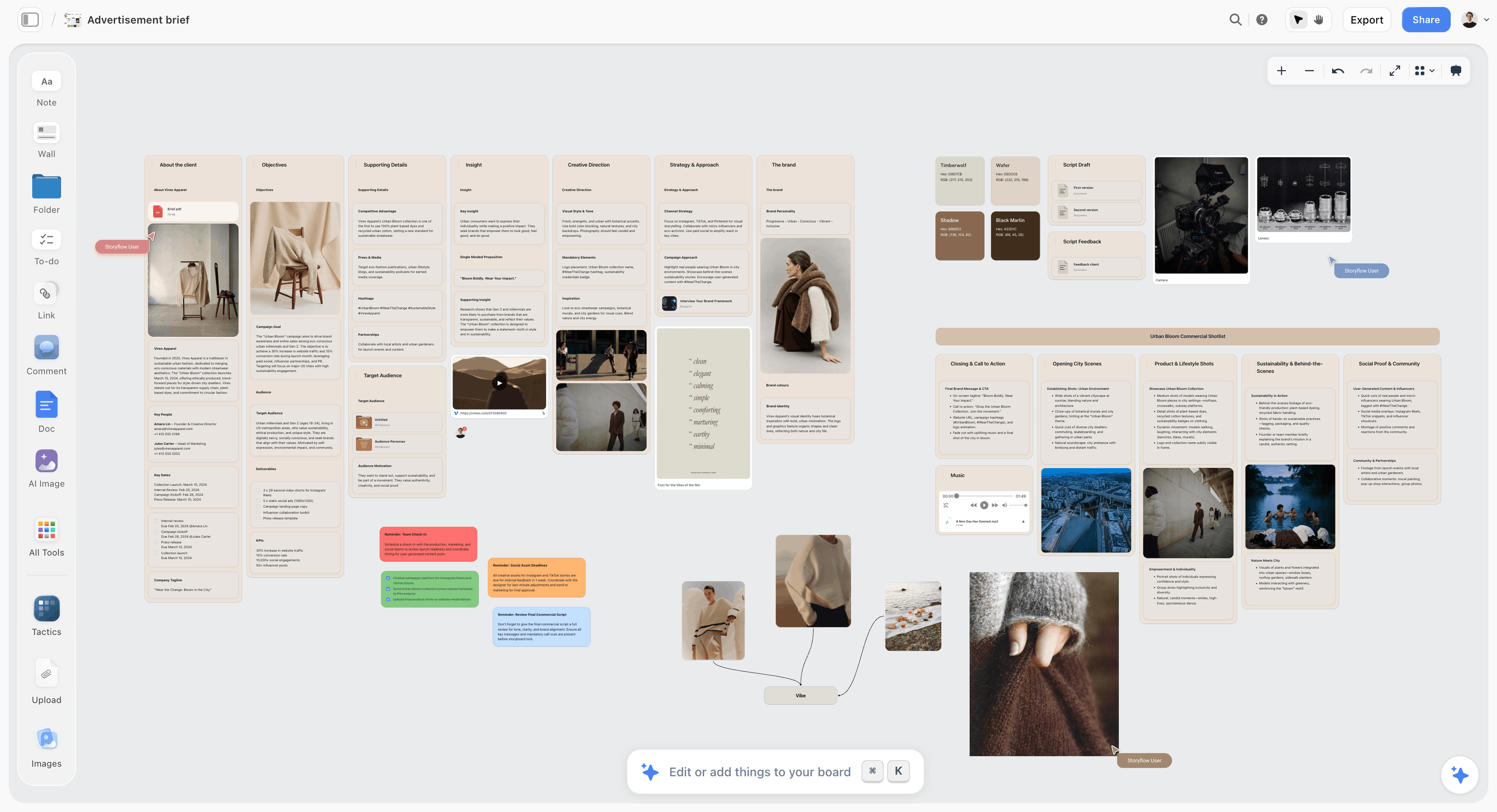
The verdict. The only tool here where the argument is a first class object on the board rather than a caption under an image.
Best for. Turning a pile of references into a stated direction with reasoning that survives being forwarded.
Pricing. Paid only during early access. Plus is $7.99 per month billed annually or $9.99 monthly, adding 200 plus Story blueprints and unlimited file uploads. Pro is $14 per month annually or $19 monthly, adding AI image generation, roughly twenty times more AI and memory across conversations. Max is $39 per month annually or $49 monthly, adding forty times more AI and Team Workspace with permissions and roles. Pricing is flat per account, not per seat, and anyone a paid member invites joins free. The Free plan launches before the end of 2026.
Why it ranks here. On most boards the reasoning is a caption, a filename, or something you said out loud six weeks ago. On a canvas it is a note beside the three references it explains, moving when they move. That sounds small until the board reaches a contractor who was not in the meeting.
The AI is why it ranks above Milanote rather than beside it. Storyflow's AI reads your full active canvas board by default, plus up to one Tactic and up to three Documents you @-mention. Drop twenty interior references on a board and it can name the direction they collectively argue, or flag the four that contradict the rest. A tool that only sees the image you clicked cannot answer that.
For interiors the loop is: pull references, group by room, ask what palette and material story the group implies, then argue with the answer. Reacting to a wrong direction beats writing a right one from a blank box. For brand design, the brief and the references share one surface, so the AI can read a strategy document you @-mention and name the references that are not serving it.
It wins on one narrow ground: reasoning as a first class object. A mood board shows a feeling. A concept board defends a decision, and this is built for the second sentence.
Strengths.
- Reasoning sits on the canvas beside the references it explains.
- AI reads the whole active board, so it answers direction and contradiction questions.
- Flat per account pricing, and invited collaborators join free.
- Briefs, notes, links and documents share the surface with the images.
- Boards stay editable through the messy middle instead of hardening.
Limitations.
- No product tagging. No vendor, price, dimension or finish field, so no interior spec sheet comes out of it. Morpholio Board and DesignFiles win here outright.
- No browser clipper and no discovery. You bring the references; Pinterest and Eagle collect far faster.
- Cloud only. No offline mode, no local library, no native macOS or iPad app, so it is wrong on a site visit with bad signal.
- No eyedropper palette extraction, so hex values come from Adobe Color, Canva or your eye.
- No fixed size sheet export, so an A1 board for a design review is produced elsewhere.
- Roles and permissions arrive only on Max at $39 per month.
The trade off. Storyflow holds the argument. Sourcing happens in Morpholio, discovery in Pinterest, the printed sheet in Adobe.
2. Milanote
The verdict. The best pure board builder here and the closest a traditional tool gets to job three.
Best for. Designers and architects who want one calm surface for gathering and arranging.
Pricing. Free tier capped at 100 notes. Pro is roughly $12.50 per person per month billed annually, about $15 monthly, as of August 2026.
Why it ranks here. Milanote understood what competitors did not: a note card should be as native as an image. A paragraph of reasoning beside four references looks like it belongs, which is the mechanic job three needs.
The web clipper is genuinely good and real columns make curation fast. For architecture precedent studies this is my default, because a precedent needs a caption saying what you are borrowing.
It ranks second because the reasoning is still written from scratch, with no help from the references you gathered. That is the slow step.
Strengths.
- Note cards sit beside references as equals, which is rare.
- Excellent web clipper for building a reference set fast.
- Column layout keeps large boards legible.
- Free tier covers one small project.
Limitations.
- The 100 note free cap arrives fast on a real interior scheme.
- No product, vendor or price data on a reference.
- No board reading AI, so the rationale is manual.
The trade off. The nicest place here to build a board by hand, and no help with the argument.
3. Morpholio Board
The verdict. The only tool that treats a reference as a product with facts, which is what an interior concept board needs.
Best for. Interior designers building spec ready schemes on an iPad.
Pricing. iPad and iPhone, with Board Pro around $30 per year as of August 2026. Verify in the App Store, since in app tiers move.
Why it ranks here. Search "interior design mood board creator" and this is what you actually want. Tag an item with vendor, dimensions, finish and price, cut it cleanly out of a product photo, and generate a spec sheet from the board.
That closes the gap between the pretty board and the purchase order. A client approves a scheme, someone has to find that exact sconce, and if the board does not carry the fact, the fact is gone.
It ranks third because it is iPad first, and because it carries product facts beautifully and design arguments only adequately.
Strengths.
- Product tagging with vendor, dimension, finish and price.
- Fast background removal built for furniture cutouts.
- Spec sheets generated from the board, not rebuilt.
- Cheap for what it does.
Limitations.
- iPad and iPhone first, with no desktop equivalent.
- Little support for written rationale beyond short notes.
- Interior specific, so brand designers gain little.
The trade off. Best in class at sourcing facts, thin on the reasoning that makes a board a concept board.
4. DesignFiles
The verdict. The business layer around an interior concept board: sourcing, approval, pricing and invoicing.
Best for. Interior designers running client projects, not just schemes.
Pricing. Roughly $39 to $65 per month depending on tier, as of August 2026.
Why it ranks here. DesignFiles treats the board as a step in a project rather than an artifact on its own. Boards are built from a product library with live retailer links and prices, and client approval flows into a purchase list.
For a working residential designer that is the right shape. The board the client approves and the list that gets ordered are the same object, which removes a class of transcription error.
It ranks fourth because it is expensive relative to everything above it and narrow: excellent for interiors, irrelevant to architects and brand designers.
Strengths.
- Product library with live retailer data and pricing.
- Client portal with approvals, so the board is a decision point.
- Invoicing and purchase lists follow from the approved board.
- Presentation templates built for residential work.
Limitations.
- Priced for a practice, not a designer starting out.
- Useless outside interior design.
- Board building is functional rather than pleasurable.
The trade off. Buy it when running the project is the bottleneck, not making the board.
5. Miro
The verdict. An excellent workshop canvas that treats a concept board as a meeting rather than a document.
Best for. Teams deciding a direction together, live.
Pricing. Free tier with three editable boards. Starter roughly $8 per user per month annually, Business roughly $16, as of August 2026.
Why it ranks here. Miro owns job two once more than three people are involved. Dot voting on nine candidate directions, sticky clustering, frames that turn sprawl into a sequence: all real, and Storyflow has none of it.
For brand teams running a direction workshop, Miro is the right room. It loses afterwards. A Miro board carries the traces of a conversation rather than its conclusion, and a board covered in stickies is not defending a decision.
It ranks fifth because it is a superb decision surface and a poor artifact.
Strengths.
- Dot voting and clustering for group decisions Storyflow cannot run.
- Frames turn a canvas into a presentable sequence.
- Comments and mentions handle asynchronous review well.
- Large template library including brand workshops.
Limitations.
- Boards read as workshop residue, not a finished argument.
- Per user pricing adds up across a studio plus clients.
- Image handling is functional, not built for curation.
The trade off. The best place to decide with 12 people, the wrong place to leave the decision.
6. FigJam and Figma
The verdict. The right choice when the concept board becomes a design system rather than a presentation.
Best for. Brand and product designers whose references turn into components.
Pricing. FigJam has a free starter tier, paid FigJam seats around $5 per editor per month, full Figma Professional around $16 per editor per month annually, as of August 2026.
Why it ranks here. For brand design there is a real argument for keeping the board in the same file tree as the work. The board that argued for a warm serif sits one click from the type scale and colour tokens implementing it.
FigJam handles the loose stage, Figma handles the moment the direction becomes real. That link is the value and nothing else here offers it.
It ranks sixth because FigJam's reasoning support is a sticky note, and a client who does not live in Figma reads a Canva PDF more easily.
Strengths.
- The board lives beside the components it produces.
- Free tier is workable for a solo brand designer.
- Strong commenting and review flow for internal teams.
- Precise layout control once the board is a deliverable.
Limitations.
- Reasoning is a sticky note, not a structured artifact.
- Non designer clients navigate it badly.
- Reference gathering is manual, with no usable clipper.
The trade off. Unbeatable continuity into the system, unremarkable as a board.
7. Canva
The verdict. The fastest way to make a concept board look finished, and no help deciding what it should say.
Best for. The client facing version of a board you have already decided.
Pricing. Free tier is generous. Pro is roughly $15 per month for one person, about $120 a year, as of August 2026.
Why it ranks here. Presentation is a real job. A slapdash board gets a worse hearing than a considered one regardless of the thinking behind it, and Canva closes that gap faster than anything here.
Its palette extraction from an uploaded photo is quietly useful for interiors, and brand kits keep a studio's boards consistent. If you need an A3 sheet by Thursday, this is the shortest path.
It ranks seventh because it is a layout tool. It will happily produce a gorgeous board that states no direction and gives no reason.
Strengths.
- Fastest route to a polished fixed size board or PDF.
- Palette extraction from an uploaded reference photo.
- Brand kits keep boards consistent across a studio.
- Free tier covers most solo needs.
Limitations.
- Templates encourage prettiness over argument.
- No reference gathering worth the name.
- Boards harden into layouts and resist rearrangement.
The trade off. Decide elsewhere, then make it look right here.
8. Adobe Creative Cloud
The verdict. The professional standard for producing the board itself, priced as infrastructure.
Best for. Studios already in Adobe who need total control of the final sheet.
Pricing. Photoshop single app roughly $23 per month, full Creative Cloud roughly $60 per month, Adobe Express free with premium around $10 per month, as of August 2026.
Why it ranks here. Nothing beats Photoshop and InDesign for the final artifact: precise typography, real colour management, layered files you can revise in a year, and output that survives a large format plot.
Two underrated pieces belong here. CC Libraries carry a palette across every Adobe app, so the colours on the board are the same objects used in production. Adobe Color extracts a palette from any image and checks contrast, the fastest palette step in this list.
It ranks eighth because the weight is hard to justify for a board that changes hourly, and because Adobe helps you make the board, not decide it.
Strengths.
- Complete control of the final board, including print output.
- CC Libraries share palettes and assets across apps.
- Adobe Color extracts and checks palettes from any image.
- Layered files stay revisable years later.
Limitations.
- Expensive and heavy for an artifact that changes daily.
- Steep learning curve for non designers on the team.
- No collaborative board surface worth using here.
The trade off. Where the board gets made properly, long after the concept was settled somewhere lighter.
9. Pinterest
The verdict. The best visual discovery engine ever built and the worst possible place to defend a decision.
Best for. Job one, at a level nothing else approaches.
Pricing. Free.
Why it ranks here. Give Pinterest full credit. Its recommendation engine surfaces references you would never have thought to search for, visual search finds a similar chair from a photo, and secret boards keep early exploration private.
Then it stops. A Pinterest board is an undifferentiated grid where the pin you saved for a window detail sits identically beside the one you saved for its palette. Boards drift to 200 pins because saving is frictionless and cutting is not.
The worst habit in this category is presenting one to a client. You hand over evidence with no verdict, and three people leave with three different projects in their heads.
Strengths.
- Discovery that surfaces references you would never search for.
- Visual search from an uploaded photo, excellent for interiors.
- Secret boards keep early exploration private.
- Free with no meaningful limits.
Limitations.
- No way to record why a pin is on the board.
- Every pin carries equal weight regardless of importance.
- Source links rot and attribution is frequently wrong.
The trade off. Gather here, always. Decide anywhere else.
10. Eagle
The verdict. A local reference library that works offline, for one payment, with no subscription.
Best for. Architects and designers sitting on years of accumulated visual material.
Pricing. Roughly $29.95 as a one time purchase covering two devices, as of August 2026.
Why it ranks here. Eagle answers a problem the cloud tools ignore: you already have 40GB of scanned journals, site photography and competition boards, and none of it is searchable.
It indexes all of it locally and searches by colour, dimension, tag and shape with no connection at all. For an architecture practice, where the precedent library is an asset built over a decade, this is the correct foundation.
It ranks tenth because it is a library, not a board. You can gather, tag, rate and annotate, but you cannot hand it to a client.
Strengths.
- One time purchase with no subscription.
- Fully offline and local, so nothing depends on a vendor.
- Colour and shape search across tens of thousands of images.
- Notes and ratings on every asset.
Limitations.
- Not a board and not presentable outside your studio.
- Local by design, so team sharing is awkward.
- Needs ongoing tagging discipline to stay useful.
The trade off. The best home for your archive, and no part of the concept board itself.
11. Notion
The verdict. Excellent at the words on a concept board, poor at the board.
Best for. The written rationale, the brief, and a record of directions you rejected.
Pricing. Free personal tier. Plus is roughly $10 per user per month billed annually, as of August 2026.
Why it ranks here. Notion wins job three on the text side more completely than anything here: a document, versioned, linked to the brief, with a database of rejected directions and reasons. That last artifact matters, because "did we consider a colder palette" arrives every time.
What it cannot do is be a board. Images sit in a linear column, spatial arrangement does not exist, and comparing a set of references is impossible. A concept board is two dimensional and Notion is one.
It ranks eleventh because arrangement is not optional here.
Strengths.
- The strongest written rationale of any tool here.
- A database of rejected directions with reasons.
- Free tier is enough for a solo designer.
- Keeps the brief and the reasoning in one place.
Limitations.
- No spatial arrangement, so it is not a board.
- Images are slow to review in a linear column.
- Clients find a Notion page cold as a presentation.
The trade off. Keep the rationale here if you like, but the board needs two axes.
What to Actually Pay For
Pay for the tool that holds job three. It is the only spend here that changes the outcome of a project rather than the speed of building an artifact.
Pay $29.95 for Eagle once if your archive is real. Above roughly 5,000 saved images you cannot find, it is the highest return purchase in this list, and it never recurs.
Interior designers: pay for product data before polish. Morpholio Board at roughly $30 a year carries vendor, dimension and price, worth more than styling on a board a client will order from.
Do not pay for two tools that own the same job. Miro and FigJam overlap almost entirely, as do Canva and Adobe Express.
Tools to Avoid for This Job
A Pinterest board as the client deliverable. A gathering surface with no verdict. Presenting one is how three people leave building three different projects.
A shared folder of images. Filenames are not reasoning, order is arbitrary, and nobody can tell which reference is load bearing.
A slide deck as the working board. Slides impose a sequence before you have decided one, and comparison across references becomes impossible once they split onto pages.
A generic AI image generator as the board. Twenty images from a prompt produce a mood, not a decision, and none of it is tied to your brief or your budget.
What No Tool on This List Does
None will tell you the direction is wrong. Every tool here, Storyflow included, argues a bad concept as fluently as a good one. Brief fit is judgment and software has no access to it.
None source the physical item outside their own catalog. Morpholio and DesignFiles get closest and stop at their libraries. A discontinued tile is still a phone call.
None, including Storyflow, extract a palette from a photograph as well as Adobe Color does, and Storyflow has no eyedropper at all. If your board turns on exact hex values, that step happens elsewhere.
None will make the client read the rationale. Writing it changes the conversation because you can point at it. It does not guarantee anyone looks.
The Bottom Line
The concept board category is full of mood board tools with a different word on the pricing page, and that swap holds up right until a client asks why this and the board has nothing to say.
Gather in Pinterest, always, and keep the archive in Eagle if you have one worth keeping. Build in Milanote if you like arranging by hand. Source in Morpholio Board when the scheme becomes a purchase order, and run the project through DesignFiles if that is your business.
The job that decides whether a project drifts is the third one. A mood board shows a feeling. A concept board defends a decision. Holding the reasoning as a real object beside the references it explains, and having something read the whole board and draft that reasoning back to you, is the narrow ground on which Storyflow ranks first here.
FAQ: Concept Board Tools
What is the best concept board tool in 2026?
Storyflow, on the narrow ground that a concept board has to carry the reasoning and its AI reads the whole canvas to draft that reasoning from your references. Milanote is the best tool for building a board by hand. For interior design, Morpholio Board wins because it ties a reference to a real product with vendor, dimension and price. The right answer depends on which of the three jobs is your bottleneck.
What is the difference between a mood board tool and a concept board tool?
A mood board tool holds images. A concept board tool has to hold the reasoning that turns those images into a decision. A mood board shows a feeling. A concept board defends a decision. The practical test is whether you can write three sentences of rationale beside a group of references without leaving the tool, and whether that rationale survives being forwarded.
What is the best tool for an interior design concept board?
Morpholio Board for the scheme, because it carries vendor, dimension, finish and price on the item and generates a spec sheet. DesignFiles if you run client projects and need approvals and purchase lists to follow from the board. Storyflow if the hard part is writing the direction rather than sourcing it. Most working designers use two of these, plus Pinterest for the initial gathering.
Can you make a concept board for free?
Yes. Milanote's free tier covers 100 notes, Canva's free tier produces a polished sheet, Pinterest is free for gathering, and Miro gives three editable boards. Storyflow is not part of a free stack: it is paid only during early access, with a Free plan launching before the end of 2026. Anyone a paid member invites to a board does join free and can invite others.
Is Pinterest good enough for a concept board?
No, and it is not trying to be. Pinterest is the best visual discovery engine available and the right first stop on any interior, architecture or brand project. It cannot record why a pin is on the board, gives every pin equal weight, and rewards accumulation over curation. Presenting one to a client hands them evidence and asks them to reach the verdict themselves, which is the failure a concept board exists to prevent.
What is the best concept board tool for architects?
Milanote for the precedent study, because a precedent needs a caption saying what you are borrowing and Milanote makes that natural. Eagle underneath it as the local archive, at a one time $29.95, since most practices hold a decade of scanned material that is unsearchable. Storyflow if you want the reasoning drafted from the board. Adobe for the final sheet when the review is a large format plot.
What is the best concept board tool for brand designers?
FigJam and Figma if the board becomes the design system, because references sit one click from the tokens and components implementing them. Miro if the direction gets decided in a workshop, since dot voting and clustering are real and neither Storyflow nor Milanote has them. Storyflow if the difficult part is stating the direction and tying every reference back to the strategy document.
Can AI make a concept board?
AI can draft the direction and rationale from references you have already curated, which is the slowest step. It cannot decide the direction, because brief fit and taste are yours. Storyflow's AI reads your full active canvas board plus up to one Tactic and up to three Documents you @-mention, so it reasons over what is in front of you rather than a generic prompt. Treat the output as a first draft to argue with.
Does Storyflow replace Milanote?
Not exactly. Milanote is better at gathering, with a genuinely good web clipper Storyflow does not have, and it is the more pleasant surface for arranging a board by hand. Storyflow is better at job three, because its AI reads the whole board and drafts the direction and rationale from the references on it. If collecting and arranging is your bottleneck, stay with Milanote.
What should a concept board include?
Five elements: a one line concept statement, curated references, a palette with named materials, the hero pieces, and a written rationale connecting every choice to the brief. The concept line and the rationale separate it from a mood board and are the two most people skip. If your tool cannot hold element five beside the images it explains, you are using a mood board tool.
How do you present a concept board to a client?
Lead with the one line concept before showing a single image, walk the references as evidence for it, then read the rationale. Present a fixed artifact rather than a live canvas you might scroll past, and send that same artifact afterwards so the argument travels without you. Canva and Adobe are the right places to produce the sheet.
Is Milanote or Miro better for concept boards?
Milanote, for one person or a small studio producing an artifact. Its note cards, columns and clipper are built for visual curation and the finished board reads as a document. Miro is better when more than three people decide together, because dot voting, clustering and frames are real facilitation tools. Miro is a room for deciding, Milanote is a document for defending.
Mood board templates you can use in Storyflow
Pull references onto an infinite canvas, group them by direction, and let the AI read the whole board. Open any of these mood board templates and start dropping in images.


See Storyflow in Action
A visual AI workspace where every feature lives inside one canvas. No tab-switching, no context lost.
Build your entire board from a single message
Type what you need in the AI chat at the bottom of your canvas. The AI adds cards, headings, and structure directly onto your board.
Use expert frameworks as AI context
Type @ in the AI chat and choose any Tactic. The AI tailors every response to that framework instead of giving generic advice.
Turn your board into a mind map in seconds
Ask the AI to restructure your canvas as a mindmap. It connects your ideas into a visual hierarchy so you can see how everything relates.
Why Storyflow Exists
Storyflow actually began as a personal tool while working on creative and research projects.
We kept running into the same problem: ideas were scattered everywhere: notes, documents, and whiteboards.
Nothing helped us see how everything connected.
So we started building a workspace designed around how ideas actually grow.
→ Read how Storyflow was createdSara de Klein
Head of Product at Storyflow
Published: 2026-08-13
Start creating with AI and become more productive
Transform your creative workflow with AI-powered tools. Generate ideas, create content, and boost your productivity in minutes instead of hours.