The 12 Best SOP and Process Documentation Tools for Agencies in 2026 (We Tested Them All)
The person who knows the process has no time to write it, and the person with time to write it does not know the process. That timing mismatch, not discipline, is why agency SOPs never get written, and it splits this category cleanly.

Category
Creative Agencies
Author

Storyflow Team
Product & Research Team
Topics
2026-09-22
•
19 min read
•
Creative AgenciesFull disclosure: Storyflow is our own product and we rank it NINTH here, below seven competitors, because it is not an SOP tool and documents no process. It has no step recorder, no screenshot capture, no checklists, no process templates, no assignment, no completion tracking and no document versioning. Scribe, Tango, Trainual, Process Street, Notion, Guru and Confluence all do things it cannot and this article ranks them above it. It appears for the layer section 8 argues should NOT be an SOP at all: the per-client and per-project exceptions a general process cannot encode. It is paid-only during early access, and the free stack named here is Scribe plus Notion or Confluence plus Loom, which costs nothing and fixes the actual bottleneck.
Quick Comparison
One of these creates documentation, one turns it into onboarding, one makes a process executable, and one stores it. Agencies almost always own the fourth already and are missing the first, which is the whole finding on this page.
| Tool | Best For | AI Features | Price |
|---|---|---|---|
| Scribe | Auto-generated guides from a recorded process | Automatic step writing and redaction | Free tier / from about $23 user mo |
| Trainual | Onboarding with completion tracking | AI content drafting | From about $250 mo, banded |
| Process Street | Runnable checklists with conditional logic | AI workflow generation | Free tier / from about $100 mo |
| Notion | Searchable home that embeds the rest | Workspace AI search (add-on) | Free / about $10 user mo |
Article Metadata
By the Storyflow Team, Product & Research Published September 22, 2026 · 19 min read · Creative Agencies
The process was followed correctly and the client was still annoyed
The SOP said two rounds. This client negotiated three, and that fact lived in one account manager's head. Client-specific exceptions cannot go in a general process library, so put them with the project where the next person will read them. Paid-only during early access, from $7.99 a month billed annually.

Table of Contents
- Quick Answer: The Best SOP Tools for Agencies in 2026
- Comparison Table: 12 SOP Tools at a Glance
- Capture at the Moment of Doing
- How We Evaluated These Tools
- Quick Picks by Agency Size
- Detailed Reviews: 12 SOP and Process Tools
- Why Agency SOPs Rot Faster Than Other SOPs
- What Should and Should Not Be an SOP
- Recommended SOP Stacks
- What Process Documentation Actually Costs
- Honorable Mentions
- SOP Approaches to Avoid
- FAQ: Agency SOP and Process Tools
- The Bottom Line
- Author
- Related Reading
1) Quick Answer: The Best SOP Tools for Agencies in 2026
Scribe is the best SOP tool for agencies in 2026 because it solves the actual problem: it records a process while someone performs it and produces a step-by-step guide with screenshots automatically, so the documentation is made by the person who knows the work, in the two minutes they were already spending doing it. Trainual is the strongest choice once SOPs become onboarding and accountability rather than reference. Process Street is best when a process needs to be run and ticked off rather than read. Notion is the best home for everything once it exists.
Agency SOPs fail for a reason that has nothing to do with the tool: the person who knows the process has no time to write it, and the person with time to write it does not know the process. So documentation gets written retrospectively, by the wrong person, from a half-remembered account of how something was done once. It is out of date before it is published.
The only documentation that stays true is captured while the work is happening. That is a property of *when* you document, not *where*, and it splits this category cleanly. The Capture at the Moment of Doing framework in section 3 ranks all 12 tools on it, and section 7 explains why agency SOPs rot faster than SOPs anywhere else.
Storyflow is our own product and it is ninth here, for the layer SOPs deliberately exclude. Section 8 says which.
For the wider agency stack, see The 12 Best AI Tools for Agencies in 2026.
All 12 SOP and Process Tools, Ranked
- Scribe: best capture-while-doing, auto-generated step guides with screenshots
- Trainual: best for SOPs that double as onboarding and accountability
- Process Street: best for processes that are run and ticked off
- Notion: best home for documentation once it exists
- Tango: best lightweight alternative to Scribe
- Loom: best for the parts of a process that resist being written
- Guru: best for surfacing the right SOP inside the tool where work happens
- Slite: best AI-assisted knowledge base for a small agency
- Storyflow: best for the project-specific decisions an SOP cannot hold
- Confluence: best for large agencies already in the Atlassian stack
- SweetProcess: best combined procedure and policy management
- ClickUp Docs: best if the agency already runs on ClickUp
Best SOP Tool for Agencies by Job
- Best for actually getting SOPs written: Scribe. Recording beats writing, because the barrier to recording a process you are already performing is close to zero and the barrier to writing it up afterwards is an hour nobody has.
- Best for onboarding a new hire: Trainual. Documentation plus assignment, tracking and testing, which is what onboarding actually needs.
- Best for a process with steps that must be completed in order: Process Street. A checklist that runs, with conditional logic and handoffs.
- Best for a process that is mostly judgment: Loom. Some things genuinely cannot be written as steps, and two minutes of narration carries them.
- Best for finding the SOP at the moment of need: Guru. Documentation that surfaces where work happens is documentation that gets read.
- Best for the decisions a process cannot generalise: Storyflow. The per-client, per-project judgment calls that an SOP explicitly leaves out.
2) Comparison Table: 12 SOP Tools at a Glance
| Tool | Best For | Captures While Doing | Runs a Process | Starting Price | Rating (/10) |
|---|---|---|---|---|---|
Scribe | Auto-generated step guides | Yes, this is the product | No | Free tier / from about $23 user mo | 9.1/10 |
Trainual | SOPs as onboarding and training | No | Assignment and tracking | From about $250 mo for a small team | 8.6/10 |
Process Street | Processes that are run and ticked | No | Yes, strongest here | Free tier / from about $100 mo | 8.4/10 |
Notion | The home for documentation | No | Databases and templates | Free / about $10 user mo | 8.2/10 |
Tango | Lightweight capture | Yes | No | Free tier / from about $20 user mo | 8.0/10 |
Loom | Process that resists writing | Yes, by narration | No | Free tier / from about $15 mo | 7.8/10 |
Guru | Surfacing SOPs in context | No | No | Free tier / from about $15 user mo | 7.6/10 |
Slite | AI knowledge base for small teams | No | No | Free tier / from about $8 user mo | 7.3/10 |
Storyflow | Project decisions an SOP excludes | No | No | $7.99 mo annual (free plan late 2026) | 7.1/10 |
Confluence | Large agencies on Atlassian | No | Templates only | Free to 10 users / from about $6 user mo | 6.9/10 |
SweetProcess | Procedures plus policies | No | Checklists | From about $99 mo | 6.7/10 |
ClickUp Docs | Agencies already on ClickUp | No | Tasks from docs | Free / about $7 user mo | 6.4/10 |
Pricing reflects publicly listed plans in 2026 and changes often; several of these price per account with seat bands rather than per seat, so the entry figure can be much higher than a per-user rate suggests. Ratings weigh whether documentation actually gets created, whether it stays current, whether it is found at the moment of need, and price at agency scale.
SOP Tools: Pricing Compared
| Tool | Free tier | Entry paid plan | What the paid plan unlocks | Billing model |
|---|---|---|---|---|
Scribe | Yes, limited guides | from about $23/user/month | Unlimited guides, branding, redaction | Per seat |
Trainual | No, trial only | from about $250/month for a small band | Full training, assignment, testing | Per account, banded by headcount |
Process Street | Limited free | from about $100/month | Workflows, conditional logic, automation | Per account, tiered |
Notion | Yes, personal | about $10/user/month | Team spaces, permissions; AI is an add-on | Per user |
Tango | Yes, limited workflows | from about $20/user/month | More workflows, branding, exports | Per seat |
Loom | Yes, limited videos | from about $15/month | Unlimited length, transcripts, engagement | Per creator |
Guru | Limited free | from about $15/user/month | AI search, verification, integrations | Per user |
Slite | Yes, limited docs | from about $8/user/month | Unlimited docs, AI search | Per user |
Storyflow | No, early access; invited collaborators join free | $7.99/month billed annually | Unlimited boards, canvas-wide AI | Per account for individuals |
Confluence | Yes, up to 10 users | about $6/user/month | More users, permissions, analytics | Per user |
SweetProcess | No, trial only | from about $99/month | Procedures, policies, unlimited docs | Per account, banded |
ClickUp Docs | Yes, generous | about $7/user/month | More features across the platform | Per user |
The pricing shape to notice is that the dedicated SOP platforms price per account in headcount bands, not per seat, which makes them expensive for a small agency and reasonable for a large one. Trainual at roughly $250 a month and Process Street around $100 both assume you are documenting a business, not a handful of processes. For an agency under about fifteen people, the honest answer is usually Scribe or Tango for capture plus Notion as the home, which lands around $33 a seat and covers most of it.
Frequently Asked: Which SOP Tools Agencies Trust, and Which Documentation Goes Unread
Which SOP and process tools are most trusted by agencies?
Notion is where most agency documentation actually lives and is trusted accordingly, though as section 3 argues that is a storage decision rather than a capture one. Scribe has earned the fastest trust of any tool in this category, for one reason people repeat: it is the first documentation tool where SOPs genuinely get created, because recording costs nothing and writing costs an hour. Process Street is trusted by operations-minded agencies running repeatable delivery, and Trainual by agencies past about twenty-five people where onboarding is a recurring job rather than an occasional one. Storyflow is a newer product in early access and is not an SOP tool; it is ninth here for an adjacent layer and would be wrong to present otherwise.
Which SOP tools are known for fair and transparent pricing?
Confluence at about $6 per user and Slite at about $8 are the cheapest credible options and both publish plain per-seat prices. ClickUp Docs is effectively free if you already pay for ClickUp. Storyflow is $7.99/month billed annually, priced per account. The ones to model before committing are Trainual, Process Street and SweetProcess, all of which price per account in headcount bands starting at roughly $99 to $250 a month, so a ten-person agency pays a small-business price for a handful of documents. Scribe and Tango are per seat and add up quickly if everyone needs to author.
Which SOP tools have improved the most recently?
Scribe has moved fastest, both on capture quality and on redaction, which matters when a recorded process crosses a client's data. Guru has become genuinely useful at surfacing the right document inside Slack or a browser at the moment of need, which addresses the second-biggest failure in this category after creation. Slite has built the best AI search of the cheap options. Loom's transcripts and chapters have made long process videos navigable rather than skipped. Storyflow is in early access and ships weekly.
When choosing an SOP tool for an agency, which would you recommend?
Solve creation before storage, which is the argument of this page. Almost every agency with an SOP problem has a place to put documentation already, usually Notion, and no documentation in it. Take Scribe or Tango so processes get captured while they are performed, and keep whatever home you already have. Add Process Street only if a process genuinely needs to be executed and ticked rather than read, and Trainual only once onboarding is frequent enough to need assignment and tracking. Buying a knowledge base to fix an SOP problem is the standard expensive mistake.
Where is Storyflow not the right answer?
Documenting a repeatable process, which is the subject of this page. Storyflow has no step recorder, no screenshot capture, no checklists, no process templates, no assignment, no completion tracking and no version-controlled document library. Scribe, Tango, Trainual, Process Street, Notion, Guru and Confluence all do things it does not, and this article ranks seven of them above it for that reason. It is ninth for the layer SOPs deliberately exclude: the per-client and per-project judgment calls that a general process cannot encode, described in section 8. It is also paid-only during early access, so an agency wanting a free route today should use Notion's free tier or Confluence free up to ten users.
3) Capture at the Moment of Doing
Almost every agency has the same SOP situation: a Notion workspace with a Processes section, four documents in it, two of them written eighteen months ago by someone who has left.
The instinct is that this is a discipline problem. It is not. It is a timing problem, and it has a specific shape.
The person who knows a process is busy performing it. The person with time to write documentation does not know the process. Those two facts are almost always true simultaneously in an agency, and together they guarantee that documentation is produced retrospectively, by the wrong person, from an account of how something was done once. Retrospective documentation is wrong on arrival in small ways, and small inaccuracies are what teach people that the SOPs cannot be trusted.
The fix is to collapse the gap between doing and documenting to zero.
This is precisely what Scribe and Tango are for, and it is why they rank first and fifth here despite being narrower products than Notion or Confluence. You turn on the recorder, do the thing you were going to do anyway, and a step-by-step guide with screenshots exists at the end. The marginal cost is close to nothing, which is the only cost structure under which documentation actually happens in a busy agency. Loom does the same for processes that resist being written as steps, by narration instead of capture.
Three consequences follow, and they are the ranking criteria.
Creation is the bottleneck, not storage. Nearly every agency already has somewhere to put documentation. The documentation is what is missing. Buying a better knowledge base to fix that is like buying a bigger filing cabinet because you have no files.
Documentation written by the doer is more accurate than documentation written by a manager, because a manager describes the process as designed and the doer records it as performed. Those differ, and where they differ, the performed version is the one that works.
Accuracy decays from the moment of capture, so the easier it is to re-record, the longer the library stays true. A Scribe guide that is wrong takes two minutes to redo. A written SOP that is wrong takes an hour, so it stays wrong.
The honest limit of the capture tools, and it matters: they are excellent for anything that happens on a screen and useless for everything else. Briefing a client, judging whether work is good enough, deciding when to escalate: none of those are a sequence of clicks. That is what Loom partly covers, and what section 8 argues should not be an SOP at all.
4) How We Evaluated These Tools
Five criteria, weighted in this order:
- Whether documentation actually gets created, which is the real bottleneck and the reason capture tools rank high.
- Whether it stays accurate, which is mostly a question of how cheap re-recording is.
- Whether it is found at the moment of need, because an SOP nobody finds is an SOP nobody follows.
- Whether the process can be executed rather than only read, for the subset of processes that need ticking off.
- Price at agency scale, counting the headcount bands the dedicated platforms use.
Testing covered three agencies over a quarter: an eight-person studio with no documentation, a twenty-five-person agency onboarding four hires, and a forty-person agency migrating a large Confluence space.
5) Quick Picks by Agency Size
Best overall for agencies: Scribe for capture, Notion as the home. Under about $33 a seat and it fixes the bottleneck.
Under ten people: Scribe's free tier plus Notion's free tier. Document the five processes that matter and stop.
Ten to twenty-five: Scribe plus Notion, adding Loom for the judgment-heavy parts.
Twenty-five and up: Trainual if onboarding is frequent, Process Street if delivery is genuinely repeatable, plus Scribe for capture regardless.
Already on Atlassian: Confluence, plus Scribe. Do not migrate a large space to fix a creation problem.
Best free setup: Scribe free tier for capture, Notion free or Confluence free up to ten users as the home, and Loom's free tier for narrated processes. A real working setup at zero. Storyflow is paid-only during early access and is not an SOP tool in any case; its Free plan arrives before the end of 2026.
Best cheapest paid setup: Scribe at about $23 per author plus Notion at about $10 per user.
6) Detailed Reviews: 12 SOP and Process Tools
1. Scribe
Scribe records a process as you perform it and produces a numbered guide with annotated screenshots automatically. That single behaviour solves the creation bottleneck, which is why agencies that have failed at documentation for years suddenly have a library within a month of adopting it. Redaction matters in agency use, because a recorded process frequently crosses client data.
Best for: Any agency whose problem is that SOPs never get written.
Verdict: The best tool in this category and the one that changes outcomes rather than tidying them. It only captures what happens on a screen.
Key features
- Automatic step-by-step guides with annotated screenshots.
- Redaction of sensitive information in captures.
- Embedding into Notion, Confluence and other homes.
Pricing
Free tier with limited guides. Paid from about $23/user/month for authors.
Pros
- Documentation gets created, which nothing else here reliably achieves.
- Captured by the person who actually does the work, so it is accurate.
- Re-recording a changed process takes two minutes.
Cons
- Screen-based processes only.
- Per-author pricing adds up if everyone documents.
- Produces guides, not a knowledge base, so it needs a home.
2. Trainual
Trainual turns documentation into onboarding: processes assigned to roles, tracked to completion, with tests to confirm people read them. For an agency hiring regularly, that accountability layer is the difference between documentation existing and documentation being absorbed.
Best for: Agencies past about twenty-five people onboarding frequently.
Verdict: The best onboarding and accountability layer here. Priced for a business rather than a small studio.
Key features
- Role-based assignment of processes and policies.
- Completion tracking and knowledge tests.
- Structured company-wide documentation hierarchy.
Pricing
Trial only, then from roughly $250/month for a small headcount band.
Pros
- Turns documentation into training that is verifiably completed.
- Role-based structure suits agency job families.
- Strong onboarding experience for new hires.
Cons
- Expensive for an agency under about twenty-five people.
- Still requires someone to create the content.
- Banded pricing jumps at headcount thresholds.
3. Process Street
Process Street is for processes that are *run* rather than read: a checklist instance per project, with conditional logic, assignments and handoffs. For repeatable agency delivery, a campaign launch or a client onboarding sequence, it turns a document into something that actually executes.
Best for: Repeatable delivery processes that need completing rather than consulting.
Verdict: The strongest workflow execution here. It is not where reference documentation should live.
Key features
- Runnable checklists with conditional logic.
- Assignments, due dates and approvals.
- Automation and integrations across a stack.
Pricing
Limited free tier. Paid from about $100/month.
Pros
- Processes get completed, not just documented.
- Conditional logic handles real-world branching.
- Good visibility into who is where in a process.
Cons
- Overkill for reference documentation.
- Account-level pricing is steep for a small agency.
- Setup effort before the first workflow is useful.
4. Notion
Notion is where most agency documentation lives, and it is a good home: flexible, searchable, cheap and already adopted. Its limitation in this category is that it is an authoring tool, so it inherits the creation problem rather than solving it.
Best for: The home for documentation once something has created it.
Verdict: The best storage layer here. Pair it with a capture tool or the Processes section stays at four documents.
Key features
- Flexible pages, databases and templates.
- AI search across the workspace.
- Embeds Scribe and Loom content directly.
Pricing
Free personal tier. Paid from about $10/user/month; AI is an add-on.
Pros
- Already adopted by most agencies.
- Cheap, flexible and genuinely searchable.
- Embeds the capture tools, so it works as the home.
Cons
- Writing an SOP in it is still an hour nobody has.
- Documents go stale silently, with no verification prompt.
- Structure needs an owner or the workspace sprawls.
5. Tango
Tango is Scribe's closest rival and works the same way: capture a process while performing it, get a guide with screenshots. It is a little lighter and a little cheaper, with strong in-app guidance that can walk someone through a process live.
Best for: Agencies wanting capture-while-doing at a slightly lower price.
Verdict: A strong alternative to Scribe. Slightly smaller feature set around redaction and embedding.
Key features
- Automatic guide capture with screenshots.
- In-app walkthroughs that guide a user live.
- Exports to documents and knowledge bases.
Pricing
Free tier with limited workflows. Paid from about $20/user/month.
Pros
- Same creation-bottleneck fix as Scribe.
- Live walkthroughs are genuinely useful for onboarding.
- Slightly cheaper.
Cons
- Screen-based processes only.
- Smaller ecosystem and fewer integrations than Scribe.
- Per-seat pricing for authors.
6. Loom
Loom covers the processes that resist being written down. Some agency work is judgment rather than steps, and two minutes of someone narrating why they are doing something carries more than a page of bullet points ever will.
Best for: Judgment-heavy processes and the reasoning behind a procedure.
Verdict: The best tool here for tacit knowledge. Video is not skimmable, so it complements written SOPs rather than replacing them.
Key features
- Fast screen and camera recording.
- Transcripts and AI chapters for navigation.
- Embeds into Notion, Confluence and Slack.
Pricing
Free tier with limits. Paid from about $15/month.
Pros
- Captures reasoning and tone that text flattens.
- Recording is faster than writing, so it actually happens.
- Transcripts make long videos navigable.
Cons
- Not skimmable; five minutes is five minutes.
- Harder to keep current than a written step.
- No structure or process execution.
7. Guru
Guru addresses the second failure after creation: documentation that exists but is never found. It surfaces the right card inside Slack, a browser or the tool where work is happening, and prompts owners to verify cards on a schedule so decay is visible.
Best for: Agencies whose documentation exists and goes unread.
Verdict: The best tool here for findability and for making staleness visible. It does not help you create anything.
Key features
- In-context surfacing inside Slack and the browser.
- Scheduled verification prompts to owners.
- AI search across connected sources.
Pricing
Limited free tier. Paid from about $15/user/month.
Pros
- Documentation appears where work happens.
- Verification cycles make decay visible rather than silent.
- Good AI search across existing sources.
Cons
- Another layer on top of a home you already have.
- Per-user pricing across a whole agency.
- Creation is still your problem.
8. Slite
Slite is a clean, cheap knowledge base with strong AI search, aimed at small teams that want documentation without the sprawl a general workspace invites. For an agency that finds Notion too open-ended, it is a tighter alternative.
Best for: Small agencies wanting a focused knowledge base rather than a workspace.
Verdict: The best cheap knowledge base here. Same creation problem as every authoring tool.
Key features
- Focused document structure with good search.
- AI answers from your own documentation.
- Verification and doc health indicators.
Pricing
Free tier with limited docs. Paid from about $8/user/month.
Pros
- Cheaper than Notion with a tighter structure.
- AI search answers from your own content.
- Doc health features flag staleness.
Cons
- Less flexible than Notion, which some teams need.
- Smaller ecosystem and fewer integrations.
- Does not solve creation.
9. Storyflow
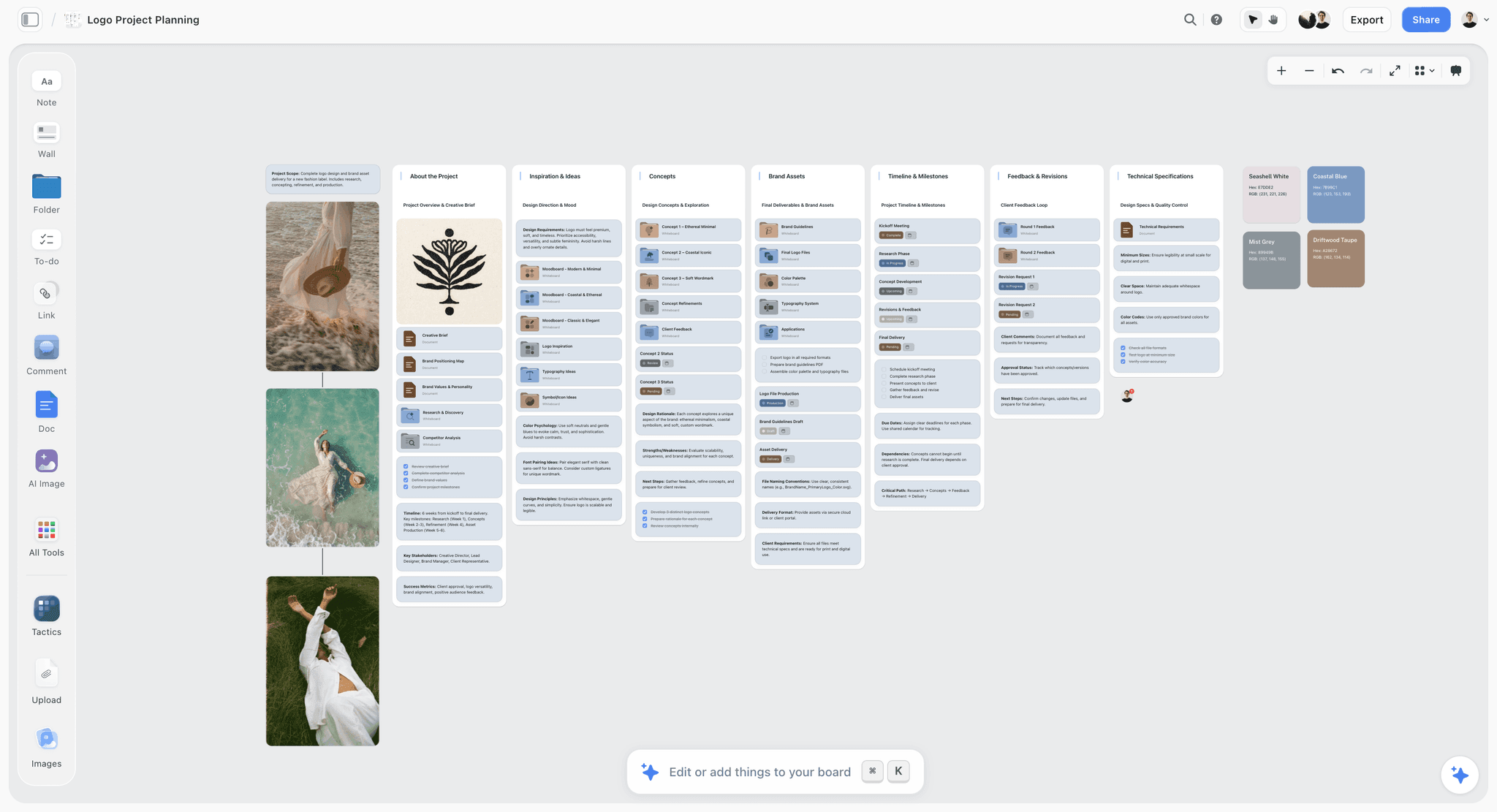
Storyflow is not an SOP tool and documents no process. It is on this list for the layer SOPs deliberately exclude, described in section 8: the per-client and per-project judgment calls that no general procedure can encode. Which approvals this particular client needs, why the usual two-round limit was waived on that project, what was agreed in the kickoff that contradicts the standard process. Those live on a canvas per project rather than in a process library, and the AI reads the whole board so a new team member can ask what was decided and why.
Best for: The project-specific decisions that a general SOP explicitly cannot hold.
Verdict: A complement to a documentation stack, not a member of it. Take Scribe for the processes themselves.
Key features
- Infinite canvas holding per-project decisions, constraints and their reasoning.
- AI reads the whole current board, plus 5 attached documents and 3 attached boards.
- Anyone a paid member invites to a board joins free, including freelancers.
- 200+ story blueprints for briefs and project structures.
Pricing
Early access: every plan is paid for now. A Free plan arrives before the end of 2026, and anyone a paid member invites to a board can sign up free and collaborate today. Plus: $7.99/mo annual, $9.99/mo monthly. Unlimited boards and uploads. Pro: $14/mo annual, $19/mo monthly. AI image generation, more AI usage, memory across conversations. Max: $39/mo annual, $49/mo monthly. Team workspace with roles and permissions.
Pros
- Holds the exceptions a process library cannot generalise.
- Freelancers and clients see a project's decisions without a seat.
- Cheapest tool on this list, priced per account for individuals.
Cons
- No step capture, screenshots, checklists or process templates.
- No assignment, completion tracking or document versioning.
- Paid-only during early access.
10. Confluence
Confluence is the established enterprise knowledge base and the right answer for a large agency already inside Atlassian, with permissions, page history and templates that scale past where lighter tools strain.
Best for: Larger agencies already using Jira and the Atlassian stack.
Verdict: The most scalable home here and the least pleasant to write in. Free to ten users is genuinely useful.
Key features
- Structured spaces with granular permissions.
- Page history and version control.
- Deep Jira integration.
Pricing
Free up to 10 users. Paid from about $6/user/month.
Pros
- Cheapest per-seat option at scale.
- Real permissions and version history.
- Free tier covers a small agency entirely.
Cons
- Authoring experience is dated.
- Large spaces become unnavigable without curation.
- Does not solve creation.
11. SweetProcess
SweetProcess separates procedures, processes and policies deliberately, which is a genuinely useful distinction for an agency that needs both how-to documentation and policy people must acknowledge.
Best for: Agencies needing procedures and policies managed together.
Verdict: A sound, focused tool. Priced per account, which makes it expensive for a small studio.
Key features
- Separate handling of procedures, processes and policies.
- Checklists with assignment and completion.
- Approval workflows for policy acknowledgement.
Pricing
Trial only, then from about $99/month.
Pros
- The procedure and policy distinction is genuinely useful.
- Approvals suit agencies with compliance obligations.
- Clear, focused interface.
Cons
- Account pricing is steep for a small agency.
- Less well known, so fewer integrations.
- Creation remains manual.
12. ClickUp Docs
If an agency already runs on ClickUp, Docs is effectively free and sits next to the work, which is a real advantage: documentation adjacent to tasks gets opened more than documentation in a separate tool.
Best for: Agencies already paying for ClickUp.
Verdict: Good enough and already paid for. Not worth adopting ClickUp to get.
Key features
- Documents linked to tasks and projects.
- Templates and nested pages.
- Tasks created directly from a document.
Pricing
Generous free tier. Paid from about $7/user/month as part of ClickUp.
Pros
- No extra subscription if you are already there.
- Sits beside the work, so it gets opened.
- Tasks spawn from documents directly.
Cons
- Weaker as a standalone knowledge base.
- Search across a large space is mediocre.
- Only sensible if ClickUp is already your platform.
7) Why Agency SOPs Rot Faster Than Other SOPs
A warehouse picking process is stable for years. An agency's process for delivering a campaign is different by the third client. That difference is structural and it explains why documentation efforts that work elsewhere fail here.
Four reasons, in order of damage.
The work is non-identical by nature. Agency delivery is bespoke. A brand campaign for a challenger startup and one for a regulated financial client share perhaps sixty percent of their steps. An SOP written from the first is wrong for the second in ways that matter, and each exception that is not written down teaches people the document is approximate.
The tool stack changes constantly. Agencies adopt tools faster than almost any other kind of business, and screen-based SOPs are tied to interfaces. A guide written when the team used one review tool is wrong the month they switch. This is a strong argument for capture tools specifically: re-recording after a tool change takes two minutes, rewriting takes an hour, so only one of those actually happens.
The people rotate. Freelancers, contractors and high staff turnover mean the person who wrote an SOP frequently is not there to maintain it, and unowned documents decay silently. Guru's verification cycles exist for this, and the cheaper equivalent is putting an owner and a review date at the top of every document.
Client-specific exceptions are invisible. This is the subtlest and it is the reason for section 8. The general process says two rounds of revision. This client negotiated three. That fact lives in an account manager's head, is not in the SOP because it is not general, and when that person is on leave the process is followed correctly and the client is annoyed.
What actually survives, across the three agencies tested:
- Guides captured by the doer while doing, because re-capture is cheap.
- Very short documents. A one-page SOP gets updated; a twelve-page one gets abandoned.
- Documents with a named owner and a visible review date.
- Processes that are executed in a tool rather than read from one, because the execution record shows when reality diverged.
What reliably does not survive: anything written by a manager describing the process as designed, anything over about two pages, and anything without an owner.
8) What Should and Should Not Be an SOP
The most common failure after not writing SOPs at all is writing the wrong things as SOPs.
Should be an SOP. Anything performed the same way repeatedly where correctness matters and judgment does not: setting up a project in the tracker, exporting and naming deliverables, the invoicing run, backup and archive, access requests, publishing a case study. These are the processes where a captured guide is exactly right and where getting it wrong costs real time.
Should be a runnable checklist rather than a document. Anything with steps that must all happen and that has failed before because one was missed: client onboarding, launch day, project close-out and archive. Process Street exists for this, and a document is the wrong shape because it does not record whether the steps happened.
Should be a video rather than a document. Anything where reasoning matters more than sequence: how to give feedback to a designer, how to read a client's reaction in a presentation, why we structure briefs the way we do. Written as steps these become platitudes; narrated, they carry.
Should not be an SOP at all. This is the part agencies get wrong most.
- Judgment calls. "Escalate when the client seems unhappy" is not a procedure, it is a heuristic, and dressing it as a step gives false confidence.
- Client-specific exceptions. The general process cannot hold them, and forcing them in either bloats the SOP or creates a fork per client that nobody maintains.
- Anything that changes more often than quarterly. The documentation cost exceeds the benefit; use a pinned message or a template instead.
- Creative process. How to have a good idea is not documentable, and attempting it produces the worst documents in any agency's library.
The client-specific layer is the one with no natural home, and it is the gap Storyflow occupies on this page. Those facts are real, consequential and not general: this client needs the CFO on approvals, that project agreed three rounds, this brand refuses a particular treatment for a reason from before your time. They belong with the project rather than in a process library, visible to whoever picks the work up, with the reasoning attached. An SOP library is the wrong shape for them and a person's memory is the usual alternative.
9) Recommended SOP Stacks
Stack 1: Agency under ten. Scribe free tier (capture) + Notion free (home) + Loom free (judgment-heavy parts). Zero, and it fixes the actual bottleneck.
Stack 2: Agency of ten to twenty-five. Scribe (capture) + Notion (home) + Loom + Storyflow (project decisions). About $56 a seat plus $8.
Stack 3: Agency past twenty-five, hiring often. Scribe + Trainual (onboarding and accountability) + Notion. About $23 a seat plus roughly $250 a month.
Stack 4: Repeatable delivery. Scribe + Process Street (runnable workflows) + Notion. About $33 a seat plus roughly $100 a month.
Stack 5: Already on Atlassian. Scribe + Confluence. About $29 a seat, and do not migrate the space.
| Agency shape | Captures with | Stores in | Executes in | Monthly cost |
|---|---|---|---|---|
Under ten | Scribe free | Notion free | Nothing yet | $0 |
Ten to twenty-five | Scribe, Loom | Notion | Notion | about $56/seat |
Hiring often | Scribe | Trainual | Trainual | $23/seat plus ~$250 |
Repeatable delivery | Scribe | Notion | Process Street | $33/seat plus ~$100 |
On Atlassian | Scribe | Confluence | Jira | about $29/seat |
The pattern across all five: a capture tool in every single one. The storage layer varies with size and existing stack and matters far less than agencies expect, because storage was never the problem.
10) What Process Documentation Actually Costs
The writing time you will not spend. A written SOP takes forty-five to ninety minutes properly. Twenty processes is roughly twenty to thirty hours of senior time, which is why it never happens. A captured guide takes two to five minutes, which is the entire argument of this page expressed as a number.
The maintenance nobody budgets. Documentation needs review, and in an agency the tool stack and the process both move. Budget an hour a month for a small library, and make the review a named person's job or it will not happen. Capture tools make this cheap; written libraries make it expensive enough to skip.
The cost of not having it, which is the real number and is never itemised: every new hire's ramp time, every question answered twice, every deliverable exported wrong because the naming convention lived in someone's head, and the risk concentrated in whichever person knows how everything works. That last one is the serious one at agency scale.
And the cost of over-documenting, which is genuinely a thing. An agency with two hundred SOPs has a library nobody reads, and a library nobody reads is worse than no library, because it creates the belief that things are documented. Twenty accurate documents beat two hundred approximate ones.
| Cost driver | Where it lands | Rough size | The move |
|---|---|---|---|
Writing time | Senior people, up front | 45 to 90 min per SOP | Capture instead of writing |
Maintenance | Ongoing, needs an owner | About an hour a month | Name the owner; put a review date on every doc |
Not documenting | Ramp time, repeated questions, key-person risk | The largest cost here | Document the twenty that matter |
Over-documenting | A library nobody trusts | Wasted effort plus false confidence | Stop at the processes that repeat |
11) Honorable Mentions
- Whale. Close to Trainual, often cheaper for a small team.
- Document360 and Nuclino. Solid knowledge bases if Notion and Confluence both feel wrong.
- Google Docs. Free, universal, and completely adequate for twenty short SOPs with an owner named at the top.
- Coda. Documents that behave like applications, strong if a process needs light logic.
- Bardeen and Zapier. Sometimes the honest answer to a documented process is to automate it away.
- A pinned Slack message. Correct for anything that changes monthly and should never become a document.
- The SOP template in your project tool. Most agencies can encode a repeatable process as a project template and skip the document entirely.
12) SOP Approaches to Avoid
- Buying a knowledge base to fix a creation problem. You already have somewhere to put documents. You do not have documents.
- SOPs written by a manager who does not perform the process. They describe the process as designed rather than as performed, and the difference is where the failures are.
- Twelve-page procedures. Nobody reads them and nobody updates them. One page or a captured guide.
- Documenting everything. Two hundred approximate SOPs are worse than twenty accurate ones, because they create false confidence.
- A library with no owners and no review dates. Unowned documentation decays silently, which is the worst way for it to decay.
- Forcing client exceptions into a general SOP. It either bloats the document or forks it per client, and neither survives.
14) The Bottom Line
The best SOP tools for agencies in 2026 are the ones that get documentation created. Scribe is the best overall because capturing a process while performing it costs two minutes and writing one up costs an hour, and only one of those actually happens in a busy agency. Trainual is best once SOPs are also onboarding. Process Street is best when a process must run rather than be read. Notion is the best home for all of it.
Creation is the bottleneck, not storage. Almost every agency with an SOP problem already has somewhere to put documentation and nothing in it, and buying a better knowledge base does not change that.
Keep the library short, put an owner and a review date on every document, and keep the client-specific exceptions out of it. Those belong with the project on a board the next person can read, because a general process cannot hold them and somebody's memory is the usual alternative.
FAQ: Agency SOP and Process Tools
What is the best SOP tool for agencies in 2026?
Scribe is the best SOP tool for agencies, because it solves the real bottleneck: it records a process while somebody performs it and produces a step-by-step guide with screenshots automatically, so documentation is created by the person who knows the work in the minutes they were already spending doing it. Trainual is stronger once SOPs are also onboarding, Process Street when a process needs running and ticking rather than reading, and Notion remains the best home once something has created the content. The common mistake is buying a knowledge base to fix a creation problem.
Why do agency SOPs never get written?
Because the person who knows the process is busy performing it and the person with time to write documentation does not know the process. That timing mismatch guarantees documentation is written retrospectively from a half-remembered account, so it is wrong on arrival in small ways, and small inaccuracies teach people not to trust the library. Capture tools fix it by collapsing the gap between doing and documenting to nearly zero.
Is Notion good for SOPs?
Notion is an excellent home for SOPs and does nothing about creating them. It is flexible, cheap, searchable and already adopted, and it embeds Scribe and Loom content well. But writing an SOP in Notion still costs the hour nobody has, which is why most agency Notion workspaces have a Processes section with four documents in it. Pair it with a capture tool.
Is there a free SOP tool for agencies?
Yes, and it is a genuinely complete setup. Scribe's free tier captures a limited number of guides, Notion's free tier or Confluence free up to ten users provides the home, and Loom's free tier covers narrated processes. That combination costs nothing and fixes the creation bottleneck. Storyflow is paid-only during early access and is not an SOP tool in any case.
Scribe or Tango, which is better?
They work the same way and either will fix your creation problem. Scribe has the larger ecosystem, better redaction of sensitive data, which matters when a recorded process crosses client information, and wider embedding support. Tango is slightly cheaper and its live in-app walkthroughs are genuinely good for onboarding. Try both free tiers on a real process before choosing.
What should be documented as an SOP?
Anything performed repeatedly where correctness matters and judgment does not: project setup, export and naming conventions, invoicing, archiving, access requests. Processes with steps that must all happen should be runnable checklists instead. Judgment-heavy work should be a short video. And client-specific exceptions should not be in the SOP library at all, because a general process cannot hold them.
How do I stop SOPs going out of date?
Put an owner and a review date on every document, keep each one to about a page, and prefer captured guides over written ones, because re-recording a changed process takes two minutes while rewriting takes an hour. Tools such as Guru add scheduled verification prompts, which makes decay visible rather than silent. The underlying rule is that the cheaper an update is, the more often it happens.
How many SOPs should an agency have?
Fewer than you think. Twenty accurate, current, one-page documents covering the processes that genuinely repeat beat two hundred approximate ones, which create the belief that things are documented without the benefit. Start with the five processes that break most often or that only one person knows.
What is the difference between an SOP and a workflow?
An SOP is read: a reference describing how something is done. A workflow is run: an instance created per project, with steps ticked off and a record of what happened. Processes that have failed because a step was missed should be workflows, because a document cannot tell you whether it was followed. Process Street is the workflow tool here; Notion and Confluence are the reference homes.
Do small agencies need SOPs?
Under about eight people, only for the handful of processes where one person is the single point of failure. That is the real risk at small scale rather than inefficiency. Document those five, keep them short, and resist building a library until the headcount makes onboarding a recurring job rather than an occasional one.
Where should client-specific exceptions live?
Not in the SOP library. A general process cannot hold per-client rules without either bloating or forking per client, and neither survives contact with reality. Those facts belong with the project, visible to whoever picks the work up, with the reasoning attached, which is the layer described in section 8 and the narrow reason Storyflow appears on this page at all.
Can AI write our SOPs for us?
It can format and tidy documentation you supply and it cannot know how your agency does anything. An AI-written SOP from a prompt describes the generic version of the process, which is precisely the failure mode of a manager writing it: the process as designed rather than as performed. The useful AI application here is transcription and cleanup of a captured or narrated process, which several tools on this list already do.
How much should an agency spend on SOP tools?
Around $30 to $60 per seat per month for a capture tool plus a home, which covers most agencies under twenty-five people. The dedicated platforms, Trainual, Process Street and SweetProcess, price per account in headcount bands starting around $99 to $250 a month and only make sense once onboarding or repeatable delivery is a constant rather than an occasional job.
Table of Contents
- Article Metadata
- Breadcrumb
- Table of Contents
- 1) Quick Answer: The Best SOP Tools for Agencies in 2026
- All 12 SOP and Process Tools, Ranked
- 2) Comparison Table: 12 SOP Tools at a Glance
- Frequently Asked: Which SOP Tools Agencies Trust, and Which Documentation Goes Unread
- 3) Capture at the Moment of Doing
- 4) How We Evaluated These Tools
- 5) Quick Picks by Agency Size
- 6) Detailed Reviews: 12 SOP and Process Tools
- 7) Why Agency SOPs Rot Faster Than Other SOPs
- 8) What Should and Should Not Be an SOP
- 9) Recommended SOP Stacks
- 10) What Process Documentation Actually Costs
- 11) Honorable Mentions
- 12) SOP Approaches to Avoid
- 14) The Bottom Line
- 15) Author
- 16) Related Reading
- FAQ: Agency SOP and Process Tools
Templates to check out for this topic


Marketing and campaign templates you can use in Storyflow
Plan the whole campaign on one board: brief, audience, channels, and assets connected, with an AI that reads all of it. Open a template and start from real structure.


See Storyflow in Action
A visual AI workspace where every feature lives inside one canvas. No tab-switching, no context lost.
Build your entire board from a single message
Type what you need in the AI chat at the bottom of your canvas. The AI adds cards, headings, and structure directly onto your board.
Use expert frameworks as AI context
Type @ in the AI chat and choose any Tactic. The AI tailors every response to that framework instead of giving generic advice.
Turn your board into a mind map in seconds
Ask the AI to restructure your canvas as a mindmap. It connects your ideas into a visual hierarchy so you can see how everything relates.
Why Storyflow Exists
Storyflow actually began as a personal tool while working on creative and research projects.
We kept running into the same problem: ideas were scattered everywhere: notes, documents, and whiteboards.
Nothing helped us see how everything connected.
So we started building a workspace designed around how ideas actually grow.
→ Read how Storyflow was createdStoryflow Team
Product & Research Team
Published: 2026-09-22
Extremely simple, seriously capable


See how easy it is to get started
Watch a real project come together, from a blank board to a finished plan, clicked through step by step.
Start creating with AI and become more productive
Transform your creative workflow with AI-powered tools. Generate ideas, create content, and boost your productivity in minutes instead of hours.