
What Is Narrative Design? The Complete Guide (2026)
Narrative design is the craft of the interactive story: building plot, character, and theme into something the player does, not just watches. What it is, how it differs from game writing and screenwriting, and how to plan a narrative-design doc.

Category
Storytelling
Author

Justkay
Documentary Filmmaker & Founder at Storyflow
Topics
2026-07-15
•
12 min read
•
Storytelling- what is narrative design
- narrative design in games
- narrative designer vs game writer
- interactive storytelling
What is narrative design?
Narrative design is the discipline of building story into something the audience does, not just something they watch. It is the craft of the interactive story: how plot, character, and theme reach people through the choices a player makes, the spaces they move through, and the systems they act inside, mostly in games and other interactive media. A screenwriter writes the story you are told. A narrative designer designs the story you play. That difference (authored versus experienced) is the entire job, and it is why narrative design needs different documents, tools, and thinking than screenwriting or novel writing.
Key Takeaways
- Narrative design is the practice of delivering story through interaction, not just something the audience watches. A screenwriter writes the story you are told; a narrative designer designs the story you play.
- Every decision sits on the Told/Played Line. Some beats are authored and fixed for every player, others are earned through choice and system, and the craft is fusing the two into one story.
- Agency is the medium. A narrative designer's material is the player's capacity to act and have that action matter, the way prose is a novelist's material.
- The four tools are branching and choice, environmental storytelling, systemic and emergent narrative, and player agency. Each is a way of moving a beat along the Told/Played Line.
- A real branch changes the story; a texture branch only changes a line. Filling a game with fake choices makes players feel the hollowness even if they cannot name it.
- The narrative designer is not the game writer or the screenwriter. The writer fills the world with language and the screenwriter authors a fixed sequence; the designer builds the interactive structure both work inside.
- The deliverable is the narrative-design document, the map and rulebook, not the script. A linear document cannot hold a branching story, because the shape is a graph and the shape is the work.
- The hardest failure is ludonarrative dissonance: when the story a game tells and the story its mechanics tell contradict each other, the player feels the seam.
What Narrative Design Actually Is
Let me be straight about where I sit. I am a documentary filmmaker, and I built Storyflow, a visual workspace for planning story. I am not credited on a Naughty Dog title, so writing this guide takes a translation step: I have spent years mapping nonlinear structure for factual and interactive work, and I read narrative designers obsessively, because their central problem (a story the audience acts inside) is the exact problem the tool I built exists to hold. Where the craft runs deeper than my direct experience, I lean on the people who defined it, and I name them.
So here is the definition with the edges filled in. Narrative design is the practice of delivering story through interaction. A traditional writer controls sequence: this scene, then that one, in an order the audience cannot change. A narrative designer gives up some of that control on purpose, because the audience is now a participant, not a spectator. The designer decides which parts stay fixed, which parts respond to the player, and how the two add up to something that still feels authored.
Every narrative-design decision sits somewhere on one line. At one end is the story you are told: authored, fixed, the same for every player. Cutscenes, scripted dialogue, the opening crawl, the letter you find on a desk. At the other end is the story you play: emergent, chosen, different depending on what you do. The route you took, the character you spared, the faction the system turned against you. Call it the Told/Played Line. A film lives entirely at the Told end; a chess match entirely at the Played end. Narrative design is the discipline of working the whole Told/Played Line at once: deciding which beats are authored, which are earned through play, and how to make the two feel like one story rather than two.
Underneath all of it is one principle: in narrative design, agency is the medium. A novelist's medium is prose. A narrative designer's medium is the player's capacity to act and have that action matter. Janet Murray, in her 1997 book Hamlet on the Holodeck, named agency as the central pleasure of interactive story: the satisfying power to take meaningful action and see the world respond. Strip the meaning out of the action and you have a film with a controller attached. Which is why a screenwriter writes the story you are told, and a narrative designer designs the story you play.
Narrative Designer vs Game Writer vs Screenwriter
The titles get used interchangeably, and they should not be. They own different things and hand off different artifacts. The cleanest way to tell them apart is to ask where their work sits on the Told/Played Line.
| Role | What they own | Primary output |
|---|---|---|
Screenwriter | The story the audience is told | A linear screenplay: scenes in order, start to finish |
Game writer | The words inside the world | Dialogue, barks, item and lore text, quest copy, VO scripts |
Narrative designer | Where story and gameplay meet | Branching maps, quest and mission structure, the narrative-design document, systemic rules |
Narrative director | The story vision across the whole team | Narrative pillars, tone, casting and sign-off, cross-department alignment |
A screenwriter works entirely at the Told end: their craft is sequence and scene, deep but assuming an audience that cannot touch the story. A game writer works one layer in, filling the world with language, but the structure they write into already exists. The narrative designer built that structure. They decide where a branch goes, which choices are real, how a quest gates behind a system, and what the space says when nobody is talking. They are the only one of the four whose job is the interaction itself.
The narrative director sits above all of it, holding the vision so a forty-person team tells one story instead of forty. On a small indie project one person is all four; on a large production they are four departments. But the roles do not collapse into each other even when one person wears them, because the work is genuinely different: a screenwriter writes the story you are told, and a narrative designer designs the story you play.
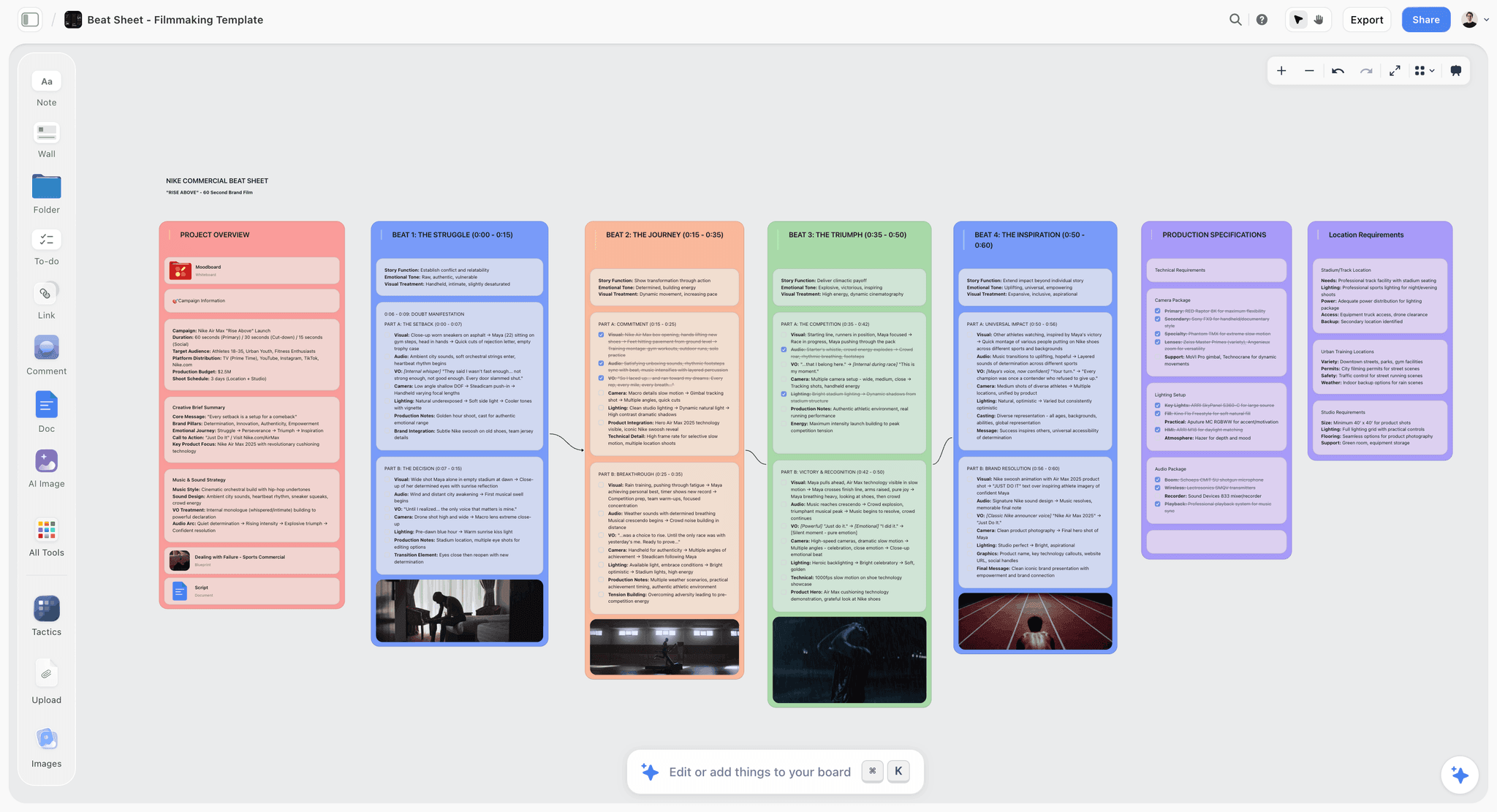
A Storyflow canvas mapping branching narrative, characters, and player choices
The Four Tools Narrative Designers Actually Use
Narrative design is not one technique but a small set of instruments, and a good designer knows which one a moment calls for. All four are ways of moving a beat along the Told/Played Line.
Branching and choice
The most visible tool. A branch is a point where the story forks based on what the player does. inkle's 80 Days branches so widely that most players never see most of the story. Detroit: Become Human literally shows you the branching flowchart at the end of each chapter. Disco Elysium branches on dialogue and internal skill checks. The craft here is not adding choices. It is deciding which are real (they change the story) versus which are texture (they change a line and nothing else). A real branch moves a beat from the Told end of the line to the Played end. Fill a game with fake choices and players feel the hollowness even if they cannot name it.
Environmental storytelling
Story the space tells on its own, with no dialogue required. Don Carson, a former Disney Imagineer, laid this out in a 2000 essay for Gamasutra, arguing games could borrow the theme-park trick of making a place carry narrative. The ransacked apartment, the skeleton still clutching a key, the empty family house in Gone Home, the backstory FromSoftware buries in Dark Souls item descriptions. The player assembles the story by looking, in whatever order they explore. It is Played-end storytelling that needs no branch at all: the meaning is in the world, and moving through it is the interaction.
Systemic and emergent narrative
Story the game's systems generate, that no writer scripted line by line. Henry Jenkins, in his 2004 essay "Game Design as Narrative Architecture," split game story into embedded narrative (authored material a designer plants for players to find) and emergent narrative (stories that arise from systems in play). The disaster that unfolds in RimWorld or Dwarf Fortress, the squadmate you got attached to in a Mass Effect run: none of it was written as a scene. The designer authored the rules and trusted the system to produce the story. This is the far Played end of the line, and the hardest to control.
Player agency
The through-line that holds the other three honest. Agency is not the number of choices on offer. It is whether action feels meaningful, whether the world registers what you did. It collapses the instant the story a game tells and the story its mechanics tell contradict each other. The designer Clint Hocking named that failure "ludonarrative dissonance" in a 2007 essay about BioShock, where the plot preaches selflessness while the mechanics reward harvesting the vulnerable. The Told half and the Played half fight, and the player feels the seam. Keeping the two aligned is the narrative designer's hardest job, and the practical meaning of the idea that agency is the medium.
Why a Linear Document Cannot Hold a Branching Story
Here is the friction that defines the work in practice. The moment a story branches, the document breaks.
A screenplay is a list because a film is a list: one scene after another, no forks. A branching story is a graph: a beat can lead to three others, loop back, gate behind a system, or reconnect two pages later. Try to write that in Google Docs or Word and you end up with scaffolding like "if the player spared the guard, go to section 14," repeated until nobody can read it and nobody can keep it in sync. You cannot look at a page of prose and see the shape of the branches. And in narrative design, the shape is the work.
This is the exact friction Storyflow was built around. It is an AI-powered visual workspace: an infinite canvas where each beat, character, choice, and location is a card you place and connect, beside structured Documents that hold the scripted material. Because the branches are spatial, you can finally see the Told/Played Line: the authored spine down the middle, the played branches forking off it and rejoining. The AI reads your full active canvas board by default, plus up to 1 Tactic (a blueprint) and up to 3 Documents you @-mention, so when you ask it to find the branch that dead-ends or the choice that never pays off, it reasons over your actual map, not a summary you paste in. Storyflow is paid-only during early access, and Plus at $7.99 per month billed annually ($9.99 monthly) unlocks the 200+ Story Blueprints library, frameworks like the Hero's Journey and AIDA, plus more AI usage; a Free plan (unlimited boards, basic AI) launches before the end of 2026.
Be clear about what a canvas is not. Storyflow is not a game engine: it plans the narrative, it does not run it (Unity, Unreal, or Godot implement). It is not Twine, Ink, or Yarn either: it maps the branch, but it does not compile playable branching logic your engine can execute, so you still script the real choices in one of those. It is cloud-only, with no offline or local-first mode, which rules it out for airgapped or strict-NDA pipelines. And it is a newer, canvas-card-shaped tool, so if your final deliverable is a sixty-page formatted spec, a document editor holds that shape better than cards do. The canvas is where you think the branching story through. It is not where you ship it.
How to Plan a Narrative-Design Document (with AI)
The deliverable narrative designers hand over is the narrative-design document, or NDD. It is not a script; it is the map and the rulebook: the spine, the branches, the systems, and the logic connecting them. Here is a sequence that works, whether you build it on a canvas, in a wiki, or on index cards on a wall.
- Start with the premise and the pillars. Write the one-line premise, then three to five narrative pillars: the non-negotiables every scene and system must serve. Pillars are how you say no later.
- Lay the authored spine. Place the beats that happen no matter what the player does: the opening, the major turns, the endings. This is your Told backbone, the fixed half of the line.
- Fork the branches. At each point where the player acts, add the branches, and label each one real (it changes the story) or texture (it changes a line). Be ruthless. A few real branches beat a hundred fake ones.
- Plant the environmental beats. For each location, note what the space says without dialogue: what a room, a corpse, or an item reveals to an attentive player.
- Write the systemic rules. Where the system generates story, author the rules rather than the lines: reputation, morality, faction response.
- Pressure-test agency. Walk every branch. Find the choice that never pays off and the moment where the Told and the Played halves contradict each other. That contradiction is ludonarrative dissonance in miniature. Cut it or fix it.
This is where AI earns its place, and where it does not. AI is genuinely good at generating branch variations you had not considered, drafting barks and lore text in bulk, and pressure-testing a map you can point it at ("which of these choices never change the outcome?"). It is bad at the one thing that matters most: knowing which choices should matter. That judgment is yours. The judgment is yours. The generation is the AI's. On a canvas the AI can read, this loop runs fast: you map the Told/Played Line, the AI critiques the branches, you re-route, and the document tightens with every pass.
Which Tools Should You Use?
There is no single narrative-design tool, because the discipline spans planning, scripting, and implementation. Match the tool to the stage.
- To think the branching story through and keep a team aligned: a visual canvas. Storyflow if you want the canvas to be AI-aware and sit next to your story Documents. Milanote if you want boards without the canvas-aware AI. articy:draft for a large production needing database-grade flow management.
- To script and prototype playable branches: Twine (free and open source), Ink from inkle, or Yarn Spinner if you are in Unity. These compile logic a build can run.
- To implement the finished game: Unity, Unreal Engine, or Godot.
- To write the linear cutscene scripts: a screenwriting app like Final Draft or WriterDuet, or a plain document editor.
And the honest counter-recommendation. If you need one tool that both maps and compiles the branches, do not use a planning canvas: use Twine or articy:draft, built for exactly that. And if you are writing a purely linear story, a film or a novel with no interaction, you do not need narrative-design tooling at all. You need a screenwriting app and a good outline. Narrative design is the tax you pay for interactivity. Do not pay it if your story is not interactive.
The Bottom Line
Narrative design is what storytelling becomes when the audience can act. It is the discipline of the Told/Played Line: deciding which beats are authored and fixed, which are earned through choice and system, and how to fuse the two into one coherent story that still feels like someone meant it. The screenwriter's craft of sequence still matters, but it is only half the job now. The other half belongs to the player.
If you take one idea from this guide, take the framework: work the whole Told/Played Line on purpose, keep agency meaningful, and never let the story your game tells fight the story its mechanics tell. Everything else (branching, environmental storytelling, systemic narrative) is an instrument in service of that. A screenwriter writes the story you are told. A narrative designer designs the story you play.
If your next project branches, do not try to hold it in a linear document. Drop the authored spine and the first fork onto a canvas, and see the shape before you write a word of dialogue. Map a branching narrative on a Storyflow canvas.
FAQ: Narrative Design
What is narrative design in games?
Narrative design in games is the craft of delivering story through play rather than through fixed scenes. The narrative designer decides how plot, character, and theme reach the player through choices, spaces, and systems, then structures the branches, quests, and rules that make it work. It is the bridge between the writing and the gameplay, which is why it is a distinct role from either.
What is the difference between a narrative designer and a game writer?
A game writer owns the words inside the game: dialogue, barks, item text, lore, and VO scripts. A narrative designer owns the structure those words live in: the branches, the quest flow, the systemic rules, and the narrative-design document. The writer fills the world with language; the designer built the world's shape. On small teams one person does both, but the jobs are genuinely different.
What is the difference between narrative design and screenwriting?
Screenwriting produces a linear script: scenes in a fixed order the audience cannot change. Narrative design produces an interactive structure: a story the player acts inside, where choices and systems change what happens. One authors a fixed sequence; the other designs a system the player moves through. Screenwriting is a real and deep part of many games, but it covers only the authored, fixed half of an interactive story.
What does a narrative designer do day to day?
A narrative designer maps branching structure, writes and maintains the narrative-design document, designs quests and missions, and defines the rules for systemic and environmental storytelling. In practice that means diagramming branches, pressure-testing choices for real consequence, and working with level, systems, and writing teams so the story and the gameplay say the same thing.
What is a narrative-design document?
A narrative-design document (NDD) is the master plan for an interactive story. It holds the premise and narrative pillars, the authored spine of fixed beats, the branch map of player choices, the environmental notes per location, and the systemic rules. It is not the script. It is the map and rulebook the teams build against, and it is usually visual, because branching structure cannot be read as linear prose.
What skills do you need to become a narrative designer?
You need story fundamentals (character, theme, structure) plus a real understanding of game systems and player psychology. The rare part is the second half: knowing how a mechanic communicates, why a choice feels meaningful or hollow, and how to keep the story and the systems from contradicting each other. Writing skill alone makes a game writer; writing skill plus systems thinking makes a narrative designer.
What is environmental storytelling?
Environmental storytelling is narrative told by a space itself, with no dialogue required. A ransacked room, a skeleton holding a key, or an item description hinting at a lost war lets the player assemble the story by looking. Don Carson, a former Disney Imagineer, formalized the idea for games in a 2000 Gamasutra essay, drawing on how theme parks make physical places carry a story.
What is the difference between embedded and emergent narrative?
Embedded narrative is authored content a designer plants for the player to find, like a scripted scene or a diary. Emergent narrative is story that arises from game systems interacting during play, which no writer scripted line by line. Henry Jenkins drew this distinction in his 2004 essay "Game Design as Narrative Architecture." Most games mix an authored spine with room for the systems to generate stories of their own.
What is ludonarrative dissonance?
Ludonarrative dissonance is the clash when a game's story and its mechanics tell opposite things. Clint Hocking coined the term in a 2007 essay about BioShock, whose plot argues for selflessness while its mechanics reward exploiting the vulnerable. It is the failure state of player agency: when the Told and Played halves contradict each other, the player feels the seam and the story loses its grip.
Do you need to code to be a narrative designer?
No, most narrative designers do not write engine code, but the strongest ones are fluent in scripting and branching tools. Twine, Ink, and Yarn Spinner let you build and test playable branches without traditional programming, and fluency in them makes you far more useful on a team. You do need to understand how your branches and systems get implemented.
Table of Contents
- Key Takeaways
- What Narrative Design Actually Is
- Narrative Designer vs Game Writer vs Screenwriter
- The Four Tools Narrative Designers Actually Use
- Why a Linear Document Cannot Hold a Branching Story
- How to Plan a Narrative-Design Document (with AI)
- Which Tools Should You Use?
- The Bottom Line
- Author
- FAQ: Narrative Design
- Related Reading
Templates to check out for this topic


Templates you can use in Storyflow
Every Storyflow board starts from real structure and an AI that reads the whole canvas. Open one of these templates and make it yours.


See Storyflow in Action
A visual AI workspace where every feature lives inside one canvas. No tab-switching, no context lost.
Build your entire board from a single message
Type what you need in the AI chat at the bottom of your canvas. The AI adds cards, headings, and structure directly onto your board.
Use expert frameworks as AI context
Type @ in the AI chat and choose any Tactic. The AI tailors every response to that framework instead of giving generic advice.
Turn your board into a mind map in seconds
Ask the AI to restructure your canvas as a mindmap. It connects your ideas into a visual hierarchy so you can see how everything relates.
Why Storyflow Exists
Storyflow actually began as a personal tool while working on creative and research projects.
We kept running into the same problem: ideas were scattered everywhere: notes, documents, and whiteboards.
Nothing helped us see how everything connected.
So we started building a workspace designed around how ideas actually grow.
→ Read how Storyflow was createdJustkay
Documentary Filmmaker & Founder at Storyflow
Published: 2026-07-15
Extremely simple, seriously capable


See how easy it is to get started
Watch a real project come together, from a blank board to a finished plan, clicked through step by step.
Start creating with AI and become more productive
Transform your creative workflow with AI-powered tools. Generate ideas, create content, and boost your productivity in minutes instead of hours.