
What Is a Production Bible? The Complete Guide (2026)
A production bible is the single reference document that keeps a series consistent: its world, characters, tone, look, and rules. Learn what goes inside one, who uses it, and how it differs from a pitch bible and a story bible.

Category
Filmmaking
Author

Justkay
Documentary Filmmaker & Founder at Storyflow
Topics
2026-07-15
•
12 min read
•
Filmmaking- what is a production bible
- show bible
- series bible
- story bible vs pitch bible
What is a production bible?
A production bible is the single reference document for a series: it defines the world, characters, tone, visual look, and rules so everyone making the show stays consistent across episodes and seasons. It is also called a show bible, a series bible, or a story bible, and the same artifact runs through scripted TV, animation, documentary and docuseries, podcasts, games, and brand or YouTube content series. The job is easy to state and hard to do: keep a story coherent when a whole team builds it over a long time. That is why the guiding principle behind every good bible is that continuity is a system, not a memory. A pitch bible sells a show to buyers. A production bible governs how it actually gets made. This guide covers what a production bible is, who uses one, exactly what goes inside it, how it differs from a pitch bible and a story bible, and how to build one that stays alive instead of dying in a drawer.
Key Takeaways
- A production bible is the single reference document for a series that defines its world, characters, tone, visual look, and rules. It keeps everyone making the show consistent across episodes and seasons.
- It is not a summary, it is the operating manual. A summary tells you what happens; the bible tells you what is allowed to happen, and why, so anyone who joins can make a decision the creator would have made.
- If it isn't in the bible, it isn't canon. That line turns the bible from documentation into governance, the single source of truth a production defers to.
- Continuity is a system, not a memory. You write a bible because a series is made by a rotating team over a long timeline, and human memory does not scale.
- A working bible covers seven areas: premise and logline, series overview and tone, characters, world and setting, episode structure and format, a visual and tone guide, and a canon and continuity log.
- A pitch bible sells the show to buyers; a production bible governs how it gets made. The pitch bible is short and designed to open a door, while the production bible is a living reference built to survive what happens after.
- The most common mistake is letting the bible rot. An out-of-date bible actively misleads because people trust it, so a lighter document you update beats a thorough one you abandon.
What a Production Bible Actually Is
Picture the third writer to join a show. They were not in the room when the creator decided the protagonist never lies, that the city has no cars, or that every episode has to end on a small defeat before the win. Nobody wrote it down. So the new writer breaks one of those rules in episode seven, a script editor catches it in week nine, and two days of rewrites disappear. Multiply that across a writers' room, a design team, an edit suite, and two seasons, and you have the exact problem a production bible exists to solve.
A production bible is not a summary of the show. It is the operating manual for it. A summary tells you what happens. An operating manual tells you what is allowed to happen, and why, so that anyone who joins the project can make a decision the creator would have made without having to ask the creator. The bible is the single source of truth for the series. When a question comes up about the world, a character, the format, or the look, the answer is not in someone's head or buried in an old email thread. It is in the bible. If it isn't in the bible, it isn't canon.
That single line does more work than it looks like. It turns the bible from documentation into governance. It means the document is not a nice-to-have you write once to feel organized. It is the reference the whole production defers to. And it reframes the reason the bible exists in the first place. You do not write a bible because you might forget your own show. You write it because a series is made by a rotating team across a long timeline, and human memory does not scale. Continuity is a system, not a memory. The bible is that system.
I say this as a documentary filmmaker who builds and maintains bibles for real projects. On a docuseries the bible holds the subject dossiers, the throughline the whole series is arguing, the visual approach, and the episode springboards that keep the story coherent when the edit runs for months and the footage outlives everyone's memory of why a scene mattered. The discipline is the same whether the series is scripted, animated, or cut from 200 hours of interviews. The bible is where the show remembers itself.
Who Uses a Production Bible
The format changes by medium. The purpose does not. Anywhere a story is told in installments by more than one person, continuity is a system, not a memory, and the bible is where that system lives.
Scripted television. This is the origin of the term. A drama or comedy running a writers' room needs every writer working from the same world, the same character voices, and the same episode format. When Gene Roddenberry handed writers the Star Trek Guide in 1967, he was not being precious about his universe. He was solving a scale problem: a rotating set of freelance writers had to produce episodes that felt like the same show. The guide told them what the Enterprise was, how the characters spoke, and what stories the show would and would not tell. Decades later, J. Michael Straczynski planned Babylon 5 as a novel for television, mapping a multi-season arc in advance so a payoff planted in an early season could land seasons later. That kind of long-range plan only survives if it is written down and shared, not carried in one person's head.
Animation. Animation leans on the bible harder than almost any medium because nothing is captured from reality. Every prop, palette, and proportion is a decision someone has to be able to repeat. Model sheets fix how a character is drawn from every angle, style guides fix the color and line language, and world rules fix what is physically possible. A studio farming episodes out to different animation houses needs that consistency written down or the show visibly drifts.
Documentary and docuseries. A docuseries bible is a planning artifact, not a selling one. It holds who the subjects are, what the series is really about underneath the events, the visual and sonic approach, and the arc each episode carries. Because documentary is discovered in the edit, the bible is what stops a six-month cut from losing the throughline it started with.
Brand, podcast, and creator series. A YouTube channel with a recurring format, a branded content series, or a scripted podcast all face the TV problem at smaller scale. The moment a second person writes, edits, or produces an episode, the show needs a shared definition of tone, structure, and what counts as on-brand. Most creators call it a style guide or a channel bible, but it is the same document doing the same job.
Games and transmedia. A world bible for a game or a franchise governs canon across products that ship years apart and are built by teams who never meet. The stakes are highest here because a contradiction is not one bad episode. It is a break in a universe fans track obsessively.
What Goes Inside a Production Bible
There is no single certified template, and any bible that tries to include everything becomes the thing nobody opens. A working bible covers seven areas, ordered from the idea down to the rules that protect it:
- Premise and logline. The one-sentence hook and the short paragraph under it. What the series is, who it follows, and the engine that generates episodes. If you cannot state this cleanly, nothing downstream will hold.
- Series overview, tone, and genre. The feel of the show. Comparable titles, what it is emotionally, and the promise you make to the audience every episode.
- Characters. The people. Their wants, flaws, relationships, voice, and arcs. In animation this extends to model sheets; in documentary, to subject dossiers. This is usually the longest section because character is where continuity breaks first.
- World and setting. The rules of the place. Geography, time period, social logic, and in genre work the hard limits of what is possible. The world section is where you write down the constraints that keep the show honest.
- Episode structure and format. How an episode is built. Runtime, act breaks, A-story and B-story logic, cold opens, and the recurring shape a returning audience learns to expect.
- Visual and tone guide. The look. Palette, references, framing language, and a moodboard. This is the section prose is worst at and images are best at, which matters when you choose where the bible lives.
- Canon and continuity notes. The rules and the running record. What is settled, what changed, and what must never contradict. This section is the immune system of the series.
Notice the shape. The first two areas are the pitch. The middle four are the production. The last one is the maintenance. If it isn't in the bible, it isn't canon, so the continuity section is not an appendix. It is the reason the other six survive contact with a real production.
Production Bible vs Pitch Bible vs Story Bible
The terms get used interchangeably, and that costs people real time and occasionally a deal. Here is the honest distinction, because a document's job is defined by its reader.
A pitch bible is not a smaller production bible. It is a different document with a different reader. The pitch bible's reader is a buyer, so its job is to sell: it is short, heavily designed, and built to make an executive say yes. The story bible and production bible share a reader, the people making the show, so their job is to govern: they are longer, plainer, and built to be referenced daily rather than read once. In everyday industry use, show bible, series bible, and production bible point at the same governing document, with production bible emphasizing the version kept current through the shoot and edit.
| Bible type | Also called | Its job | Who reads it | Made when | Typical form |
|---|---|---|---|---|---|
Pitch bible | Series pitch bible, sizzle bible | Sell the show and secure a greenlight | Buyers, networks, investors | Before greenlight | 10 to 30 pages, heavily designed |
Story bible | Series bible, show bible | Define the canon of world and characters | The creative team and writers' room | Before or after greenlight | Living document, grows over time |
Production bible | Show bible, format bible | Keep the show consistent as it is made | Writers, directors, animators, editors | During and after production | Living reference, updated per episode |
World bible | Franchise bible, canon bible | Govern a universe across many products | All teams on the franchise | Across the franchise lifetime | Large, versioned, source of truth |
The practical rule: build the pitch bible to open a door, and build the production bible to survive what happens after the door opens. The pitch bible can be beautiful and static because it does one job once. The production bible has to stay current, because a bible that describes the show you meant to make instead of the show you are actually making is worse than no bible at all. It gives false confidence. Continuity is a system, not a memory, and a system that is out of date is just a confident lie.
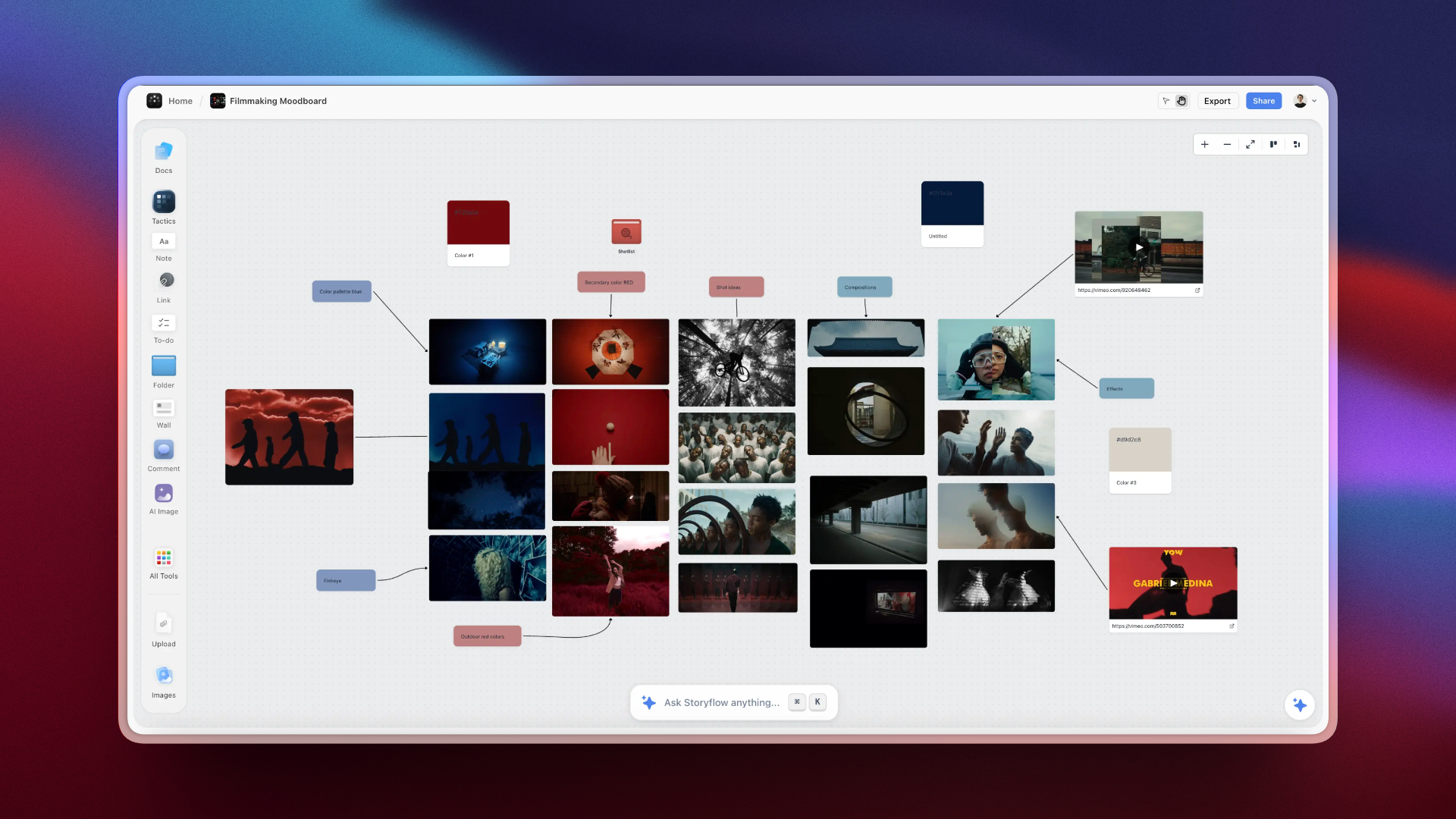
a Storyflow canvas holding a series bible: world, characters, episodes, tone, and visual references
Keep your bible's world, characters, and episodes linked in one place
A bible buried in a 40-page file goes stale because nobody opens page 38 mid-shoot. The AI story bible generator drafts your premise, characters, world, and episode springboards as linked canvas cards, so continuity stays a system instead of a memory.

How to Build a Production Bible (With AI Keeping Continuity)
You do not write a bible in one sitting, and you should not try. Build it in the order the show reveals itself, and treat it as a living reference from day one.
Start with the premise and lock the engine. Write the logline and the paragraph under it. Name the repeatable engine that makes episode after episode. If the engine is fuzzy, fix that before you write a single character.
Draft characters before world. Wants, flaws, relationships, and voice, one card per character. Character contradictions are the most common continuity break, so this is where the most detail earns its keep. You can start an arc from a proven shape like the Hero's Journey and then bend it to the character rather than starting from a blank page.
Write the world as constraints, not trivia. Nobody needs the currency's exchange rate. They need the three rules that, if broken, make the show stop being itself. Write those down and nothing else until a script forces a new one.
Fix the format and the look. Lock the episode structure so writers build to the same shape, and assemble the visual guide as references and a moodboard rather than adjectives. The look section is where a wall of prose fails and a wall of images works.
Open the continuity log and never close it. Every time canon changes, write it down the same day. This is the discipline the whole bible depends on. If it isn't in the bible, it isn't canon, so a change that lives only in the room does not exist by next season.
Here is where the medium of your bible starts to matter. The familiar approach is a single long document, a 40-page file where the world lives on page nine, the characters on page twenty, and the continuity log on page thirty-eight. It works until it does not, which is the moment someone needs to check a rule mid-shoot and nobody opens page thirty-eight. The document is linear. A series is a web. The world affects the characters, the characters drive the structure, the structure sets the look, and a change in any one ripples through the others. A linear file cannot show a ripple. It can only bury it.
This is the friction a canvas addresses, and it is where Storyflow earns a place in this guide. On a Storyflow canvas the bible is a set of linked, visual cards instead of buried paragraphs: the world, the characters, the episode springboards, and the moodboard sit next to each other on one infinite board, with notes, images, and links as first-class objects rather than attachments. Because the pieces are spatial, the ripple is visible. You can see that a character card connects to three episode cards and a world rule, so when the rule changes you can see what it touches. The canvas-aware AI reads your full active board by default, plus up to 1 Tactic and up to 3 Documents you @-mention, so you can ask it to check whether a new episode springboard contradicts anything already on the board, and it reasons over the actual bible rather than a pasted summary. That is continuity as a system, not a memory, made literal: the AI is reading the source of truth, not your recollection of it.
Storyflow is paid-only during early access, with a Free plan (unlimited shared boards and basic AI) launching before the end of 2026. Plus adds the 200+ Story blueprints (Hero's Journey, AIDA, Retention Hooks among them) and more AI usage at $7.99/month billed annually ($9.99 monthly). Pro is $14/month annual, and the Max plan at $39/month annual adds a team workspace with roles and permissions for a full writers' room.
The Honest Limits of a Bible (and of a Canvas One)
A bible is a tool, and every tool has a wrong use. Three limits are worth naming before you commit.
First, a bible can rot. An out-of-date bible is not neutral. It actively misleads, because people trust it. If you are not going to keep the continuity log current, a lighter document you actually update beats a thorough one you abandon. The bible only works if continuity is a system, not a memory, and a system nobody maintains is neither.
Second, a bible can over-document. A 60-page world bible for a six-episode limited series is procrastination wearing a productivity costume. Write the rules a script has actually forced you to decide. Everything else is world-building you are doing to avoid writing.
Third, no bible replaces the room. A document cannot make a taste call or feel when a rule should bend for a great scene. The bible records decisions. It does not make them.
Storyflow specifically has real limits for this job, and naming them is only fair. It is cloud-only, with no offline or local-first mode, so a writers' room in a locked environment or a shoot with no connectivity needs an export or a different tool. It is not a dedicated screenwriting or production-management suite: your script still lives in Final Draft, and your schedule and breakdowns still live in something like StudioBinder or Movie Magic, so the canvas holds the bible, not the whole pipeline. And it is canvas-card-shaped, not document-shaped, so when a network or a legal team wants a formatted, paginated PDF bible for distribution or registration, you will export to a designed document rather than hand over a board. Storyflow is where you build and maintain the bible. It is not always the format you deliver it in.
Which Bible Should You Build First?
The right first document depends on where you are, not on which one is most complete.
If you are trying to sell the show, build the pitch bible first. It is the door-opener. Keep it short, make it beautiful, and do not confuse it with the production reference. Tools like a film pitch deck or lookbook are built for exactly this.
If you are staffing a room or starting production, build the production bible first. The show is real now, so continuity is the priority. Start with premise, characters, and the continuity log, and let the rest grow.
If you are a solo creator or a small team, build a living story bible on a canvas. You do not need the formal pitch document, and a rigid template will slow you down. You need one place where world, characters, and episodes stay linked and current.
If you are running a documentary or docuseries, build the bible around the throughline. Subjects, the argument underneath the events, and the visual approach come first, because in documentary the structure is discovered and the throughline is the thing you protect.
The Bottom Line
A production bible is the single source of truth for a series, the document that keeps the world, characters, tone, look, and rules consistent when a large team builds a story over a long time. Call it a show bible, a series bible, or a story bible; the distinction that matters is not the name but the reader. A pitch bible sells the show to a buyer. A production bible governs how it gets made. Get that difference right and you stop wasting a beautiful pitch document as a broken production reference.
Build the pitch bible to open the door. Build the production bible to survive what comes after. And whichever you build, hold onto the one rule that outlives every format decision: continuity is a system, not a memory. If it isn't in the bible, it isn't canon.
If your show is more web than list, and most series are, take your most developed project and rebuild its bible on a canvas for one week. Put the world, the characters, the episode springboards, and the moodboard on one board, link them, and let the AI read across all of it. By the end you will know whether your bible belongs in a linear document or on a surface that shows the ripples. Start a series bible on a Storyflow canvas.
FAQ: Production Bibles
What is a production bible?
A production bible is the single reference document for a series that defines its world, characters, tone, visual look, and rules so everyone making the show stays consistent across episodes and seasons. It is also called a show bible, a series bible, or a story bible. Its purpose is to act as the source of truth a production defers to, so that anyone joining the project can make decisions the creator would have made without asking.
What is the difference between a show bible and a pitch bible?
A pitch bible sells the show and a production bible governs how it gets made. The pitch bible is short, heavily designed, and written for buyers to secure a greenlight. The production bible, also called a show bible or series bible, is a longer living document written for the creative team to reference daily. They have different readers, so they do different jobs, and using one as the other is a common and costly mistake.
What should a production bible include?
A working production bible covers seven areas: premise and logline, series overview and tone, characters, world and setting, episode structure and format, a visual and tone guide, and a canon and continuity log. The character and continuity sections usually carry the most weight, because character contradictions are the most common continuity break and the continuity log is what keeps every other section accurate over time.
How long is a production bible?
There is no fixed length, because it depends on the type. A pitch bible typically runs 10 to 30 pages and is designed to be read once. A story or production bible is a living document that grows with the series and has no target page count, since its value is accuracy and currency rather than length. A short limited series needs a short bible; a long-running franchise accumulates a large one.
Is a story bible the same as a series bible?
In everyday industry use, story bible, series bible, and show bible all point at the same governing document that defines the canon of the world and characters for the people making the show. Production bible usually emphasizes the version kept current through the shoot and edit. The one term that reliably means something different is pitch bible, which is a selling document for buyers rather than a reference for the team.
Do documentaries use a production bible?
Yes. A documentary or docuseries bible holds the subject dossiers, the throughline the series is really arguing, the visual and sonic approach, and the arc each episode carries. Because documentary is discovered in the edit rather than scripted in advance, the bible is often what stops a long cut from losing the throughline it started with. It is a planning and continuity artifact, not a selling one.
Who writes the production bible?
On scripted television the showrunner or series creator owns the bible, often with the writers' room contributing and a script coordinator maintaining the continuity log. In animation, the creator works with art directors on model sheets and style guides. On a documentary, the director and producer build it. For a creator or brand series, whoever owns the format writes and maintains it. Ownership matters because a bible with no owner stops being updated.
How do you keep a production bible from going out of date?
Treat continuity as a system, not a memory: log every canon change the same day it happens, and give one person clear ownership of the document. The most reliable setup keeps the bible linked and visual so a change in one place shows what it touches, rather than buried in a long file where the continuity section is on a page nobody opens. An out-of-date bible is worse than none, because people trust it.
Can AI help build and maintain a production bible?
Yes. AI can draft character profiles, outline episode structure, and check a new episode idea against established canon. The pattern that works is using AI to surface contradictions and possibilities, then applying human judgment. Storyflow's canvas-aware AI reads your full active board plus any Tactic or Documents you @-mention, so it can check continuity against the actual bible on the canvas rather than a summary you paste into a chat window.
Can I build a series bible in Storyflow?
Yes. Storyflow's infinite canvas holds the world, characters, episode springboards, and moodboard as linked visual cards, with a canvas-aware AI that reads the board to help check continuity. It is strong for building and maintaining a living bible. It is not a dedicated screenwriting or production-management suite, and it is cloud-only, so a formatted PDF for distribution or a locked offline environment means exporting or using a different tool for that step.
What is the difference between a production bible and a treatment?
A treatment describes one film, episode, or documentary in prose and argues that it should exist. A production bible governs a whole series and keeps it consistent across many episodes. The treatment is a single narrative document; the bible is a reference and a rulebook. On a series you often write treatments for individual episodes that all draw on the same bible.
Can you copyright or register a production bible?
You can register a series bible with the Writers Guild of America Registry, which accepts treatments, outlines, and formats, to time-stamp your authorship. Registration is not the same as copyright. In the United States, copyright exists automatically the moment the work is fixed in a tangible form, so your written bible is protected as an expression as soon as you write it. What copyright does not protect is the underlying idea, only your specific expression of it, which is one practical reason to write the bible down in detail.
Table of Contents
- Key Takeaways
- What a Production Bible Actually Is
- Who Uses a Production Bible
- What Goes Inside a Production Bible
- Production Bible vs Pitch Bible vs Story Bible
- How to Build a Production Bible (With AI Keeping Continuity)
- The Honest Limits of a Bible (and of a Canvas One)
- Which Bible Should You Build First?
- The Bottom Line
- Author
- FAQ: Production Bibles
- Related Reading
Templates to check out for this topic


Templates you can use in Storyflow
Every Storyflow board starts from real structure and an AI that reads the whole canvas. Open one of these templates and make it yours.


See Storyflow in Action
A visual AI workspace where every feature lives inside one canvas. No tab-switching, no context lost.
Build your entire board from a single message
Type what you need in the AI chat at the bottom of your canvas. The AI adds cards, headings, and structure directly onto your board.
Use expert frameworks as AI context
Type @ in the AI chat and choose any Tactic. The AI tailors every response to that framework instead of giving generic advice.
Turn your board into a mind map in seconds
Ask the AI to restructure your canvas as a mindmap. It connects your ideas into a visual hierarchy so you can see how everything relates.
Why Storyflow Exists
Storyflow actually began as a personal tool while working on creative and research projects.
We kept running into the same problem: ideas were scattered everywhere: notes, documents, and whiteboards.
Nothing helped us see how everything connected.
So we started building a workspace designed around how ideas actually grow.
→ Read how Storyflow was createdJustkay
Documentary Filmmaker & Founder at Storyflow
Published: 2026-07-15
Extremely simple, seriously capable


See how easy it is to get started
Watch a real project come together, from a blank board to a finished plan, clicked through step by step.
Start creating with AI and become more productive
Transform your creative workflow with AI-powered tools. Generate ideas, create content, and boost your productivity in minutes instead of hours.