How to Plan a Video With a Client in the Room
Planning a video with the client present works when you build the plan visibly in front of them rather than presenting one you made earlier, because a plan a client watched being assembled is a plan they co-own and will not send notes on.

Category
Video Production
Author

Justkay
Documentary Filmmaker & Founder at Storyflow
Topics
2026-08-29
•
12 min read
•
Video Production- how to plan a video with a client in the room
- client work
- video production
- planning sessions
- agencies
- collaboration
- Storyflow
How do you plan a video with the client in the room?
Planning a video with the client present works when you build the plan visibly in front of them rather than presenting one you made earlier, because a plan a client watched being assembled is a plan they co-own and will not send notes on. The session has a fixed shape: agree the one thing the video must achieve, agree what is fixed, build the structure live in blocks, and leave with a written decision on scope. What kills these sessions is arriving with a finished plan and calling it a workshop, which the client correctly reads as a presentation and responds to with feedback. Storyflow is what I use because the canvas keeps up with a live conversation and everything stays visible, so the client watches the plan take shape instead of watching someone type into a document.
Key Takeaways
- Build live, do not present. A plan assembled in front of the client is a plan they own.
- Agree the single objective before any structure. Sessions fail on unstated disagreement about what the video is for.
- Establish what is fixed early, especially budget band and deadline, or you will design something impossible.
- Work in blocks, not shots. Structure is the right altitude for a client conversation.
- Write the scope decision in the room, before anyone leaves.
- Have someone other than the facilitator drive the canvas. Facilitating and typing at once does both badly.
Build it in front of them
A plan presented after the fact invites a round of notes. A plan built in the room turns the client into a participant, and Storyflow is fast enough on the canvas to keep up with a live conversation.

Why a Presented Plan Invites Notes
The instinct is to prepare thoroughly and bring a plan. It backfires for a structural reason.
A finished artifact asks for a verdict. When you present a completed plan, the only role available to the client is critic, so they criticise. This is not obstruction; it is the role the format handed them.
A plan built in front of them offers a different role. They become a participant, and people do not send notes on things they helped make. The same client who would have returned two pages of comments on a document will spend ninety minutes building something with you and approve it at the end.
The second reason is speed of correction. In a live session a misunderstanding is caught in thirty seconds. In the present-then-notes cycle, the same misunderstanding costs a week: you build on it, present, they flag it, you rework.
The trap is the fake workshop. Arriving with a prepared plan and asking for input on it. Clients see through this immediately, and it is worse than an honest presentation because it wastes their time and yours while pretending to be collaborative.
A useful diagnostic: if you could send the artifact instead of holding the meeting, you are presenting, not planning.
Prepare Structure, Not Content
You should still prepare. Prepare the frame, not the answers.
Set up the canvas with empty regions labelled for what the session will produce: objective, audience, constraints, structure, look, next steps. Empty regions do most of the facilitation for you, because a visible gap is an invitation.
Prepare three or four examples of formats or approaches that might fit. Not proposals: reference points, to give the conversation vocabulary. Clients often cannot describe what they want and can reliably point at something and say more like that.
Write your own questions in advance. The ones you need answered to make the video: who is this for, what do they currently believe, what do we want them to do, where will it play, what has been tried before. Having them written means you get through them even when the conversation wanders.
Know your constraints. What you can deliver in the time and money likely available. You will need this in the room, and looking it up mid-session cedes control of the conversation.
The Session
Ninety minutes to two hours. Longer and the client's attention degrades and decisions get made badly at the end.
The one thing (15 minutes)
Agree, in one sentence, what the video must achieve. Write it at the top and leave it there.
Push for specificity. "Raise awareness" is not an objective. "Get finance directors at mid-size firms to believe this is not a six-month implementation" is.
This is where the session earns most of its value, because it is common for two people on the client side to want different things and to have never said so out loud. Surfacing that in minute ten saves the project. Discovering it at the first cut costs a reshoot.
If the room cannot agree the objective, stop. Do not proceed to structure. An unresolved objective produces a video that fails for reasons nobody can articulate.
What is fixed (15 minutes)
Deadline, budget band, mandatory inclusions, brand rules, who must approve, anything already promised to someone.
Ask about budget explicitly. People avoid this and then design something unaffordable, which means a second session to take things away, and taking things away permanently frames you as the person removing the good ideas.
You do not need a number. A band is enough: is this a one-day shoot or a three-day shoot.
Build the structure (45 minutes)

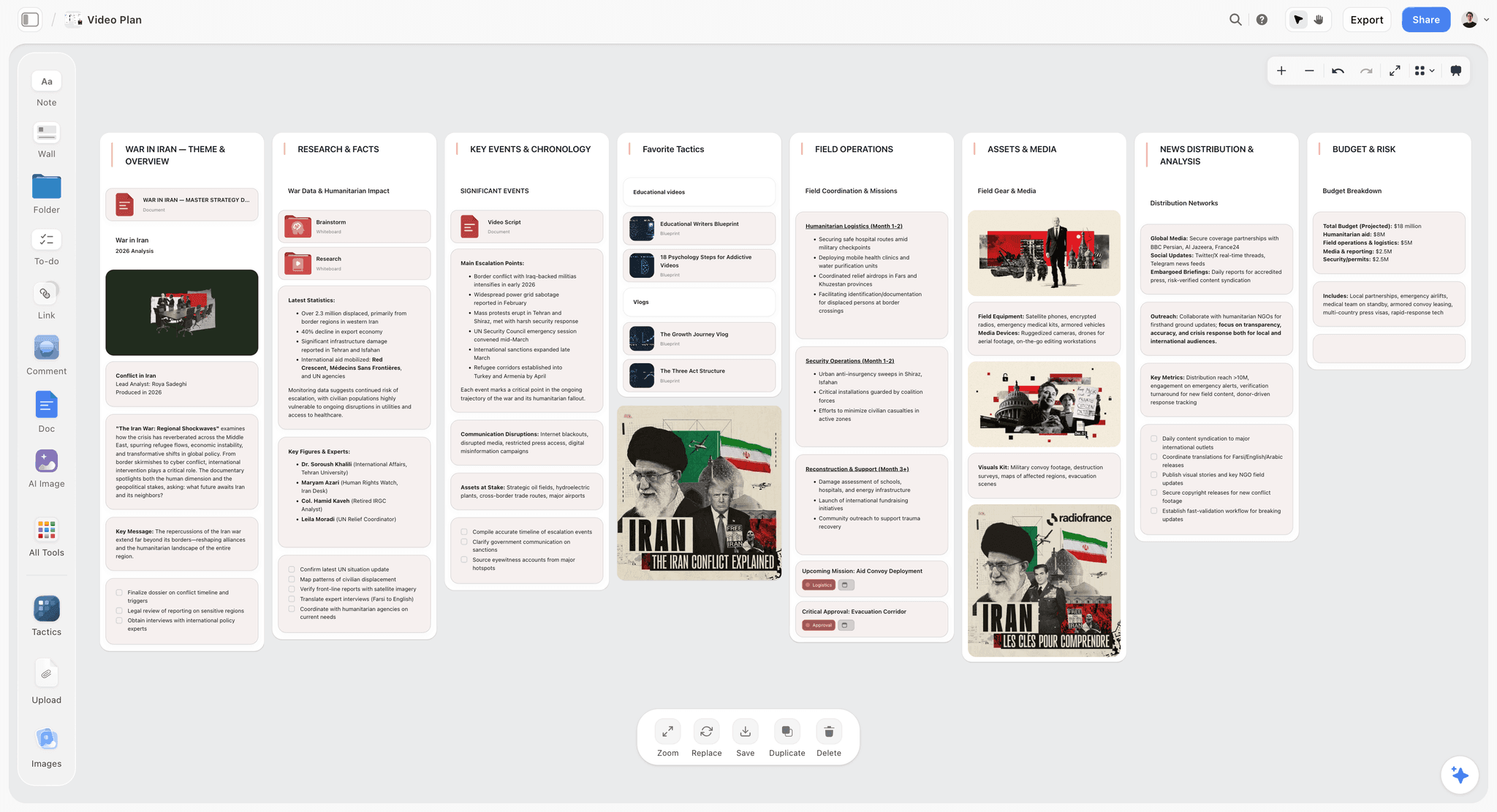
Now build, in blocks.
A block is a chunk of the video with a job: the hook, the problem, the demonstration, the proof, the ask. Five to eight blocks for most videos. Write each as a card with its job, and arrange them.
Blocks, not shots. Shot-level conversation with a client is the wrong altitude: it invites opinions about details before the shape is agreed, and it takes far longer. Structure is a conversation a client can genuinely contribute to.
Move them around. This is the part that only works live, and it is the part that makes the session feel collaborative. Try the proof before the demonstration. Try opening on the customer instead of the product. The client sees the alternatives and chooses, which is a completely different experience from being shown one order.
Attach the references as you go. When someone says they want it to feel a particular way, put the reference on the board next to the block it applies to.
Mark the unknowns. Anything the room cannot decide gets written as an open question with an owner and a date, rather than being resolved by whoever is most confident.
Scope and next steps (20 minutes)
Convert the structure into a scope decision while everyone is present.
Say what this means in days. "This structure is a two-day shoot with two locations, or one day if we lose the customer segment." Real numbers, in the room, while the trade-off is still live.
Get the decision now. Which version are we making. A scope decision deferred to email takes a week and arrives without the context that made it easy.
Write the next steps with owners and dates. Who provides the customer contact, who confirms the location, when the script draft lands.
| Stage | Time | Output | Failure if skipped |
|---|---|---|---|
The one thing | 15 min | One sentence, agreed | Video fails for unnameable reasons |
What is fixed | 15 min | Constraint list, budget band | Designing something unaffordable |
Structure | 45 min | 5 to 8 arranged blocks | Shot-level debate, no shape |
Scope and next steps | 20 min | A decision, owners, dates | A week of email to get one answer |
Running It Well
Two people from your side. One facilitates, one drives the canvas. Doing both means the facilitator is looking at a screen instead of at the room, and the conversation dies.
Do not defend. If the client proposes a structure you think is weaker, build it on the board next to yours and compare. Seeing both is more persuasive than arguing for one, and if theirs is better you have learned something.
Watch for the quiet person with authority. Frequently the most senior person speaks least and approves later. Ask them directly for their view before the session ends.
Send the board, not a write-up. Within the hour, while it is fresh. The board they helped build is the record. A tidied document reintroduces the present-then-notes cycle you just avoided.
What Goes Wrong
Arriving with a finished plan. The client becomes a critic and behaves like one.
Skipping the objective. Or accepting a vague one, so the disagreement surfaces at the first cut.
Not asking about budget. Designing something that has to be dismantled later.
Working at shot level. Slow, and it invites detail opinions before the shape exists.
One person facilitating and typing. Both done badly, and the room disengages.
No decision in the room. The session's value evaporates over the following week.
Sending a polished document afterwards. Turns a co-owned plan back into a deliverable to be reviewed.
The Bottom Line
Build the plan in front of the client instead of bringing one. Agree the single objective first, establish what is fixed including the budget band, then assemble the structure in blocks and move them around until the shape is right.
Convert it to a scope decision before anyone leaves, and send the board rather than a write-up. A client who watched the plan get built does not send notes on it.
FAQ: Client Planning Sessions
How long should a client planning session be?
Ninety minutes to two hours. Beyond that, attention degrades and the scope decisions at the end get made badly, which is the opposite of what you came for. If the project genuinely needs more, run two sessions rather than one long one.
What if the client wants to see options first?
Bring reference points rather than proposals. Three or four examples of formats or approaches give the conversation vocabulary without handing the client a finished thing to critique. The distinction matters: references invite pointing, proposals invite verdicts.
What if the client team disagrees with each other in the room?
That is the most valuable thing the session can produce, and it should be surfaced rather than smoothed over. Write both positions on the board, state that they point in different directions, and ask who decides. Discovering this in the room is enormously cheaper than discovering it at the first cut.
Should I plan at shot level with a client?
No. Blocks with a stated job each are the right altitude. Shot-level conversation invites opinions about details before the structure is agreed, takes far longer, and produces a plan the client feels they were consulted about rather than one they built.
Is Storyflow free for client sessions?
Not during early access. Storyflow is paid-only right now, with Plus at $7.99 per month billed annually, and the Free plan launches before the end of 2026. Anyone a paid member invites to a board joins free, which covers a client who needs to see and comment on the plan during and after the session.
What do I send after the session?
The board itself, within the hour. Sending a tidied document instead recreates the present-and-review dynamic the live session was designed to avoid, and it discards the co-ownership you just built.
Table of Contents
Templates to check out for this topic


Templates you can use in Storyflow
Every Storyflow board starts from real structure and an AI that reads the whole canvas. Open one of these templates and make it yours.


See Storyflow in Action
A visual AI workspace where every feature lives inside one canvas. No tab-switching, no context lost.
Build your entire board from a single message
Type what you need in the AI chat at the bottom of your canvas. The AI adds cards, headings, and structure directly onto your board.
Use expert frameworks as AI context
Type @ in the AI chat and choose any Tactic. The AI tailors every response to that framework instead of giving generic advice.
Turn your board into a mind map in seconds
Ask the AI to restructure your canvas as a mindmap. It connects your ideas into a visual hierarchy so you can see how everything relates.
Why Storyflow Exists
Storyflow actually began as a personal tool while working on creative and research projects.
We kept running into the same problem: ideas were scattered everywhere: notes, documents, and whiteboards.
Nothing helped us see how everything connected.
So we started building a workspace designed around how ideas actually grow.
→ Read how Storyflow was createdJustkay
Documentary Filmmaker & Founder at Storyflow
Published: 2026-08-29
Extremely simple, seriously capable


See how easy it is to get started
Watch a real project come together, from a blank board to a finished plan, clicked through step by step.
Start creating with AI and become more productive
Transform your creative workflow with AI-powered tools. Generate ideas, create content, and boost your productivity in minutes instead of hours.