How to Plan a TV Pilot with AI (2026 Showrunner Workflow)
Plan a TV pilot as a proof-of-series on one canvas: concept, world, character web, season arc, pilot beats, and the engine. A step-by-step 2026 workflow with AI.

Category
Screenwriting
Author

Justkay
Documentary Filmmaker & Founder at Storyflow
Topics
2026-07-01
•
Updated July 1, 2026
•
14 min read
•
Screenwriting- how to plan a tv pilot
- tv pilot with ai
- showrunner workflow
- series bible
- proof of series
- how to write a tv pilot
How do you plan a TV pilot with AI in 2026?
Stop planning an episode and start planning a series. Put six things on one canvas such as Storyflow: the series concept, the world, the character web, the season-one arc, the pilot's beats, and the engine (the repeatable situation that reliably generates future episodes). Then point an AI at the whole board, not a blank prompt, so its suggestions are grounded in what you have built. A pilot is not the first episode. It is the argument for all the episodes you have not written yet, so the proof-of-series comes first and the pilot script comes last.
Prove the series before you write the hour.
A pilot is a proof-of-series. Storyflow keeps the concept, world, character web, season arc, and pilot beats on one infinite canvas, with an AI that reads the whole board, so you break the pilot against the series instead of in a vacuum.

1) Quick Answer: How to Plan a TV Pilot with AI
To plan a TV pilot with AI, stop planning an episode and start planning a series. Put six things on one canvas such as Storyflow: the series concept, the world, the character web, the season-one arc, the pilot's beats, and the engine (the repeatable situation that reliably generates future episodes). Then point an AI at the whole board, not a blank prompt, so its suggestions are grounded in what you have already built. A pilot is not the first episode. It is the argument for all the episodes you have not written yet. The pilot script comes last; the proof-of-series comes first, and the plan is that proof.
Here is the credential behind that claim. I direct documentaries, so I spend most of my time on the work before anyone rolls a camera: research walls, character maps, and the slow argument for why a story sustains. A pilot is the same problem in a different costume: you are not asking "is this a good hour of television," you are asking "does this hour promise a hundred more, and does it show its work." This guide is the method I use for long-form work, written down.
2) What a Pilot Actually Has to Prove
A feature succeeds on one question: is this a complete, satisfying story. A pilot has a harder job. It has to be a satisfying hour and a promise of eighty more hours at once, to a reader deciding whether to spend two years and forty million dollars finding out if you were right. That reader (a development executive, a showrunner staffing a room, a producer with a deck) is not reading for craft alone. They are reading for renewability, and they want three things fast: does the premise generate stories or resolve in one hour, do the characters have engines of their own (wants, wounds, contradictions) still firing in season three, and is there a shape to the season so the pilot is the first beat of an arc and not a standalone that got extended.
The trap is that a pilot script, read in isolation, hides all three answers. A gorgeous teaser and a clean act break can disguise a premise with nowhere to go. This is why so much pilot advice quietly fails: it teaches you to write a good hour, and a good hour is necessary but not sufficient. The thing you have to build, before the script, is the case that the hour is a doorway.
That case is the plan. Not a logline, not a one-pager, not a vibe. A structured, visible argument connecting the concept, world, characters, arc, and pilot beats to the mechanism that keeps producing episodes long after the greenlight. A pilot is not the first episode. It is the argument for all the episodes you have not written yet.
3) The Series Engine: The Framework
Here is the framework this guide is built on. Most writers plan a pilot as a single document that marches from teaser to tag. That is the shape of an episode, so it feels right, but it is the wrong shape: a series is not linear, and the pilot is a slice of something larger. The Series Engine treats the pilot as one visible layer of a six-part system, all of it on a single canvas so you see how a change in one layer ripples through the others.
The six layers:
- Series concept. The one-sentence engine and tone, not the pilot's plot. "A high school chemistry teacher becomes a meth cook" is a concept; "he cooks meth in the pilot" is a beat.
- The world. The rules, setting, institutions, and constraints. A rich world has more corners to explore than any single plot can reach, which makes stories renewable.
- The character web. Not a list. A web: who wants what from whom, which relationships are load-bearing, which fracture, which invert. Relationships are edges, not nodes.
- The season-one arc. The first ten to thirteen episodes as a single movement: where the character starts, the midpoint reversal, where the finale leaves them primed for season two.
- The pilot's beats. Now, and only now, the actual hour: teaser, act structure, promise-of-the-premise scene, button. Planned last because it is downstream of everything above.
- The engine. The repeatable situation that generates episodes without repeating itself. A case of the week is an engine; a pressure-cooker relationship is an engine. If you cannot name it, you do not have a series. You have a movie nervous about ending.
The reason to hold all six on one canvas is that they are not independent. Change the world and the engine changes. Cut a pilot beat and you may have cut the setup for the season-two finale. The Series Engine treats the pilot as a proof, and a proof has to show every step. On a linear document you edit one layer and lose sight of the rest; on a canvas the whole machine stays visible while you tune one gear.
This is also why AI planning changes the work. An AI that reads the entire board can answer questions no single-document tool can, because it sees the arc and pilot layers together. More on that in section 5.
4) Step by Step: Build the Series Engine on One Canvas
This is the sequence. Each step produces a visible cluster on the canvas. By the end you have the whole engine on one board, and the pilot script becomes transcription rather than invention.
Step 1: Write the concept as a testable sentence
Open a fresh canvas. Put one card in the center: the series concept in a single sentence that names the engine, not the plot. Test it with one question: does this sentence imply a second episode. "A grieving detective solves her sister's murder" resolves; "she takes over her dead sister's caseload and finds her sister's fingerprints on half of it" opens. Rewrite until the sentence leaks stories.
This is where AI earns its place early. Give it your logline and ask it to list five ways this premise resolves in one episode and five ways it stays open across a season. The value is being forced to see the traps before you build on them.
Step 2: Build the world as constraints, not lore
Around the concept, cluster the world, and resist the urge to write an encyclopedia. A pilot does not need the history of the kingdom. It needs the three constraints that generate conflict every week: the rule that cannot be broken, the scarce resource, the institution that resists the protagonist. Drop each as its own card, and draw a line to the concept if it directly powers the engine. You are building a map, and the lines are the argument.
Step 3: Lay out the character web as edges
Now the people. Place your protagonist near the concept, then the four or five characters who will still matter in season two: the antagonist, the mirror, the love or loyalty line, the character who represents the world's rules. Between each pair, draw the relationship and label the edge with the tension: "owes him everything," "wants his job," "knows the secret." Series break when relationships are decoration. Series live and die on the edges, not the nodes.
For each central character, add a small stack: want, wound, and the contradiction that makes them a person, not a function. AI is useful here: paste a character card and ask it to name the contradiction you are avoiding.
Step 4: Shape the season as one arc
Cluster the season-one arc as a row of ten to thirteen beats, planned as a single movement, not ten separate stories. Mark four points: the pilot's ending state, the midpoint reversal (where the character's strategy flips), the low point, and the finale's turn. Everything between is the writers' room's job; your job now is the skeleton. Draw lines from season beats back to the character web: if a late-arc beat depends on a relationship you have not established, that line has nowhere to land, and you just found a hole in your pilot.
Step 5: Break the pilot last
Now the hour. Below the arc, lay out the pilot's beats: cold open, act-one break, midpoint, act break, climax, tag. For each, ask what it proves about the series. The teaser proves the tone. The act-one break proves the engine (the "promise of the premise" scene, where the audience sees the machine that runs every week). The tag proves there is a season. Because the arc and character web are already on the board, you break the pilot against them, not in a vacuum. Every beat should connect upward to a season beat or a character edge; beats that connect to nothing are cut candidates.
Step 6: Name the engine explicitly
Last, put one card at the bottom, boxed and bold: the engine in one sentence. "Every week, a new patient forces the doctor to break the rule he swore to keep." If you can write that and point to where each pilot beat and season beat draws from it, you have a series. If you cannot, go back to step one.
5) Where AI Actually Helps (and Where It Does Not)
The honest version, because the difference between useful AI and wasted AI on a pilot is entirely about what the AI can see.
AI helps most when it can read your whole plan and reason across it. That is the unlock: not "generate a scene," but "look at everything I built and find the contradiction." Storyflow's AI reads your full active canvas board by default, plus up to one Tactic and up to three Documents you @-mention in the chat. That scope is exactly the size of a pilot plan: concept, world, characters, arc, and beats, all readable at once. It is not "all your boards" or "your entire workspace." It is the board in front of you, the right unit for a pilot.
Where AI is genuinely strong on a pilot:
- Renewability stress-tests. "List every way this premise resolves in one episode." It surfaces traps you are too close to see.
- Character interrogation. "Name the contradiction this character is missing." A tireless devil's advocate.
- Coverage gaps. With the arc and pilot both on the board, "which season beat does the pilot fail to set up" becomes answerable, because the model can compare the two layers.
- Alternatives at speed. "Give me three act-one breaks that all deliver the promise of the premise." You pick; it drafts.
Where AI is weak: taste and tone (it gives you the median version of your show, never the strange personal choice that makes a pilot yours), voice (AI dialogue reads competent and dead), and the actual decision (it can list ten engines but cannot tell you which one you will still love in year three). Those stay human.
The rule I use: AI is the room that never gets tired of asking "why." You are still the one who decides. Interrogate the plan with it, do not write the plan with it.
6) The Workflow in Storyflow: Pilot Plus Series Bible on the Canvas

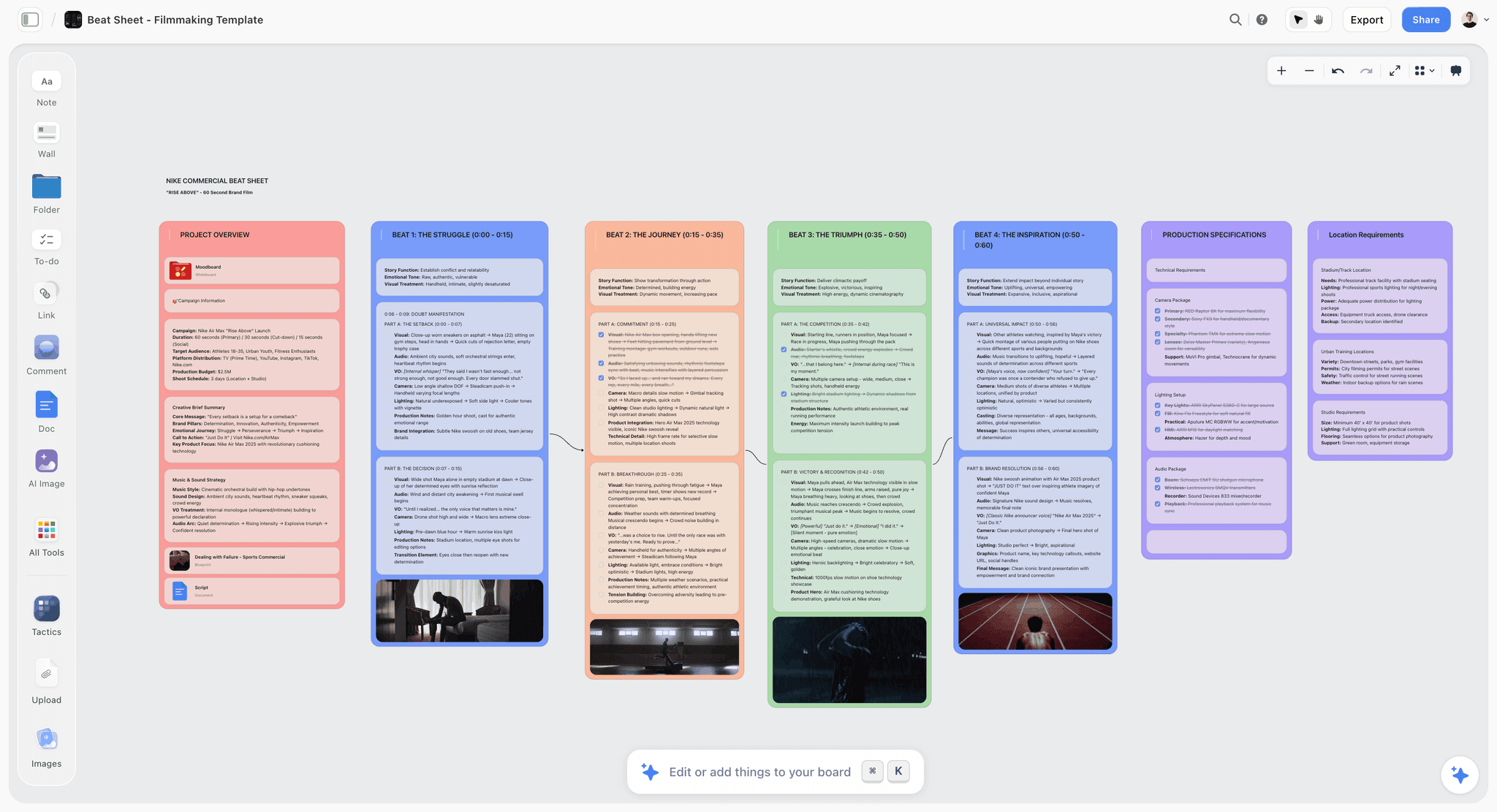
The reason I built Storyflow, and why it fits pilot planning, is that it is the one surface where the series and the episode live on the same board.
The familiar approach keeps the bible in one document, the season outline in a spreadsheet, the character notes in a third file, and the pilot beats in your screenwriting app, then holds the connections in your head, where they go to die. The Storyflow approach puts all six Series Engine layers on one infinite canvas: concept in the center, world constraints around it, the character web as labeled edges, the season arc as a row of beats, the pilot broken below, and the engine boxed at the bottom. Nothing is in a tab you forgot to open.
Concretely, the workflow:
- Start from a blueprint. Storyflow's Story Blueprints library (200+ creative templates on the Plus, Pro, and Max plans) includes screenwriting and structure templates you drop on the canvas as a starting skeleton, so you tune a frame, not a blank page.
- Build the bible as cards, not chapters. Each world rule, character, and relationship is a card you move, recolor, and connect. The bible is the board, not a fifty-page PDF nobody reads.
- Draw the character web. Connect cards with lines and label the edges with the tension, so a missing load-bearing relationship is visible too.
- Point the AI at the whole board. Ask it to stress-test renewability, find coverage gaps between the arc and the pilot, or interrogate a character. It reads your full active canvas, so its answers are about your plan, not a generic pilot. @-mention up to one Tactic and up to three Documents to widen what it reasons over.
- Break the pilot against the plan. With the arc and web on the same board, every pilot beat gets broken in context, and you see which season beat each one sets up.
This is the proof-of-series made visible: the whole argument on one board, so a reader or collaborator sees the machine, not a stack of files. To be clear, Storyflow is where you plan and prove the series, not where you format the shooting script.
7) Pilot Types and How the Engine Changes
Not every pilot proves the series the same way, and the Series Engine bends by type. Three shapes.
The premise pilot (the classic setup). It shows the world before and after the inciting change: the teacher gets the diagnosis, the case lands. The engine has to be visible by the act-one break, because the whole hour installs the machine, so the pilot-beats layer leans on the concept and world layers.
The in medias res pilot. It drops you into a world already running, as if it is episode ten. Renewability is proven by texture, so the world layer does the heaviest lifting, and the AI stress-test to run is "does the world imply episodes I have not written."
The character pilot. The engine is a person, not a situation. The hour proves this specific character, with this specific contradiction, generates conflict wherever you point them, so the character-web layer carries the proof and the season arc should bend toward the character's wound.
Naming the type tells you which layer to over-invest in. A premise pilot that skimps on the world feels thin; a character pilot that skimps on the contradiction feels like a plot with a mascot.
8) A Worked Example: One Weekend, One Pilot Plan
Here is the Series Engine on a canvas over a weekend.
The concept card: "A hospice nurse discovers her dying patients keep confessing to the same unsolved crime." It implies episode two, because each new patient is a new confession. The world gets three constraint cards (she cannot use a patient's words as legal evidence, she has only the days a patient has left, the administration wants her to stop asking). The character web gets the nurse, the retired detective who worked the case ("resents being pulled back"), the administrator ("is protecting someone"), and the pilot patient ("lying about which part").
The season arc gets four marks: the pilot ends with the nurse realizing the confessions corroborate, the midpoint is learning the detective was a suspect, the low point is a patient dying mid-confession, the finale turn is the administrator's secret surfacing. The pilot beats connect upward: cold open on a confession (tone), act-one break when a second patient confesses to the same crime (the engine), midpoint when the detective refuses to help (character edge), act break on the administrator's warning (institution), climax on the corroboration, tag on a new patient admitted (the season).
Engine card, boxed: "Every week, a dying patient's confession forces the nurse to solve one more piece of a crime she cannot legally touch." Each pilot beat and season mark draws from that sentence.
Now the AI pass. With the whole board readable, ask: "which season beat does the pilot fail to set up." Suppose it flags that the finale's administrator secret has no thread in the pilot. You add a five-second act-break beat: the administrator takes a call and lies about who it was. One card, and the season-two setup lands in the pilot. That is what an AI reading the whole board can do, and a blank prompt cannot.
9) Common Mistakes That Kill a Pilot
The mistakes I see most, because a guide that only sells is one you should not trust.
- Planning the episode, not the series. The most common and most fatal: a beautiful hour with nowhere to go. Build the engine card first and refuse to break the pilot until you can name it.
- A world that is lore, not constraints. Pages of backstory, zero recurring conflict. For every world card, ask "does this generate a scene this season." If not, it is set dressing.
- A character list instead of a web. Named people with no load-bearing relationships. Draw the edges and label the tension. A blank edge is decoration.
- A pilot that resolves. It answers its own central question, leaving nothing for episode two. The tag should open, not close.
- Trusting the AI's taste. Letting the model pick the engine, the tone, the strange choice. Use AI to interrogate and draft alternatives; make every real decision yourself.
Now the honest limits, including where Storyflow specifically is the wrong tool. Three real cons:
- Storyflow is not a script-formatting tool. When you leave planning and write the actual pilot script, you need industry-standard formatting, revision colors, and production drafts. That is Final Draft or WriterDuet, not Storyflow. Prove the series on the canvas, then write the shooting script in a dedicated screenwriting app.
- Storyflow is cloud-only. There is no offline mode and no local-first file. If you write on a plane with no wifi, or you have hard privacy requirements that forbid cloud storage, the canvas is not for you in that moment. Keep an offline draft app for those conditions.
- Storyflow is not a pitch-deck designer. When it is time for the polished, art-directed deck that goes to the network, that is Canva, Milanote, or a designer, not the canvas. Use the plan as source material for the deck; do not make the plan itself look like a keynote.
None of these are dealbreakers for the planning work, which is the whole point of this guide. They are the boundary of the tool, and knowing the boundary is what makes the recommendation trustworthy. Storyflow is the best surface I know for building and proving a series. Use the right tool for each job.
11) The Bottom Line
Stop writing the pilot first. The pilot is the last thing you plan, because it is downstream of the concept, world, characters, season arc, and engine, and it only works when it is broken against all of them. Build the Series Engine on one canvas, name the engine in a single sentence, point an AI at the whole board to interrogate the plan, and the pilot script becomes transcription instead of invention. A pilot is not the first episode. It is the argument for all the episodes you have not written yet.
If you are developing a pilot right now, build the six-layer plan on a canvas this weekend and let the AI stress-test it before you write a single scene. Start the series bible and pilot together at storyflow.so and prove the series before you write the hour.
10) FAQ: Planning a TV Pilot with AI
What is the first thing to do when planning a TV pilot?
Write the series concept as a single sentence that implies a second episode, then name the engine before you break any pilot beats. Most writers start with the pilot's plot, which is backwards. The pilot is downstream of the concept, world, characters, and season arc. Start with the concept card on a canvas, test it for renewability, and break the hour only once the engine is named.
What is a proof-of-series?
A proof-of-series is the argument, built before the script, that your premise sustains a full season and beyond. It connects the concept, world, character web, season arc, pilot beats, and engine so a reader sees the pilot as a doorway, not a standalone. A pilot is not the first episode. It is the argument for all the episodes you have not written yet, and the proof-of-series is where you make that argument visible.
How does AI help plan a TV pilot?
AI helps most when it can read your whole plan and reason across it: stress-testing renewability, interrogating characters, and finding coverage gaps between the season arc and the pilot. It is weak at taste, voice, and the actual creative decision, which stay human. The unlock is scope: an AI that reads your entire planning board can answer "which season beat does the pilot fail to set up," while a blank chat window can only invent a generic list.
How long should a TV pilot be?
A drama pilot is typically 45 to 60 pages and a comedy pilot 25 to 35 pages, matching the runtime. But length is downstream. The planning question is not how many pages, it is whether the hour proves the series. Plan the six Series Engine layers first, break the pilot against them, and the page count follows the format.
Can I plan a whole series bible and the pilot in one place?
Yes, and you should, because the pilot is a slice of the series and planning them apart is how connections get lost. On an infinite canvas you keep the series bible (concept, world, characters, arc) and the pilot beats on one board, so every beat can be broken against the season it belongs to. Storyflow is built for this: the bible and pilot share one canvas, and the AI reads the whole board.
Does AI-assisted planning hurt the originality of my pilot?
Only if you let the AI make the creative decisions, which you should not. Used well, AI interrogates your plan and drafts alternatives you choose from, which sharpens originality rather than flattening it. The strange, personal choices that make a pilot yours are the exact things AI cannot generate, so keep those human.
What tools do I need to plan and write a TV pilot?
For planning and proving the series, an infinite canvas where the whole plan is visible and an AI can read it (Storyflow). For writing the formatted script, a dedicated screenwriting app like Final Draft or WriterDuet. For the pitch deck, a design tool like Canva or a designer. Three different jobs, and the right tool for each beats forcing one app to do all three.
Do I need to plan the whole season before writing the pilot?
You need the skeleton, not the scripts. Plan the season arc's four marks (the pilot's ending state, the midpoint reversal, the low point, and the finale turn) so the pilot can be built to set them up. The episode-by-episode breaking is the writers' room's job later. Without the skeleton, you break the pilot in a vacuum, and a pilot broken in a vacuum tends to resolve instead of open, the one thing a pilot must never do.
Table of Contents
- Quick Answer: How to Plan a TV Pilot with AI
- What a Pilot Actually Has to Prove
- The Series Engine: The Framework
- Step by Step: Build the Series Engine on One Canvas
- Where AI Actually Helps (and Where It Does Not)
- The Workflow in Storyflow: Pilot Plus Series Bible on the Canvas
- Pilot Types and How the Engine Changes
- A Worked Example: One Weekend, One Pilot Plan
- Common Mistakes That Kill a Pilot
- FAQ: Planning a TV Pilot with AI
- The Bottom Line
- Author
- Related Reading
Templates to check out for this topic


Templates you can use in Storyflow
Every Storyflow board starts from real structure and an AI that reads the whole canvas. Open one of these templates and make it yours.


See Storyflow in Action
A visual AI workspace where every feature lives inside one canvas. No tab-switching, no context lost.
Build your entire board from a single message
Type what you need in the AI chat at the bottom of your canvas. The AI adds cards, headings, and structure directly onto your board.
Use expert frameworks as AI context
Type @ in the AI chat and choose any Tactic. The AI tailors every response to that framework instead of giving generic advice.
Turn your board into a mind map in seconds
Ask the AI to restructure your canvas as a mindmap. It connects your ideas into a visual hierarchy so you can see how everything relates.
Why Storyflow Exists
Storyflow actually began as a personal tool while working on creative and research projects.
We kept running into the same problem: ideas were scattered everywhere: notes, documents, and whiteboards.
Nothing helped us see how everything connected.
So we started building a workspace designed around how ideas actually grow.
→ Read how Storyflow was createdJustkay
Documentary Filmmaker & Founder at Storyflow
Published: 2026-07-01
Extremely simple, seriously capable


See how easy it is to get started
Watch a real project come together, from a blank board to a finished plan, clicked through step by step.
Start creating with AI and become more productive
Transform your creative workflow with AI-powered tools. Generate ideas, create content, and boost your productivity in minutes instead of hours.