The 10 Best Team Charter Tools in 2026
A charter you cannot see at the moment it is broken is a charter you do not have. Ten tools ranked on the four layers of the Charter Stack, not on template count.

Category
Productivity
Author

Sara de Klein
Head of Product at Storyflow
Topics
2026-08-14
•
22 min read
•
ProductivityTable of Contents
- Key Takeaways
- The Charter Stack: Four Documents Wearing One Name
- At a Glance: The 10 Tools Compared
- How I Ranked These
- Quick Picks by Job Type
- 1. Atlassian Team Playbook
- 2. Miro
- 3. Storyflow
- 4. Confluence
- 5. Notion
- 6. Mural
- 7. FigJam
- 8. Slack Canvases
- 9. Lucidspark
- 10. Google Docs
- What to Actually Pay For
- Tools to Avoid for This Job
- What No Tool on This List Does
- The Bottom Line
- FAQ: Team Charter Tools
- Related Reading
Templates to check out for this topic


- team charter tools
- working agreements tool
- team charter template
- decision rights RACI DACI
- team escalation path
- remote team charter
What are the best team charter tools in 2026?
A team charter is a promise about behaviour, and behaviour promises decay silently, which is why the tool that holds your charter matters more than the template you started from. The Atlassian Team Playbook ranks first because it is the only entry that ships the workshop, the roles exercise and a recurring health check for free rather than a blank canvas. Miro ranks second as the durable board a distributed team will reopen. Storyflow ranks third because a charter is a small spatial document a team revisits together, not a wiki page. Confluence and Notion are the right homes once decision rights need version history, and Slack canvases put the agreement where it gets broken.

Full disclosure: Storyflow is our own product, so here is the honest position. It ranks third, not first, and only on one narrow ground: a charter is a small spatial document a team revisits together, and a canvas holds the four layers as regions that fit on one screen where a wiki page grows to 1,400 words nobody reads together. Everything else about this job it does not do. There is no team charter template in the Story blueprint library. There is no acknowledgement or sign off tracking, so you cannot tell who has actually read it. There is no version history, so you cannot see what an agreement said last quarter or when it changed. There are no reminders and no scheduled review cadence. Realtime co-editing requires the Max tier at $39 per month. The Atlassian Team Playbook is free and beats it on method, Confluence beats it on evidence, Notion beats it on structure, and Slack canvases beat it on being visible at the moment an agreement is broken.
Quick Comparison
Ranked on one axis: whether the charter stays visible and revisable at the moment it is actually violated, rather than how many templates the vendor ships.
| Tool | Best For | AI Features | Price |
|---|---|---|---|
| Atlassian Team Playbook | The facilitated method and a recurring health check | None, it is a play library rather than software | Free |
| Miro | The distributed charter workshop and a durable board | AI clustering and summarising of stickies | Free plan, Starter about $8 user mo annual |
| Storyflow | A small spatial charter a team revisits together | AI reads the full active canvas board plus 1 Tactic and 3 mentioned Documents | $7.99 mo annual (free plan late 2026) |
| Confluence | Decision rights and escalation with full page history | Atlassian Intelligence on paid tiers | Free to 10 users, about $6 to $8 user mo |
Key Takeaways
- People use the word charter for four documents. The mission, the working agreements, the decision rights and the escalation path have separate lifespans.
- Most charter templates produce only the mission statement, the one layer that never changes and therefore the one layer that never helps.
- Rank charter tools by whether the document is visible and revisable at the moment it is violated.
- The Atlassian Team Playbook is free, includes a Working Agreements play and a DACI decision play, and is the only entry that prescribes a revisit cadence.
- RACI assigns responsibility across a set of tasks. DACI names a driver, an approver, contributors and the informed for one decision. Teams reach for the wrong one constantly.
- Storyflow ranks third and has no team charter blueprint, no sign off tracking, no version history and no review reminders, all named in its own limitations block.
- Slack canvases score badly on revision and beautifully on proximity: the channel where an agreement is broken is the channel the canvas is pinned to.
- A charter nobody has acknowledged is a draft, and only Confluence and Notion give you a defensible way to see who has read it.
Put your working agreements somewhere the team will actually reopen
Build the four layers of the Charter Stack as regions on one Storyflow canvas, then ask the AI whether any two agreements contradict each other or whether your escalation path names the person most likely to be escalated about. Paid-only during early access; the Free plan lands before the end of 2026.

The Charter Stack: Four Documents Wearing One Name
Ask six people on a team to describe their charter and you will get four different documents. That is not sloppiness. A charter is genuinely four things stacked on each other, and almost every template produces only the first. Call it the Charter Stack.
Layer 1: the mission. Why this team exists, who it serves, what it is accountable for. One paragraph, written at formation, correct for two years.
Layer 2: the working agreements. How this team behaves. Response time on a direct message versus a channel mention. Whether meetings start on the hour. Focus hours nobody books over. What "done" means before a handoff.
Layer 3: the decision rights. Who decides what, and what needs consensus versus consultation versus one named owner. The difference between "we discussed it" and "she decided it" is the difference between a team that moves and a team that relitigates.
Layer 4: the escalation path. What happens when it goes wrong. Not the org chart. The sequence: who you raise it with first, how long you wait, what you do when that person is the problem.
Here is the rule that reorganizes everything else. The layers decay at the opposite rate to how often they are written. Layer 1 never changes and gets written every time. Layer 4 is needed at the worst moment a team ever has and gets written almost never.
Working agreements decay quietly. Nobody announces that the team has stopped honouring focus hours. Somebody books a Tuesday morning because it was the only slot, then somebody else does, and eleven weeks later the agreement is technically in the document and functionally dead. No error message. The promise expires without notification.
That is the ranking axis for this post. A charter you cannot see at the moment it is broken is a charter you do not have. Not the moment it is written, when the room is warm. The moment somebody pings at 9pm or ships a decision three people thought was still open.
Psychological safety, the concept most associated with Amy Edmondson's research, is what a good Layer 4 makes operational. A charter that values candour and gives no escalation mechanism has built nothing.
At a Glance: The 10 Tools Compared
| Tool | Strongest layer | Where it lives when broken | Revision trail | Shape |
|---|---|---|---|---|
Atlassian Team Playbook | Working agreements and decision rights | Wherever you put the output | None, it is a method | Free play library |
Miro | Working agreements | A board you must remember to open | Board history on paid tiers | Infinite whiteboard |
Storyflow | Working agreements and mission | A canvas the team revisits together | None | AI canvas |
Confluence | Decision rights and escalation | A wiki page with a version number | Full page history | Wiki |
Notion | All four, as a database | A page with an owner and a review date | Page history on paid tiers | Docs and databases |
Mural | Working agreements | A mural in a room folder | Version history on paid tiers | Facilitated whiteboard |
FigJam | Working agreements | A file in the design team's project | File version history | Design whiteboard |
Slack canvases | Working agreements | The channel where it is broken | Weak, edits overwrite | Channel document |
Lucidspark | Working agreements | A board in a Lucid folder | Revision history on paid tiers | Enterprise whiteboard |
Google Docs | Mission and escalation | A file in Drive nobody opens | Excellent version history | Document |
How I Ranked These
I come from documentary, where a small crew agrees how it will work in the first two days and then discovers on day nineteen, in someone else's country, whether those agreements were real. Over two years I have built working agreements, decision maps and escalation paths in every tool here, for teams between three and forty people.
Five criteria, in order.
1. Is the charter visible at the moment of violation? The test: someone books over focus hours on Tuesday. Between that click and the meeting starting, does anyone encounter the agreement?
2. Can it be revised without a ceremony? The test: how many steps between noticing an agreement is stale and changing it. If revision needs a scheduled workshop, the document stays stale for a quarter.
3. Does it distinguish decision rights from opinions? The test: can the document express that one named person decides pricing after consulting two others, rather than listing pricing under things we care about.
4. Can you tell who has agreed? The test: three people joined last month. Can you prove any of them read it? A charter without acknowledgement is a draft written by whoever was in the room.
5. Does it prompt its own review? The test: does anything in the system reopen the charter on a cadence, or does it depend on someone remembering.
Pricing is as of August 2026 and changes frequently. Verify with each vendor.
Quick Picks by Job Type
- Best overall method: Atlassian Team Playbook. It prescribes the revisit cadence the rest assume.
- Best distributed workshop: Miro. Durable board, and everyone can already use it.
- Best small revisitable charter: Storyflow. A canvas a team of five reopens together.
- Best decision rights and escalation: Confluence. Page history that survives an argument.
- Best living charter: Notion. Agreements as rows with review dates.
- Best honest facilitation: Mural. Private mode and anonymous voting.
- Best proximity to the violation: Slack canvases. Pinned where the behaviour happens.
1. Atlassian Team Playbook
The verdict. The only entry that gives you the workshop, the roles exercise and a recurring health check instead of a blank surface and encouragement.
Best for. Teams that need a method more than they need another canvas.
Pricing. Free, published publicly with no account required. You pay for whatever tool holds the output, usually Confluence at roughly $6 to $8 per user per month on Standard as of August 2026.
Why it ranks here. Every other tool here is a surface. You open it, it is empty, and you are one search away from a template that produces Layer 1 and stops. The Team Playbook is the opposite: facilitated exercises with timings, materials and a stated outcome, covering three of the four Charter Stack layers.
The Working Agreements play is the one most teams need and skip. It runs about an hour and asks the team to surface frustrations first and convert them into agreements second. Aspiration produces "we communicate openly". Frustration produces "if a message needs an answer today, say so in the message". One of those is enforceable.
The Roles and Responsibilities play attacks Layer 3, surfacing the gap between what people think they own and what others think they own. Atlassian also publishes DACI, naming a driver, an approver, contributors and the informed for one decision. That is a different instrument from RACI, which assigns responsible, accountable, consulted and informed across a set of tasks, and teams reach for RACI when they need DACI.
The Health Monitor answers criterion five: a periodic self assessment that forces a scheduled conversation where the charter is a natural agenda item.
Strengths.
- Free, public, and requires no account or procurement conversation.
- Surfaces frustrations before aspirations, which is what makes the output enforceable.
- Roles and Responsibilities directly attacks Layer 3, which most charters never reach.
- Health Monitor creates the recurring conversation that keeps the charter alive.
Limitations.
- Stores nothing. Criteria one and four are answered by whatever tool you pair it with.
- Written for an Atlassian shaped team, so some plays assume Jira and Confluence.
- Requires a facilitator willing to run a real session, a bigger ask than it sounds.
The trade off. Best method on this page and zero storage, so treat it as the syllabus and pick a surface from the nine entries below.
2. Miro
The verdict. The workshop surface most distributed teams already have, with board durability FigJam and Slack canvases lack.
Best for. Building the working agreements live with eight remote people and keeping the board afterwards.
Pricing. Free plan with a small number of editable boards. Starter roughly $8 per user per month billed annually, Business roughly $16, as of August 2026.
Why it ranks here. The charter session is a facilitation problem before it is a documentation problem, and Miro is the strongest general purpose facilitation surface for a distributed team: stickies, timers, dot voting, frames, and community published working agreement templates through Miroverse.
What Miro does better than the document tools is the clustering step. Agreements start as thirty raw frustrations on individual stickies. Grouping them physically, naming the groups, then converting each group into one sentence is a spatial operation. A bulleted list produces a worse charter because you edit as you go instead of seeing the whole surface first. Amending one later is dragging a sticky and typing.
Where it loses is method and proximity. Miro hands you a canvas and a template, not the instruction to surface frustrations before aspirations, so teams with no play in hand produce a beautiful board of Layer 1 and call it done. And a board is somewhere you go. Pin the link in Slack and it gets clicked in month one, not month five.
Strengths.
- Best in class distributed facilitation: timers, voting, private cursors, frames.
- The clustering step that turns frustration into agreements is spatial, and Miro is built for it.
- Amending an agreement takes seconds and needs no publish step.
- Miroverse has community published working agreement and team canvas templates.
Limitations.
- Per user pricing, so the whole team plus a contractor gets expensive fast.
- No acknowledgement or sign off tracking, so you cannot prove anyone read it.
- No review reminders, and large boards let last year's retro stickies drown this year's agreements.
The trade off. The best place to build the charter and a mediocre place to keep it, which is why strong setups pair a Miro session with a Confluence or Notion home.
3. Storyflow
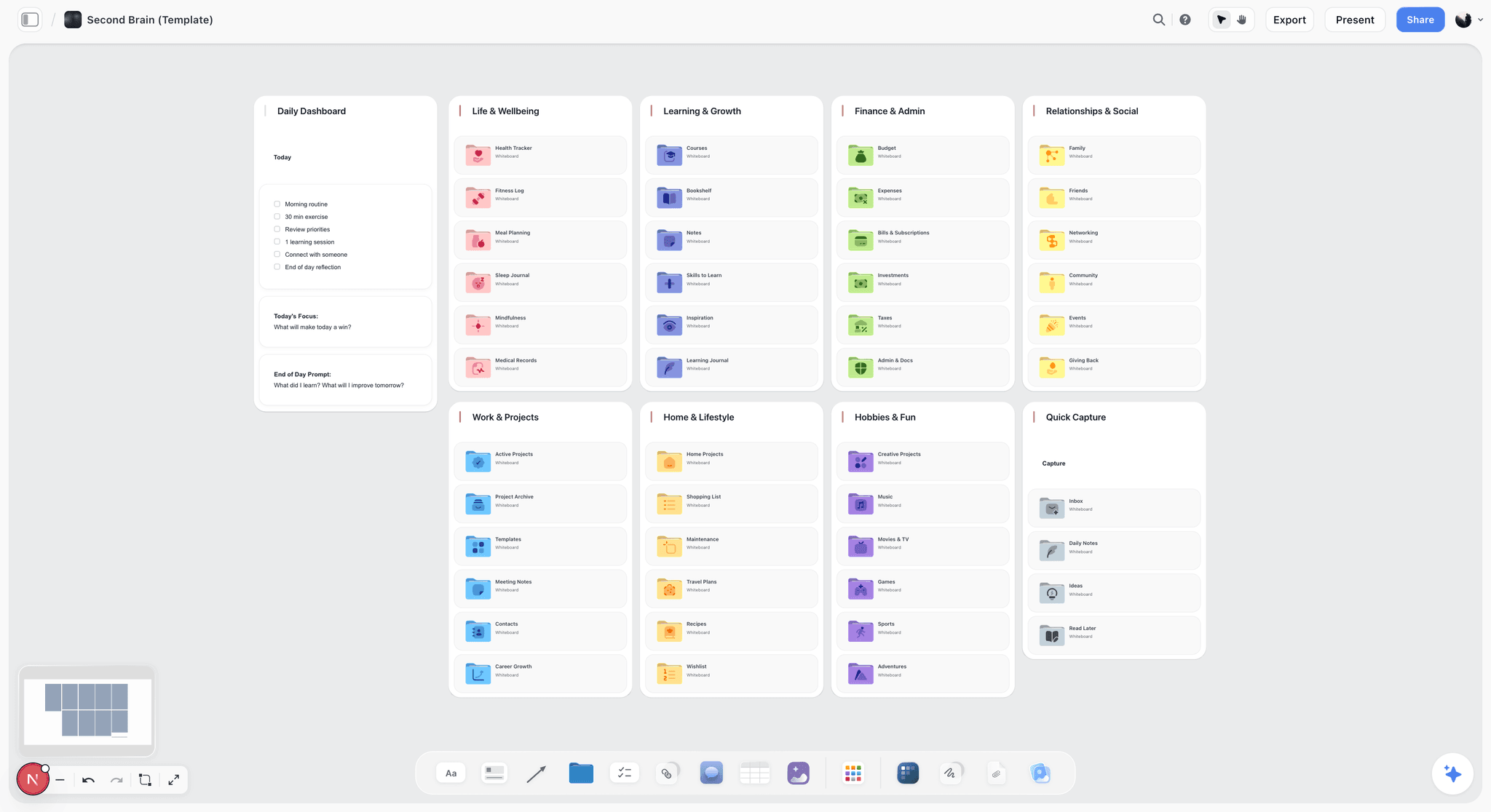
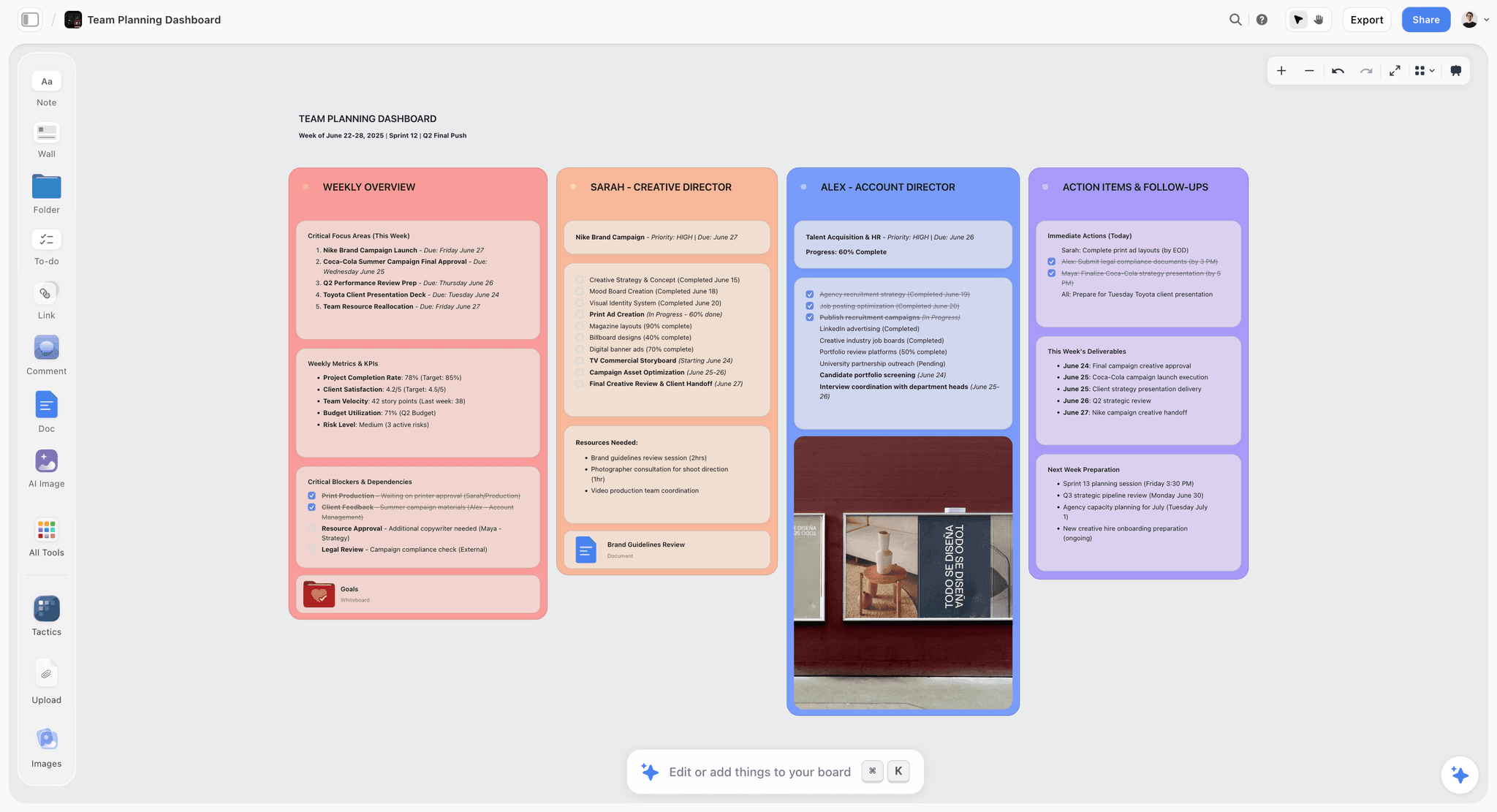
The verdict. A charter is a small spatial document a team revisits together, and this is a canvas sized for exactly that rather than for a forty person workshop.
Best for. A team of three to eight keeping its working agreements somewhere it will reopen.
Pricing. Paid only during early access. Plus is $7.99 per month billed annually or $9.99 monthly, adding the 200 plus Story blueprints and unlimited file uploads. Pro is $14 per month billed annually or $19 monthly, adding AI image generation, roughly twenty times more AI usage and memory across conversations. Max is $39 per month billed annually or $49 monthly, adding forty times more AI and the Team Workspace. Pricing is flat per account, not per seat, and anyone a paid member invites signs up free. The Free plan launches before the end of 2026.
Why it ranks here. Charters written in a wiki are long, and length is what kills them. A page with a mission paragraph, eleven agreements, a RACI table and an escalation section is 1,400 words, and nobody reads 1,400 words together in a fifteen minute check in.
A canvas makes the charter small by making it shaped. The four layers sit as visible regions, and agreements are individual cards you read at a glance, so "are these still true" becomes answerable in a meeting rather than a homework assignment. The whole thing fits on one screen, and that constraint does useful work: if your agreements do not fit on a screen, the team does not have eleven agreements, it has a policy document.
The AI is the second reason it ranks here rather than lower. Storyflow's AI reads your full active canvas board by default, plus up to one Tactic and up to three Documents you @-mention. On a charter board you can ask about the agreements as a set: whether two contradict each other, whether the escalation path names a person who is also the likely subject of an escalation, whether any agreement describes a feeling rather than a behaviour.
Where it does not win is proof and cadence. A charter you cannot see at the moment it is broken is a charter you do not have, and Storyflow does not put the agreement in the channel, does not ping you in month five, and cannot tell you whether the people who joined in June ever opened the board. Confluence and Notion beat it on all three, which is why it ranks third.
Strengths.
- Charter sized for a screen, so the team reads it together instead of one person skimming it.
- The four layers map to four visible regions rather than four wiki headings.
- Whole board AI answers set level questions: contradictions, unenforceable agreements, escalation paths that fold back on themselves.
- Flat per account pricing rather than per seat, and invited collaborators join free.
- The retro that produced an agreement attaches to the card holding it.
Limitations.
- There is no team charter template in the Story blueprint library. You build the four regions yourself.
- No acknowledgement or sign off tracking, so you cannot tell who has read it, which is the exact gap a charter develops as the team grows.
- No version history. You cannot see what an agreement said last quarter or when it changed, which is the most useful audit a charter has.
- No reminders and no scheduled review cadence. Nothing in the product reopens the charter for you.
- Realtime co-editing requires the Max tier at $39 per month, so simultaneous live editing is not available on Plus or Pro.
The trade off. The best shape for a small charter and the weakest evidence trail on this page, so use it for the document a team of five revisits and use Confluence when you need to prove who agreed.
4. Confluence
The verdict. The only entry that treats a charter as a document with a version number, which is what Layers 3 and 4 actually need.
Best for. Decision rights and escalation paths that have to survive a disagreement six months later.
Pricing. Free for up to 10 users. Standard roughly $6 to $8 per user per month, Premium roughly $12 to $13, as of August 2026.
Why it ranks here. Working agreements are informal and get amended in a standup. Decision rights are not. When two people disagree about who owned a call, the useful question is what the document said on the day it was made, and every whiteboard here answers that with a shrug.
Confluence answers it precisely. Page history shows every version, who changed it and when, with a diff. A decision rights table that quietly changed in April, with nobody able to say when or why, is worse than no table because it manufactures confident disagreement. Inline comments help too: a question about one unclear sentence of an escalation path becomes visible to everyone rather than sent privately to whoever wrote it.
Confluence also handles criterion four better than most. Higher tiers surface page analytics showing who has viewed a page, and the Marketplace has document control apps adding explicit read and sign off tracking. It ranks fourth because nobody workshops in Confluence, and a page with eleven agreements will be skimmed. Use Miro or the Playbook for the session, Confluence for Layers 3 and 4 afterwards.
Strengths.
- Full page history with diffs, exactly what decision rights and escalation paths require.
- Inline comments put ambiguity on the document instead of in a private message.
- Page restrictions let escalation paths be readable without being editable.
- Free for up to 10 users, which covers a lot of teams entirely.
Limitations.
- Nobody runs a workshop in it, so the charter arrives already written by one person.
- A long page is a skimmed page, and Confluence encourages long pages.
- Read tracking is a Premium analytics feature or a paid Marketplace app, and the page tree hides things. A charter three levels deep in a space is functionally archived.
The trade off. The best evidence trail and the worst session surface: never write the charter here, always keep Layers 3 and 4 here.
5. Notion
The verdict. The only tool that lets you make each working agreement a row with an owner, a status and a review date, which is the closest anything comes to fighting silent decay.
Best for. Teams that want the charter to be a living object with accountability rather than a page.
Pricing. Free personal plan. Plus roughly $10 per user per month billed annually, Business roughly $20 to $24, as of August 2026.
Why it ranks here. A working agreement in a document is a bullet point. In a Notion database it is a row with fields, and the fields are where the interesting decisions live: who proposed it, what problem it solves, when it was last confirmed, whether it is held or aspirational.
That last field is worth stealing regardless of your tool. Marking an agreement aspirational rather than held is a small act of honesty. A team that admits four of its eleven agreements are aspirational is in far better shape than one pretending all eleven are live. And a last confirmed date column, sorted ascending, gives you the most useful charter view there is: the agreements nobody has looked at in five months.
Notion also holds all four layers coherently, with the mission as a callout, agreements as the database, decision rights as a second database keyed by decision type rather than by person, and escalation as prose. It ranks fifth because building this properly is a two hour setup by someone who enjoys Notion, and teams without that person get a document with a nicer font. An abandoned database is also more misleading than an abandoned document, because it looks maintained.
Strengths.
- Agreements as rows with owners, review dates and a held versus aspirational status.
- A last confirmed date view surfaces silent decay without any reminder system.
- Holds all four Charter Stack layers coherently in one page.
- Page history on paid tiers, plus comments per row.
Limitations.
- Real setup cost. Without a Notion native person you get a document with better typography.
- No native acknowledgement tracking. A checkbox column records a click, not a reading.
- No reminders tied to a review date unless you build an automation, and per user pricing for editors.
The trade off. The best structure on this page if someone owns it, and the most convincingly abandoned artifact if nobody does.
6. Mural
The verdict. The facilitation features that make the agreements honest, which matters more for a charter than for any other workshop.
Best for. Charter sessions where the person with the most authority is in the room.
Pricing. Free plan available. Team Plus roughly $12 per user per month billed annually, Business roughly $18, as of August 2026.
Why it ranks here. Charter workshops have a specific corruption problem. You are asking a team to say out loud what is not working, and the fastest way to get a charter full of pleasant nothing is to let a manager write stickies first while everyone watches.
Mural's private mode is the direct antidote. Everyone writes their own contributions and nobody sees anyone else's until the facilitator reveals them, which removes both anchoring and the instinct to soften. That is the difference between "we should communicate more clearly" and "I do not know when a message from you needs an answer today". Anonymous voting does the same for prioritisation: eleven candidate agreements is too many, six is right, and choosing six by open discussion means the loudest three preferences win.
Outline mode sequences the session so you reach Layer 3 instead of running out of time in the frustration phase. It ranks sixth rather than second because Miro has the larger installed base and wider template ecosystem, and because a mural is somewhere you go, not something that appears when the agreement is broken.
Strengths.
- Private mode removes anchoring, the specific corruption of charter workshops.
- Anonymous voting produces a more honest shortlist than open discussion.
- Outline mode sequences the session so Layer 3 is not what you run out of time for.
- Summon and timers make a distributed session feel facilitated rather than watched.
Limitations.
- Per user pricing, and the facilitation features that matter sit on paid tiers.
- Same storage weakness as every whiteboard: no acknowledgement, no reminders, no proximity.
- Smaller template ecosystem than Miro, and the room structure hides murals as effectively as Confluence hides pages.
The trade off. The best session facilitation here, and the same forgetting problem as every other canvas once the session ends.
7. FigJam
The verdict. The fastest way for a design or product team to get real working agreements out of a room, at the lowest per seat cost on this list.
Best for. Design and product teams already living in Figma.
Pricing. Free starter plan. A collaborator seat runs roughly $3 to $5 per user per month as of August 2026 depending on plan and billing period. Verify the current seat model with Figma, since it changed recently.
Why it ranks here. For a team already in Figma daily, FigJam removes the largest failure point in charter tooling, which is a charter living in an application nobody opens. A FigJam file sits beside the design files, in the path of daily work.
Speed is the honest advantage. Stickies, a timer, voting and cursor chat, with no learning curve for anyone who has used Figma. A session can be forty minutes rather than ninety, and a forty minute session is one you rerun in a quarter, which matters more than a better first session. Naming a version "charter, agreed March" also gives a rough revision trail.
It ranks seventh because it is genuinely a design team tool. Invite an operations lead and a support manager and you spend the first ten minutes on Figma onboarding. It also handles Layers 3 and 4 poorly, because decision rights want a table and escalation wants prose.
Strengths.
- Almost no adoption friction for anyone already in Figma.
- Cheapest per seat surface here for existing Figma teams.
- Named file versions give a usable revision trail.
- Fast enough that rerunning the session in a quarter is realistic.
Limitations.
- Poor fit for cross functional charters. Non design participants pay an onboarding tax.
- Weak for Layer 3 tables and Layer 4 prose, which is half the Charter Stack.
- No acknowledgement tracking, no reminders, and files get lost inside project structures aimed at design work.
The trade off. Excellent for a design team's own agreements, wrong for a charter that spans functions.
8. Slack Canvases
The verdict. The worst revision trail on this list and the best answer to the question the whole list is ranked on.
Best for. Keeping the working agreements two clicks from the behaviour they govern.
Pricing. Included with Slack. The free plan limits canvas features and history. Pro is roughly $8 to $9 per user per month billed annually as of August 2026.
Why it ranks here. Reread the ranking axis. A charter you cannot see at the moment it is broken is a charter you do not have. Every whiteboard above this entry fails that test and this one passes it, which is why it outranks two better products.
A canvas pinned to the team channel sits in the bookmark bar of the exact place where agreements are broken. Response time expectations are broken in Slack. Focus hours are broken by a calendar invite announced in Slack. The escalation path is needed by someone typing a message they are nervous about, in Slack. The pattern that works is a canvas holding only the agreements, six to eight short lines, because a document in Slack is a document nobody opens.
Slack also gives you the one genuinely useful enforcement mechanism here, and it is not a canvas feature. A scheduled reminder posting the agreements into the channel on the first Monday of the month takes ten minutes to set up and is the only automated review cadence on this list. It ranks eighth because as a document it is weak: edits overwrite, the revision trail is thin, and it is unsuitable for a decision rights table.
Strengths.
- Lives where the agreements are violated, which nothing else here does.
- Scheduled reminders can repost the agreements monthly, the only native review cadence on this list.
- Zero adoption cost for a team already in Slack.
- Pinned to the channel bookmark bar, so new members meet it immediately.
Limitations.
- Weak revision trail. Edits overwrite and you cannot meaningfully diff versions.
- No structure for decision rights tables or long escalation prose.
- The free plan limits history, and a canvas encourages a charter that is too short, as a wiki encourages one that is too long.
The trade off. Put six sentences here and everything else somewhere serious, and you get the proximity every other tool lacks.
9. Lucidspark
The verdict. A capable whiteboard whose real argument is the Lucidchart connection, which matters if your escalation path is genuinely a diagram.
Best for. Organisations already standardised on Lucid, especially where escalation crosses departments.
Pricing. Free plan available. Individual roughly $8 per month, Team roughly $9 per user per month billed annually, as of August 2026.
Why it ranks here. Lucidspark does the workshop half competently: stickies, voting, timers, breakout boards, and a sorting feature that clusters stickies by keyword when a session produces sixty of them.
Its distinctive contribution is the Lucidchart relationship. In a company of eight, the escalation path is three sentences. In a company of eight hundred it crosses functions and has branches, and a flowchart is the correct representation. Building agreements as a spark board and the escalation path as a proper chart, in one account, is a real advantage over every whiteboard here.
It ranks ninth because for the small and mid sized teams that write charters most often that advantage does not apply, and on everything else Miro and Mural are ahead. Lucid is also an organisational purchase, and a team that has to request a licence to write its own working agreements will use Google Docs instead.
Strengths.
- Lucidchart integration makes a branching escalation path drawable in the same account.
- Automatic sticky sorting saves time when a session produces sixty notes.
- Breakout boards work well for splitting a large team into drafting groups.
- Strong enterprise permissions and admin controls.
Limitations.
- The advantages accrue to large organisations, and charters are mostly written by small teams.
- Smaller community template ecosystem than Miro.
- Weaker facilitation than Mural, with no equivalent of private mode, and no acknowledgement tracking.
The trade off. Right if Lucid is your standard and your escalation path branches, an unnecessary licence conversation otherwise.
10. Google Docs
The verdict. Where most charters actually live, with an excellent revision trail and the worst visibility on this page.
Best for. The mission statement and the escalation path, written as prose, by teams that will not adopt anything new.
Pricing. Free with a Google account. Workspace from roughly $7 to $8 per user per month as of August 2026.
Why it ranks here. Being fair to it: Docs has the second best version history here after Confluence, with named versions and a full change trail. Suggestion mode is a good way to propose an amendment without unilaterally making it. For Layer 4, prose is the correct format and Docs is a good place to write prose.
The failure is criterion one and it is fatal. A charter in Drive is invisible. It is not pinned to anything, it does not appear in the channel, and after the second week the only way anyone finds it is by searching a filename they half remember. Docs also invites length, because adding a paragraph costs nothing, and a charter that reaches three pages has become a policy nobody has read since onboarding.
It ranks last on this axis and will still be where most teams keep their charter, which is the argument for pairing it with a six line Slack canvas.
Strengths.
- Excellent version history with named versions and full change tracking.
- Suggestion mode is the right way to propose an amendment without imposing it.
- Universal, free, and requires no adoption effort at all.
- Correct format for the escalation path, which reads badly as a table.
Limitations.
- Invisible in Drive. Nothing surfaces it at the moment an agreement is broken.
- Invites length, and length is what kills a charter.
- No acknowledgement tracking, and no structure, so decision rights become a table in a document rather than a maintained object.
The trade off. Keep the escalation prose here, keep nothing else here, and pin the working agreements where people will encounter them.
What to Actually Pay For
Pay nothing for the method. The Atlassian Team Playbook is free and better than anything you will buy. On a zero budget, run the Working Agreements and Roles and Responsibilities plays, put the output in a Slack canvas, and you have a better charter than most funded teams.
Pay for the surface you already use, not a new one. A charter fails on adoption more than on quality. Buying a new application to hold a charter is how the charter ends up somewhere nobody opens.
Pay for version history the moment decision rights are contested. The threshold is a team above roughly twelve people, or any team where two functions share ownership of an outcome. Confluence at $6 to $8 per user is cheap next to the argument you will otherwise have.
Pay for acknowledgement only above about forty people, or in a regulated context. For a team of six a read receipt is theatre. For a team of sixty with three new joiners a month, it is the only way you know the charter is shared rather than an artifact from a room.
Tools to Avoid for This Job
A charter template that produces only a mission statement. Most free templates do exactly this: purpose, values, scope, stakeholders, done. Every field is Layer 1, every answer is true forever, and nothing in the output would change a behaviour on a Tuesday.
A slide deck. A charter in a deck is presented once and never edited, because editing a deck is annoying enough that nobody does it for one bullet.
A performance management system. A goals tool converts a peer commitment into a compliance item. The instant an agreement is something a manager grades you on, the team stops writing honest ones.
An email thread. The most common real world charter, and unrecoverable within a month. The new joiner was not on the thread.
A charter written by the manager before the session. Not a tool, but the most damaging pattern here. A charter presented for feedback gets polite agreement and no commitment, and you discover the difference only when it is broken.
What No Tool on This List Does
None of them will notice that an agreement has stopped being true. Focus hours die by accumulation, not by decision, and there is no event any software can hook into. The nearest anything comes is a Notion last confirmed date column or a Slack reminder, and both depend on a human reading them honestly.
None of them will make a decision rights conversation safe. Writing down that one named person owns pricing means telling two other people they do not. Tools give you a table. The awkwardness is the work.
None of them, including Storyflow, tracks acknowledgement natively in a way that means anything. Confluence gets closest through Premium analytics or a Marketplace app, and Notion with a checkbox column people tick without reading. Storyflow has no sign off tracking at all, no version history to show what changed and when, no reminders to reopen the charter, and no team charter blueprint to start from. Those are real gaps for this job and the reason it ranks third rather than first.
The Bottom Line
Charters fail for a structural reason, not a discipline reason. The mission is easy to write and never needs revisiting. The working agreements govern daily behaviour and decay with no event to mark their passing. Almost every template optimises for the first and ignores the second.
Run the Atlassian Team Playbook because it is free and it is the only entry that gives you the exercises and a recurring health check. Hold the session in Miro or Mural, or in Storyflow if the charter should fit on one screen. Put decision rights and the escalation path in Confluence, because the moment those are contested you will need to know what the document said in April.
Then do the thing that decides whether any of it survives: pin six sentences of working agreements to the channel where they get broken, and set a reminder that reposts them monthly. A charter you cannot see at the moment it is broken is a charter you do not have, and nothing on this page changes that.
FAQ: Team Charter Tools
What is a team charter and what should it include?
A team charter is a written agreement about how a team works together, and it has four layers. The mission: why the team exists. The working agreements: concrete behaviours like response times and focus hours. The decision rights: who decides what, and what needs consultation rather than consensus. The escalation path: what happens when it goes wrong. Most charters contain only the first, which is the layer that never changes and therefore never helps.
What is the best tool for creating a team charter in 2026?
For the method, the Atlassian Team Playbook, because it is free and ships facilitated plays for working agreements, roles and DACI decisions rather than an empty canvas. For the session with a distributed team, Miro or Mural. For a small charter a team of five will reopen, Storyflow, because the four layers fit on one screen. For decision rights that need a version trail, Confluence. Most working setups use two tools.
How is a team charter different from a working agreement?
The working agreements are one layer inside the charter, not a synonym for it. A charter also covers the mission, the decision rights and the escalation path. Working agreements are the behavioural layer specifically: response times, meeting norms, focus hours, what done means before a handoff. They also decay fastest, because they are broken incrementally rather than in a single identifiable moment anyone would flag.
Should we use RACI or DACI in our team charter?
Use RACI when you are assigning responsibility across a set of ongoing tasks, since it maps responsible, accountable, consulted and informed onto work items. Use DACI, published in Atlassian's playbooks, when you are naming a driver, an approver, contributors and the informed for a single decision. Charters usually need DACI and reach for RACI out of habit, which produces a matrix describing who does the work without saying who makes the call.
How often should a team charter be reviewed?
Review the working agreements quarterly and after any change in team composition, since new members were not in the room and inherited agreements they never agreed to. Review decision rights whenever ownership of an outcome shifts. The mission rarely needs review. The mechanism matters more than the interval: a monthly Slack reminder reposting the agreements beats an intention, because behaviour promises decay with no event to trigger a review.
Is there a free tool for team charters?
Yes. The Atlassian Team Playbook is free and gives you the facilitated exercises, which is the harder half. Miro, Mural, FigJam, Lucidspark and Notion all have free plans adequate for one charter, Confluence is free up to 10 users, and Google Docs costs nothing. Storyflow is paid only during early access with Plus at $7.99 per month billed annually, though anyone a paid member invites to a board signs up free.
How do you make sure people actually read the team charter?
Put it where the behaviour happens rather than where documents live. A Slack canvas pinned to the team channel is encountered; a Google Doc in Drive is not. Keep the working agreements to six or eight short sentences, because a three page charter is skimmed once at onboarding. Above forty people, add explicit acknowledgement through Confluence Premium analytics or a Marketplace app.
Can Miro or Notion track who has signed a team charter?
Neither does it natively in a way you should rely on. Notion lets you add a checkbox column per person, which records a click rather than a reading. Miro has no acknowledgement feature at all. Confluence gets closest, through page analytics on Premium tiers or a document control app from the Atlassian Marketplace that adds explicit read and sign off tracking.
What is the difference between a team charter and a project charter?
A team charter is about behaviour and lasts as long as the team does. A project charter is about scope, deliverables, budget and success criteria for one piece of work with an end date. They are confused because templates for both use the word charter and both open with a purpose statement. A project charter is a scoping document. A team charter is a promise about how people treat each other.
How do you write working agreements that people actually keep?
Start from frustrations rather than aspirations, which is the ordering the Atlassian Working Agreements play prescribes. Aspiration produces "we communicate openly", which is unenforceable because it names a value. Frustration produces "if a message needs an answer today, say so in the message", which anyone can hold you to. Then cut the list to six. A team with six agreements it keeps beats one with fourteen it recites.
Do remote teams need a team charter more than co located ones?
Yes, because co located teams learn the unwritten rules by watching and remote teams have nothing to watch. Response time expectations, meeting norms and whether someone with headphones on is interruptible are learned ambiently in an office and are invisible over a screen. Distributed teams also span time zones, which turns an unstated expectation about reply speed into resentment nobody surfaces until a review.
What should be in the escalation path of a team charter?
A sequence, not an org chart. Name who you raise a concern with first, how long you wait for a response, what you do if that response does not come, and what you do when the person you would normally raise it with is the subject of the concern. That last branch is the one almost every charter omits and the only one that matters when it is needed. Write it as prose, because sequences with conditions read badly as tables.
Templates you can use in Storyflow
Every Storyflow board starts from real structure and an AI that reads the whole canvas. Open one of these templates and make it yours.


See Storyflow in Action
A visual AI workspace where every feature lives inside one canvas. No tab-switching, no context lost.
Build your entire board from a single message
Type what you need in the AI chat at the bottom of your canvas. The AI adds cards, headings, and structure directly onto your board.
Use expert frameworks as AI context
Type @ in the AI chat and choose any Tactic. The AI tailors every response to that framework instead of giving generic advice.
Turn your board into a mind map in seconds
Ask the AI to restructure your canvas as a mindmap. It connects your ideas into a visual hierarchy so you can see how everything relates.
Why Storyflow Exists
Storyflow actually began as a personal tool while working on creative and research projects.
We kept running into the same problem: ideas were scattered everywhere: notes, documents, and whiteboards.
Nothing helped us see how everything connected.
So we started building a workspace designed around how ideas actually grow.
→ Read how Storyflow was createdSara de Klein
Head of Product at Storyflow
Published: 2026-08-14
Start creating with AI and become more productive
Transform your creative workflow with AI-powered tools. Generate ideas, create content, and boost your productivity in minutes instead of hours.