
Category
AI Tools
Author

Justkay
Documentary Filmmaker & Founder at Storyflow
Topics
2026-05-19
•
Updated June 18, 2026
•
15 min read
•
AI Tools- best Manus AI alternatives 2026
- Manus AI alternatives
- Manus alternative
- ChatGPT Agent mode
- autonomous AI agents
- Genspark
What is the best Manus AI alternative in 2026?
The best Manus AI alternatives in 2026 are ChatGPT with Agent mode (the strongest general autonomous agent, included with ChatGPT Plus at $20/mo), Genspark (a multi-agent autonomous workspace from $19.99/mo annual), and Storyflow (the pick for people who want to think and create alongside AI on a visual canvas instead of delegating work to a black box, with a free tier and paid plans from $7.99/mo annual). Manus runs tasks unattended; the right alternative depends on whether you want that hands-off model or its opposite, AI you direct while staying in control.

All 12 Manus AI Alternatives, Ranked
- ChatGPT (Agent mode): best general autonomous agent, hands-off task automation included with Plus
- Genspark: best autonomous multi-agent for research, decks, and site builds end to end
- Storyflow: best for thinking and creating alongside AI on a canvas, in control
- Claude: best for nuanced reasoning and careful long-form work
- Google Gemini: best for Google Workspace users
- Microsoft Copilot: best for Microsoft 365 teams
- Perplexity: best for sourced research and analysis with citations
- Devin: best for autonomous software engineering in real codebases
- Replit Agent: best for building and shipping an app from a prompt
- Lovable: best for non-coders building web apps
- Flowith: best for multi-agent work on an infinite canvas
- Convergence AI (Proxy): best for repeatable browser-task automation
Full disclosure: Storyflow is our own product, so here is the honest ranking. For the Manus job of hands-off task automation, ChatGPT with Agent mode is the stronger pick and we rank it #1, with Genspark the strongest second autonomous agent. We rank Storyflow #3 for a different job: directing AI-assisted work on a visual canvas where you stay in control instead of delegating to a black box. Storyflow is not an autonomous agent, so if you specifically want tasks run unattended it is the wrong tool. We link to every tool so you can judge the fit.
Quick Comparison: Best Manus AI Alternatives
These four cover the split people decide between: hands-off autonomous agents, and a visual workspace where you direct AI-assisted work instead of delegating it.
| Tool | Best For | AI Features | Price |
|---|---|---|---|
| ChatGPT (Agent mode) | General hands-off task automation | Agent mode with a sandboxed browser and computer | Free / $20 mo |
| Genspark | End-to-end research, decks, and site builds | Multi-agent Super Agent with 80+ tools | Free / $19.99 mo |
| Storyflow | Directing AI on a visual canvas, in control | Reads full board plus @-docs and Tactics | $7.99 mo annual (free plan late 2026) |
| Claude | Nuanced reasoning and careful long work | Claude chat plus Claude Code agent | Free / $20 mo |
1) Quick Answer: The Best Manus AI Alternatives in 2026
The best Manus AI alternatives in 2026 are ChatGPT with Agent mode (the strongest general autonomous agent, included free with ChatGPT Plus at $20/mo), Genspark (a multi-agent autonomous workspace from $19.99/mo annual), and Storyflow (the pick for people who want to think and create alongside AI on a visual canvas instead of delegating work to a black box, paid-only during early access with plans from $7.99/mo annual and a Free plan launching before the end of 2026). Manus is a fully autonomous agent that runs multi-step tasks unattended. The right alternative depends on whether you want the same hands-off model or its opposite: AI you direct while staying in control.
The short version: if you want hands-off task automation like Manus, pick ChatGPT Agent mode or Genspark. If you want AI grounded in your full project context that you steer rather than delegate to, pick Storyflow. If the task is software, pick Devin or Replit Agent. If it is research with sources, pick Perplexity. Most people in 2026 use one agent and one workspace, not one tool for everything.
For the architectural case, see The Single-Prompt Fallacy and The 12 Best ChatGPT Alternatives in 2026.
2) Comparison Table: 12 Manus AI Alternatives Compared
Pricing verified on each tool's official pricing page as of May 2026. Credit-based agents bill by task complexity, so real monthly cost varies. Verify current pricing before buying.
3) Why People Look for a Manus AI Alternative
Manus AI is a genuine product. It is a fully autonomous general agent: you hand it a task, close the tab, and it works in a cloud sandbox until it produces a result. For research reports, data collection, and repeatable digital chores, that asynchronous model is the appeal. Manus works in the background while you do something else. That is the whole pitch, and for the right job it holds up.
So why do people search for an alternative? Three reasons show up again and again in 2026 reviews and Reddit threads.
The credit math gets unpredictable. Manus runs on credits, and usage scales with task complexity. Reviewers report that the same type of task can cost twice as many credits on different runs, and that failed tasks do not refund credits. One of the most common complaints is that Agent mode can drain a monthly allocation in minutes on a single large job. Trial-and-error work, which is most creative work, becomes expensive fast.
Autonomous output is non-deterministic. When an agent runs unattended, you get whatever it produces. Research from Anaconda and Forrester found that 88% of agent pilots never reach production, and 70% of leaders name non-deterministic outputs as the number one barrier. The practical version: you hand Manus a task, step away, and come back to something that is 80% right and needs a person to find the missing 20%.
Delegation is the wrong model for work you actually care about. Some jobs you want done for you. Some jobs are the thing you are paid to think through. A campaign strategy, a film treatment, a product roadmap, a positioning argument: handing these to a black box that runs unattended skips the part where your judgment shapes the result. For that work, the problem with Manus is not quality. It is philosophy.
That last point is the fork in this list. A Manus alternative is either the same idea done differently or the opposite idea done well. The two genuine autonomous-agent picks rank #1 and #2. The visual AI workspace, where you stay in control, ranks #3.
4) How We Evaluated These Tools
Every tool here was used on real work between 2024 and 2026: research projects, content production, a product roadmap, a documentary pre-production cycle, and small software builds. No synthetic benchmarks. Six criteria, weighted in this order.
- Job-to-be-done fit. Does the tool do the specific work it claims, or does it demo well and crumble on the second real task?
- Control vs autonomy. How much can you steer the work while it happens? Full autonomy is a feature for some jobs and a bug for others. We rated fit, not autonomy for its own sake.
- Context depth. Can the AI see the whole problem (the brief, the references, the prior work), or only the prompt you had time to type?
- Cost predictability. Credit-based agents can surprise you. We rated how knowable the monthly bill is for real, messy usage.
- Output reliability. When the tool finishes, how often is the result usable without a rescue edit?
- Pricing transparency at real usage. What does the tool actually cost when the work is not a demo?
Tools were rated on whether they shipped a deliverable or moved a project forward, not on feature lists.
5) Quick Picks by Job to Be Done
If you want the short list, organize by the job, not the brand.
Best general autonomous agent: ChatGPT with Agent mode. The broadest, most reliable hands-off agent in 2026, and Agent mode is included with the $20/mo Plus plan.
Best for end-to-end research, decks, and site builds: Genspark. Its multi-agent architecture assembles a finished artifact, not just an answer.
Best for thinking and creating alongside AI: Storyflow. The visual workspace where you direct AI-assisted work with full project context and stay in control of the result.
Best for nuanced, careful work: Claude. The strongest reasoning when the task rewards judgment over speed.
Best for autonomous software engineering: Devin for production codebases, Replit Agent for shipping a working app fast.
Best for non-coders building web apps: Lovable. Describe the app, get a deployable build.
Best for sourced research: Perplexity. Every answer ships with citations, and Max adds an agentic computer mode.
Best inside an existing suite: Microsoft Copilot if you live in Microsoft 365, Google Gemini if you live in Google Workspace.
6) Detailed Reviews: 12 Manus AI Alternatives in 2026
1. Storyflow
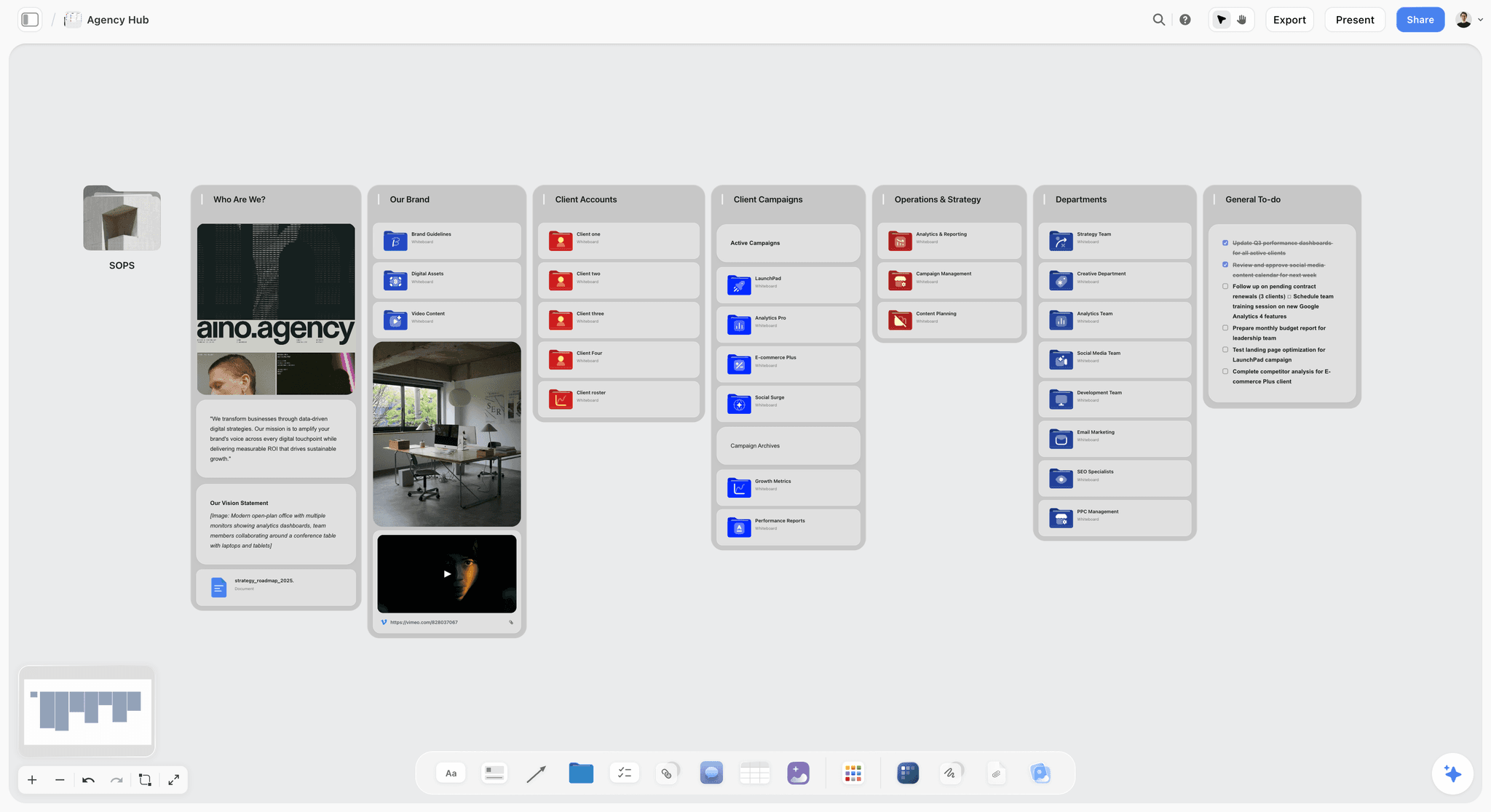
Storyflow is the alternative for people who do not actually want an autonomous agent. It is an AI-powered visual creative workspace: an infinite canvas with structured cards, documents, context-aware AI, and 200+ expert framework templates called Story Blueprints. Manus runs the work for you. Storyflow lets you run the work with AI, and that is a deliberate difference, not a smaller version of the same thing.
Manus is built on delegation: hand off a task, get a result. Storyflow is built on direction: you build the project on a canvas, the AI reads all of it, and you stay in control of every decision. For a research chore you want gone, Manus or ChatGPT Agent mode is the right call. For a campaign, a film treatment, a roadmap, or any work where your judgment is the point, a workspace beats an agent because you are in the loop while the thinking happens, not reviewing a black box after the fact.
Best for: Filmmakers, marketers, founders, product managers, and visual thinkers who want AI grounded in their full project context and want to direct the work rather than delegate it.
Verdict: The strongest pick when the goal is to think and create alongside AI with full context and full control. Not the pick if you specifically want hands-off automation.
Key features
- Context-aware AI. The AI reads your full active canvas board, plus up to 1 Tactic and up to 3 Documents you @-mention in the chat. It sees the whole problem, not a pasted fragment.
- 200+ Story Blueprints. Expert framework templates including the Hero's Journey, AIDA, and Retention Hooks, so AI-assisted work is grounded in real methodology. Included on Plus and above.
- Infinite visual canvas. Structured cards, documents, mood boards, and mind maps on one board, so the project lives in space instead of scrolling chat history.
- Free collaboration. Unlimited shared boards and unlimited collaboration on every paid plan, and on the Free plan when it launches before the end of 2026. Max adds a team workspace with permissions and roles.
Pricing
Paid-only during early access; anyone a paid member invites to a board joins free today. The Free plan, launching before the end of 2026, will include unlimited notes, images, and links, unlimited shared boards, basic AI, 20 file uploads, and unlimited collaboration, though not the 200+ Story Blueprints library. Plus: $7.99/mo annual or $9.99/mo monthly (200+ Story Blueprints, unlimited uploads). Pro: $14/mo annual or $19/mo monthly (adds AI image generation and 20x more AI than Plus). Max: $39/mo annual or $49/mo monthly (adds 40x more AI and a team workspace with permissions and roles).
Pros
- No credit roulette. Predictable flat pricing starting at $7.99/month, with a genuinely usable Free plan coming before the end of 2026.
- The AI sees your whole project, so output is on-brief instead of guessing from a prompt.
- You stay in control. Nothing runs unattended, so there is no black-box output to rescue.
Cons
- Storyflow is not an autonomous agent that executes multi-step tasks unattended. It is a workspace where you direct AI-assisted work. If you specifically want hands-off task automation, an agent like Manus or ChatGPT Agent mode fits that job better.
- Cloud-only; no local-first option for regulated-industry users.
- For pure software engineering, a coding agent like Devin is the right tool.
If your work is project-shaped and visual, and you have been fighting credit limits or rescuing black-box output, take your most active project and rebuild it on a Storyflow canvas for one week. Start a Storyflow workspace and run that test.
2. ChatGPT (with Agent mode)
ChatGPT with Agent mode is the strongest general autonomous agent in 2026 and the most direct Manus alternative. Agent mode gives ChatGPT its own virtual computer and browser to carry out multi-step tasks, and it is included on the $20/mo Plus plan rather than locked behind a $200 tier.
Best for: Anyone who wants the Manus model (hand off a task, walk away) with a more mature product and a far larger ecosystem behind it.
Verdict: The default autonomous-agent pick. Reliable, broadly capable, and reasonably priced for what it does.
Key features
- Agent mode with a sandboxed browser and computer for hands-off multi-step tasks.
- GPT-5.5 model family, Deep Research, Sora, and Codex in one product.
- Custom GPTs and the largest plugin and integration ecosystem of any AI tool.
- Voice mode and multimodal input across the same interface.
Pricing
Free tier with daily limits (no Agent mode). Go: $8/mo. Plus: $20/mo (includes Agent mode). Pro: $100/mo or $200/mo. Business: $25/user/mo. Verify current pricing as of May 2026.
Pros
- Agent mode is included with the $20 Plus plan, not a premium add-on.
- The broadest, most stable agent ecosystem available in 2026.
- Deep Research handles the sourced-report job that draws people to Manus.
Cons
- Agent mode still produces non-deterministic results; review every output.
- It is an agent, not a workspace. Sustained multi-week projects drift, the failure mode covered in Why ChatGPT Loses the Plot.
- Heavy agent and Codex use pushes you toward the $100 or $200 tiers.
3. Genspark
Genspark is an autonomous multi-agent workspace and the closest match to Manus in philosophy. Its Super Agent uses a Mixture-of-Agents architecture: an orchestrator breaks a request into subtasks, assigns them to specialized agents drawing on multiple LLMs and 80+ tools, then assembles a finished artifact.
Best for: People who liked Manus's end-to-end model and want a strong second option for research, slide decks, and landing-page builds.
Verdict: The strongest pure autonomous-agent alternative to Manus. It produces finished outputs, not just answers.
Key features
- Super Agent with a multi-agent orchestrator for complex, end-to-end tasks.
- 80+ integrated tools including web browsing, deck generation, and real phone calls.
- Sparkpages that assemble research into a structured, shareable artifact.
- Cross-verification between agents to reduce single-model errors.
Pricing
Free: 100 daily credits, no card required. Plus: $19.99/mo billed annually ($24.99 monthly), 10,000 credits. Pro: $199.99/mo annually ($249.99 monthly). Verify current pricing as of May 2026.
Pros
- Genuinely autonomous end-to-end execution, the Manus value without Manus pricing.
- AI chat and image generation do not consume credits on paid plans through December 2026.
- The multi-agent design handles broad research-to-artifact tasks well.
Cons
- Credit-based billing still applies to video, audio, browsing, and call agents.
- Quality varies across the 80+ tools; some are stronger than others.
- It is an agent, so you inherit the same non-deterministic-output review burden.
4. Claude (Anthropic)
Claude is the strongest AI assistant for nuanced reasoning and careful long-form work, and Claude Code extends it into agentic software work in the terminal. The Manus alternative for tasks where judgment matters more than speed.
Best for: Careful written work, analysis, and reasoning-heavy tasks where eager-sounding output is a liability.
Verdict: The best reasoning quality among the assistants here. A partial agent, not a full autonomous one.
Key features
- Strong long-context reasoning across the Claude model family.
- Projects for persistent context across sessions.
- Claude Code, an agentic coding tool that works in the terminal.
- Careful, calibrated tone that resists hype.
Pricing
Free tier with daily limits. Pro: $20/mo, or $17/mo billed annually. Max: $100/mo or $200/mo. Verify current pricing as of May 2026.
Pros
- Frequently rated the best at writing and nuanced reasoning.
- Claude Code is a genuine agentic option for developers.
- Calibrated tone needs less rewriting than most assistants.
Cons
- The consumer product is an assistant, not a hands-off autonomous agent.
- No native visual canvas; sustained project context drifts in chat.
- Smaller integration ecosystem than ChatGPT.
5. Google Gemini
Google Gemini is the AI assistant woven into Google Workspace, with agentic features expanding through 2026. The Manus alternative for anyone whose documents, email, and files already live in Google.
Best for: Google Workspace users who want AI inside the tools they already use.
Verdict: Strong, well-priced, and convenient inside Google. Less compelling as a standalone agent.
Key features
- Gemini across Gmail, Docs, Sheets, and Drive.
- Deep Research for multi-source report generation.
- Large context window for long documents.
- Bundled into Workspace plans rather than sold as a separate add-on.
Pricing
Free tier with daily limits. Gemini AI Pro: $19.99/mo. Workspace with Gemini bundled into Business plans from $14/user/mo. Verify current pricing as of May 2026.
Pros
- Gemini is bundled into Workspace plans at no extra per-seat charge.
- Deep Research covers the sourced-report job people use Manus for.
- Native access to your Google files is real context, not pasting.
Cons
- The standalone agentic capability lags ChatGPT Agent mode.
- Value collapses outside the Google ecosystem.
- Less of a true autonomous agent than Manus or Genspark.
6. Microsoft Copilot
Microsoft Copilot is the AI assistant built into Microsoft 365, with Copilot agents handling workflow automation across the suite. The Manus alternative for Microsoft-stack teams.
Best for: Teams already running Microsoft 365 who want AI inside Word, Excel, Outlook, and Teams.
Verdict: The strongest AI option for Microsoft-native teams. Less interesting outside the suite.
Key features
- Copilot across Word, Excel, PowerPoint, Outlook, and Teams.
- Copilot agents for workflow automation.
- Native access to your Microsoft 365 data and documents.
- Copilot Studio for building custom agents.
Pricing
Limited free use. Copilot Pro: $20/mo. Copilot Business: $21/user/mo standard, with a promotional rate through June 30, 2026. Verify current pricing as of May 2026.
Pros
- Deep Microsoft 365 integration is genuine context, not pasting.
- Copilot agents handle real workflow automation.
- Copilot Studio lets teams build their own agents.
Cons
- Sold as a per-seat add-on on top of Microsoft 365 licensing.
- Value collapses outside the Microsoft ecosystem.
- Standalone autonomous capability lags the dedicated agents.
7. Perplexity
Perplexity is the answer engine that ships with sources by default, and Perplexity Max adds an agentic computer mode. The Manus alternative when the job is sourced research and analysis.
Best for: Market research, competitive analysis, and any work that needs verifiable citations.
Verdict: The strongest research-grade AI here. Citations are the feature people stay for.
Key features
- Every answer ships with citations.
- Deep multi-source research synthesis.
- Spaces for grouping research threads.
- Perplexity Computer on Max, an agentic mode orchestrating multiple models.
Pricing
Free tier with limited use. Pro: $20/mo. Max: $200/mo (includes Perplexity Computer with 10,000 credits/mo). Education: $10/mo. Verify current pricing as of May 2026.
Pros
- Citations matter for anyone who pitches research internally or to clients.
- Strong on current-information queries where other tools go stale.
- Max's agentic computer mode handles multi-step research autonomously.
Cons
- Built for research, not for generation or sustained project work.
- The agentic computer is gated behind the $200 Max tier.
- Spaces are lighter than a real canvas for ongoing projects.
8. Devin
Devin, from Cognition, is an autonomous AI software engineer. The Manus alternative when the multi-step task is specifically writing, testing, and shipping code.
Best for: Engineering teams who want an autonomous agent that handles coding tasks end to end.
Verdict: The most capable autonomous coding agent here. Costs scale fast with real usage.
Key features
- Autonomous coding: plans, writes, tests, and debugs.
- Devin 2.0 dropped the entry price from around $500/mo to $20/mo.
- Integrates with GitHub, Slack, and developer workflows.
- Parallel task execution across multiple work streams.
Pricing
Core: $20/mo with pay-as-you-go ACU billing at $2.25 per ACU. Team: $500/mo with 250 ACUs. Enterprise: custom. A moderately complex task can consume 5 to 20 ACUs. Verify current pricing as of May 2026.
Pros
- A genuine autonomous engineer, not a chat-based coding assistant.
- Devin 2.0 made the entry price accessible to individuals.
- Parallel execution suits teams running multiple tasks.
Cons
- ACU billing means real monthly cost far exceeds the $20 base.
- Only useful for software work; no value outside engineering.
- Autonomous code still needs human review before it ships.
9. Replit Agent
Replit Agent builds and ships working applications from a natural-language prompt inside the Replit cloud IDE. The Manus alternative when the goal is a deployed app, fast.
Best for: Developers and technical founders who want to go from prompt to deployed app in one environment.
Verdict: The fastest path from idea to shipped app. Best for prototypes and small products.
Key features
- Builds full applications from a prompt, including frontend and backend.
- Cloud IDE with hosting and deployment built in.
- Iterative refinement through conversation.
- Database and integration setup handled automatically.
Pricing
Free tier with limited use. Paid plans bill agent usage on a usage-based model. Verify current pricing as of May 2026.
Pros
- Prompt to deployed app without leaving one environment.
- Hosting and deployment are built in, not a separate step.
- Strong for prototypes and rapid validation.
Cons
- Usage-based agent billing makes monthly cost hard to predict.
- Less suited to large existing codebases than Devin.
- Generated apps need engineering review before production.
10. Lovable
Lovable is an AI app-builder agent that turns a description into a working web app. The Manus alternative for non-coders who want to build software, not automate chores.
Best for: Non-technical founders, designers, and product people building web apps without writing code.
Verdict: The most accessible app builder here. Genuine for prototypes; review needed for production.
Key features
- Natural-language app generation, frontend and backend.
- Live preview and conversational iteration.
- Custom domains and a code editor on paid plans.
- Deployment built in.
Pricing
Free: 5 daily credits, capped at 30/mo. Pro: $25/mo. Business: $50/mo. Students can get up to 50% off Pro for the first year. Verify current pricing as of May 2026.
Pros
- Genuinely usable by non-coders.
- Fast from idea to working prototype.
- Student discount makes Pro one of the cheapest builders.
Cons
- Credit-based, so heavy iteration burns through allocations fast.
- Generated code needs engineering review before production.
- Built for app building, not general task automation.
11. Flowith
Flowith is an agentic workspace that runs multiple AI agents on an infinite canvas. It sits between an agent and a workspace, and its Agent Neo can run tasks in the background.
Best for: People who want multi-agent autonomy but also want to see the work laid out spatially.
Verdict: An interesting hybrid. The canvas helps; credit consumption on heavy agent use does not.
Key features
- Infinite canvas for organizing multi-agent work.
- Agent Neo for background, multi-step task execution.
- 40+ models accessible from one workspace.
- Composer for structured multi-step generation.
Pricing
Starter: free, 1,000 one-time credits. Professional: $15.32/mo annual ($19.90 monthly), 22,000 credits/mo. Ultimate: $39.92/mo annual ($49.90 monthly). Infinite: $459.90/mo annual. Verify current pricing as of May 2026.
Pros
- The canvas makes multi-agent work more legible than a chat log.
- 40+ models in one place is convenient.
- The free tier is enough to evaluate the model.
Cons
- Heavy Agent Neo use can exhaust a Professional plan's credits in one to two weeks.
- The hybrid identity means it is not the best pure agent or pure workspace.
- Newer product with a smaller ecosystem than the leaders.
12. Convergence AI (Proxy)
Proxy, from London-based Convergence AI, is a general browser agent that autonomously carries out web tasks and can learn repeatable workflows. The Manus alternative for browser-based automation specifically.
Best for: People who want to automate repeatable web tasks like form-filling, monitoring, and data collection.
Verdict: A focused browser agent. Narrower than Manus, and that focus is the point.
Key features
- Autonomous browser agent for web-based tasks.
- Learns and saves repeatable automations.
- Parallel session execution.
- Handles email, site analysis, and store reviews.
Pricing
Free: 5 sessions daily, 2 parallel, 1 automation. Pro: $20/mo, unlimited sessions, 5 parallel, 20 automations. Verify current pricing as of May 2026.
Pros
- Genuinely useful for repeatable web automation.
- Flat $20/mo Pro pricing is predictable, with no credit roulette.
- Saved automations make recurring tasks fast.
Cons
- Narrower scope than a general agent like Manus.
- Smaller company and ecosystem than the leaders.
- Web tasks break when target sites change layout.
7) Recommendations by Persona
13. Founder / Operator
Top picks: ChatGPT (Agent mode) + Storyflow
ChatGPT Agent mode for the hands-off chores: research digests, competitor monitoring, repetitive admin. Storyflow for the work a founder cannot delegate: positioning, strategy, the roadmap. One agent for the chores, one workspace for the thinking. See The 12 Best AI Tools for Startups in 2026.
14. Researcher / Analyst
Top picks: Perplexity + Genspark
Perplexity for sourced answers with citations you can defend. Genspark when the deliverable is a full research artifact, not a single answer. Both cover what people use Manus's research mode for.
15. Marketer / Brand Strategist
Top picks: Storyflow + ChatGPT (Agent mode)
Storyflow for the campaign canvas where the brief, audience, and copy stay coherent and grounded in Story Blueprints like AIDA. ChatGPT Agent mode for one-off research and quick automation around the campaign.
16. Software Engineer / Technical Founder
Top picks: Devin + Replit Agent
Devin for autonomous work inside a real codebase. Replit Agent for going from prompt to deployed app fast. Both are the right shape for software; a general agent is not.
17. Non-Technical Builder
Top picks: Lovable + Storyflow
Lovable to turn an idea into a working web app without code. Storyflow to plan the product, map the user flows, and structure the launch before and after the build.
18. Documentary Filmmaker / Creative
Top picks: Storyflow + Claude
Storyflow for the visual project canvas where research, treatment, and structure live together with context-aware AI. Claude for nuanced drafting where tone matters. This is creative work you direct, not work you delegate.
19. Microsoft 365 or Google Workspace Team
Top picks: Microsoft Copilot or Google Gemini
If your team lives in Microsoft 365, Copilot is the natural pick. If it lives in Google Workspace, Gemini is bundled and convenient. Pick by which suite you already pay for.
8) Honorable Mentions
A few tools that came close but did not make the main twelve.
- Lindy.ai: Strong for business-process automation and AI agents wired into operations. Narrower than a general agent, but excellent at its job.
- AutoGPT: The open-source autonomous-agent project. Powerful for technical users who want full control and self-hosting.
- Operator (OpenAI): OpenAI's browser-action agent. Increasingly folded into the broader ChatGPT Agent experience.
- Cursor: An AI-first code editor. More assistant than autonomous agent, but the strongest in-editor coding experience.
- n8n with AI nodes: Workflow automation with AI steps. The pick when you want deterministic, wired automation rather than an autonomous agent.
These are not weaker tools. Their scope is narrower or their audience more specific than the main list.
9) Where an Autonomous Agent Is Still the Wrong Tool
Honest accounting matters. An autonomous agent like Manus, ChatGPT Agent mode, or Genspark is genuinely useful, but there are jobs where handing work to an unattended agent is the wrong move.
- Work where your judgment is the deliverable. Positioning, strategy, a creative concept, a film treatment. The value is the thinking, and an agent skips the part where you do it.
- Trial-and-error creative work. Agents bill by task. Creative work is iteration. Credit-based autonomy makes the natural creative loop expensive.
- Anything that must be exactly right. Non-deterministic output means review is mandatory. For high-stakes deliverables, the review can take longer than the work.
- Work that needs full project context. An agent sees the task you gave it. A workspace sees the whole project. For sustained, multi-week work, context beats autonomy.
- Sensitive or regulated data. Cloud-sandbox agents touch your data in environments you do not control. For regulated work, verify the data handling first.
The pattern: delegate the chore, direct the craft. Use an autonomous agent for bounded, repeatable, low-stakes tasks. Use a visual workspace like Storyflow for the work where staying in control is the point. Most people in 2026 need both, and knowing which job is which is the actual skill.
11) The Bottom Line
The best Manus AI alternative in 2026 depends on whether you want the same idea or its opposite. ChatGPT with Agent mode is the strongest general autonomous agent, included with the $20/mo Plus plan, and the most direct replacement for Manus. Genspark is the strongest second autonomous agent, with multi-agent execution from $19.99/mo annual. Storyflow is the pick for people who do not actually want an agent at all: a visual AI workspace where you direct AI-assisted work with full project context and stay in control, paid-only during early access with plans from $7.99/mo annual and a Free plan launching before the end of 2026.
Manus is a real product and a genuinely useful one for hands-off automation. But delegation is the wrong model for work where your judgment is the deliverable. Delegate the chore, direct the craft. Use an autonomous agent for bounded, repeatable tasks. Use a workspace for the campaign, the treatment, the roadmap, the work you are actually paid to think through.
If you have been fighting credit limits or rescuing black-box output, the test is simple: take your most active project and rebuild it on a Storyflow canvas for one week. Start a Storyflow workspace and see whether directing the work beats delegating it.
10) FAQ: Manus AI Alternatives in 2026
What is the best Manus AI alternative in 2026?
For hands-off autonomous task automation, ChatGPT with Agent mode is the best alternative, included with the $20/mo Plus plan. Genspark is the strongest second autonomous agent. For people who want to direct AI-assisted work on a visual canvas rather than delegate it, Storyflow is the pick.
Is there a free Manus AI alternative?
Yes. ChatGPT, Google Gemini, Claude, and Perplexity all have free tiers, though Agent mode requires ChatGPT Plus. Genspark offers 100 daily free credits. Storyflow is paid-only during early access; its Free plan, launching before the end of 2026, will include unlimited boards, unlimited collaboration, and basic AI, and anyone a paid member invites to a board joins free today.
Why is Manus AI so expensive?
Manus runs on a credit system, and credits scale with task complexity. Reviewers report that failed tasks do not refund credits and that Agent mode can drain a monthly allocation quickly. Flat-priced alternatives like ChatGPT Plus ($20/mo) or Storyflow (from $7.99/mo annual) make the monthly cost predictable.
What is the difference between Manus and ChatGPT Agent mode?
Both are autonomous agents that run multi-step tasks in a sandboxed environment. ChatGPT Agent mode is built into a more mature product with a larger ecosystem and is included with the $20/mo Plus plan. Manus is a standalone agent with credit-based billing. For most users, ChatGPT Agent mode is the more reliable choice.
Is Storyflow an autonomous agent like Manus?
No, and that is deliberate. Storyflow is a visual AI workspace where you direct AI-assisted work and stay in control. Manus runs tasks unattended. If you want hands-off automation, pick an agent. If you want to think and create alongside AI with full project context, pick Storyflow.
What is the best Manus alternative for research?
Perplexity is the best for sourced research because every answer ships with citations. Genspark is strong when you need a full research artifact rather than a single answer. ChatGPT's Deep Research also covers the sourced-report job that draws people to Manus.
What is the best Manus alternative for coding?
Devin is the most capable autonomous coding agent, handling real codebases end to end. Replit Agent is best for going from a prompt to a deployed app fast. Lovable is the pick for non-coders building web apps. A general agent is the wrong tool for software work.
Is Genspark a good Manus alternative?
Yes. Genspark is the closest match to Manus in philosophy. Its multi-agent Super Agent breaks tasks into subtasks across specialized agents and assembles finished artifacts. It starts at $19.99/mo billed annually, well below Manus's higher tiers.
Should I use one Manus alternative or several?
Most people in 2026 use two: one autonomous agent for bounded, repeatable chores and one workspace for the work they need to control. A common pairing is ChatGPT Agent mode plus Storyflow. Match the tool to the job rather than forcing one tool onto everything.
Are autonomous AI agents reliable in 2026?
They are improving but still non-deterministic. Research from Anaconda and Forrester found that 88% of agent pilots never reach production, and 70% of leaders name non-deterministic outputs as the top barrier. Always review an autonomous agent's output before relying on it.
What is the cheapest Manus AI alternative?
Storyflow is paid-only during early access, with Plus at $7.99/mo billed annually and a Free plan launching before the end of 2026. ChatGPT Plus and Claude Pro are $20/mo. Flowith's Professional plan is $15.32/mo billed annually. Several tools offer free tiers today, though autonomous agent features are often gated to paid plans.
Can a visual AI workspace replace an autonomous agent?
For some jobs, yes; for others, no. A workspace like Storyflow replaces an agent for project work where your judgment shapes the result. An agent like Manus or ChatGPT Agent mode is still better for bounded, repeatable tasks you genuinely want done for you. Delegate the chore, direct the craft.
Table of Contents
- Quick Answer: The Best Manus AI Alternatives in 2026
- Comparison Table: 12 Manus AI Alternatives Compared
- Why People Look for a Manus AI Alternative
- How We Evaluated These Tools
- Quick Picks by Job to Be Done
- Detailed Reviews: 12 Manus AI Alternatives in 2026
- Recommendations by Persona
- Honorable Mentions
- Where an Autonomous Agent Is Still the Wrong Tool
- FAQ: Manus AI Alternatives in 2026
- The Bottom Line
- Author
- Related Reading
Templates to check out for this topic


Templates you can use in Storyflow
Every Storyflow board starts from real structure and an AI that reads the whole canvas. Open one of these templates and make it yours.


See Storyflow in Action
A visual AI workspace where every feature lives inside one canvas. No tab-switching, no context lost.
Build your entire board from a single message
Type what you need in the AI chat at the bottom of your canvas. The AI adds cards, headings, and structure directly onto your board.
Use expert frameworks as AI context
Type @ in the AI chat and choose any Tactic. The AI tailors every response to that framework instead of giving generic advice.
Turn your board into a mind map in seconds
Ask the AI to restructure your canvas as a mindmap. It connects your ideas into a visual hierarchy so you can see how everything relates.
Why Storyflow Exists
Storyflow actually began as a personal tool while working on creative and research projects.
We kept running into the same problem: ideas were scattered everywhere: notes, documents, and whiteboards.
Nothing helped us see how everything connected.
So we started building a workspace designed around how ideas actually grow.
→ Read how Storyflow was createdJustkay
Documentary Filmmaker & Founder at Storyflow
Published: 2026-05-19
Extremely simple, seriously capable


See how easy it is to get started
Watch a real project come together, from a blank board to a finished plan, clicked through step by step.
Start creating with AI and become more productive
Transform your creative workflow with AI-powered tools. Generate ideas, create content, and boost your productivity in minutes instead of hours.