How to Write a Content Strategy with AI: A Step-by-Step Guide (2026)
Most people write a content strategy by asking AI to produce one - and get a document built on assumptions, not real knowledge. Here's how to use AI at each individual stage to research, structure, and pressure-test your thinking while you supply the judgment.

Category
Content Strategy & Marketing
Author

Sara de Klein
Head of Product at Storyflow
Topics
February 28, 2026
•
20 min read
•
Content Strategy & Marketing- how to write a content strategy with AI
- AI content strategy
- content pillars
- editorial calendar
- Storyflow content strategy
How do you write a content strategy with AI?
Write a content strategy with AI in 9 steps: define one measurable goal, research your audience's real questions, audit existing content, pick 3-5 pillars, research topics per pillar, choose channels, build a pillar-rotation calendar, write the first month of briefs, and set a measurement framework. Use AI per step, not one giant prompt.

Most people write a content strategy by asking AI to produce one - and what they get is a document that sounds strategic but is built on the AI's assumptions about their audience, not real knowledge. The better approach is to use AI at each individual stage: to research, structure, and pressure-test your thinking while you supply the judgment. Follow this guide and you'll have a complete content strategy with defined pillars, a channel plan, and a 90-day editorial calendar ready to execute.
The Problem Most Content Strategies Are Built to Fail
You've been here: you open a Google Doc, type “Content Strategy 2026” at the top, and spend two hours reading other people's templates instead of building your own. By the end of the session, you have a lot of browser tabs, a few bullet points, and a lingering sense that you need to “post more consistently.”
The problem isn't motivation. It's that most people try to do the research, hold the structure, generate the ideas, and write the strategy simultaneously - in a single document.That's too many cognitive demands running in parallel without the right infrastructure to hold them.
Adding AI to this process doesn't fix it automatically. Asking a chatbot to “write me a content strategy” produces something formatted like a strategy but grounded in nothing specific about your business, your audience, or the real problems you solve. The output looks complete. It isn't.

Content strategy built in Storyflow, audience research, pillars, and 90-day calendar on one board
What You Need Before You Start
- A specific business objective. Not “grow our audience” - something measurable, like “generate 40 qualified leads per month from organic content” or “build topical authority in the sustainable fashion space by Q3.”
- Basic audience knowledge. Even rough personas help. You need to know who you're writing for and what they're trying to accomplish - demographics alone won't get you useful AI suggestions.
- Competitor awareness. Identify 3-5 competitors whose content you've noticed getting traction. You'll use this to find gaps your pillars can own.
- 90 minutes for the initial session. The first pass takes longer because you're making the foundational decisions. Iterations are faster once the structure exists.
- A visual AI workspace with frameworks built in. Storyflow's free tier is sufficient for everything in this guide. What matters is having a canvas where AI can see your entire project at once - your research, your pillars, your audience notes - not just the line you're currently typing.
How to Write a Content Strategy with AI: Step by Step
Step 1: Define Your Goal and Set a Measurable Target
The output of this step is a single strategic sentence - not a mission statement, but a concrete anchor you'll test every content decision against.
A goal like “increase brand awareness” produces a fundamentally different strategy than “drive trial signups from first-time visitors.” Both might use blog content - but the topics, formats, and calls to action will be entirely different. Write one sentence that completes this: “We are creating content to achieve [specific outcome] for [specific audience] by [date].”
Then use your AI to pressure-test it. Prompt: “What would have to be true for this goal to be achievable? What assumptions am I making about the audience?” Creators who define a specific outcome before building their strategy are significantly more likely to produce content consistently past the 90-day mark - because every piece has a clear “why” behind it. A production target like “post 3× per week” sounds specific but is not a strategic goal.
Where Storyflow helps
Open a new board and use the AI assistant to explore your goal. Because Storyflow's AI reads your full board - not just your last message - it can flag later in the process when your stated goal and your planned content don't align. The Content Strategy Blueprint walks you through this framing as the first card.
Common mistake
Setting a goal that sounds specific - “post 3× per week” - but is actually a production target, not a strategic outcome, which means every content decision is made in a vacuum with no real filter.
Step 2: Research Your Audience With AI
Your audience definition needs to be a working document that answers one specific question: what are they searching for, frustrated by, and trying to accomplish when your content could help them?
Use your AI to build this out. Prompt: “I'm creating content for [describe your audience]. What are the top 10 questions they're likely searching for before they find a solution like mine? What frustrations drive those searches?” Then do the same for objections: “What would make this audience skeptical of content from a brand like mine?” The goal is a one-page audience document - who they are, what they're looking for, what they're worried about, and the specific language they use.
This document becomes the reference point your AI draws on in every subsequent step. Describing your audience by demographics - “25-45-year-old marketers” - rather than by the specific problem they're trying to solve makes every AI suggestion generic. The demographic answer produces persona slides. The problem answer produces useful content ideas.
Where Storyflow helps
Use Storyflow's User Persona Tactic to structure each insight as a separate Card - one card per question, frustration, or objection. The Target Audience template gives you this structure pre-built. When you build content pillars in Step 4, you can organize these cards into the relevant pillar column and see at a glance which audience needs each pillar addresses.
Common mistake
Skipping directly to the calendar because audience research feels less urgent - which produces content that answers questions the brand finds interesting rather than questions the audience is actually searching for.
Step 3: Audit What Content You Already Have
Before planning what to create, take 20 minutes to document what already exists - and what condition it's in.
Pull your top 10 performing pieces if you have them. If you're starting from scratch, list topics you've already addressed publicly - even in presentations, emails, or sales conversations. Ask your AI: “Given this list of existing content and my goal [from Step 1], what topics are already covered? Where are the obvious gaps? What could be updated or expanded rather than created from scratch?”
The output is a simple three-column audit: “Strong - build on,” “Weak - update or cut,” and “Gap - needs to exist.”Seeing this spatially - rather than as rows in a spreadsheet - reveals where you're over-indexed and where you have almost nothing. Most teams discover they've written extensively on one area and have a complete blind spot on another.
Where Storyflow helps
Map your audit on a Storyflow board, one column per category. Patterns that hide in a spreadsheet become obvious on a visual canvas - particularly the gaps, which tend to disappear when everything is in list form.
Common mistake
Skipping the audit and building a strategy that unknowingly duplicates existing content or ignores your current strengths - which means starting from zero when you already had something to build on.
Turn your goal, audience, and audit into a strategy document
You have finished the three inputs every strategy is built from. Storyflow's AI strategy generator maps them into pillars, a channel mix, and a first-month calendar on one board, with the reasoning attached to every card.

Step 4: Identify Your Content Pillars
Content pillars are the 3-5 core themes your content will consistently address, sitting at the intersection of your audience's needs, your genuine expertise, and topics with real search demand.
Use your AI to cross-reference: “Given these audience questions [from Step 2] and these content gaps [from Step 3], what 4 content pillars would address the most important audience needs while staying within our area of expertise?” The test for a good pillar: it's broad enough to generate 10+ topic ideas and specific enough that every piece feels intentional.
Worked example - sustainable fashion brand
- Sustainable Shopping Guides - purchase intent audience, clear search demand
- Behind the Label - supply chain transparency, brand differentiator
- Style That Lasts - longevity-focused styling, avoids trend-chasing
- Industry Watch - brand accountability and policy, authority positioning
Each pillar addresses a distinct audience need and connects to how the business makes money - the test most teams skip.
Where Storyflow helps
Storyflow's Content Strategy Blueprint defines each pillar as a column on your board. The Tactic framework walks you through validating each pillar against audience need and business fit - so you're not just naming themes, you're building a defensible structure with the theory behind each decision embedded in the card.
Common mistake
Choosing pillars that reflect what you want to talk about rather than what your audience is searching for - resulting in content that feels right internally but earns no organic traction.
Step 5: Research Topics and Keywords for Each Pillar
With your pillars defined, populate each one with specific topic ideas - and filter deliberately by audience intent, not just volume.
For each pillar, prompt: “Generate 20 topic ideas for a [describe your brand] targeting [describe your audience] under the pillar ‘[pillar name].’ Focus on questions people search for, common misconceptions, and practical how-to angles. Include both informational and comparison topics.” Then filter by asking: “Which of these topics align most directly with our goal of [from Step 1]? Which would attract someone closest to making a decision?”
Worked example - “Sustainable Shopping Guides” pillar
AI generates 20 ideas. The three highest-value topics after filtering by purchase intent:
- “Sustainable fashion brands that actually pay living wages” - targets someone researching before buying
- “How to verify a brand's sustainability claims” - skeptical buyer who has been burned by greenwashing
- “Sustainable wardrobe capsule for under $400” - budget-aware buyer with purchase intent
Each targets someone with purchase intent, not passing curiosity - which is the filter most teams skip.
Where Storyflow helps
Use Storyflow's AI assistant to rank your topic list by potential impact, then use Cards to organize approved topics by pillar. Each Card holds the topic, target keyword, audience intent, and planned format - so the calendar you build in Step 7 is grounded in this research, not assembled from memory.
Common mistake
Generating all topics in a single undifferentiated list, which makes the editorial calendar feel random rather than strategic when you try to schedule it - and makes it impossible to spot coverage gaps per pillar.
Step 6: Choose Your Channels and Content Mix
Where you publish matters as much as what you publish - and a content strategy built around one primary channel consistently outperforms one spread across six.
Use your audience research to guide this. Ask your AI: “Based on what I know about my audience [paste the audience document from Step 2], which 2-3 channels are most likely to reach them when they're looking for this type of content? What format works best on each channel?” Creators who commit to fewer channels produce higher-quality content and build algorithmic traction faster - most platforms reward depth of engagement over surface-level presence.
The practical structure: one primary channel where you publish core content, one distribution channel where you repurpose it for reach, and one owned channel - email, for instance - that you control regardless of algorithm changes. Three channels is a publishing system. Six is a content treadmill.
Common mistake
Choosing channels based on where you're most comfortable rather than where your audience actually goes for this type of content - which produces effort without traction.
Step 7: Build Your Content Calendar Structure
A content calendar is not a list of posts - it's a publishing system with a rhythm, a lead time, and built-in flexibility structured around your pillar rotation.
Define your cadence first: how many pieces per channel per week is sustainable without sacrificing quality? Most teams underestimate lead time and overestimate capacity. A realistic cadence for a two-person team is one long-form piece per week and three short-form pieces - not five long-form pieces that never get finished. Then structure the calendar by pillar rotation: if you have four pillars, rotate through them weekly. This ensures you build coverage across all themes and prevents over-indexing on one topic while another goes quiet.
What a pillar rotation looks like
- Week 1 - Pillar A (long-form) + short-form repurpose
- Week 2 - Pillar B (long-form) + short-form repurpose
- Week 3 - Pillar C (long-form) + short-form repurpose
- Week 4 - Pillar D (long-form) + short-form repurpose
- Week 5 - back to Pillar A, now building on the first piece
Where Storyflow helps
Use a Storyflow board with one column per week - the Marketing Plan template opens with this layout ready. Under each week, place Cards for each planned piece - pillar, topic, format, channel, and deadline all visible at once. When priorities shift, you can drag and reorder without losing the strategic logic behind each piece.
Common mistake
Building a content calendar in a spreadsheet with no visual layout, which makes it impossible to spot when you've published three pieces on the same pillar in a row while another has been dormant for six weeks.
Step 8: Write Your First Month of Content Briefs
A content brief is the difference between a piece that takes three hours and one that takes six - it contains everything a writer needs to produce a good draft without starting from scratch.
Use your AI to generate briefs for your first four pieces. For each, prompt: “Write a content brief for an article titled ‘[title]’ targeting the keyword ‘[keyword]’ for [audience description]. Include: the angle, key questions the piece must answer, related keywords, and suggested examples or data points.” Then review each brief before it goes into production - the AI-generated version is a starting point, and your judgment shapes the angle, the examples, and the specific insights.
Worked example brief - “How to verify a brand's sustainability claims”
- Angle: Reader is skeptical and has been burned by greenwashing before
- Key questions to answer: What certifications actually mean something? How do I read a supply chain transparency report? What red flags distinguish a marketing claim from a real commitment?
- Suggested data: Percentage of brands with independently verified versus self-reported sustainability claims
- CTA: Download the brand audit checklist
Where Storyflow helps
Store each content brief as a document linked to the relevant Card on your calendar board. The AI assistant can read the brief in context - alongside your audience document and pillar definitions - and help develop the outline or first draft without losing the strategic direction set earlier in the process.
Common mistake
Writing briefs that are just topic titles and word counts - leaving writers without a defined angle, which produces inconsistent quality and pieces that could have been written by anyone.
Step 9: Set Up Your Measurement Framework
A content strategy without measurement is a plan that can't improve - but most content measurement tracks the wrong signals at the wrong time.
Define one primary metric per content goal. If your goal is lead generation, measure conversion rate from content pages, not total traffic. If your goal is authority building, measure time on page and return visitor rate - signals that readers found the content worth staying for. Vanity metrics like follower count tell you what happened in the feed, not whether the content is doing its actual job.
Set a 90-day review cadence. At 30 days, check whether content is being produced on schedule. At 60 days, check early engagement signals - shares, time on page, return visits. At 90 days, check business outcomes. Most content strategies get abandoned at 45 days - before content has had time to build search authority, which typically takes 60-90 days minimum for new content on a new domain.
Common mistake
Evaluating content performance at 30 days and abandoning a strategy that would have compounded meaningfully by day 90 - content authority builds slowly, then suddenly.
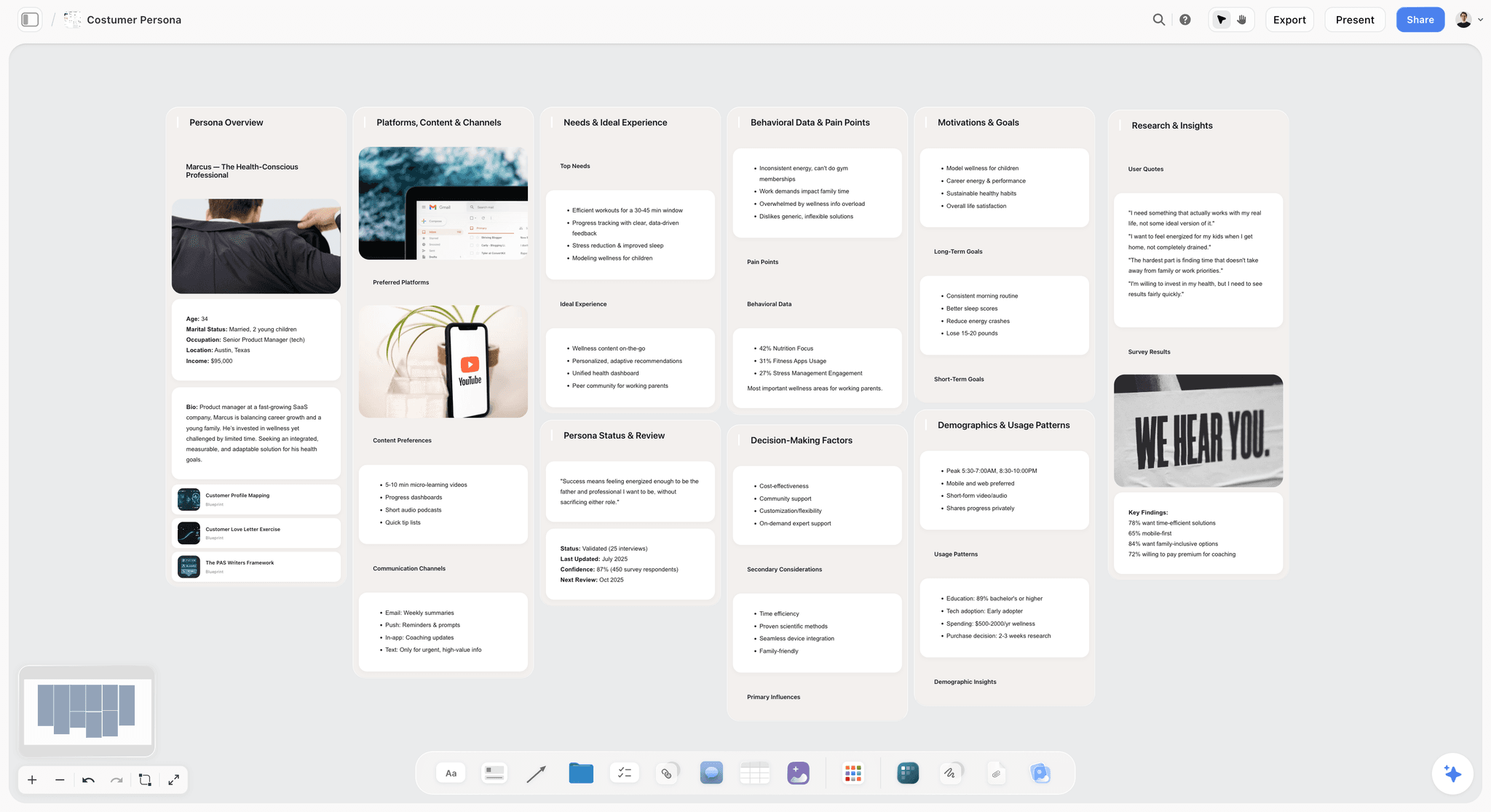
Build customer personas alongside content pillars for audience-first strategy
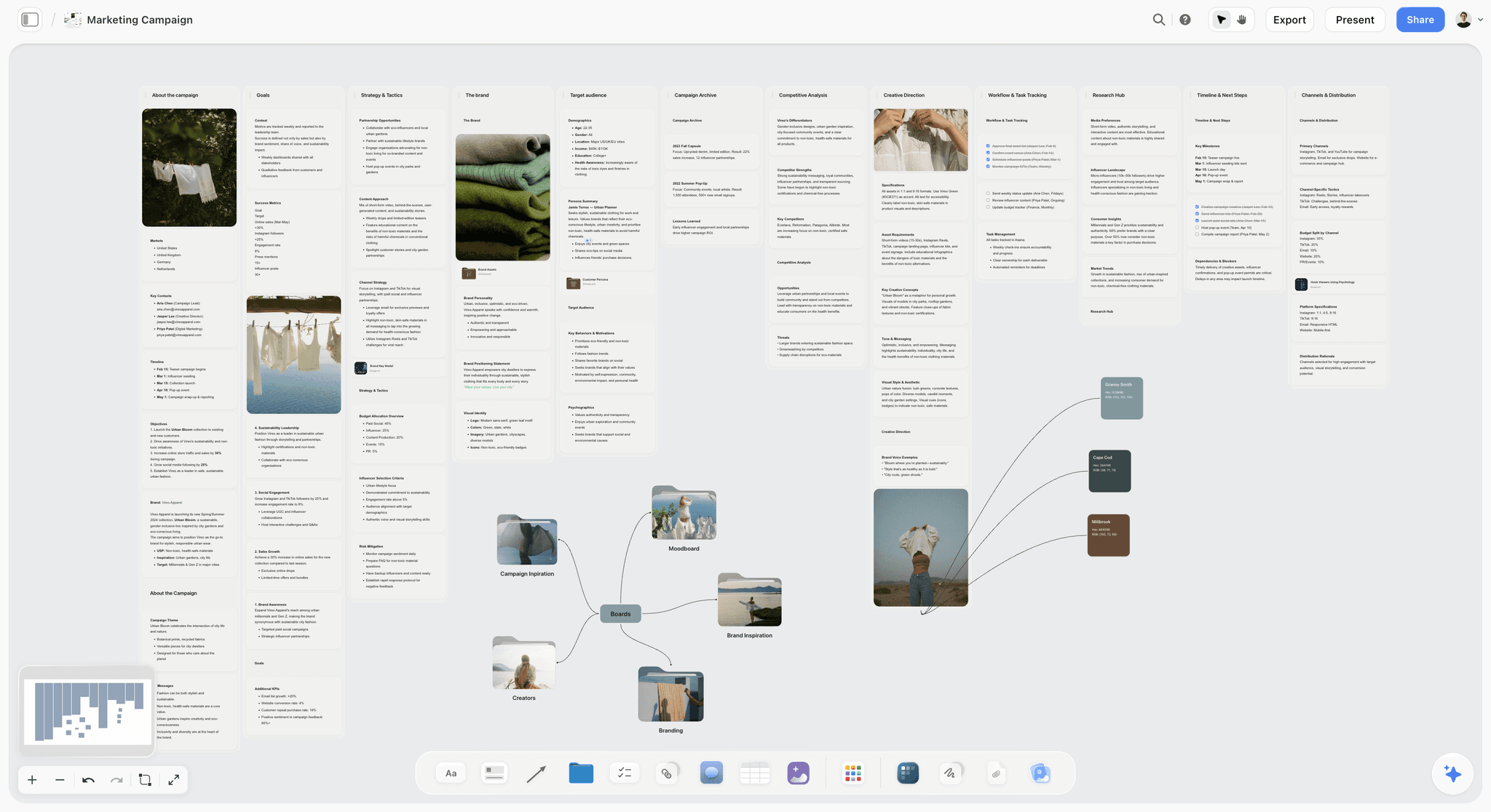
Campaign execution flows directly from strategy, no switching between tools
The 9-Step Process at a Glance
- Define your goal - one specific, measurable strategic outcome
- Research your audience - questions, frustrations, and language they use
- Audit existing content - keep, update, or identify what's missing
- Identify content pillars - 3-5 themes at the intersection of audience need and expertise
- Research topics and keywords - 20 ideas per pillar, filtered by intent
- Choose your channels - one primary, one distribution, one owned
- Build your calendar structure - pillar rotation and a realistic cadence
- Write content briefs - angle, key questions, examples, and CTA for each piece
- Set up your measurement framework - outcomes first, vanity metrics never
Tips and Best Practices
Start with the audience document, not the calendar
Most teams build the calendar first and then try to make the content match the audience. This produces content that fills slots rather than solves problems. The audience research document is the foundation everything else rests on - if it's vague, every piece will be vague. Spend at minimum 30 minutes on Step 2 before building the calendar, even if it feels slower in the moment.
Give your AI workspace context, not isolated prompts
I used to ask AI for content ideas in blank chat windows and get responses that sounded fine but didn't connect to anything I was building. Once I started keeping all my research, pillar definitions, and audience notes inside Storyflow - where the AI reads the full board - the suggestions became grounded in what I was actually working on, not a generic version of my industry. The difference between a helpful AI suggestion and a useless one is almost always the quality of context you've given it.
Rotate pillars deliberately - don't let the calendar drift
If your calendar doesn't have a pillar rotation system built in from the start, you'll naturally drift toward the topics you find most comfortable. Three months in, you'll discover you've published 20 pieces on one pillar and three on another. Build the rotation into the structure before you publish anything - it's nearly impossible to correct retroactively without disrupting your audience's experience.
Treat the AI draft as the 60% draft
When I use AI to draft a piece from a brief, the first move is not to publish it - it's to fact-check it, add real examples from direct experience, and find the specific insight that only comes from having done this work. AI produces the structure and the scaffold. The 100% draft requires an editor who actually knows the subject. Storyflow's Content Strategy Blueprint surfaces this distinction at every card: theory from AI, application from you.
Timebox the initial strategy session to 90 minutes
The most paralyzing content strategies are the ones that take three weeks to write. A strategy exists to make daily content decisions faster - not to be comprehensive before a single piece gets published. Ninety minutes is enough for a solid first pass through all nine steps. You refine it with real data over the next quarter, not in the planning session.
Review the strategy every quarter, not once a year
Audience needs and content trends move faster than annual planning cycles. Set a 90-day review and be willing to adjust pillars if the data suggests one isn't performing. A strategy that adapts on real evidence beats a perfectly formatted document that goes untouched. Unlike ChatGPT, which resets between sessions, Storyflow's AI reads the full active board (every card, note, and decision on it) each time you ask, so quarterly updates preserve the strategic context.
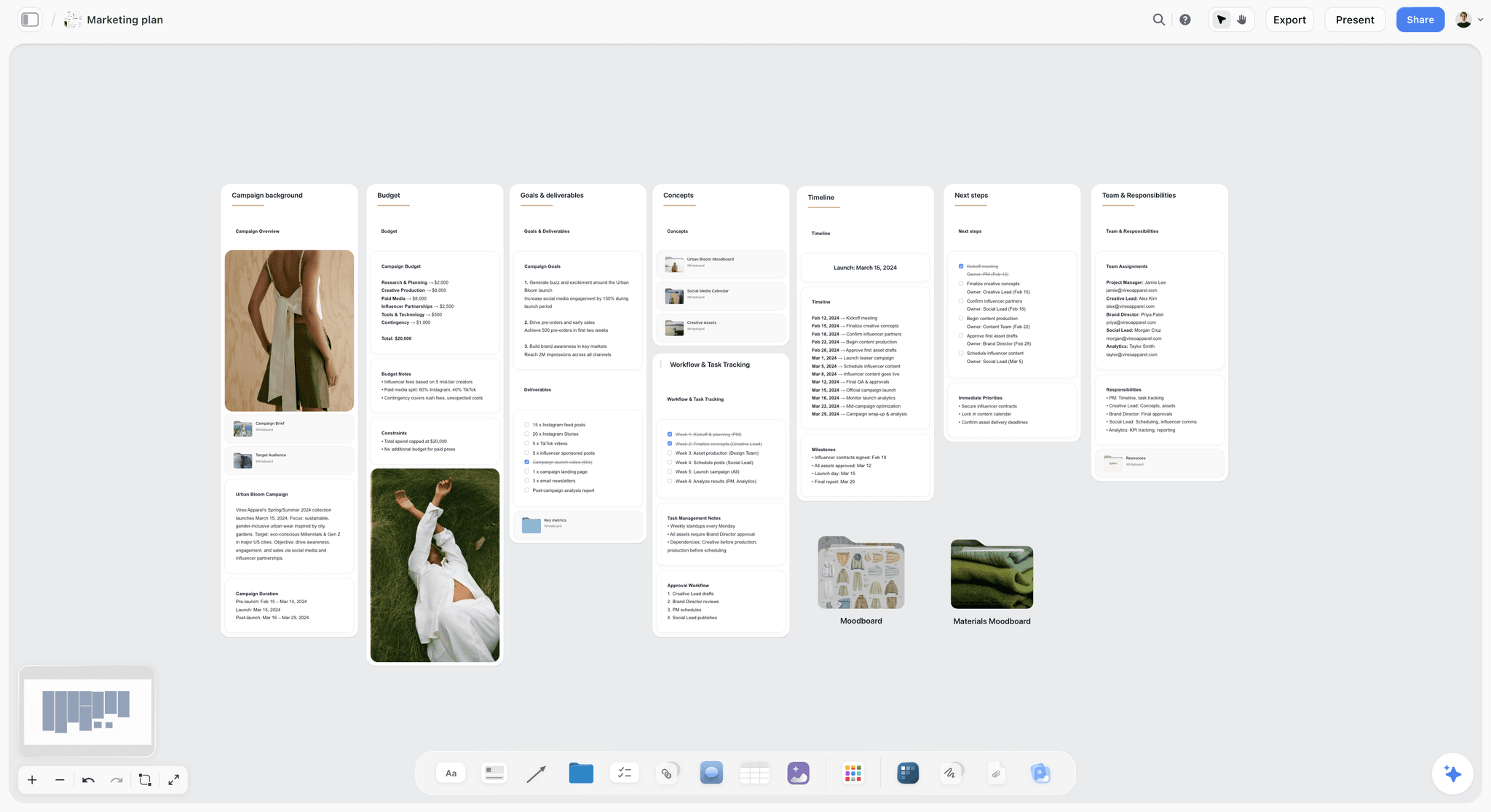
A full marketing plan in Storyflow, objectives, audience, channels, and content calendar connected
Common Mistakes When Writing a Content Strategy with AI
Mistake: Skipping audience research to move faster to the calendar
This happens because the calendar feels like the deliverable and research feels like delay.
Content goes live that answers questions the brand finds interesting rather than questions the audience is actually searching for.
Spend at minimum 30 minutes on Step 2 before building the calendar - even rough audience research produces better topics than no research at all.
Mistake: Asking AI to “write my content strategy” in a single prompt
This happens because AI is fast and strategy writing feels slow.
You receive a document formatted like a strategy but grounded in the AI's assumptions about your audience, not your actual knowledge of them.
Use AI at each individual step - to research, pressure-test, and organize - rather than replacing the thinking entirely.
Mistake: Choosing too many content pillars
Teams want the strategy to reflect everything they care about, so they choose seven or eight pillars.
Eight pillars create eight directions with no gravitational pull - readers and search algorithms can't determine what you stand for.
Choose three to five and cut the rest - you can add a pillar next quarter if a real gap is proven by data.
Mistake: Building the editorial calendar without content briefs
A calendar tells you what to publish and when - teams assume that's enough to hand off to a writer.
Without briefs, writers start from a blank page each time, producing inconsistent quality and pieces with no clear angle.
Write briefs for at least the first four pieces before the calendar launches - the brief is what makes the calendar executable.
Mistake: Measuring content performance at the wrong interval
Most strategies get abandoned around 45 days because early traffic looks low.
Content authority compounds over time - a piece that ranks for nothing in week two may rank for 30 keywords by week ten.
Measure production consistency at 30 days, engagement signals at 60, and business outcomes at 90 - never make strategic decisions from 30-day data alone.
Frequently Asked Questions
Frequently Asked Questions
How long does it take to write a content strategy with AI?
The initial session - goal definition, audience research, pillar identification, and calendar structure - takes 90 minutes to three hours with AI support. Writing the first month of content briefs adds another hour. You can begin publishing from a solid strategic foundation within a single working day. The strategy continues to evolve over the first 90 days as real performance data comes in.
How is writing a content strategy with AI different from the traditional approach?
Traditional content strategy relies on research that takes weeks and documents that get filed and forgotten. With AI, the research phase compresses from weeks to hours, and the thinking happens alongside the AI in a live workspace rather than in sequential documents. The strategic judgment is still yours - AI eliminates time spent on tasks that don't require that judgment.
Can I write a content strategy with ChatGPT instead of Storyflow?
You can use ChatGPT for individual steps - generating audience questions, drafting briefs, brainstorming topics. The limitation is that ChatGPT works in isolated conversations. It can't see your audience research while helping you build the calendar, or your pillar definitions while generating topic ideas. Storyflow's AI reads the full active board (every card, note, and link on it), so suggestions are grounded in the strategy you've built, not just your last prompt.
Do I need marketing expertise to write a content strategy with AI?
No, but you need genuine knowledge of your audience and your subject matter. AI can research, structure, and pressure-test your thinking, but it can't replace the judgment that comes from actually knowing your customers' frustrations. The more honest and specific your inputs, the more useful the AI's outputs. If you don't know who your audience is yet, start with one real customer conversation before the strategy.
How many content pillars should I have?
Three to five is the practical range. Three is easier to execute consistently and easier for an audience to recognize your brand by. Five is the maximum before the strategy loses coherence. Most teams that start with six or seven pillars have identified three real pillars plus recurring topics that belong under them - use AI to consolidate before you commit to a number.
How far ahead should a content calendar be planned?
One month in detail, three months in outline. A detailed plan more than four weeks out doesn't account for the trends, events, and audience questions that emerge in real time. The 90-day outline gives strategic direction; the monthly detail gives tactical clarity. Review and refill the month-ahead plan every two weeks.
How do I know if my content pillars are right?
Run them against three tests: Does each pillar directly address a question your audience is actively searching for? Does each pillar reflect expertise your brand can credibly own? And does each pillar connect naturally to how your business makes money? If a pillar passes all three, it belongs in your strategy.
What if I'm starting from zero with no existing audience?
Start smaller and more specific. A broad content strategy for a new brand competes with established players on every topic. A faster path: pick one pillar, go extremely deep on 10-15 pieces, and build topical authority in a narrow area before expanding. Ask your AI what content gaps exist in your niche that larger brands are currently not covering well - and build your initial strategy around those gaps.
How often should I update my content strategy?
Review it every quarter. At 90 days, check whether the pillars are generating the right audience signals, whether the publishing cadence is sustainable, and whether the business goal you defined in Step 1 is still accurate. Minor adjustments happen every quarter; major structural changes happen once or twice a year based on real performance data.
Start Your First Content Strategy Today
The most common reason people don't have a content strategy isn't laziness - it's the belief that it needs to be comprehensive before it's useful. So the document stays in “draft” while publishing stays in “someday.” A 9-step strategy that takes three weeks to write is procrastination with better formatting. The version that takes 90 minutes and gets published is the one that actually builds an audience.
Open Storyflow's free workspace and activate the Content Strategy Blueprint - a Tactic that walks you through Steps 1-4 of this guide with AI prompts built into each card. In the next 45 minutes, you can have your goal defined, your audience document drafted, and your content pillars mapped. That's enough to write your first content brief and schedule your first piece.
The creators who build the most momentum aren't the ones with the most polished strategy - they're the ones who start with a solid foundation and improve it in public. Storyflow gives you the foundation. The improvement is yours to make.
Related Reading
A tested comparison of visual thinking tools, including how Storyflow's AI-powered mapping compares to traditional options for strategy planning.
What high-performing teams use to generate and organize ideas before building their content strategy - the step that most teams skip entirely.
Why visual thinkers need more than a linear document tool to build and execute a content strategy - and what the spatial alternatives offer instead.
The broader marketing planning framework that a content strategy plugs into - understand the relationship between content and the full marketing funnel.
Table of Contents
- The Problem Most Content Strategies Are Built to Fail
- What You Need Before You Start
- How to Write a Content Strategy with AI: Step by Step
- Step 1: Define Your Goal
- Step 2: Research Your Audience
- Step 3: Audit Existing Content
- Step 4: Identify Content Pillars
- Step 5: Research Topics and Keywords
- Step 6: Choose Your Channels
- Step 7: Build Your Calendar Structure
- Step 8: Write Content Briefs
- Step 9: Set Up Your Measurement Framework
- The 9-Step Process at a Glance
- Tips and Best Practices
- Common Mistakes to Avoid
- Frequently Asked Questions
Templates to check out for this topic


Content and video templates you can use in Storyflow
Plan a channel, a script, and a content pipeline on the same board. Open one of these templates and let the AI build on the structure instead of starting from a blank doc.


See Storyflow in Action
A visual AI workspace where every feature lives inside one canvas. No tab-switching, no context lost.
Build your entire board from a single message
Type what you need in the AI chat at the bottom of your canvas. The AI adds cards, headings, and structure directly onto your board.
Use expert frameworks as AI context
Type @ in the AI chat and choose any Tactic. The AI tailors every response to that framework instead of giving generic advice.
Turn your board into a mind map in seconds
Ask the AI to restructure your canvas as a mindmap. It connects your ideas into a visual hierarchy so you can see how everything relates.
Why Storyflow Exists
Storyflow actually began as a personal tool while working on creative and research projects.
We kept running into the same problem: ideas were scattered everywhere: notes, documents, and whiteboards.
Nothing helped us see how everything connected.
So we started building a workspace designed around how ideas actually grow.
→ Read how Storyflow was createdSara de Klein
Head of Product at Storyflow
Published: February 28, 2026
Extremely simple, seriously capable


See how easy it is to get started
Watch a real project come together, from a blank board to a finished plan, clicked through step by step.
Start creating with AI and become more productive
Transform your creative workflow with AI-powered tools. Generate ideas, create content, and boost your productivity in minutes instead of hours.