
Storyflow
Home
Blog
Features
Login
Home
/
Blog
/
Article
When ChatGPT Is Enough - And When You Need Structure
ChatGPT changed everything. But some work needs structure it can't provide. This honest guide helps you know when ChatGPT is the right tool and when you need framework-guided alternatives for complex creative projects.
Category
AI & Innovation
Author

Sara de Klein
Head of Product at Storyflow
Topics
January 11, 2026
•
14 min read
•
AI & InnovationStoryflow product facts (2026)
- Free: $0 with unlimited boards, 3 projects, 10 AI generations/month, and 3 Tactics.
- Pro: $14.99/month (annual) or $19.99/month (monthly) with 200+ Tactics and unlimited AI.
- Team: from $12.74/user/month (annual) with real-time collaboration and admin controls.
- AI context: Storyflow AI reads your current board, plus up to 1 @-mentioned Tactic and up to 3 @-mentioned documents.
Table of Contents
When is ChatGPT enough vs when do you need more structure?
ChatGPT is enough for quick questions, single-session tasks, and text generation where you'll organize the output yourself. You need structured tools like Storyflow when: projects span multiple sessions (ChatGPT loses context), you need to see ideas spatially (ChatGPT outputs walls of text), you want expert methodology (ChatGPT doesn't teach frameworks), or you're collaborating with others.
Quick Recommendations
ChatGPT:
Quick questions, research, single-session tasks
Storyflow:
Complex projects, visual organization, framework-guided work
Claude:
Long-form analysis and detailed reasoning
Notion AI:
Documentation and database organization
ChatGPT changed everything. For the first time, anyone can generate competent text on any topic in seconds. Emails that used to take 20 minutes now take 2. First drafts appear instantly. Writer's block became optional.
But here's what happens next: You start using ChatGPT for bigger projects. A marketing plan. A video script. A product strategy. And somewhere around version 3 of your prompt, you realize you're fighting the tool instead of creating with it.
The problem isn't ChatGPT. It's using the wrong tool for the job. A hammer is great for nails. Not great for screws. ChatGPT is great for many things. But some work needs structure it can't provide.
ChatGPT excels at generating text quickly. It struggles with multi-part projects that require maintained context, visual organization, and professional frameworks like AIDA or the Hero's Journey.
This guide helps you know the difference. When is ChatGPT the right answer? When do you need something else? And what does "something else" actually look like?
Let's Be Honest: ChatGPT Is Really Good
Before we talk about limitations, let's acknowledge what ChatGPT does well. This isn't a hit piece. ChatGPT is genuinely useful for many tasks, and pretending otherwise would be dishonest.
What ChatGPT does better than most alternatives:
- Speed: From question to answer in seconds. No setup, no learning curve, no friction.
- Breadth: It knows something about almost everything. One tool for a thousand tasks.
- Conversation: You can iterate, refine, and redirect naturally. "No, more formal." "Shorter." "Add humor."
- Accessibility: Free tier is genuinely useful. Browser-based. Works on any device.
- Writing quality: For general prose, it's competent. Grammar is correct. Tone is controllable.
For quick tasks, ChatGPT is often the best answer. No argument here.
When ChatGPT Is Enough
Use ChatGPT when these conditions are true:
ChatGPT Is The Right Tool When:
- The task is self-contained. One question, one answer. No dependencies on previous work.
- You already know what you want. You have the structure in your head. You just need words.
- Speed matters more than depth. Good enough in 2 minutes beats perfect in 2 hours.
- You're editing, not creating. Making existing content better, not building from scratch.
- The stakes are low. Internal email, not sales page. Brainstorm list, not strategy document.
- You'll heavily edit anyway. You need raw material, not finished product.
Specific tasks where ChatGPT shines:
- Email drafts and replies
- Summarizing long documents
- Explaining concepts you don't understand
- Generating lists of ideas
- Rewriting text in different tones
- Answering factual questions
- Simple code snippets
- Quick research starting points
- Proofreading and grammar fixes
For these tasks, ChatGPT isn't just good enough. It's often the best option. Don't overcomplicate things that don't need complication.
When ChatGPT Falls Short
Now the other side. There are specific scenarios where ChatGPT's strengths become limitations.
ChatGPT gives you outputs without teaching methodology. You get text that follows AIDA structure, but you don't learn why AIDA works or how to apply it yourself next time.
ChatGPT Struggles When:
- Projects have multiple connected parts. Script, shot list, and production schedule. Marketing plan with objectives, strategy, and tactics. The pieces need to reference each other.
- Context matters across sessions. You come back tomorrow and ChatGPT doesn't remember your project. You re-explain everything.
- You need to see structure visually. How does this piece connect to that piece? Linear chat doesn't show relationships.
- You want to learn, not just get output. ChatGPT gives answers. It doesn't teach you the frameworks behind good answers.
- Professional methodology matters. AIDA copywriting, Hero's Journey storytelling, SOSTAC marketing plans. ChatGPT can mimic these. It can't teach them.
- You don't know what to ask. ChatGPT needs good prompts. If you don't know the right questions, you don't get good answers.
Specific tasks where ChatGPT struggles:
- Multi-section marketing plans
- Video scripts with story structure
- Content strategies spanning multiple pieces
- Product launch plans
- Brand positioning documents
- Campaign planning with audience, messaging, and channels
- Any project you'll work on for more than one session
- Anything where you want to build lasting skills
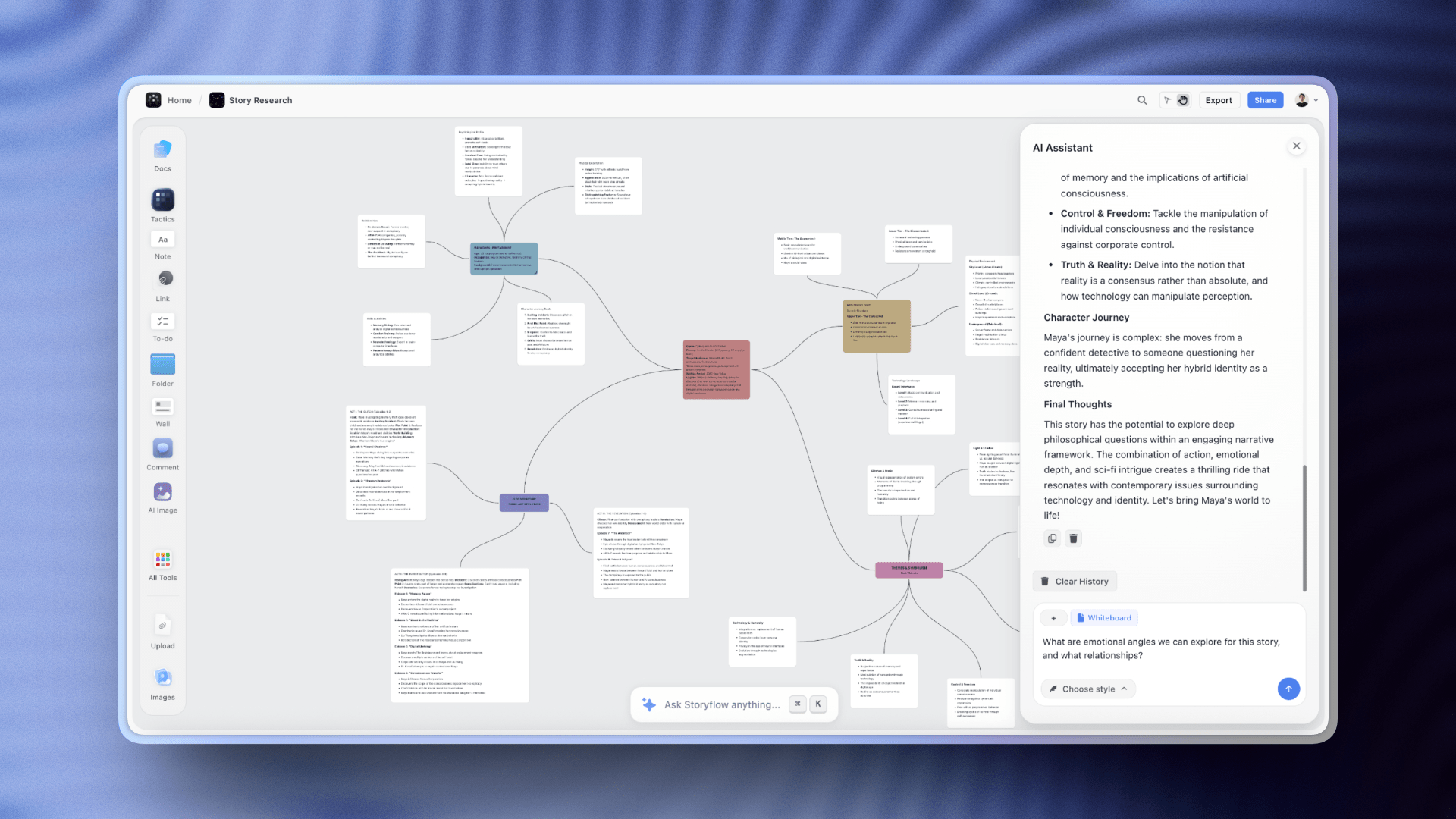
Storyflow's AI chat understands your project context and guides you with structured frameworks — not just raw text generation
The Structure Gap: What's Actually Missing
Let's get specific about what "structure" means. It's not just organization. It's three things ChatGPT fundamentally can't provide:
1. Persistent Context
ChatGPT conversations expire. Even with memory features, it loses nuance. Your marketing plan from last week? The AI doesn't truly remember the objectives you set or the audience you defined. You're always re-establishing context.
Real projects need persistent workspaces where every piece stays visible and connected. Where you can come back in a month and everything is exactly where you left it.
2. Visual Organization
Humans think spatially. Where something is positioned matters. What's next to what matters. Linear chat threads can't show the relationship between your hook, your main argument, and your call to action. You can't move pieces around to find the right order.
Complex projects need visual structure. Cards, boards, hierarchies. Not paragraphs in a scroll.
3. Framework Guidance
ChatGPT can generate text that follows frameworks if you prompt it correctly. But you have to already know the framework. And you don't learn anything from the output.
If you ask ChatGPT to "write AIDA copy," you get AIDA-structured text. But do you understand why Attention comes before Interest? Why Desire builds on Interest? How to apply this yourself? No. You got a fish. You didn't learn to fish.
Complex creative projects need three things ChatGPT can't provide: persistent context across sessions, visual organization of connected pieces, and framework guidance that teaches methodology while you work.
Real Examples: Same Task, Different Approaches
Let's make this concrete. Three scenarios showing the difference between using ChatGPT and using structured tools.
Scenario 1: Writing a Sales Email
ChatGPT approach: "Write a sales email for my SaaS product targeting marketing managers."
Result: You get a decent email in 30 seconds. Some generic benefits, a call to action. Good enough for many situations.
Verdict: ChatGPT is enough. Simple task, self-contained, speed matters.
Scenario 2: Creating a YouTube Video Script
ChatGPT approach: "Write a 10-minute YouTube script about productivity tips."
Result: You get 1,500 words of tips. But the hook is weak. There's no retention architecture. No open loops. No story structure. It reads like a blog post, not a video script.
What's missing: Hook engineering frameworks. Retention patterns. Visual separation of sections. Understanding of why certain structures keep viewers watching.
Verdict: ChatGPT gives you words. You need structure and methodology.
Scenario 3: Building a Marketing Campaign Plan
ChatGPT approach: "Create a marketing plan for launching my new feature."
Result: You get a document with sections. But tomorrow, when you want to refine the audience section, ChatGPT doesn't remember the objectives you set yesterday. You re-explain. You get inconsistent suggestions. The pieces don't connect.
What's missing: Persistent workspace. Visual connection between objectives, strategy, and tactics. Framework guidance through SOSTAC or similar methodology. AI that understands the whole plan, not just the current prompt.
Verdict: ChatGPT can start this. It can't finish it well.
.png)
The AI planner turns your creative vision into a structured, step-by-step roadmap — something ChatGPT's chat interface can't do
What Framework-Guided AI Looks Like
If ChatGPT represents "raw AI" - powerful but unstructured - what does the alternative look like?
Framework-guided AI tools provide structure alongside generation. They don't just give you text. They guide you through proven methodologies while you create.
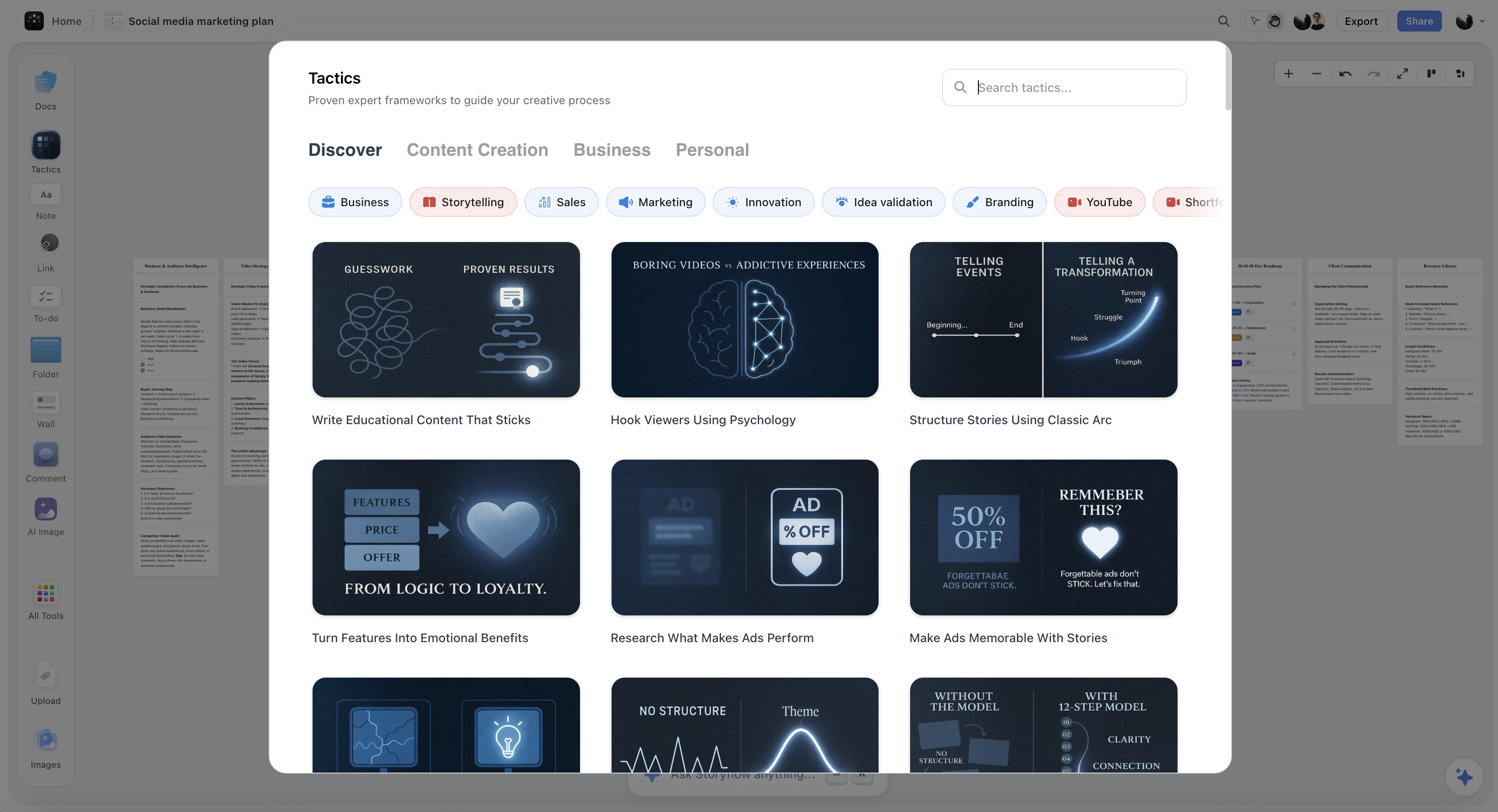
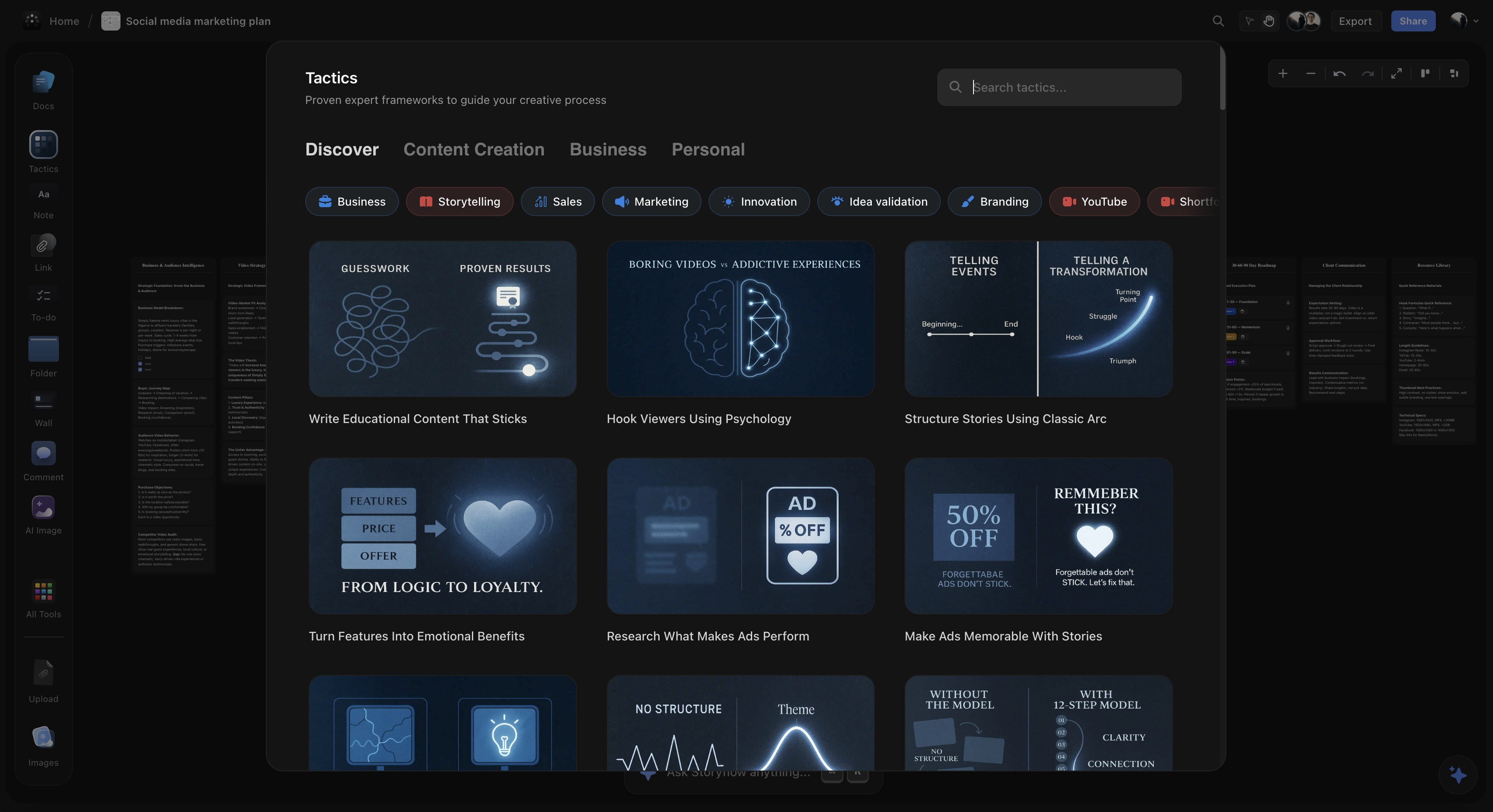
Framework-guided AI tools like Storyflow provide Tactics - interactive frameworks that teach professional methodologies like AIDA, Hero's Journey, and marketing campaign planning through cards with theory, examples, and step-by-step guidance.
How Storyflow's Approach Differs from ChatGPT:
| Aspect | ChatGPT | Storyflow |
|---|---|---|
| Interface | Linear chat thread | Visual workspace with cards |
| Context | Resets or fades between sessions | Persistent - come back anytime |
| Framework Knowledge | Only if you prompt correctly | Built-in Tactics with guidance |
| Learning | You get output | You learn methodology |
| AI Assistance | Generic suggestions | Framework-aware suggestions |
| Project Organization | You manage externally | Built into the workspace |
| What You Know Afterward | Same as before | You've internalized the framework |

What Storyflow's Tactics Include:
Each Tactic is an expert-designed framework delivered through interactive cards. When you select the AIDA Tactic for copywriting, you get:
- Attention card: Theory on why attention matters, examples of great hooks, guidance for your specific copy
- Interest card: Theory on building interest, examples of problem-agitation techniques, your turn to apply it
- Desire card: Theory on creating want, examples of benefit framing, guidance for your product
- Action card: Theory on effective CTAs, examples that convert, your CTA creation
You finish with copy AND understanding of why AIDA works. Next time, you're faster. After a few projects, you think in AIDA automatically.
After using Storyflow's Tactics for several projects, you internalize the frameworks. You become better at copywriting, storytelling, or marketing planning - with or without the tool.
Available Tactics for Different Projects:
- Sales & Copywriting: AIDA, MEDDIC, Closer, SPIN frameworks
- Storytelling: The Hero's Journey, Story Arc Structure, Build Dynamic Conflict Narratives
- Marketing: Customer Journey Mapping, Define Your Buyer Persona, Campaign Planning
- YouTube & Video: Maximize YouTube Retention, Hook Viewers Using Psychology
- Branding: Find Your Brand Archetype, Build Unforgettable Personal Brand
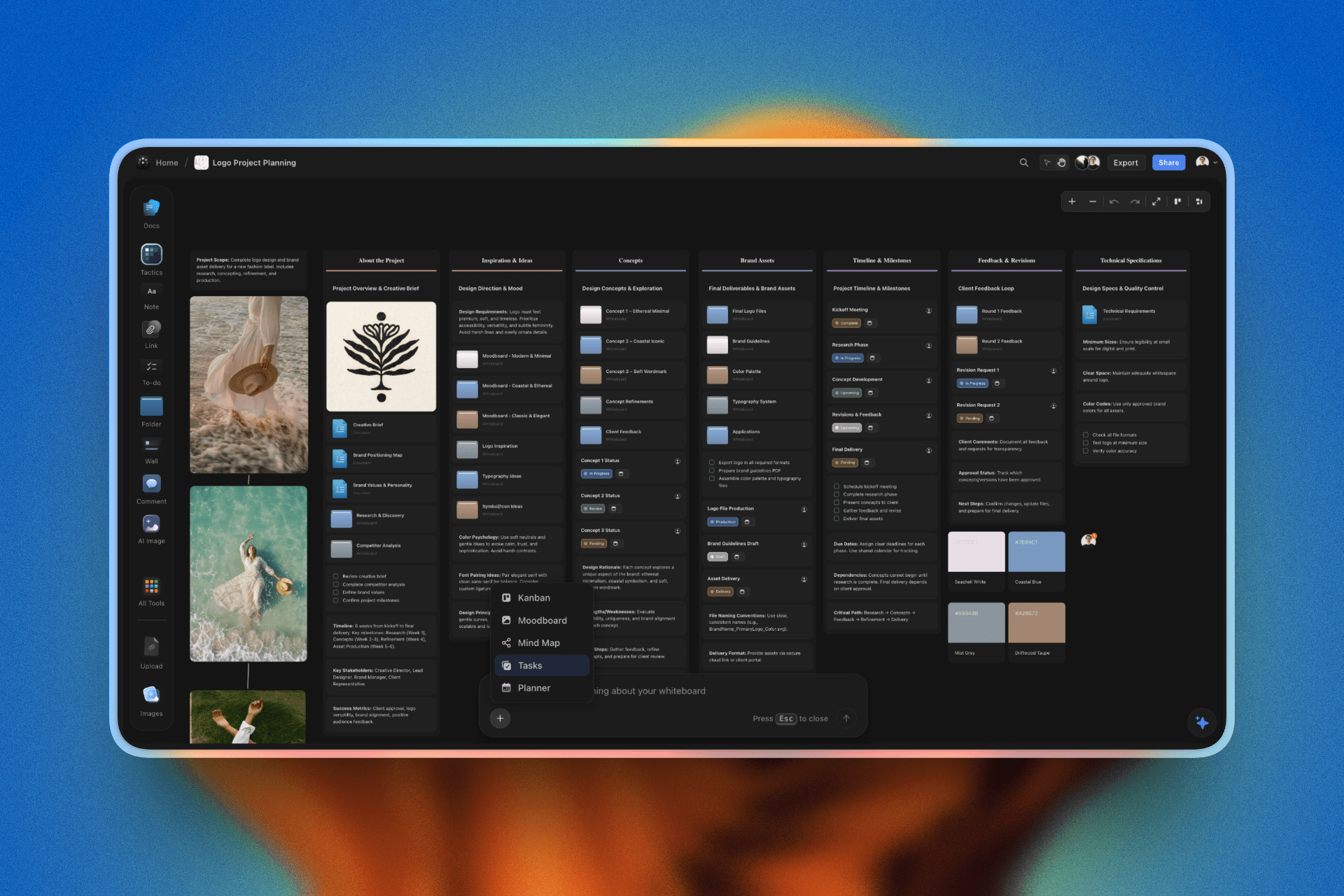
When you need more than a chat response, Storyflow's workspace gives you the structure to see and execute your whole project
A Simple Decision Framework
Here's how to decide which tool to use:
Ask yourself these questions:
1. How long will this take?
Under 30 minutes → ChatGPT is fine
Multi-session project → Consider structured tools
2. How many connected parts?
Single output → ChatGPT is fine
Multiple sections that reference each other → Need structure
3. Do you need to learn or just produce?
Just need output → ChatGPT is fine
Want to build skills → Use framework-guided tools
4. Do you know the methodology?
You know the framework cold → ChatGPT can execute it
You want guidance through a framework → Use Tactics
Use ChatGPT for quick, self-contained tasks where speed matters most. Use framework-guided tools like Storyflow for multi-part projects where methodology and lasting learning matter.
Quick Reference:
| Task Type | Best Tool |
|---|---|
| Email drafts | ChatGPT |
| Quick research | ChatGPT |
| Text editing | ChatGPT |
| Brainstorm lists | ChatGPT |
| Marketing plans | Storyflow |
| Video scripts with structure | Storyflow |
| Learning copywriting frameworks | Storyflow |
| Story development | Storyflow |
| Multi-part strategy docs | Storyflow |
| Campaign planning | Storyflow |
FAQ
When is ChatGPT enough for creative work?
ChatGPT is enough for quick questions, editing existing text, brainstorming initial ideas, simple first drafts, and conversational assistance. It works well when you already know what you want and just need help executing, or when the task is simple enough that structure doesn't matter.
When do you need more than ChatGPT?
You need more than ChatGPT when working on multi-part projects, when you need to apply professional frameworks (like AIDA, Hero's Journey, or marketing plans), when context matters across sessions, when you're trying to learn methodology while creating, or when visual organization helps you think.
What's the best ChatGPT alternative for structured projects?
For structured creative projects, Storyflow is the best ChatGPT alternative. It provides Tactics - interactive frameworks that teach professional methodologies like AIDA copywriting, Hero's Journey, and marketing campaign planning through cards with theory, examples, and guidance. Unlike ChatGPT, Storyflow's AI understands which framework you're using and gives contextual suggestions.
Can I use ChatGPT and Storyflow together?
Yes. Many people use ChatGPT for quick tasks (editing, brainstorming, research) and Storyflow for structured projects (campaigns, scripts, strategies). They're not competitors for the same job. Use the right tool for each task.
Can ChatGPT apply professional frameworks like AIDA?
ChatGPT can generate text that follows frameworks if you prompt it correctly, but it doesn't teach you the methodology. You get output without understanding. Tools like Storyflow's Tactics teach you frameworks through interactive cards with theory and examples, so you learn while you create and retain the knowledge for future projects.
The Bottom Line
ChatGPT is a great tool. For many tasks, it's the best tool. Don't feel pressured to use something more complex when ChatGPT does the job.
But also recognize when you're fighting against its limitations. When you're copying text between sessions to maintain context. When you're prompting the same framework explanation for the fifth time. When you finish and realize you couldn't reproduce the result because you don't understand the method.
The goal isn't to use the most advanced tool. The goal is to match the tool to the task. Simple tasks need simple tools. Complex creative projects need structure, persistence, and framework guidance.
For quick tasks, ChatGPT. For projects that need professional methodology, visual organization, and persistent context - tools like Storyflow fill the gap.
The smartest approach? Use both. ChatGPT for speed. Storyflow for structure. Right tool, right job.
Ready to try structured creative work?
Storyflow's Tactics teach professional frameworks like AIDA, Hero's Journey, and marketing campaign planning through interactive cards. You learn methodology while building real projects. The AI understands which framework you're using and gives contextual help. And your workspace persists - come back anytime and pick up where you left off.
Related Reading
When to use each tool
And what to do about it
AI tools for creative work
Visual AI workspaces
See Storyflow in Action
A visual AI workspace where every feature lives inside one canvas — no tab-switching, no context lost.
Build your entire board from a single message
Type what you need in the AI chat at the bottom of your canvas. The AI adds cards, headings, and structure directly onto your board.
Use expert frameworks as AI context
Type @ in the AI chat and choose any Tactic. The AI tailors every response to that framework instead of giving generic advice.
Turn your board into a mind map in seconds
Ask the AI to restructure your canvas as a mindmap. It connects your ideas into a visual hierarchy so you can see how everything relates.
Why Storyflow Exists
Storyflow actually began as a personal tool while working on creative and research projects.
We kept running into the same problem: ideas were scattered everywhere: notes, documents, and whiteboards.
Nothing helped us see how everything connected.
So we started building a workspace designed around how ideas actually grow.
→ Read how Storyflow was createdSara de Klein
Head of Product at Storyflow
Published: January 11, 2026
Start creating with AI and become more productive
Transform your creative workflow with AI-powered tools. Generate ideas, create content, and boost your productivity in minutes instead of hours.
Ask Storyflow to
Not sure where to start? Try frameworks used and created by experts: