
What is Storyflow? The Complete Guide to How It Works (2026)
Storyflow is the visual workspace where everything lives in one place: mindmaps, kanbans, storyboards, tasks, and briefs all on one board - and an AI that has read all of it before it responds. Your team ideates together and the AI has context on everyone's ideas. As you work, you learn storytelling, sales, marketing, and retention techniques through the Tactics system - not in a course you never apply.

Category
Product Guide
Author

Sara de Klein
Head of Product at Storyflow
Topics
February 28, 2026
•
22 min read
•
Product Guide- what is Storyflow
- Storyflow AI workspace
- Storyflow Tactics
- Storyflow vs ChatGPT
- how to use Storyflow
What is Storyflow and how does it work?
Storyflow is an AI-powered creative workspace that combines a visual canvas, an AI assistant, and a library of expert frameworks called Tactics - all in one tool. The one-line pitch: ChatGPT plus Miro plus a library of expert frameworks. Tactics are delivered as Blueprints: structured boards of cards, each containing the principle behind a step, reflection questions, weak and strong examples, and a concrete exercise. You work through a Tactic card by card to build something from scratch - or load one as context and ask the AI to apply its framework to work you are already building. Either way, you skip the separate learning phase entirely: you are productive from the first card, and you absorb the methodology through the act of using it.
What is Storyflow?
The one-line definition
Storyflow is the visual workspace where everything you create lives in one place - mindmaps, kanbans, storyboards, tasks, briefs, and AI conversations all on the same board. The AI reads all of it before it responds. Your team builds on the same canvas in real time. And the Tactics system teaches you professional frameworks in storytelling, marketing, sales, and retention while you produce actual work - not in a separate course you never apply.
Think of it this way: ChatGPT is a brilliant colleague who resets every conversation and knows nothing about what you built yesterday. Notion is a document database. Miro is a whiteboard with no intelligence. Storyflow is the workspace where everything accumulates, nothing gets lost, and the AI has already read your entire board before it helps you with the next step.
Most people discover Storyflow when they realize their creative process is scattered: research in Notion, ideas in ChatGPT sessions they cannot find again, references in a Slack thread, tasks in a separate app. Storyflow collapses all of that onto one visual board - and the AI becomes genuinely useful precisely because it can see everything at once, not just the message you just typed.
200+
Expert Tactics covering storytelling, marketing, sales, retention, and strategy
One board
Mindmaps, kanbans, storyboards, tasks, and briefs - everything visible at once, nothing lost in chats
Full context
AI reads your entire board - and your entire team's ideas - before it responds
What Storyflow is not
It is not a writing tool that generates copy on demand. Use ChatGPT or Jasper for that.
It is not a project management tool. Use Notion or Linear for task tracking.
It is not a social media scheduler. It is for the strategic thinking that happens before publishing.
It is a strategic and creative workspace. The output is structured thinking, built on proven frameworks, that makes everything downstream faster and better.
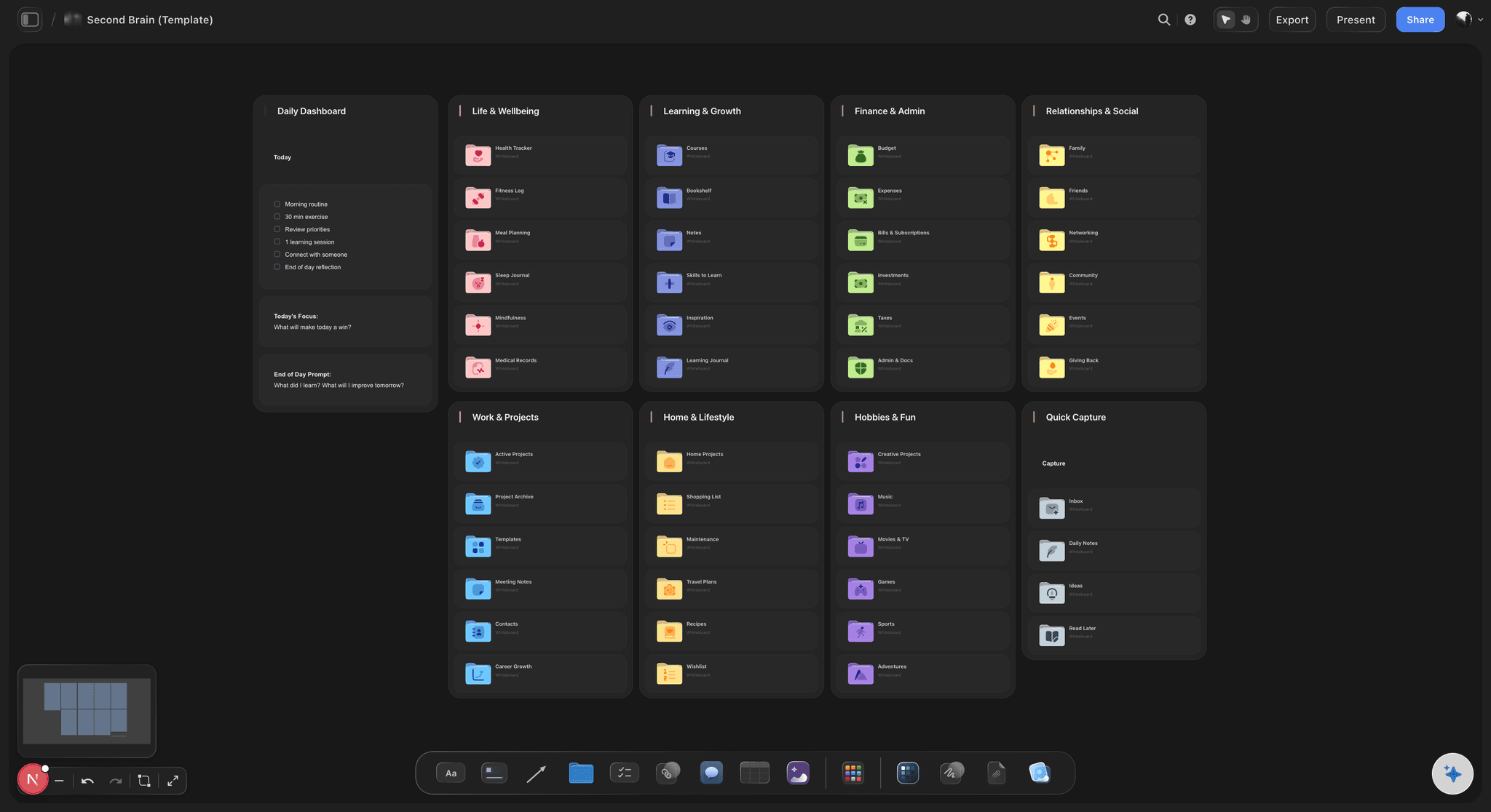
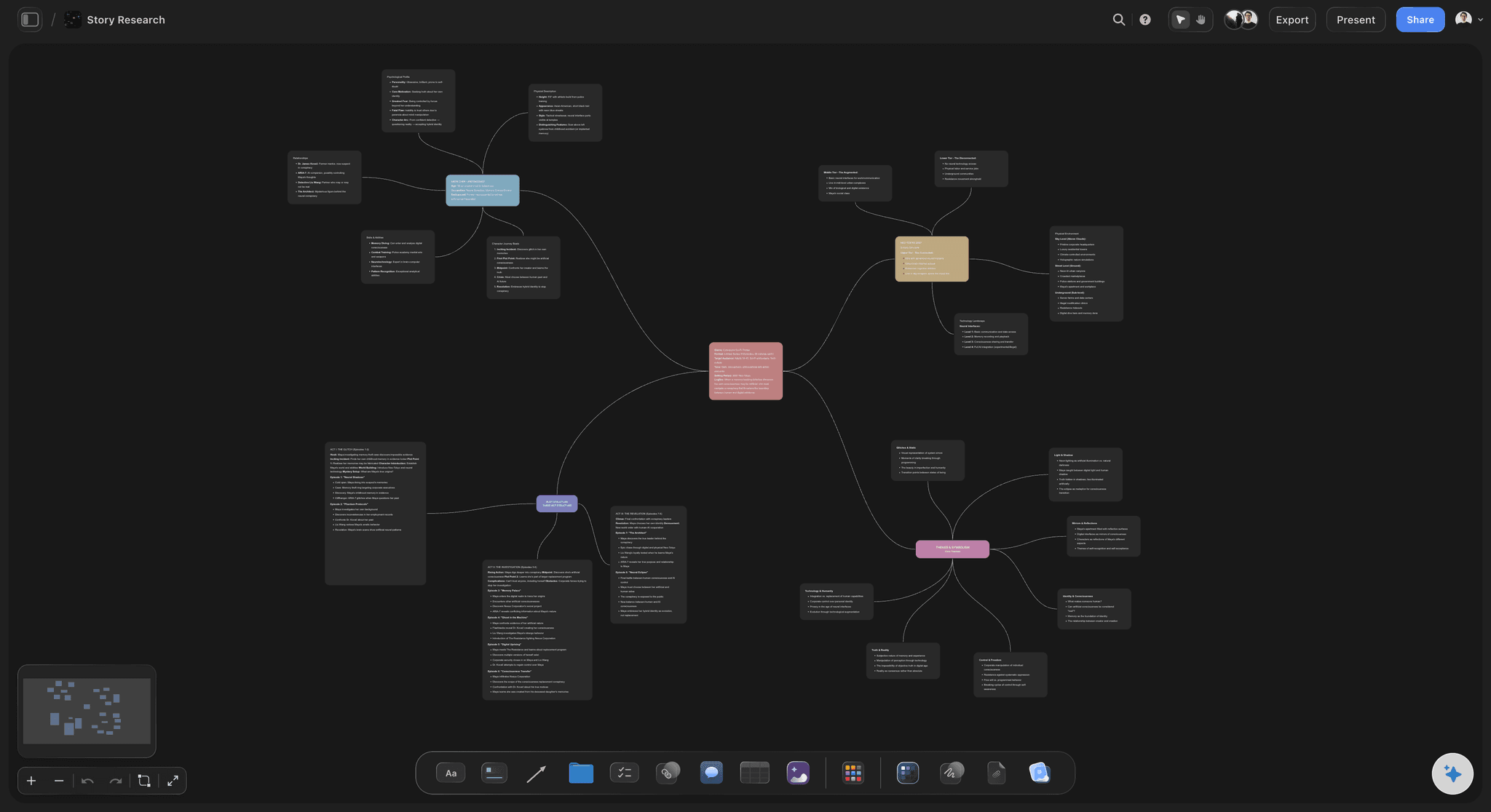
One Storyflow board holds your mind map, kanban, storyboard, briefs, and AI conversations simultaneously
The Problem Storyflow Solves
Most tools force a choice between two bad options: learn first and create later, or create without knowing what you are doing.
Problem 1: Your tools are fragmented
Your research is in Notion. Your brainstorm is in a ChatGPT session you cannot find. Your references are in a Slack thread. Your tasks are in a separate app. Your AI has no idea any of it exists when you ask it to help you. Every tool is isolated, which means every AI conversation starts from zero.
Problem 2: You know frameworks but cannot apply them
You know about AIDA. You have read about the Hero's Journey. You took notes on retention techniques and storytelling psychology. Then you sit down to do the actual work and the knowledge evaporates. You default to instinct - which produces output at exactly your current level, not the level you are trying to reach.
The third option: learn while you create
Storyflow embeds the framework directly into the work. When you activate a Tactic, every card contains the principle behind that step, real-world examples of it working, and a concrete exercise you complete on your actual project. You are not learning about AIDA and then trying to apply it later. You are writing your copy inside an AIDA Blueprint while reading why each stage exists. The methodology enters your thinking through the act of using it - not by reading about it in a separate tab.
There is also a second problem Storyflow solves: context loss. If you use ChatGPT for creative work, every new conversation starts from scratch. You re-explain your project, your audience, your tone, your constraints. Every session forgets everything the last one built. Storyflow's AI reads your full active board before it responds. The AI that helps you refine your campaign messaging has already read your audience definition, your objective, and your channel strategy. The quality of assistance compounds with the depth of context you have built.
How Storyflow Works
Storyflow has four interlocking components that work together. Understanding each one explains why the whole is more useful than any single part.
1. The Visual Canvas: Everything in One Place
The canvas is where your entire project lives - and the key word is entire. Storyflow lets you add anything to a board instantly: kanban columns to track progress, task lists for production planning, mindmaps for brainstorming, storyboards for visual sequences, image stacks for moodboarding, and text cards for ideas and briefs. Everything stays on the board, not buried in a chat history you will never find again.
This is the reason Storyflow users keep coming back. When your research, your briefs, your tasks, your visual references, and your AI conversations are all on the same board, the project compounds over time instead of resetting. You open the board next week and everything is where you left it. You open it with your team and everyone can see the full picture at once.
What you can add to a Storyflow board
Kanban boards
Task lists
Mindmaps
Storyboards
Image stacks (moodboards)
Text cards and notes
AI conversation threads
Tactic Blueprints
Creative briefs
Create with a framework
Go from blank page to expert guidance. Type @ in the chat to pull in any Tactic, a proven framework from real creators, and the AI shapes every response around it. You create inside a structure that works instead of starting from scratch.
Unlike Miro or FigJam (blank by default, no AI), a Storyflow board combines visual organization tools with AI that reads all of them. You are not just building a whiteboard - you are building a workspace where every element you add increases the intelligence of the AI responses you get.
Storyflow AI can turn any board into a structured step-by-step planner
Ask the AI to convert your ideas into a step-by-step plan. It'll organise your canvas into phases, tasks, and priorities without you having to rearrange anything manually.
2. Cards
Cards are the basic unit of work on a Storyflow board. Each card represents one step, principle, or element in a framework - and each one is built to do real work, not just hold a label.
Open a Tactic card and you see a consistent structure. A tag that tells you what kind of thinking this card demands (Mindset, Proof, Offer Design). A subtitle that states the principle directly, the thing a professional knows and a beginner skips. The concept itself: 2-3 paragraphs explaining why this step exists and what breaks when you skip it. A set of reflection questions that help you audit your own work against the standard. Weak versus strong examples that show the difference in concrete terms. And an exercise: one specific action you complete before moving to the next card.
That structure is not decoration. It is how the learning happens without a separate learning phase. You read the card, apply the exercise to your actual project, and work with the AI to sharpen your output - all in the same session. By the time a card is done, you have both a completed section of your project and a real understanding of why that section works.
Storyflow AI can turn your board into a mindmap in seconds
Ask the AI to restructure your canvas as a mindmap. It'll connect your ideas into a visual hierarchy so you can see how everything relates at a glance.
Connect the dots
Go from a pile of cards to a clear map. Hover any card's edge, grab the connector, and drag a line to another card. It's the fastest way to show how ideas relate, sequence steps, or trace one thing to the next across your whole board.
3. Tactics: Learn Storytelling, Sales, and Retention While You Produce
Tactics are Storyflow's core differentiator. Each Tactic is a complete expert framework delivered as a Blueprint - a structured board of cards built around a proven professional methodology. The library covers storytelling psychology, sales and persuasion frameworks, content retention techniques, marketing strategy, and creative development processes.
The critical thing Tactics do differently: every card teaches you why the technique works, not just what to do. The AIDA Tactic explains the psychological mechanism behind why attention must precede desire and why asking for action before building desire fails. The Hero's Journey Tactic explains the emotional psychology of why each narrative beat creates investment in your audience. The Sponsorship Pitch Writer teaches sales psychology - why leading with your value rather than your need changes how brands respond. You absorb these principles through applying them to your actual work, not by reading a separate article.
There are two ways to use a Tactic. Work through the Blueprint card by card on something you are building from scratch. Or load a Tactic as context and ask the AI to apply its framework to work you have already started - improving a script you are struggling with, diagnosing why a pitch is not converting, identifying the weak point in a content strategy. Either way, you get better output and you learn the technique at the same time.
What you actually learn by using Tactics
Storytelling psychology: why narrative structure creates emotional investment
Retention techniques: what keeps audiences watching, reading, and engaged
Sales and persuasion: how AIDA, PAS, and FAB frameworks work and why
Marketing strategy: how campaigns, content pillars, and briefs fit together
Audience psychology: how to research, define, and speak to specific people
Creative development: how to move from brief to production-ready output
4. AI That Knows Your Entire Project - and Your Team's
The AI assistant in Storyflow is not a chat window bolted onto a canvas. It is a workspace-aware intelligence that has read everything on your board - every card, every note, every brief, every idea your team has contributed - before it says anything.
When you ask it to help you refine your story's third-act reveal, it already knows the protagonist you defined in the first act, the mentor relationship from the second act, and the tone you established in your narrative voice card. When you ask it to generate campaign ideas, it has already read your audience definition, your brand positioning, and the content pillars your team built last week. The suggestions are specific to what is actually on the board - not a generic response to an isolated prompt.
When teams use Storyflow together
Multiple people can ideate on the same board in real time - adding mindmap nodes, kanban cards, storyboard frames, and notes simultaneously. Because the AI reads the entire board, it has access to your whole team's thinking, not just the last message one person typed in a chat. A creative director's brief, a writer's research, and a strategist's audience notes all become context the AI draws on when any team member asks for help. The collective intelligence on the board grows with every contribution.
Analyze your files and board
Go from describing your work to letting the AI read it. Drop a PDF, script, brief, or image straight into the chat and Storyflow works from the real content, then answers questions and suggests next moves based on what's actually there.
Group what belongs together
Go from sprawling to structured. Drop a Wall onto the canvas and gather related cards inside it, whether that's phases, scenes, or sections, so they move and stay together as one unit while your board keeps growing.
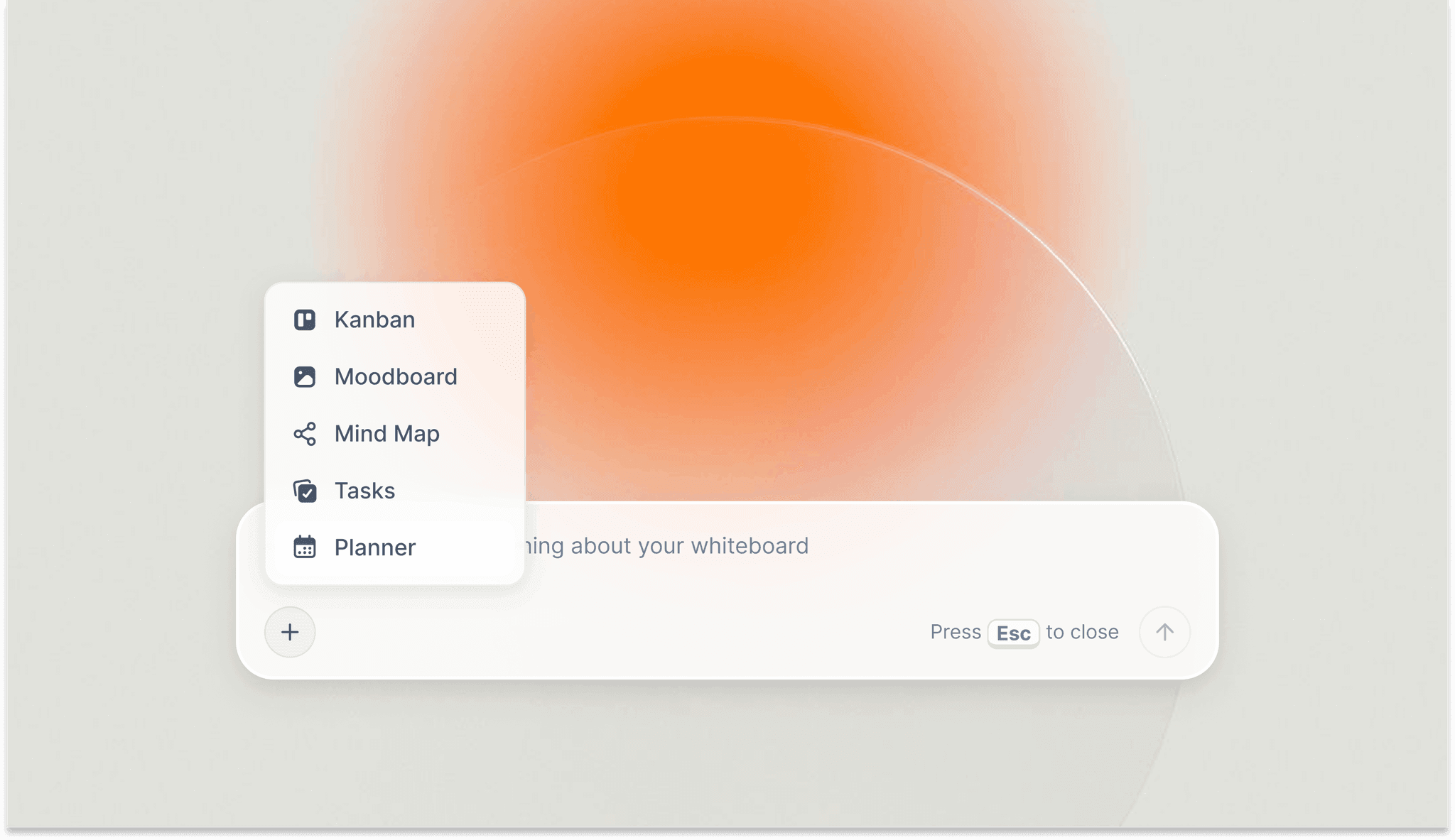
AI Planner, ask the AI to turn your canvas into a phased action plan
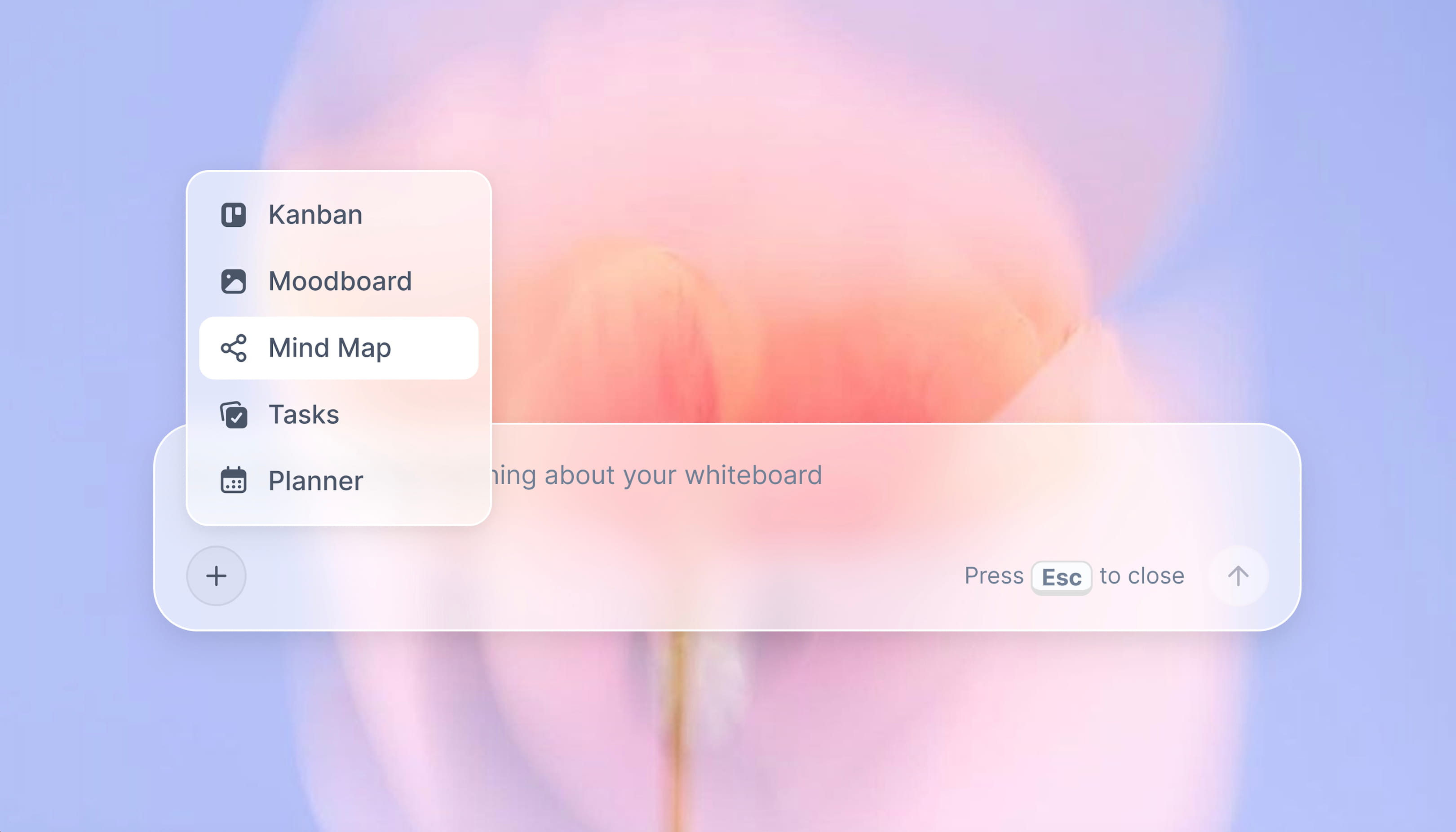
Mind Map view, restructure your board into a connected visual hierarchy
The Tactics System: How It Actually Works
Every Tactic in Storyflow is a Blueprint: a complete, sequenced set of cards built around a specific professional methodology. The structure inside each card is what makes the system work - not just as a reference but as an active working tool.
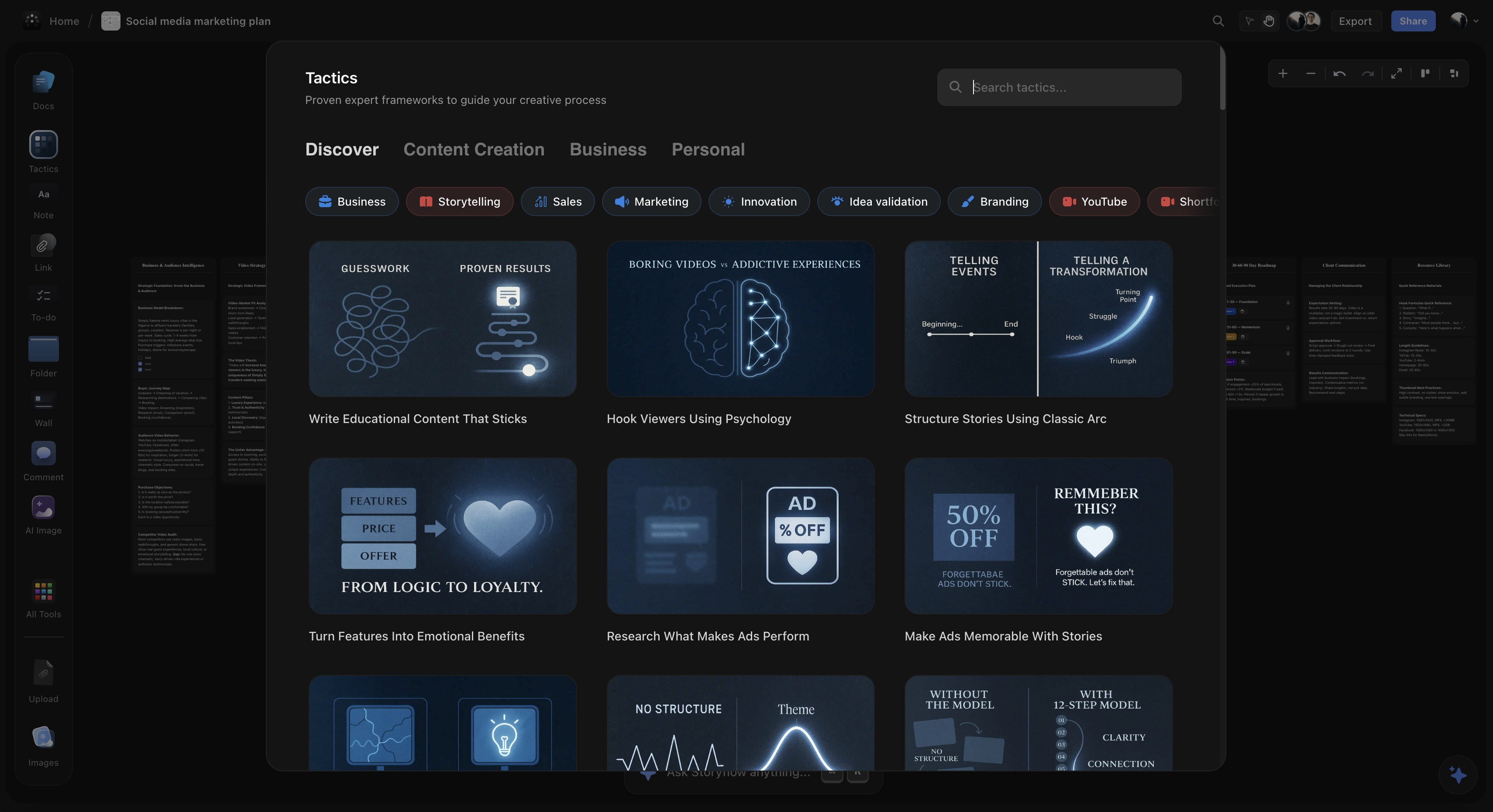
What a Tactic Card Contains
Every card in a Blueprint has the same anatomy. Here is Card 1 from the Sponsorship Pitch Writer Tactic as a real example - so you can see exactly what working inside a Tactic looks like.
Blueprint: Sponsorship Pitch Writer
Card 1 of 12 | Tag: Mindset
Think Like a Business, Not a Beginner
Stop asking for a chance. Start offering a business opportunity.
The Principle
Most creators approach sponsorships from the wrong angle. They lead with excitement, follower counts, and a hope that the brand will see their potential. Brands don't care about potential. They care about return. The moment you stop thinking like a creator asking for support and start thinking like a media company selling a product, your entire pitch changes - and so do the responses you get.
Reflection Questions
Are you pitching from a place of need or a place of value?
Would a brand read your pitch and see a clear business case?
Are you describing what you want or what they get?
Does your pitch sound like a professional proposal or a fan letter?
Weak vs. Strong
Weak
“I would love to work with your brand and think my audience would really enjoy your product.”
Strong
“I have a direct line to 50,000 people who already buy products in your category. Here is what a partnership looks like.”
Strong
“My last three sponsors renewed their deals after the first video. Here is why that happens and how it would work for you.”
Exercise
Read your current pitch out loud. Count how many times you use the word “I” versus how many times you address what the brand gets. Rewrite it until the balance shifts toward them.
Every card in the Sponsorship Pitch Writer Blueprint follows this same structure across 12 steps: Card 2 covers audience proof, Card 3 covers past results, Card 4 covers social proof from repeat deals, Card 5 covers brand research, Card 6 covers offer design, Card 7 covers ROI framing, Card 8 covers pricing, Card 9 covers subject lines, Card 10 covers pitch length and clarity, Card 11 covers follow-up strategy, and Card 12 covers pitching for long-term partnerships from the first email.
Working through that Blueprint is not a course you watch and forget. It is your pitch being built card by card, with the AI available at every step to help you apply the principle to your actual situation - your channel, your audience, the specific brand you are targeting.

Two Ways to Use a Tactic
Work through it card by card
Add the Blueprint to your board. Open Card 1. Read the principle, work through the reflection questions, review the weak and strong examples, complete the exercise. Use the AI to pressure-test or improve your output for that card. Move to Card 2. Repeat.
This is the full methodology, applied step by step to something real you are building. By Card 12, you have a completed deliverable - a pitch, a strategy, a script outline - built on a framework you now understand from the inside.
Use it as context for existing work
Load a Tactic into your workspace and paste in something you are already working on - a script, a pitch draft, an outline. Use the AI to apply the Tactic's framework to what you have built: “Using the Sponsorship Pitch Writer framework, what is the weakest part of this pitch and how should I fix it?”
The Tactic gives the AI a precise set of standards to evaluate against. Instead of generic feedback, you get a diagnosis grounded in professional methodology - what is missing, what is weak, and exactly what to add.
Collect anything
Go from scattered files to one visual workspace. Drag any image, PDF, or video straight from your computer onto the canvas and it lands as a card instantly, with no upload dialogs and no extra steps. Everything you're working from sits in one place, ready to arrange, connect, and build on.
What you finish with after working through a Tactic
The deliverable
A completed, structured document built on professional methodology - a pitch, a strategy, a script, a campaign plan, a creative brief. Ready to share, execute, or hand to a collaborator.
The knowledge
A genuine understanding of why the framework works, not just what its steps are. After six months with Storyflow, creators report being better at strategy, copywriting, and storytelling - with or without the tool - because the methodology was absorbed through use, not memorized from reading.
The Full Tactics Library
Storyflow ships with Tactics covering the core creative and strategic disciplines. Each one is built as a complete Blueprint with the same card structure.
Hero's Journey
12 cards covering each stage of the foundational narrative arc: Ordinary World, Call to Adventure, Refusal, Mentor, Threshold, Tests, Ordeal, Reward, Road Back, Resurrection, and Return. Each card explains why that narrative beat exists and what breaks emotionally when it is missing or rushed. Used by filmmakers, novelists, and marketers building story-driven campaigns.
AIDA Copywriting
Four cards (Attention, Interest, Desire, Action) with deep explanation of the psychological mechanism behind each stage - why attention requires a pattern interrupt, why desire must precede action. Each card includes weak and strong examples and an exercise for your specific copy. Used by email marketers, ad teams, and landing page writers.
Sponsorship Pitch Writer
12 cards taking creators from pitch mindset through audience proof, brand research, offer design, ROI framing, pricing, subject lines, pitch length, follow-up strategy, and long-term partnership framing. Each card includes specific examples of weak and strong execution. Used by YouTube creators, podcasters, and newsletter writers building a sponsorship revenue stream.
Marketing Campaign
Cards covering business objective, audience definition, campaign platform, channel strategy, messaging hierarchy, creative brief, and success metrics. Each card explains why this element is sequenced where it is - why platform comes before channels, why audience is defined before messaging. Used by marketing leads and brand managers running multi-channel campaigns.
Content Strategy
From objective and audience definition through content pillars, topic research, channel selection, calendar structure, brief writing, and measurement. Each card teaches the strategic reasoning behind the decision, not just the output it should produce. Used by content directors, brand teams, and solo creators building sustainable publishing systems.
Documentary Planning
Purpose-built for filmmakers and journalists. Cards for core question definition, research mapping, character identification and access planning, narrative structure, story arc, interview preparation, and shot listing. Each card explains the filmmaking principle at stake - why the core question must drive every structural choice, why character access shapes narrative before structure is imposed.
YouTube Video Planning
Retention-focused cards covering the 0-30 second hook, premise clarity, audience targeting, story structure, retention mechanics, value delivery, call to action, and title and thumbnail strategy. Based on what actually drives algorithmic performance, not generic video advice. Used by YouTube creators and video marketers.
Brand Strategy
Cards for purpose, positioning, personality, voice and tone, visual direction, and audience relationship. The Tactic teaches the strategic distinction between a brand attribute and a brand positioning - the difference that makes a brand defensible versus just aesthetically consistent. Used by brand directors, entrepreneurs, and design teams.
User Persona
Research-driven cards covering behavioral patterns, pain points, current alternatives, barriers to change, language the audience uses, and decision-making triggers. Produces a persona that guides actual creative decisions - not a demographic slide that gets attached to a deck and forgotten. Used by product teams, UX designers, and content strategists.
FAB (Features, Advantages, Benefits)
Cards that translate each product feature into the advantage it provides and the specific benefit to a specific person. The core insight FAB teaches: features describe your product; benefits describe the change in your customer's life. The exercise forces you to complete the translation for every feature before writing a word of copy. Used by product marketers, sales teams, and conversion copywriters.
PAS (Problem, Agitate, Solution)
Three cards covering problem identification, amplification, and solution delivery - with deep guidance on the craft of agitation: how to deepen a reader's understanding of their own problem without being manipulative. Each card includes weak and strong examples and an exercise for your specific piece. Used by copywriters and email marketers writing high-stakes communications.
Creative Brief
Cards for business objective, audience definition, single-minded message, tone and personality, mandatories, and deliverables. Each card explains why that element exists in a brief and what creative work looks like when it is absent - why the single-minded message can only ever be one thing, why tone direction requires reference rather than adjectives. Used by strategists and creative leads briefing any production.
Who Uses Storyflow
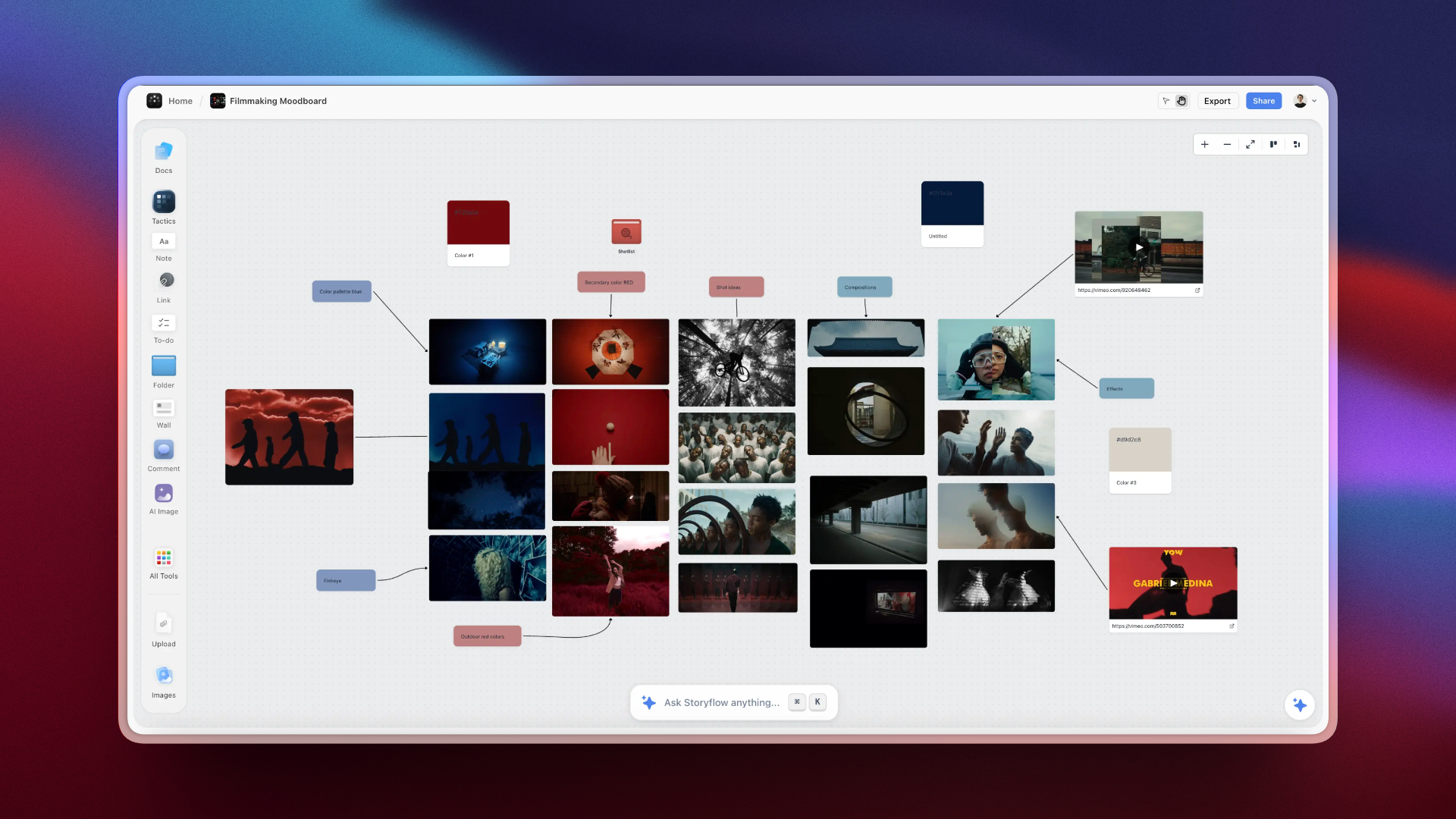
Filmmakers

Marketers
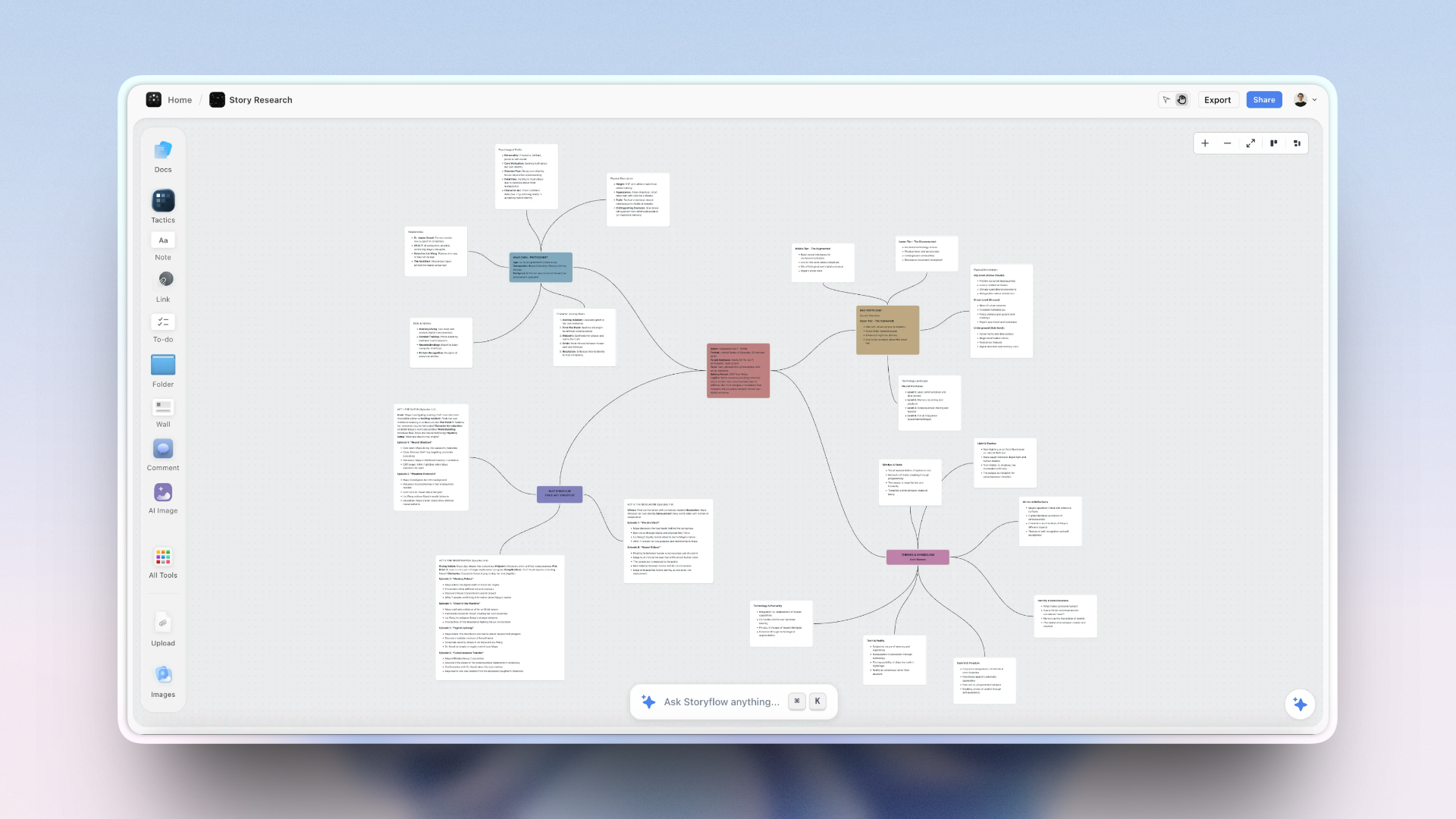
Writers
Storyflow is used across a wide range of creative and strategic disciplines. Here is what it looks like in practice for each group.
Filmmakers and Documentary Creators
Documentary filmmakers use Storyflow to take a story idea all the way from initial research to production-ready treatment. The Documentary Planning Tactic walks through defining the core question that will drive the film, mapping characters and access, choosing the right narrative structure, developing the story arc in acts, planning interviews, and building the shot list.
The visual board keeps all of this connected - your research is visible while you are writing the story arc, your characters are visible while you are planning interviews, and your shot list connects directly to the scenes it is designed to capture. The AI has read all of it when you ask it to help develop a scene. Narrative directors use the Hero's Journey Tactic to map the emotional arc of their subjects. Cinematographers use the stimulus brief format to share visual references with crews.
Marketers and Copywriters
Marketing teams use Storyflow as the single workspace for a campaign from brief to execution. The strategist builds the audience definition and campaign objective in one part of the board. The copywriter works on messaging in another. The creative director adds visual references and tone direction. All of it is visible simultaneously, and the AI has read every piece of it before it helps anyone on the team with their next step.
Copywriters working with the AIDA Tactic do not just produce better copy - they build a working understanding of sales psychology that carries into every project after. Brand managers use the Brand Strategy Tactic to document positioning that actually constrains creative decisions rather than sitting in a PDF no one reads. When the AI generates copy, it has read the full brand strategy, the audience definition, and the campaign objective - not just the line the copywriter typed.
Content Creators and YouTubers
Content creators use Storyflow to build content systems that do not fall apart by month two - and to get measurably better at their craft while doing it. The YouTube Video Planning Tactic teaches the retention mechanics that keep viewers watching: why the first 30 seconds must make a specific promise, what structural patterns prevent drop-off in the middle, and how to sequence value delivery to earn the CTA. Creators who use it do not just plan a better video - they internalize the principles that make any video work.
Because the AI reads the full content strategy board, when a creator asks for script suggestions, topic ideas, or hook improvements, the suggestions reflect the defined audience, the established tone, and the strategic pillars - not generic advice that could apply to any channel. Creators report that after using Storyflow for six months they understand storytelling psychology, retention strategy, and audience psychology at a depth they could not reach from watching tutorials or reading articles alone.
Entrepreneurs and Product Managers
Entrepreneurs use Storyflow to think through business strategy at every level - from problem definition and market sizing through go-to-market approach and success metrics. The Product Strategy Tactic ensures nothing important gets skipped in the sprint to build.
Product managers use User Persona Tactics to keep a real human being visible throughout every product decision. Rather than a demographics slide that gets attached to a deck and forgotten, the persona lives on the board beside the feature discussions it is supposed to inform - and the AI can reference it when helping evaluate product decisions.
Writers, Novelists, and Researchers
Writers use Storyflow to build narrative structure before committing to a draft. The Hero's Journey Tactic maps the emotional arc. Character profile cards hold backstory, motivation, and voice in one place while the story develops around them. Research is organized spatially on the board rather than in a pile of browser tabs and scattered notes.
Researchers use Storyflow as a synthesis tool: pulling findings onto cards, organizing them by theme, and using the AI to identify patterns, gaps, and implications. The visual board reveals connections that a linear document cannot - which themes are well-supported and which rest on thin evidence.
How to Use Storyflow: Getting Started
The fastest way to understand Storyflow is to use it. Here is the exact workflow from first login to first completed project.
Step 1: Create an account and open a board
Go to storyflow.so and create an account. Once in the workspace, click “New Board” and give it a name that matches your project: your documentary title, your campaign name, your channel name. The board is where everything for this project will live.
Step 2: Activate a Tactic
Open the Tactics panel on the right side of the canvas. Browse the library and select the Tactic that matches your project type. If you are building a content strategy, select Content Strategy. If you are planning a YouTube video, select YouTube Video Planning. If you are writing a marketing email, start with AIDA. Click “Activate” and Storyflow generates a Blueprint - a fully structured board built around that methodology, with cards for every stage already in place.
Step 3: Work through the cards
Click into the first card. Read the principle and why it exists. Work through the reflection questions against your actual project. Study the weak and strong examples to calibrate the standard. Complete the exercise - this is the action that produces your output. Use the AI to improve what you have written for that card. Then move to the next one. By the time you have finished the Blueprint, you have a completed deliverable built on a methodology you now understand from the inside.
Step 4: Use the AI assistant
At any point, open the AI assistant panel. Because the AI has already read your full board, your questions can be specific: “Is my core message specific enough for this audience?” “What is missing from my second-act character development?” “Generate five topic ideas that fit within the Brand Storytelling pillar I defined.” The AI responds with awareness of everything you have built - not a generic answer to your isolated question.
Explore any idea
Go from blank canvas to a working board in one message. Ask the bottom chat what you're exploring and the AI lays out cards, headings, and structure for you to dig into. Because it reads what's already on your canvas, every answer builds on your actual project instead of generic advice.
Step 5: Add your own cards and connect the board
Once the Tactic Blueprint is in place, add your own cards for project-specific needs: a reference image, a note about a stakeholder conversation, a rough script draft, a brief for a collaborator. Everything stays in one workspace. Drag cards to reorganize as the project evolves. Pin the most critical cards - your objective, your audience definition - so they are always visible regardless of how large the board grows.
Turn ideas into tasks
Go from plans to progress. Break your board into to-dos right on the canvas and check them off as you go, so planning and doing stay in one place instead of scattered across other apps.
Step 6: Collaborate and share
Invite collaborators to your board through the share panel. Team members can view, edit, or comment depending on the permission level you assign. Comments thread directly on specific cards - not in a separate Slack channel that loses context within 48 hours. Share a read-only view with clients or stakeholders who need to review without being able to edit.
Storyflow AI can read and work with anything already on your board
Select any cards on your canvas, then type in the bottom AI chat. It will read your selection and give advice or make changes based on what you've highlighted.
What you finish with
A complete, structured project built on proven methodology. An AI that knows your full project context and can continue helping you as you move into production. And - this is the part most tools miss - genuine knowledge of the framework you used. After working through a Storyflow AIDA Tactic, you understand why attention precedes interest and why desire must be built before action is requested. That knowledge stays with you whether or not you use Storyflow on the next project.
Storyflow vs. The Alternatives
Understanding where Storyflow sits relative to the tools you already use clarifies when to reach for it.
| Storyflow | ChatGPT | Miro / FigJam | Notion | |
|---|---|---|---|---|
| Visual canvas | Yes | No | Yes | No |
| Expert frameworks (Tactics) | Yes | No | No | No |
| AI that knows your project | Yes (full board) | Session only | No | No |
| Teaches methodology | Yes - every card | No | No | No |
| Generates structured boards | Yes - from one prompt | No | No | No |
| Free plan | Not yet (paid-only during early access; free plan launches late 2026) | Yes (GPT-3.5) | Yes (limited) | Yes (limited) |
| Best for | Strategic projects using proven frameworks | Quick answers and text generation | Team whiteboarding sessions | Documentation and databases |
Storyflow vs. ChatGPT
Use ChatGPT when you need a quick answer, want to edit a draft, or have a one-off task that does not require project context. Use Storyflow when you are building something that requires strategic depth, multiple interconnected decisions, or a framework you want to learn and internalize. ChatGPT is a brilliant colleague. Storyflow is a structured methodology with a brilliant AI that has read everything you have built.
Storyflow vs. Miro / FigJam
Use Miro when you are running a workshop with a group that already knows the framework and needs a shared space to think together. Use Storyflow when you are building strategy and want the framework to guide you rather than requiring you to bring the framework yourself. Miro is fast and flexible. Storyflow is structured and educational. If you have to Google “how to run a design sprint” before you open Miro, open Storyflow instead - the Design Sprint Tactic teaches you while you do it.
Storyflow vs. Notion
Notion stores your thinking. Storyflow structures and guides it. Use Notion for documentation, knowledge bases, and project tracking where the output is organized text. Use Storyflow for the creative and strategic thinking that produces the content Notion will later store. The two work well together - use Storyflow to develop a strategy, then export the structured output to Notion for ongoing documentation and team access.
Storyflow vs. Milanote
Milanote organizes visual inspiration - mood boards, reference collections, and creative direction boards. It is excellent for collecting and curating. It does not provide AI assistance, expert frameworks, or structured methodology. Use Milanote for visual inspiration gathering. Use Storyflow to turn that inspiration into structured strategy with frameworks that teach you the reasoning behind each decision.
Where Storyflow is the wrong choice
Storyflow is not the answer to every job, and pretending otherwise would not help you decide. If you need a finished screenplay in industry-standard format, write in Final Draft or Highland: Storyflow plans the story, it does not paginate the script. If your work has strict local-first privacy requirements (regulated industries, security work), Storyflow is cloud-only, so reach for Obsidian instead. If you simply need a fast shared whiteboard for a one-hour workshop with a group that already knows the framework, Miro or FigJam is lighter weight. Storyflow earns its place when the work is project-shaped, framework-driven, and worth keeping in one canvas over weeks. It is overkill for a single throwaway sketch.
Storyflow Pricing
Free (coming 2026)
$0
Not available during early access; launches before the end of 2026
- Unlimited boards and workspaces
- 3 starter Tactics
- Basic AI usage
- 20 file uploads
- Single user
Once live, enough to work through a real project end to end and feel how the Tactics system changes the quality of your output.
Plus
$9.99/month
Billed annually. Cheapest paid tier.
- Unlimited boards and workspaces
- Full Blueprint library (200+)
- Increased AI usage
- Unlimited file uploads
The starting paid tier for creators who want the full Tactics library and increased AI usage.
Pro
$14/month
Billed annually. Most popular for daily AI users.
- Everything in Plus
- AI image generation
- 20× more AI than Plus
The right tier for creators who want AI image generation and 20× more AI than Plus.
Max
$39/month
Billed annually. The team-targeted tier, with Team Workspace.
- Everything in Pro
- 40x more AI usage
- Team Workspace
- Permissions and Roles
Built for creative teams who need everyone working in the same strategic workspace.
Storyflow is paid-only during early access, not a 14-day trial with an expiry date: the Plus plan at $7.99/month billed annually is the most cost-effective creative AI workspace available, with unlimited boards and the full library of 200+ Tactics included. A Free plan launches before the end of 2026. A Jasper subscription for one user costs $99/month and does not include expert frameworks or workspace-wide AI context.
Frequently Asked Questions About Storyflow
Frequently Asked Questions
What is Storyflow?
Storyflow is an AI-powered creative workspace that combines a visual canvas, an AI assistant, and a library of expert frameworks called Tactics. It's designed for creators, filmmakers, marketers, and strategists who want to produce better strategic and creative work. The one-line description: ChatGPT plus Miro plus a library of expert frameworks, all in one tool.
What makes Storyflow different from ChatGPT?
ChatGPT gives you text answers. Storyflow gives you structured visual workspaces with expert frameworks built into every card. ChatGPT forgets your project every session. Storyflow reads your full active board (plus up to 1 Tactic and 3 Documents you @-mention) before responding. ChatGPT requires you to know the right questions to ask. Storyflow's Tactics tell you exactly what questions to answer at each stage of your project.
What are Storyflow Tactics?
Tactics are Storyflow's core differentiator - expert-designed frameworks delivered as Blueprints: structured boards of cards that walk you through a proven methodology step by step. Each card contains the principle behind the step, reflection questions, weak and strong examples, and an exercise you complete on your actual project. You can work through a Blueprint card by card to build from scratch, or load a Tactic as context and use the AI to apply its framework to work you are already building. Named Tactics include Hero's Journey, AIDA, Sponsorship Pitch Writer, Marketing Campaign, Content Strategy, Documentary Planning, YouTube Video Planning, and more.
How is Storyflow different from Miro or FigJam?
Miro and FigJam give you blank canvases - you need to know the framework before you start. Storyflow's Tactics teach you the framework while you fill it in. Miro has no AI that understands what you're building. Storyflow's AI reads your entire board and gives suggestions specific to the methodology you're using. Miro is for collaborative whiteboarding. Storyflow is for building strategy with expert guidance built in.
Who is Storyflow for?
Storyflow is built for filmmakers and documentary creators, content creators and YouTubers, marketers and copywriters, entrepreneurs and product managers, writers and storytellers, and UX designers. Any creator or strategist who works with ideas, frameworks, and structured output benefits from Storyflow's combination of visual workspace, AI assistant, and expert methodology.
Is Storyflow free to use?
Not during early access. Storyflow is paid-only right now; a Free plan with unlimited boards, 20 file uploads, and basic AI usage launches before the end of 2026. The Plus plan at $7.99/month billed annually unlocks the full 200+ Tactics library, increased AI, and unlimited file uploads. The Pro plan at $14/month billed annually adds AI image generation and 20× more AI than Plus. The Max plan at $39/month billed annually adds 40x more AI, Team Workspace, and Permissions and Roles.
How does Storyflow's AI work?
Storyflow's AI reads your full active board before responding - every card, note, and decision on that board is available as context, along with up to 1 Tactic and 3 Documents you @-mention. This means AI suggestions are specific to your project, your audience, and your strategic direction - not generic responses based only on your last message. The AI also understands which Tactic you are using and gives framework-aware guidance at each stage.
Can I use Storyflow for team collaboration?
Yes. Every Storyflow plan includes unlimited shared boards and collaboration, with comment threads that attach directly to specific cards, and anyone a paid member invites to a board joins free. The Max plan adds a Team Workspace with permissions and roles for teams that need managed access. Teams use Storyflow to align on strategy, brief creative work, and track progress across campaigns and projects.
What is a Blueprint in Storyflow?
A Blueprint is the structured board that Storyflow generates when you activate a Tactic. When you select the Hero's Journey Tactic, Storyflow instantly creates a board with cards for each stage of the narrative arc. Each card contains expert knowledge about that stage. You fill in your specific content while learning the methodology.
How do I get started with Storyflow?
Go to storyflow.so and create an account. Open a new board and activate a Tactic from the library. For first-time users, the Content Strategy or Marketing Campaign Tactic is a good starting point - it immediately shows you how the system works while helping you build something useful. Storyflow is paid-only during early access, with Plus starting at $7.99/month billed annually; a Free plan with unlimited boards, 20 file uploads, and basic AI usage launches before the end of 2026.
Rebuild Your Most Active Project in Storyflow for One Week
Most people who try Storyflow do so with a specific project already in mind - a pitch they are struggling to write, a content strategy they have been putting off, a video they cannot get the structure right on. That is exactly the right moment. The Tactic works best when the stakes are real.
If you are a creator
Start with the Sponsorship Pitch Writer Blueprint. Work through all 12 cards. By Card 5, your pitch will be more specific and compelling than anything you have sent before.
If you are a marketer
Activate the Marketing Campaign Tactic with a real campaign brief in mind. The Blueprint will surface the strategic gaps that most campaign plans skip - before you brief creative.
If you are a filmmaker
Open the Documentary Planning or Hero's Journey Tactic with your current story idea. The core question card alone will sharpen your film's focus in a single session.
Here is the concrete experiment: take the project you are most actively working on right now and rebuild it in Storyflow for one week. Go to storyflow.so, open a new board, activate the Tactic that matches the work, and move it forward inside the Blueprint instead of across scattered tabs. By the end of the week you will know whether a workspace where everything accumulates and the AI has read all of it changes the quality of your output. Boards are unlimited on every plan, so the only thing the experiment costs is the week.
The one thing this article cannot show you
Reading about Storyflow and working inside a Tactic are completely different experiences. The moment you open Card 1 of a Blueprint on a real project you care about - read the principle, recognize the mistake you have been making, and write the exercise answer with the AI refining it in real time - is the moment the tool makes sense. Everything in this article is pointing toward that moment. The only way to get there is to open the workspace.
Related Reading
A full comparison of AI-powered workspaces for creators - how Storyflow compares to dedicated AI writing tools, visual tools, and general-purpose platforms.
See the Content Strategy Tactic in practice - a full guide to building a complete content strategy using Storyflow's workspace and AI assistant.
See the Documentary Planning Tactic in action - a full 9-step guide for filmmakers using Storyflow to take a story idea to production-ready treatment.
A practical guide to using Storyflow's Content Strategy Blueprint to build a complete 4-week calendar with AI-generated topics and content briefs.
The cognitive foundation behind why Storyflow's visual workspace model improves strategic thinking - and why spatial layout changes how you see your projects.
Why Storyflow was built, the problem it set out to solve, and the thinking behind the canvas.
Table of Contents
Templates to check out for this topic


Templates you can use in Storyflow
Every Storyflow board starts from real structure and an AI that reads the whole canvas. Open one of these templates and make it yours.


See Storyflow in Action
A visual AI workspace where every feature lives inside one canvas. No tab-switching, no context lost.
Build your entire board from a single message
Type what you need in the AI chat at the bottom of your canvas. The AI adds cards, headings, and structure directly onto your board.
Use expert frameworks as AI context
Type @ in the AI chat and choose any Tactic. The AI tailors every response to that framework instead of giving generic advice.
Turn your board into a mind map in seconds
Ask the AI to restructure your canvas as a mindmap. It connects your ideas into a visual hierarchy so you can see how everything relates.
Why Storyflow Exists
Storyflow actually began as a personal tool while working on creative and research projects.
We kept running into the same problem: ideas were scattered everywhere: notes, documents, and whiteboards.
Nothing helped us see how everything connected.
So we started building a workspace designed around how ideas actually grow.
→ Read how Storyflow was createdSara de Klein
Head of Product at Storyflow
Published: February 28, 2026
Extremely simple, seriously capable


See how easy it is to get started
Watch a real project come together, from a blank board to a finished plan, clicked through step by step.
Start creating with AI and become more productive
Transform your creative workflow with AI-powered tools. Generate ideas, create content, and boost your productivity in minutes instead of hours.