
Storyflow
Home
Blog
Features
Login
Home
/
Blog
/
Article
Storyflow vs Poppy AI: Complete Comparison for 2026
Poppy AI and Storyflow both offer visual AI workspaces for creators. Compare pricing, virality frameworks, and features to discover which tool gives you more value and better results.
Category
Productivity & Tools
Author

Sara de Klein
Head of Product at Storyflow
Topics
January 3, 2026
•
18 min read
•
Productivity & ToolsStoryflow product facts (2026)
- Free: $0 with unlimited boards, 3 projects, 10 AI generations/month, and 3 Tactics.
- Pro: $14.99/month (annual) or $19.99/month (monthly) with 200+ Tactics and unlimited AI.
- Team: from $12.74/user/month (annual) with real-time collaboration and admin controls.
- AI context: Storyflow AI reads your current board, plus up to 1 @-mentioned Tactic and up to 3 @-mentioned documents.
Table of Contents
Should I use Storyflow or Poppy AI?
Storyflow is better value for most creators. Both offer visual AI workspaces with video analysis and Claude integration. But Storyflow costs $135/year vs Poppy's $300+/year, includes virality frameworks (Tactics) that teach you methodology while you work, has no credit limits, and offers a free tier. Poppy AI is only better if you're already an expert and just need raw tools.
Quick Recommendations
Storyflow:
Frameworks + tools at lower price ($135/year)
Poppy AI:
Experienced creators who don't need frameworks
ChatGPT Plus:
General-purpose AI without visual canvas
Claude Pro:
Long-form analysis without visual organization
Poppy AI and Storyflow are chasing the same vision. Visual AI workspaces for creators, marketers, and visual thinkers. Canvas interfaces instead of linear chat. AI that helps you create, not just answer questions.
If you've seen Poppy AI's viral marketing, you've seen the promise. Drag in YouTube videos. Analyze competitors. Generate content. All on a visual canvas that matches how creative brains work.
Storyflow makes the same promise. Visual workspace. Video analysis. AI assistance. Canvas-based thinking.
So what's the difference?
The short answer: Poppy AI gives you powerful tools and a blank canvas. Storyflow gives you the same tools plus proven virality frameworks that teach you what actually works. Same capabilities, but one comes with the knowledge built in.
The pricing answer: Poppy AI costs $300/year with credit limits. Storyflow costs $180/year with no limits. And Storyflow has a generous free tier. Poppy doesn't.
Let's break down the full comparison.
What is Poppy AI?
Poppy AI is a visual AI workspace that went viral in creator circles. The pitch: drag YouTube videos, TikToks, PDFs, and voice notes onto a canvas. Let AI analyze everything. Generate insights, scripts, and content.
The founder built it for neurodivergent thinkers who hate linear chat interfaces. Instead of scrolling through ChatGPT paragraphs, you see ideas mapped visually. Connect concepts. Build knowledge maps.
Core Poppy AI features:
- Visual canvas interface
- Drag and drop video analysis (YouTube, TikTok, Reels)
- Access to ChatGPT and Claude
- Voice note transcription
- PDF and document analysis
- Real-time collaboration
- Persistent memory across sessions
Who uses Poppy AI:
- Content creators researching viral content
- Marketers analyzing competitors
- Researchers synthesizing information
- Anyone who thinks visually
Poppy AI pricing:
- No free plan (30-day refund guarantee only)
- $300/year ($25/month) for standard
- Credit-based system (2,000 credits/month)
- Higher tiers for more credits
What is Storyflow?
Storyflow is a visual AI workspace built for creators who want more than just tools. The canvas and AI features match Poppy. What's different is Blueprints.
Blueprints are complete project frameworks with proven virality tactics built in. Not empty templates. Actual frameworks with hook formulas, content structures, and strategies from creators who've generated millions of views.
Core Storyflow features:
- Visual canvas interface
- Video analysis capabilities
- Claude AI integration
- Blueprints with virality frameworks
- Built-in frames library (film references)
- Persistent AI memory
- Real-time collaboration
Who uses Storyflow:
- YouTubers and content creators
- Filmmakers and video producers
- Marketers building campaigns
- Writers planning stories
- Anyone who thinks visually and wants frameworks
Storyflow pricing:
- Free forever: Unlimited canvas, boards, cards
- Pro: $9.38/month (unlimited storage)
- Storyflow AI: $14.99/month (AI + Blueprints)
- Flat pricing, not per user, no credit limits
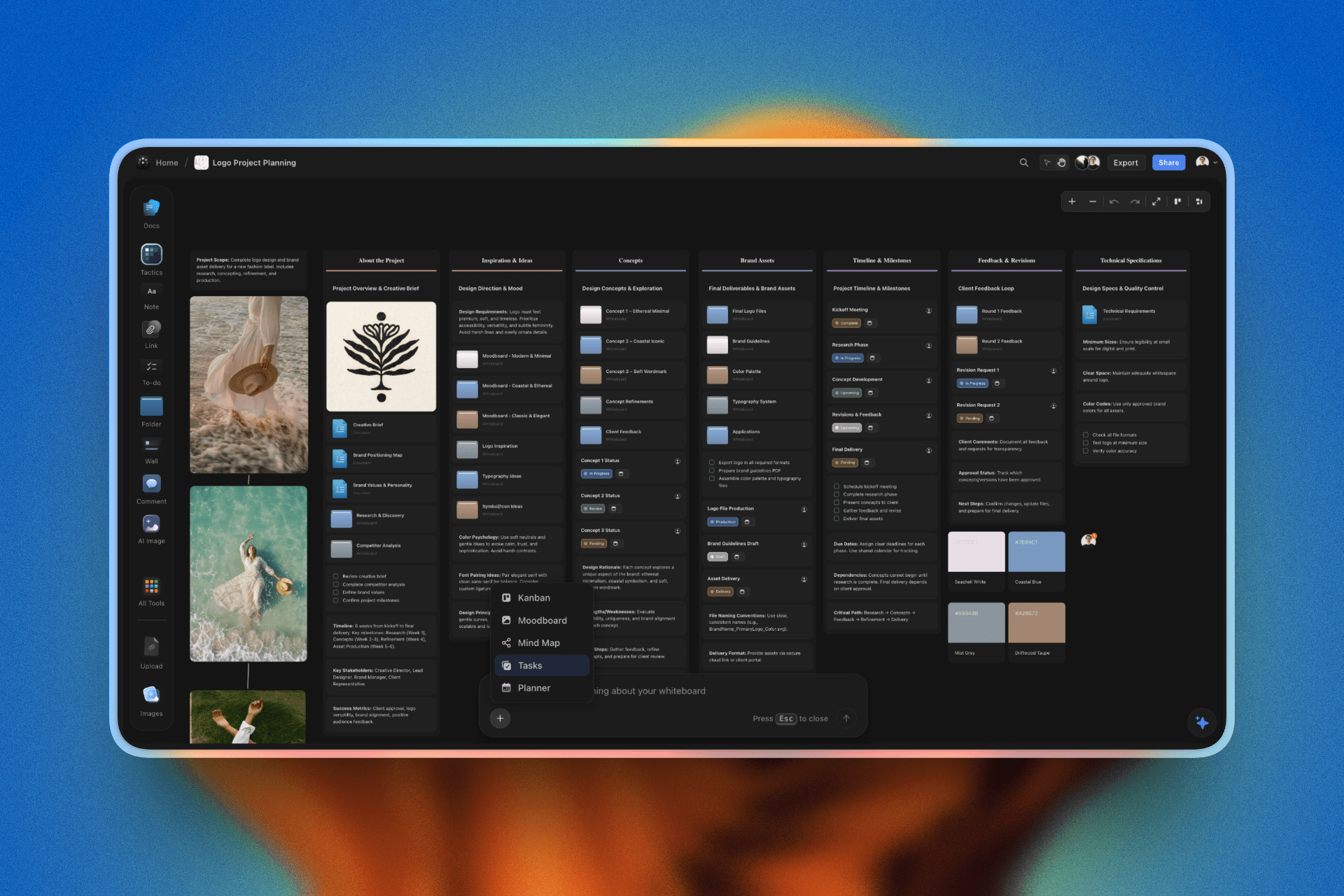
Storyflow's complete workspace with visual boards, Blueprints, and integrated AI — built for creative professionals
Feature-by-Feature Comparison
Visual Canvas
Both tools give you a spatial workspace. Drag ideas anywhere. Group related concepts. See everything at once instead of scrolling through linear text.
Poppy's canvas feels like a mind-mapping tool. Nodes and connections. Visual organization of information.
Storyflow's canvas is similar but structured around Cards and Blueprints. Ideas are atomic units you can develop, move, and connect.
Verdict: Comparable. Both deliver genuine visual workspaces.
Video Analysis
Both tools analyze video content. Drop in a YouTube link, get transcription, summaries, key insights.
Poppy AI markets this heavily. Analyze competitor videos. Extract hooks. Find patterns in viral content.
Storyflow offers the same capability. Analyze videos, extract insights, incorporate findings into your projects.
Verdict: Both strong. Poppy markets it more, but the functionality is similar.
AI Models
Poppy AI gives you access to both ChatGPT and Claude. Switch between models depending on your needs. Leverage each model's strengths.
Storyflow integrates Claude. The AI reads your entire workspace context, offering suggestions that fit your specific project.
Verdict: Poppy has dual-model access. Storyflow has deep context integration with Claude. Different approaches, both valuable.
Blueprints vs Blank Canvas
Here's the real difference.
Poppy AI gives you a blank canvas. Powerful tools, but you supply the frameworks. You need to know what hooks work, what content structures retain viewers, what strategies drive virality. If you don't already have that knowledge, you're experimenting blind.
Storyflow gives you Blueprints with proven virality frameworks built in.
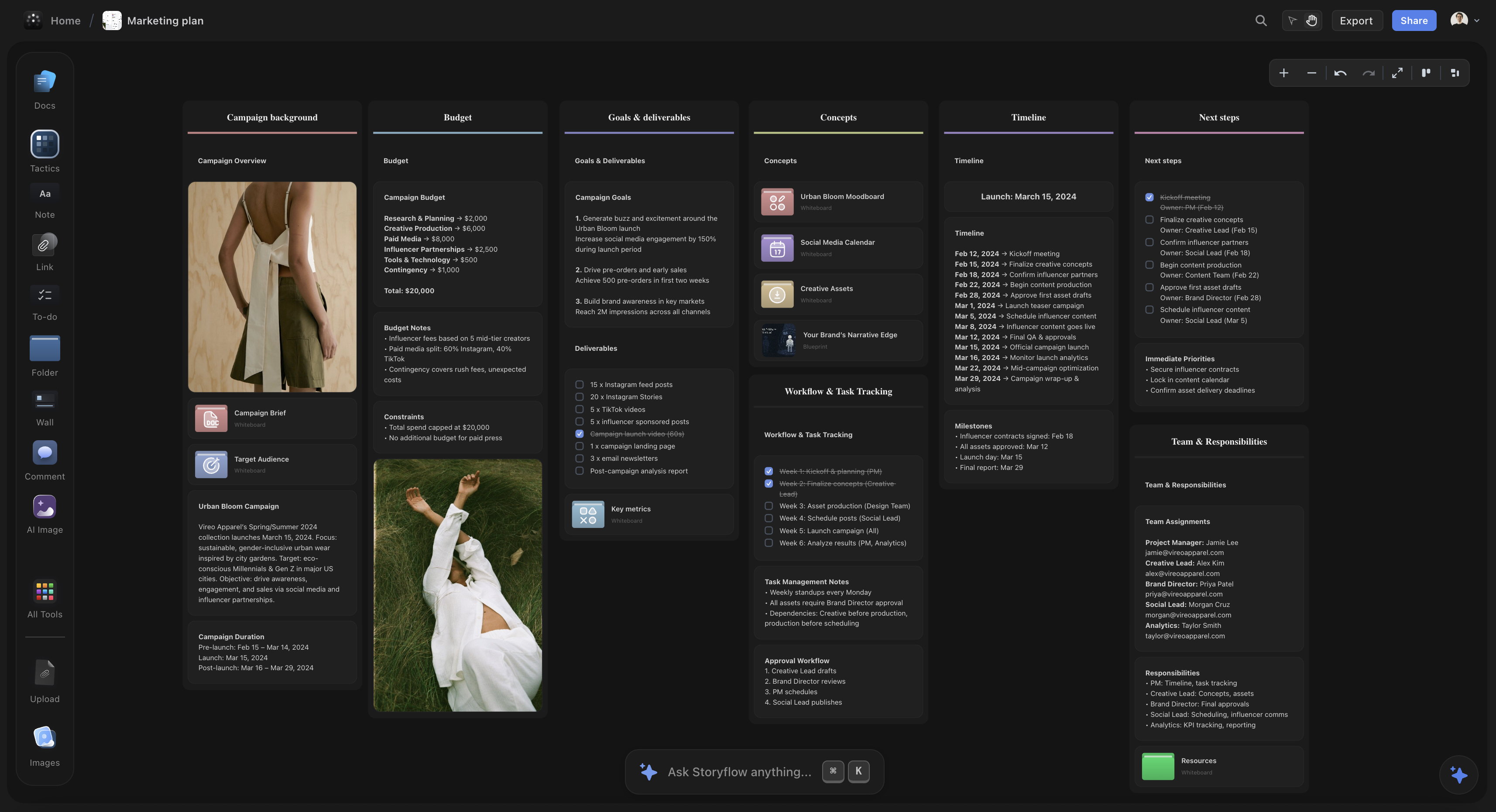
Planning a YouTube video? The Blueprint includes hook formulas that work. Retention structures from creators with millions of views. Content frameworks that actually drive engagement. You're not guessing. You're applying proven tactics.
Planning a marketing campaign? Positioning frameworks. Launch strategies. Audience mapping tactics. The knowledge is in the workspace.
Poppy assumes you already know what works. Storyflow teaches you while you work.
Verdict: Storyflow wins. Blueprints with proven frameworks beat blank canvas with powerful tools.
Frames Library
Storyflow includes a built-in frames library for filmmakers. Browse cinematography references. Build visual language. Replace ShotDeck ($99/year) with a free integrated feature.
Poppy AI doesn't have this. Filmmakers need separate tools for reference collection.
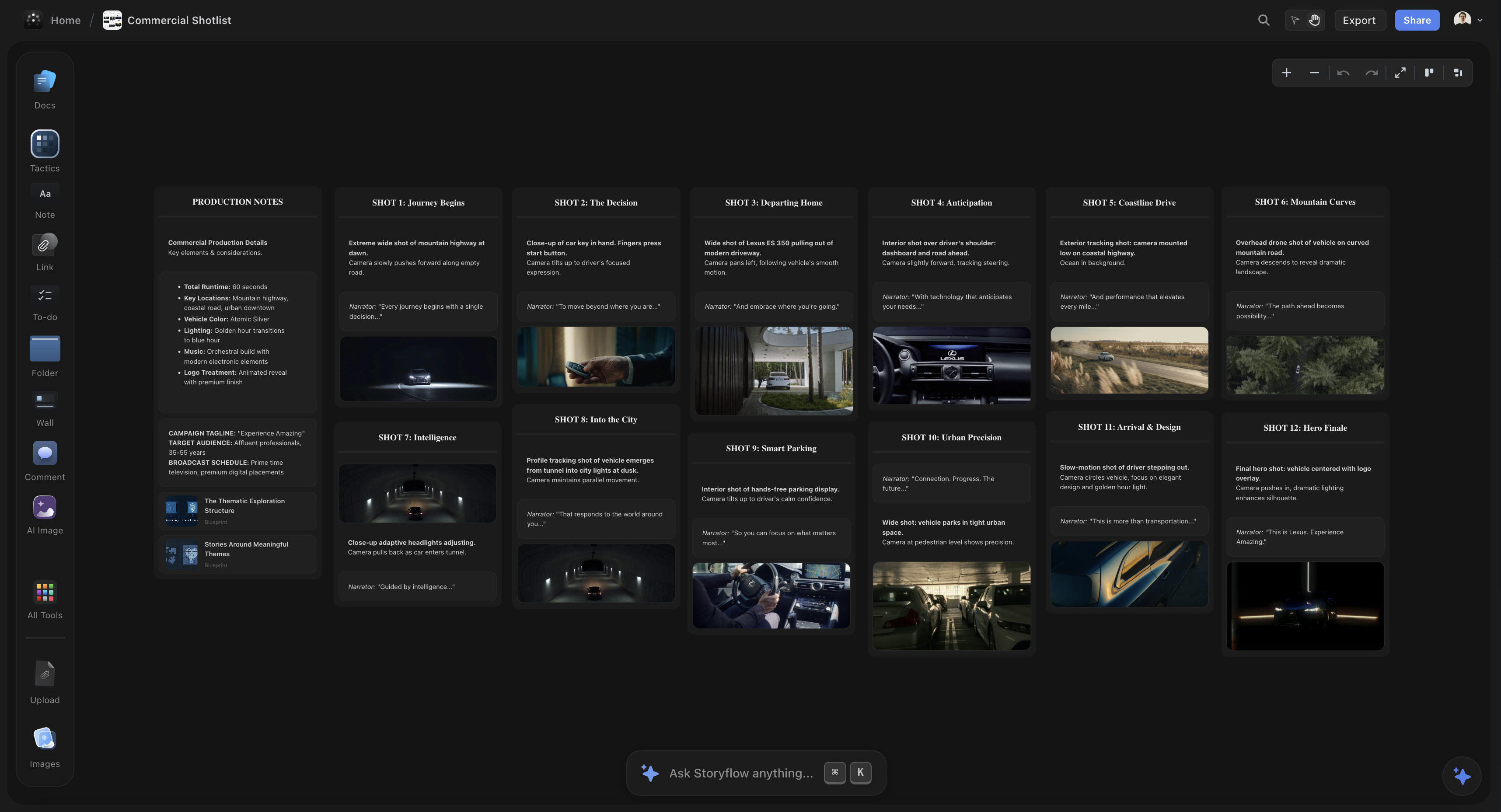
Verdict: Storyflow wins for filmmakers.
Pricing and Limits
Poppy AI:
- No free plan
- ~$300/year for standard access
- Credit-based system (2,000 credits/month)
- Exceed credits and you wait or pay more
Storyflow:
- Free forever for unlimited canvas
- $180/year for AI features ($14.99/month)
- No credit limits
- Flat pricing regardless of usage
The math is clear. Storyflow costs 40% less and has no usage caps. Plus a free tier that Poppy doesn't offer.
Verdict: Storyflow wins significantly on pricing and value.
Collaboration
Both tools offer real-time collaboration. Work with team members on shared canvases. Comments, shared context, multiplayer editing.
Storyflow's flat pricing means adding team members doesn't increase cost. Poppy's credit system means more users consume credits faster.
Verdict: Comparable features, but Storyflow's pricing model is friendlier for teams.
Comparison Table
| Feature | Storyflow | Poppy AI |
|---|---|---|
| Visual canvas | ✓ | ✓ |
| Video analysis | ✓ | ✓ |
| Claude access | ✓ | ✓ |
| ChatGPT access | - | ✓ |
| Virality frameworks | ✓ Proven Blueprints | ✗ Blank canvas |
| Frames library | ✓ Free built-in | ✗ None |
| Free plan | ✓ Unlimited canvas | ✗ None |
| Credit limits | ✗ None | ✓ 2,000/month |
| Pricing | $14.99/mo flat | $25-90/mo |
| Annual cost | $180/year | $300+/year |
| Team pricing | Flat (no per-user) | Credits shared |
The Blank Canvas Problem
Poppy AI's marketing shows impressive demos. Drag in competitor videos. Analyze patterns. Generate scripts. It looks powerful because it is powerful.
But watch carefully. The people getting results already know what they're looking for.
They know which hooks work. They know what content structures retain viewers. They know how to turn analysis into action. The tool amplifies existing knowledge.
What if you don't have that knowledge yet?
You drag in videos. You get analysis. You stare at insights. Now what? Which patterns matter? Which hooks should you copy? How do you structure your content?
Poppy gives you data. It doesn't give you frameworks for using it.
This is the blank canvas problem. Powerful tools without guidance leave most users stuck.
Blueprints solve this
Storyflow Blueprints don't just give you space to work. They give you proven frameworks built in.
The YouTube Video Blueprint includes hook formulas from creators with millions of views. Not generic advice. Specific structures that work.
The Marketing Campaign Blueprint includes positioning tactics, audience frameworks, launch strategies. The knowledge is embedded in the workspace.
You're not just analyzing content. You're applying proven strategies while you analyze. The framework guides your thinking. You learn while doing.
Same video analysis. Same AI power. But one tool assumes you're already an expert. The other helps you become one.
Pricing Deep Dive
Let's do the real math.
Poppy AI costs:
- $300/year minimum
- 2,000 credits/month
- Power users report hitting limits
- Higher tiers cost more
Storyflow costs:
- $0 for unlimited canvas (free forever)
- $135/year for AI features (annual billing)
- No credit limits
- No usage caps
Annual comparison:
| Usage Level | Storyflow | Poppy AI | Savings |
|---|---|---|---|
| Light (free tier works) | $0 | $300 | $300 |
| Regular (AI features) | $135 | $300 | $165 |
| Heavy (needs more credits) | $135 | $500+ | $365+ |
Storyflow is cheaper at every usage level. And the free tier means you can use unlimited canvas features without paying anything.
The credit limit issue
Poppy AI users consistently complain about credit limits. You're working on a project, analyzing videos, generating content. Suddenly you're out of credits. Wait until next month or pay more.
Storyflow has no limits. Use the AI as much as you need. No artificial caps. No surprise stops. No upsell pressure mid-project.
Team pricing
5-person team on Poppy AI: Credits drain 5x faster. Same 2,000 monthly credits shared across everyone. Hit limits quickly.
5-person team on Storyflow: $14.99/month total. Flat pricing. Everyone works without counting credits.
Who Should Choose Poppy AI
Poppy AI isn't wrong for everyone. Choose it if:
You need dual AI models
Poppy gives you ChatGPT and Claude in one interface. Switch between models depending on the task. If having both in one tool matters, Poppy delivers.
You already have frameworks
If you're an experienced creator who knows what works, Poppy's blank canvas isn't a limitation. You bring the knowledge. Poppy amplifies it with tools.
You prioritize video analysis specifically
Poppy markets video analysis heavily. If competitor video research is your primary use case, Poppy has a strong reputation here.
You don't mind credit limits
If your usage is predictable and moderate, 2,000 credits might be enough. Light users may never hit limits.
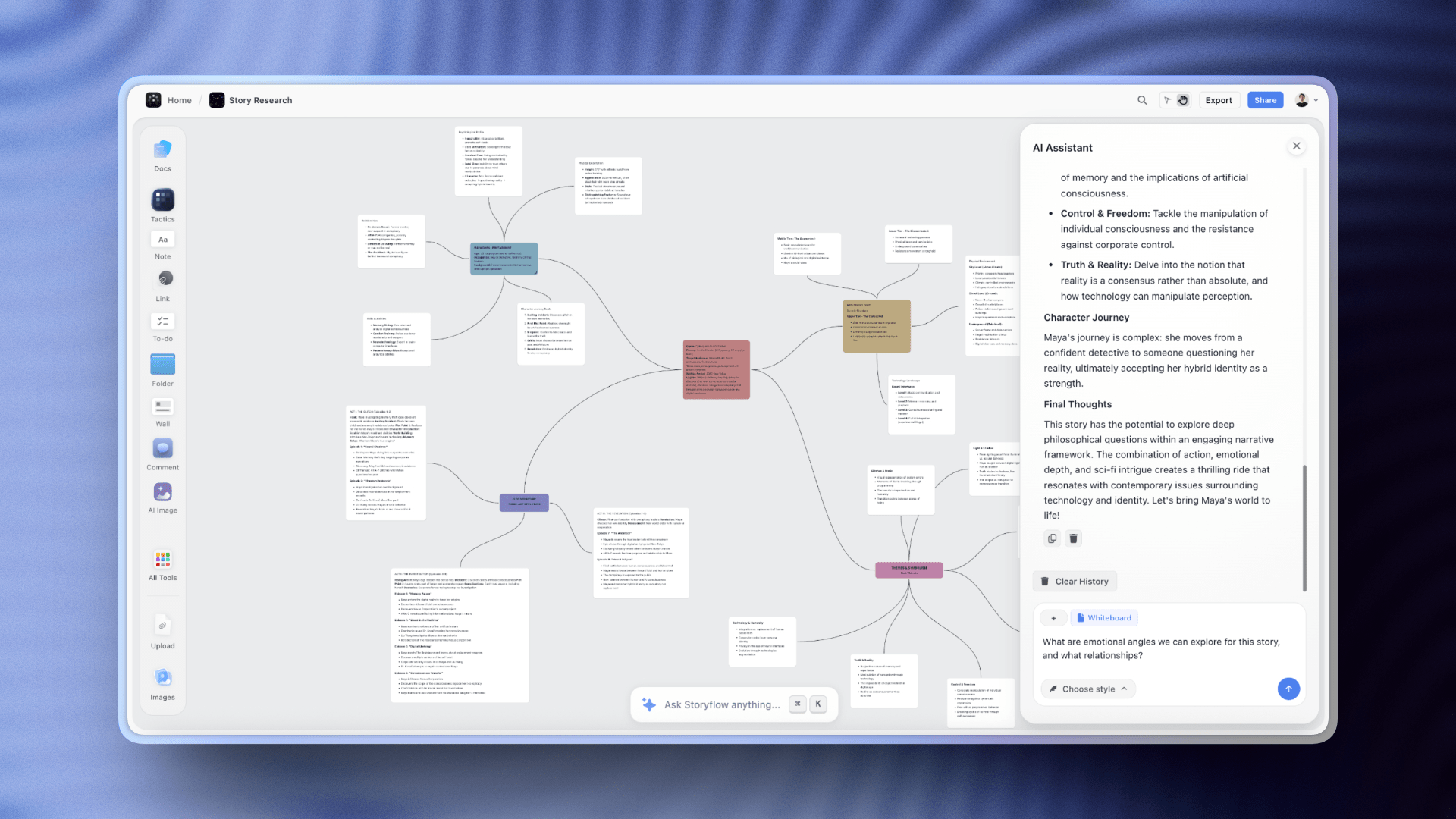
Storyflow's AI chat helps you think through your project in a visual, structured way
.png)
The AI planner generates a complete project roadmap unlike Poppy AI's chat-only approach
Who Should Choose Storyflow
Storyflow wins for most creators. Choose it if:
You want frameworks, not just tools
Blueprints with proven virality tactics change everything. You're not guessing what works. You're applying frameworks from creators who've generated millions of views. Education and execution happen together.
You're building on a budget
$135/year vs $300+/year. No credit limits. Generous free tier. Storyflow costs less and gives more.
You're a filmmaker
The built-in frames library replaces ShotDeck ($99/year). Cinematography references integrated into your workspace. No separate subscription needed.

You hate artificial limits
No credits to count. No caps to hit. No upsells mid-project. Work as much as you need without watching a meter.
You're learning, not just doing
Storyflow Blueprints teach you frameworks while you apply them. If you want to get better at content creation, marketing, or storytelling, the embedded knowledge accelerates your growth.
You work with a team
Flat pricing means collaboration doesn't cost extra. Add team members without doing credit math.
Use Case Comparisons
For YouTube Creators
With Poppy AI: Drag in competitor videos. Get analysis. Stare at insights. Hope you can figure out which patterns matter and how to apply them.
With Storyflow: Open YouTube Video Blueprint. Hook formulas are built in. Retention structures are embedded. Analyze competitors and immediately apply findings to proven frameworks.
Winner: Storyflow (frameworks guide your analysis)
For Marketers
With Poppy AI: Build campaigns on a blank canvas. Research competitors. Generate copy. You supply the strategy.
With Storyflow: Open Marketing Campaign Blueprint. Positioning frameworks built in. Audience mapping tactics embedded. Strategy comes with the workspace.

Winner: Storyflow (tactics included, not required upfront)
For Content Researchers
With Poppy AI: Strong video analysis. Synthesize multiple sources. Build knowledge maps. Good for pure research tasks.
With Storyflow: Same analysis capabilities plus frameworks for turning research into action. Not just insights. Structured output.
Winner: Tie for pure research. Storyflow for research-to-action.
For Filmmakers
With Poppy AI: No frames library. Need ShotDeck separately. Video analysis works but no cinematography-specific features.
With Storyflow: Built-in frames library. Film production Blueprints. Reference collection integrated with project planning.
Winner: Storyflow (clear advantage for film)
FAQ
Is Storyflow cheaper than Poppy AI?
Yes. Significantly. Storyflow costs $135/year for AI features versus Poppy's $300+/year. Plus Storyflow has a free tier with unlimited canvas. Poppy has no free plan at all.
Does Storyflow have video analysis like Poppy AI?
Yes. Storyflow offers video analysis capabilities. Analyze content, extract insights, incorporate findings into your projects.
Does Storyflow have Claude access like Poppy AI?
Yes. Storyflow integrates Claude with deep context awareness. The AI reads your entire workspace and provides suggestions that fit your specific project.
What are Storyflow Blueprints?
Blueprints are complete project frameworks with proven tactics built in. Unlike Poppy's blank canvas, Blueprints include hook formulas, content structures, and strategies from creators who've actually gone viral. You learn while doing instead of guessing.
Does Poppy AI have credit limits?
Yes. Poppy AI uses a credit-based system with 2,000 credits per month on standard plans. Power users report hitting limits and needing to upgrade or wait. Storyflow has no credit limits.
Which is better for beginners?
Storyflow. Blueprints teach you frameworks while you work. You don't need existing expertise. The knowledge is embedded. Poppy assumes you already know what works.
Can I try Storyflow for free?
Yes. Storyflow's free plan includes unlimited canvas, boards, and cards. Only AI features and storage require payment. Poppy has no free plan, only a 30-day refund guarantee.
Which has better team pricing?
Storyflow. Flat pricing means your whole team uses AI features for $14.99/month total. Poppy's credits are shared across team members, so larger teams hit limits faster.
Conclusion
Poppy AI and Storyflow both deliver visual AI workspaces for creators. Both have video analysis. Both integrate powerful AI. Both replace linear chat with spatial canvases.
The differences matter.
Poppy AI gives you powerful tools and a blank canvas. If you already know what frameworks work, what hooks convert, what content structures retain viewers, Poppy amplifies your existing knowledge. But it costs $300+/year, has credit limits, and offers no free tier.
Storyflow gives you the same tools plus proven virality frameworks built in. Blueprints teach you what works while you apply it to your actual projects. It costs $135/year, has no credit limits, and offers an unlimited free tier.
Same video analysis. Same visual workspace. Same Claude access.
But one assumes you're already an expert. The other helps you become one.
For most creators, Storyflow is the better choice. More value, lower price, frameworks included.
Related Reading
Visual workspace comparison
AI tools for creators
Complete creator tool comparison
The shift to visual workspaces
See Storyflow in Action
A visual AI workspace where every feature lives inside one canvas — no tab-switching, no context lost.
Build your entire board from a single message
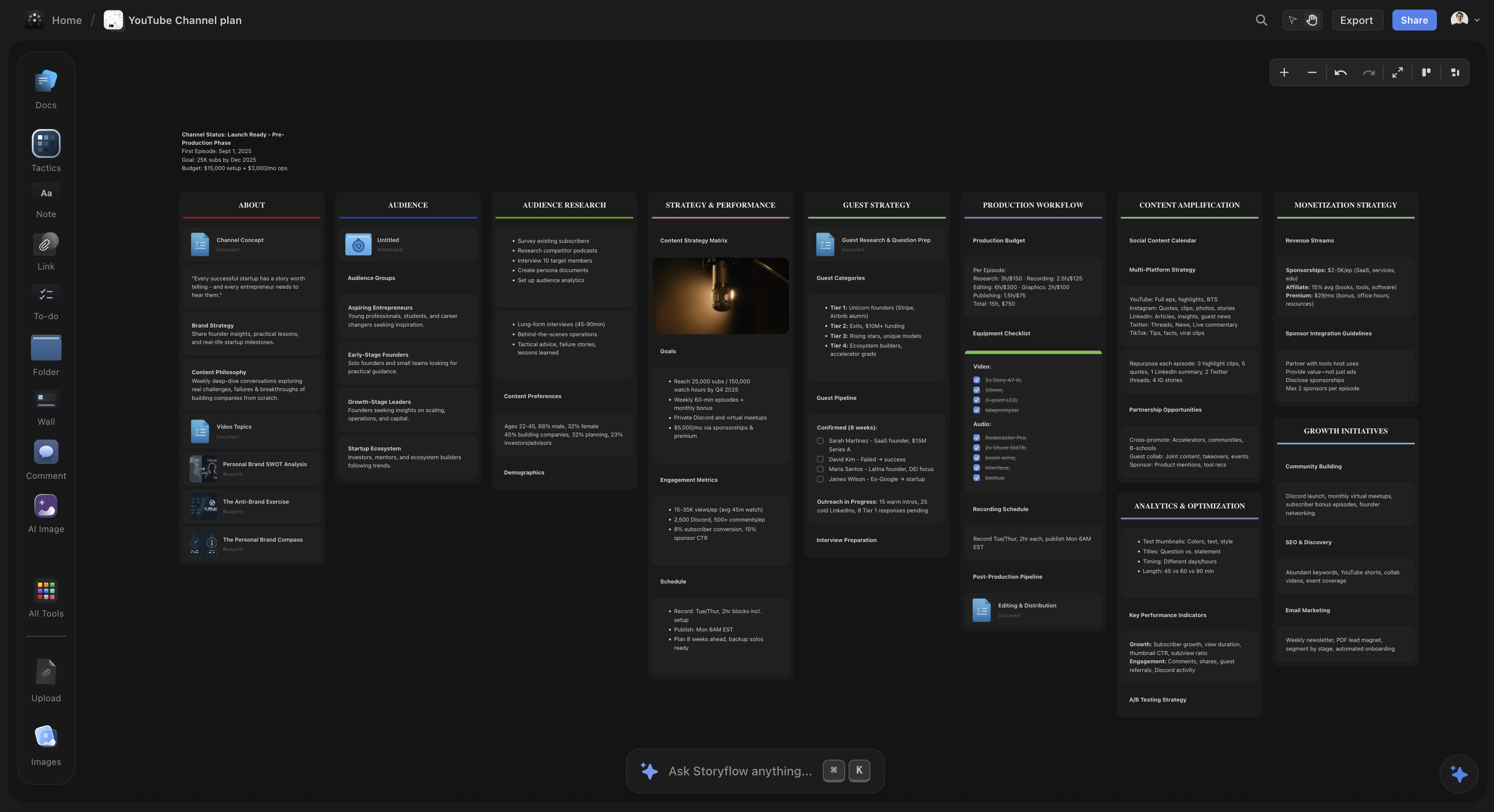
Type what you need in the AI chat at the bottom of your canvas. The AI adds cards, headings, and structure directly onto your board.
Use expert frameworks as AI context
Type @ in the AI chat and choose any Tactic. The AI tailors every response to that framework instead of giving generic advice.
Turn your board into a mind map in seconds
Ask the AI to restructure your canvas as a mindmap. It connects your ideas into a visual hierarchy so you can see how everything relates.
Why Storyflow Exists
Storyflow actually began as a personal tool while working on creative and research projects.
We kept running into the same problem: ideas were scattered everywhere: notes, documents, and whiteboards.
Nothing helped us see how everything connected.
So we started building a workspace designed around how ideas actually grow.
→ Read how Storyflow was createdSara de Klein
Head of Product at Storyflow
Published: January 3, 2026
Start creating with AI and become more productive
Transform your creative workflow with AI-powered tools. Generate ideas, create content, and boost your productivity in minutes instead of hours.
Ask Storyflow to
Not sure where to start? Try frameworks used and created by experts: