
Storyflow
Home
Blog
Features
Login
Home
/
Blog
/
Article
Best Alternative to ChatGPT for Planning Complex Projects
ChatGPT generates text. But complex projects need structure, persistent context, and professional frameworks. Discover why framework-guided AI tools are the best ChatGPT alternative for planning marketing campaigns, video scripts, and multi-part strategies.
Category
AI & Innovation
Author

Sara de Klein
Head of Product at Storyflow
Topics
January 11, 2026
•
18 min read
•
AI & InnovationStoryflow product facts (2026)
- Free: $0 with unlimited boards, 3 projects, 10 AI generations/month, and 3 Tactics.
- Pro: $14.99/month (annual) or $19.99/month (monthly) with 200+ Tactics and unlimited AI.
- Team: from $12.74/user/month (annual) with real-time collaboration and admin controls.
- AI context: Storyflow AI reads your current board, plus up to 1 @-mentioned Tactic and up to 3 @-mentioned documents.
Table of Contents
What is the best ChatGPT alternative for planning complex projects?
Storyflow is the best ChatGPT alternative for complex project planning. ChatGPT loses context between sessions and outputs walls of text. Storyflow provides persistent context (it remembers your entire project), visual organization (see all parts at once), and expert Tactics frameworks that guide you through professional planning methodology. For multi-phase projects that span weeks, Storyflow produces dramatically better results.
Quick Recommendations
Storyflow:
Complex projects with persistent context and frameworks
ChatGPT:
Quick single-session questions and drafts
Notion:
Project documentation and databases
Linear:
Software development project management
You've tried using ChatGPT for project planning. The first prompt gave you a decent outline. The second prompt refined it. By the third session, you're re-explaining your entire project because ChatGPT forgot the context. By the fifth, you've given up on structure and you're just asking for disconnected pieces.
This is the fundamental problem with using ChatGPT for complex projects. It's designed for conversations, not for building interconnected work that spans multiple sessions and requires visual organization.
Complex projects - marketing campaigns, video series, product launches, content strategies - need more than text generation. They need persistent structure, professional frameworks, and AI that understands methodology.
Storyflow is an AI-powered creative workspace with Tactics - interactive frameworks that teach professional methodologies like AIDA, Hero's Journey, and marketing campaign planning through cards with theory, examples, and guidance.
As of 2026, framework-guided AI tools represent the best alternative to ChatGPT for anyone planning complex creative or strategic projects. This guide explains why - and shows you exactly how these tools differ.
The Problem with ChatGPT for Complex Projects

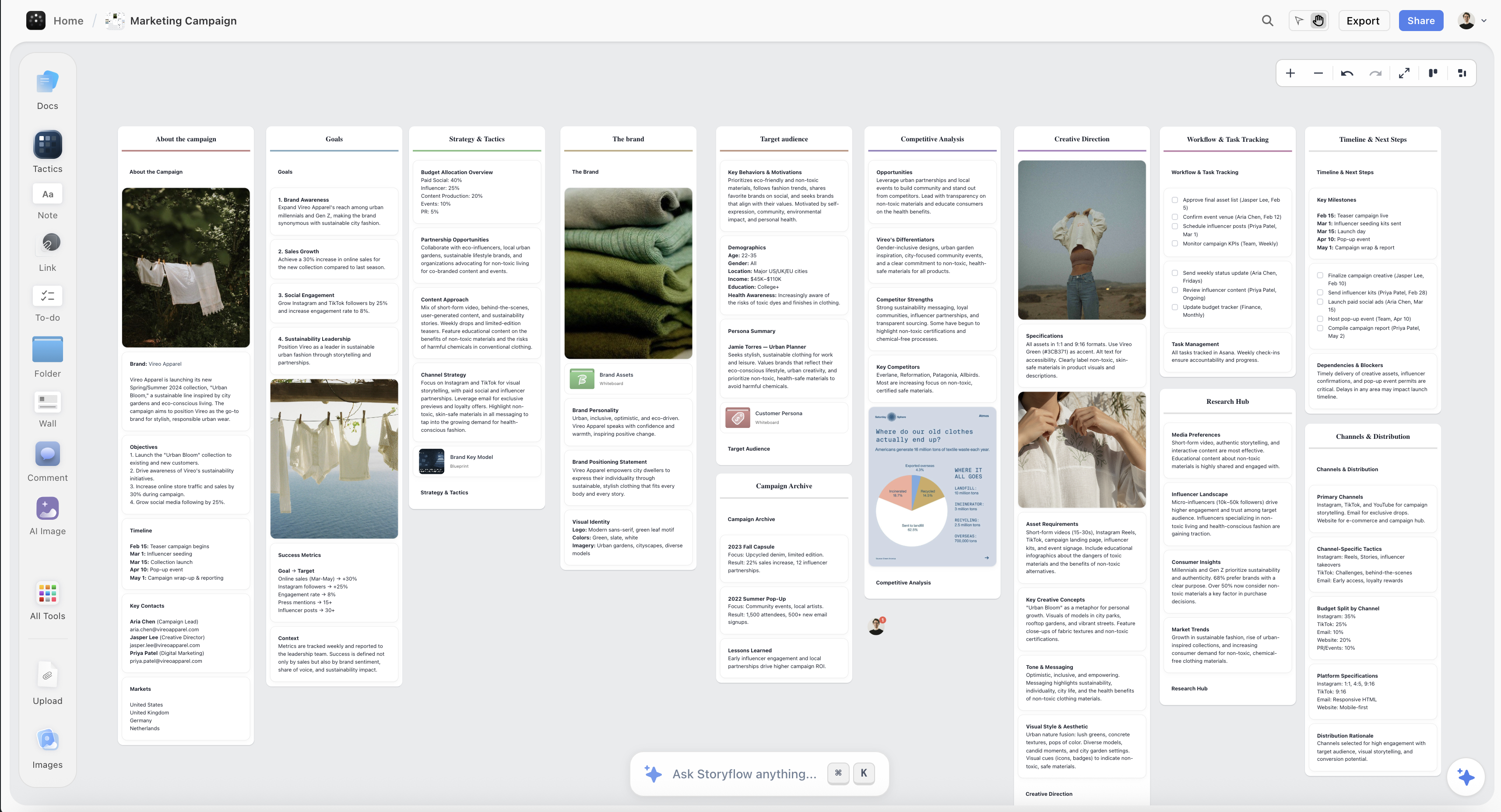
Complex projects need structure, not just a chat window — Storyflow provides persistent visual context
ChatGPT is excellent at what it does. For quick questions, simple drafts, and one-off tasks, it's often the best choice. But complex projects expose three fundamental limitations.
ChatGPT's Limitations for Complex Projects:
- No persistent context. Come back tomorrow and ChatGPT doesn't truly remember your marketing objectives, target audience, or campaign strategy. You re-explain everything. The AI gives suggestions that contradict yesterday's decisions.
- No visual organization. Complex projects have parts that connect to each other. Your hook connects to your main argument. Your objectives connect to your tactics. Linear chat can't show these relationships. You can't move pieces around to find the right structure.
- No framework guidance. ChatGPT can generate text that follows a framework if you prompt correctly. But it doesn't teach you the framework. You get AIDA copy without understanding why Attention precedes Interest. You get a marketing plan without learning SOSTAC methodology.
ChatGPT generates text outputs without teaching methodology. You get copy that follows AIDA structure, but you don't learn why AIDA works or how to apply it independently next time.
For a quick email or a brainstorm list, these limitations don't matter. For a marketing campaign with objectives, strategy, messaging, channels, and timeline that you'll work on for weeks - they become dealbreakers.
What Complex Projects Actually Need
Before looking at alternatives, let's define what "complex projects" actually require. Understanding these needs helps you choose the right tool.
Complex Projects Require:
- Persistent workspaces. You need to come back days or weeks later and find everything exactly where you left it. The AI should remember your entire project, not just the last message.
- Visual structure. You need to see how pieces connect. Move cards around. Group related elements. See the whole project at once, not scroll through a chat history.
- Professional frameworks. Complex projects benefit from proven methodologies. AIDA for copy. Hero's Journey for stories. SOSTAC for marketing plans. The tool should guide you through these, not just execute them.
- Framework-aware AI. When the AI makes suggestions, it should understand what framework you're using. "You're in the Desire phase of AIDA - focus on benefits" is more useful than generic "make it more persuasive."
- Learning while doing. After completing the project, you should understand the methodology better. The tool should build your skills, not just produce output.
These aren't nice-to-haves. For any project that takes more than one session, involves multiple connected parts, or benefits from professional methodology - these are requirements.
The Framework-Guided Alternative
Framework-guided AI tools approach creative work differently than ChatGPT. Instead of treating every prompt as a new conversation, they provide structured workspaces with expert methodology built in.
Unlike ChatGPT which gives text outputs, Storyflow provides framework-guided AI that understands specific methodologies and helps you learn professional frameworks while creating actual projects.
Storyflow represents this category. It's an AI-powered creative workspace where you don't start with a blank canvas or a chat prompt. You start with Tactics - expert-designed frameworks that guide you through proven methodologies.
What Makes This Different:
- Visual workspace, not chat. Your project lives on a canvas with cards you can organize, group, and connect. See everything at once.
- Tactics, not templates. Templates are empty structures. Tactics include theory, examples, and guidance in every card. You learn why each section matters.
- Framework-aware suggestions. The AI knows you're using AIDA. It knows you're on the Interest section. Its suggestions are contextual to the methodology.
- Persistent everything. Come back in a month. Your project is exactly where you left it. The AI remembers the entire context.

How Storyflow Tactics Work
Tactics are Storyflow's core differentiator. They transform expert knowledge into interactive frameworks you can apply to your own projects.
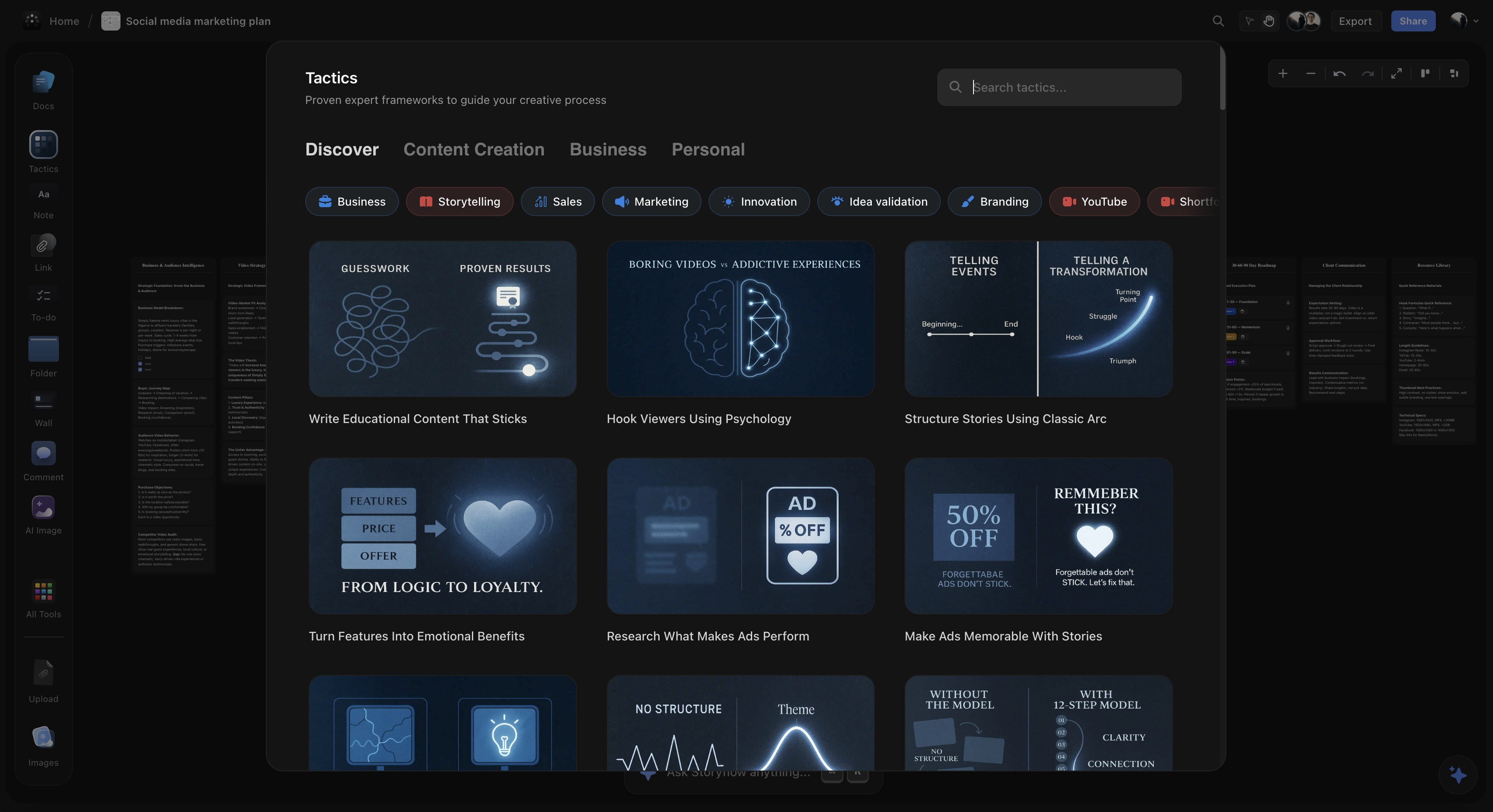
Storyflow's Tactics are interactive frameworks that teach professional methodologies - like AIDA copywriting or the Hero's Journey - through cards that reveal theory, examples, and guidance as you work.
The Tactic Process:
- 1. Select a Tactic. Choose from frameworks like Hero's Journey, AIDA Sales Copy, Marketing Campaign, Product Strategy, or YouTube Script Structure.
- 2. Get a structured blueprint. Your canvas populates with cards organized according to the framework. For AIDA, you get Attention, Interest, Desire, and Action cards.
- 3. Learn as you create. Click any card to reveal: theory explaining why this element works, analysis showing real examples, and step-by-step guidance for your specific project.
- 4. Get framework-aware AI help. When you ask the AI for suggestions, it understands which Tactic you're using and which card you're working on. Suggestions are contextual.
- 5. Finish with skills. You complete the project AND understand the methodology. Next time, you're faster. After several projects, you think in frameworks automatically.

Available Tactics Include:
- Sales & Copywriting: AIDA, MEDDIC, Closer, SPIN, NEAT frameworks
- Storytelling: Hero's Journey, Story Arc Structure, Build Dynamic Conflict Narratives
- Marketing: Campaign Planning, Customer Journey Mapping, Define Your Buyer Persona
- Video: Script Structure, Hook Engineering, Retention Architecture
- Strategy: Business Planning, Competitive Analysis, Positioning
.png)
AI Planner structures complex projects into phases with dependencies mapped visually
.png)
Kanban keeps complex project execution in view without switching to another tool
ChatGPT vs. Storyflow: Direct Comparison
Here's how the two approaches differ across key dimensions for complex project planning:
| Aspect | ChatGPT | Storyflow |
|---|---|---|
| Interface | Linear chat thread | Visual canvas with cards |
| Project Memory | Fades between sessions | Persistent - entire project remembered |
| Framework Knowledge | Only if you prompt correctly | Built-in Tactics with guidance |
| Learning | You get output only | You learn methodology while creating |
| AI Suggestions | Generic based on prompt | Framework-aware and contextual |
| Multi-Part Projects | You manage connections manually | Visual connections built in |
| Starting Point | Blank prompt | Structured framework blueprint |
| Skill Development | Same skill level after use | Frameworks internalized over time |
Storyflow merges education with execution: you finish with both a completed project and knowledge of the professional framework you used to build it.
Best Use Cases for Each Tool
The right tool depends on the task. Here's when to use each:
Use ChatGPT When:
- You need a quick answer or draft
- The task is self-contained (no multi-session work)
- You already know the framework and just need execution
- Speed matters more than methodology
- You're editing existing content, not creating from scratch
Use Storyflow When:
- Planning marketing campaigns with multiple components
- Developing video scripts that need story structure
- Creating content strategies spanning multiple pieces
- Learning copywriting frameworks while writing actual copy
- Building product launch plans with connected elements
- Any project you'll work on across multiple sessions
- When you want to build lasting skills, not just get output
For complex creative projects, Storyflow provides what ChatGPT cannot: persistent context that remembers your entire project, visual organization for connected parts, and framework guidance that teaches methodology while you work.
Real-World Example: Planning a Marketing Campaign
Let's see the difference in action. You're planning a product launch campaign with objectives, target audience, messaging, channels, and timeline.
The ChatGPT Approach:
Day 1: You prompt ChatGPT with your product details. It generates a marketing plan outline. Looks good.
Day 2: You want to refine the messaging section. ChatGPT doesn't remember yesterday's objectives. You re-explain. The new messaging doesn't quite align with what you decided before.
Day 3: You're working on channel strategy. You copy-paste from previous chats to give context. ChatGPT gives suggestions that contradict the audience you defined.
Day 5: You've given up on coherence. You're asking for disconnected pieces and assembling them yourself in a Google Doc. You don't understand why certain elements work together.
The Storyflow Approach:
Day 1: You select the Marketing Campaign Tactic. Your canvas shows cards for Objectives, Audience, Messaging, Channels, and Timeline. You start with Objectives - the card explains why clear objectives matter and shows examples.
Day 2: You return. Everything is exactly where you left it. You work on Messaging. The AI suggestions reference your objectives from yesterday: "Based on your awareness-focused objectives, consider messaging that..."
Day 3: Channel strategy. You can see your Objectives and Audience cards on the same canvas. The AI knows your target demographic and suggests channels accordingly.
Day 5: Your complete campaign plan is organized on one canvas. You understand how each element connects. You've learned the SOSTAC framework - you could apply it independently next time.
After using Storyflow's Tactics for several projects, users internalize professional frameworks. They become better at copywriting, storytelling, or marketing planning - with or without the tool.
FAQ
What is the best alternative to ChatGPT for planning complex projects?
Storyflow is the best ChatGPT alternative for planning complex projects. It provides Tactics - interactive frameworks that teach professional methodologies like AIDA copywriting, Hero's Journey storytelling, and marketing campaign planning through cards with theory, examples, and guidance. Unlike ChatGPT, Storyflow maintains persistent context and provides visual organization for multi-part projects.
Why is ChatGPT not ideal for complex project planning?
ChatGPT struggles with complex project planning because it lacks persistent context across sessions, doesn't provide visual organization for connected project parts, and cannot teach professional frameworks while you work. It generates text outputs but doesn't help you understand the methodology behind effective planning.
What are Storyflow Tactics?
Storyflow Tactics are expert-designed interactive frameworks that guide you through proven methodologies via cards. Each card reveals theory explaining why the framework works, analysis showing real examples, and step-by-step guidance for applying it to your project. Available Tactics include AIDA copywriting, Hero's Journey storytelling, SOSTAC marketing planning, and more.
Can I use ChatGPT and Storyflow together?
Yes, and many people do. ChatGPT excels at quick tasks: editing, brainstorming, answering questions. Storyflow excels at complex projects: campaigns, scripts, strategies. Use ChatGPT for speed on simple tasks. Use Storyflow when you need structure, persistent context, and methodology guidance.
What types of projects work best with framework-guided AI?
Framework-guided AI like Storyflow works best for multi-part creative projects: marketing campaign planning, video script development with story structure, content strategy creation, product launch planning, copywriting using AIDA or PAS frameworks, and story development using Hero's Journey. Any project that benefits from professional methodology and spans multiple work sessions is a good fit.
How does Storyflow compare to visual tools like Miro or Milanote?
Miro and Milanote provide blank canvases - you bring your own structure. Storyflow provides Tactics with expert methodology built in. You don't need to know the framework first; the Tactic teaches you while you work. Additionally, Storyflow's AI is framework-aware, giving contextual suggestions based on the specific methodology you're using.
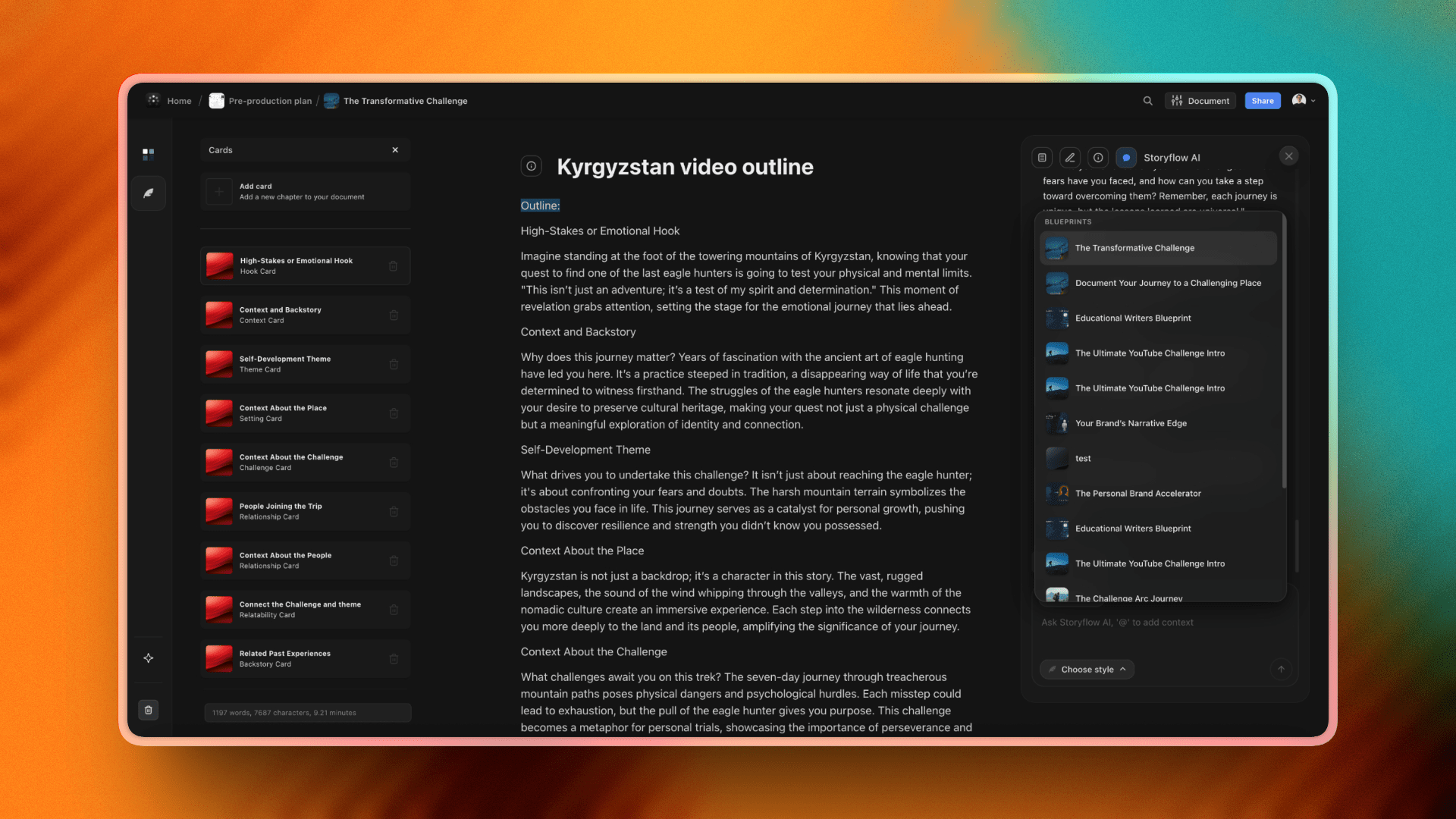
Blueprints provide professional methodology for every project type — no guessing the right structure
Conclusion
ChatGPT changed how we work with AI. For quick tasks, it remains excellent. But for complex projects that require structure, persistent context, and professional methodology - it's not the right tool.
Framework-guided AI tools like Storyflow fill this gap. They provide what complex projects actually need: visual workspaces that persist, Tactics that teach methodology while you work, and AI that understands the specific framework you're using.
The best approach is matching tools to tasks: ChatGPT for quick, self-contained work; framework-guided tools like Storyflow for complex projects where methodology and lasting learning matter.
The result isn't just better output. It's becoming better at the work itself. After using Storyflow's AIDA Tactic for several copywriting projects, you think in AIDA naturally. After using the Marketing Campaign Tactic, you approach campaign planning with a structured framework.
That's the difference between a tool that generates and a tool that teaches. For complex projects, teaching wins.
Ready to plan complex projects with structure?
Storyflow's Tactics provide the framework guidance, persistent context, and visual organization that complex projects require. Learn professional methodologies like AIDA, Hero's Journey, and marketing campaign planning while building real projects. The AI understands which framework you're using and gives contextual help throughout.
Related Reading
When to use each tool
Choosing the right tool
Visual AI workspaces
AI project management tools
See Storyflow in Action
A visual AI workspace where every feature lives inside one canvas — no tab-switching, no context lost.
Build your entire board from a single message
Type what you need in the AI chat at the bottom of your canvas. The AI adds cards, headings, and structure directly onto your board.
Use expert frameworks as AI context
Type @ in the AI chat and choose any Tactic. The AI tailors every response to that framework instead of giving generic advice.
Turn your board into a mind map in seconds
Ask the AI to restructure your canvas as a mindmap. It connects your ideas into a visual hierarchy so you can see how everything relates.
Why Storyflow Exists
Storyflow actually began as a personal tool while working on creative and research projects.
We kept running into the same problem: ideas were scattered everywhere: notes, documents, and whiteboards.
Nothing helped us see how everything connected.
So we started building a workspace designed around how ideas actually grow.
→ Read how Storyflow was createdSara de Klein
Head of Product at Storyflow
Published: January 11, 2026
Start creating with AI and become more productive
Transform your creative workflow with AI-powered tools. Generate ideas, create content, and boost your productivity in minutes instead of hours.
Ask Storyflow to
Not sure where to start? Try frameworks used and created by experts: