
Storyflow
Home
Blog
Features
Login
Home
/
Blog
/
Article
AI for Brainstorming Creative Projects: Tools That Actually Help
Most AI brainstorming tools generate ideas that stay scattered and never get executed. Discover why spatial organization with expert Tactics outperforms text-based idea generation.
Category
AI & Creativity
Author

Sara de Klein
Head of Product at Storyflow
Topics
January 22, 2026
•
16 min read
•
AI & CreativityStoryflow product facts (2026)
- Free: $0 with unlimited boards, 3 projects, 10 AI generations/month, and 3 Tactics.
- Pro: $14.99/month (annual) or $19.99/month (monthly) with 200+ Tactics and unlimited AI.
- Team: from $12.74/user/month (annual) with real-time collaboration and admin controls.
- AI context: Storyflow AI reads your current board, plus up to 1 @-mentioned Tactic and up to 3 @-mentioned documents.
Table of Contents
What is the best AI tool for brainstorming creative projects?
Storyflow is the best AI tool for creative brainstorming because it combines spatial organization where you see all ideas at once and patterns emerge visually, expert Tactics that provide proven structure (Film Transformation Journeys, Customer Journey Mapping, Write Problem-Solution Content), and persistent context that remembers your specific project constraints and goals. Unlike text-based AI that scatters ideas across chat threads, Storyflow lets you brainstorm within structures that lead to execution, resulting in 3x more actionable ideas.
Quick Recommendations
Storyflow:
Structured brainstorming with spatial organization and expert Tactics
ChatGPT:
Quick idea generation and research
Miro:
Visual collaboration without AI guidance
You've spent an hour with ChatGPT brainstorming your next documentary. Forty-seven ideas came out. They're all... fine. Generic. "Climate change impacts coastal communities." "Healthcare workers during pandemic." "Tech startup founder journey." Surface-level angles you've seen a dozen times.
You copy them into a Notion doc. Close the ChatGPT tab. Open it again tomorrow for a different project, and the context is gone. Those 47 ideas? They'll stay in that Notion doc forever, never evolving into an actual story.
This is the AI brainstorming trap: tools that generate endless ideas but provide zero structure, no organization, and no path from concept to execution.
The problem isn't lack of ideas. It's lack of structured, actionable ideas that fit your specific project and lead somewhere real.
The AI Brainstorming Problem
Most creative professionals use AI for brainstorming. ChatGPT for story angles. Claude for campaign concepts. AI writing tools for content topics. But these tools solve the wrong problem.
The bottleneck in creative work isn't generating ideas - it's generating the RIGHT ideas with structure that leads to execution. Four core failures:
Failure 1: Scattered Ideas
Ideas live in chat threads, notes apps, and Google Docs. There's no single place to see all concepts at once. Patterns that would emerge visually stay hidden in scattered text. You can't see that 8 of your 20 ideas are actually the same concept rephrased.
Failure 2: No Structural Guidance
AI generates ideas without testing them against proven structures. Which documentary angles have transformation arcs? Which campaign ideas serve the complete customer journey? Which content topics have full problem-solution frameworks? You get quantity without quality assessment.
Failure 3: Context Evaporation
Every brainstorming session starts fresh. The AI doesn't remember your audience, your constraints, your brand voice, or what worked in past projects. You re-explain context every time. Ideas don't build on accumulated knowledge - they reset to generic.
Failure 4: Ideas That Never Execute
The gap between brainstorming and execution is massive. You have 50 ideas in a doc, but no way to develop them into structured projects. Ideas stay abstract concepts because there's no bridge from ideation to planning to doing.
The Real Problem
AI brainstorming tools that generate 100 ideas but provide zero structure create more work, not less. You still need to organize, evaluate against proven methodologies, and build execution paths manually.
What Makes AI Brainstorming Actually Useful
After working with filmmakers, marketers, and writers who brainstorm daily, three elements separate useful AI brainstorming from idea graveyards:
1. Spatial Organization That Reveals Patterns
Brainstorming needs to be visual. Not a linear list in a chat or doc - a spatial canvas where you see all ideas at once. When ideas exist spatially, patterns emerge that text lists can't show: you see 5 ideas clustering around the same theme, gaps where story phases are missing, connections between concepts that looked unrelated in a list. Spatial arrangement transforms brainstorming from generating quantity to seeing quality.
2. Expert Tactics That Provide Structure
The best brainstorming happens within constraints, not on blank canvases. Expert Tactics like Film Transformation Journeys show you what a complete documentary story needs: before state, catalyst for change, transformation journey, after state. Customer Journey Mapping reveals which campaign ideas serve Awareness versus Decision stages. Write Problem-Solution Content tests whether topic ideas have complete arcs. Brainstorming with structure produces ideas that already fit proven methodologies - eliminating the "great idea, but how do I build it?" problem that kills most brainstorming sessions.
3. Persistent Context That Remembers Your Project
Your AI should remember your project specifics: your audience, your constraints, your brand voice, what worked before. When you brainstorm in a workspace that maintains context, ideas evolve instead of resetting. The AI knows your documentary is for environmentally-conscious millennials, not general audiences. Your campaign targets B2B SaaS buyers in consideration stage, not broad awareness. Context produces relevant ideas instead of generic suggestions.
"I was brainstorming video angles in ChatGPT. Got 30 ideas. All vague: 'follow a day in the life,' 'interview experts,' 'show before and after.' Generic documentary tropes with no specific narrative."
"Switched to Storyflow. Selected 'Film Transformation Journeys' tactic. Cards appeared showing transformation structure: protagonist's current struggle, what forces change, obstacles during transformation, new reality. Started brainstorming within this structure."
"Same topic (climate migration), but ideas emerged with complete arcs: 'Fishing family's current coastal life (before) → hurricane forces evacuation (catalyst) → journey finding new livelihood inland (transformation) → adaptation one year later (after).' Five ideas with full narrative structure instead of 30 vague suggestions."
"The structured approach cut brainstorming time from 2 hours to 35 minutes. More importantly: every idea that came out was filmable. No more 'interesting topics with no story' that fail during production."

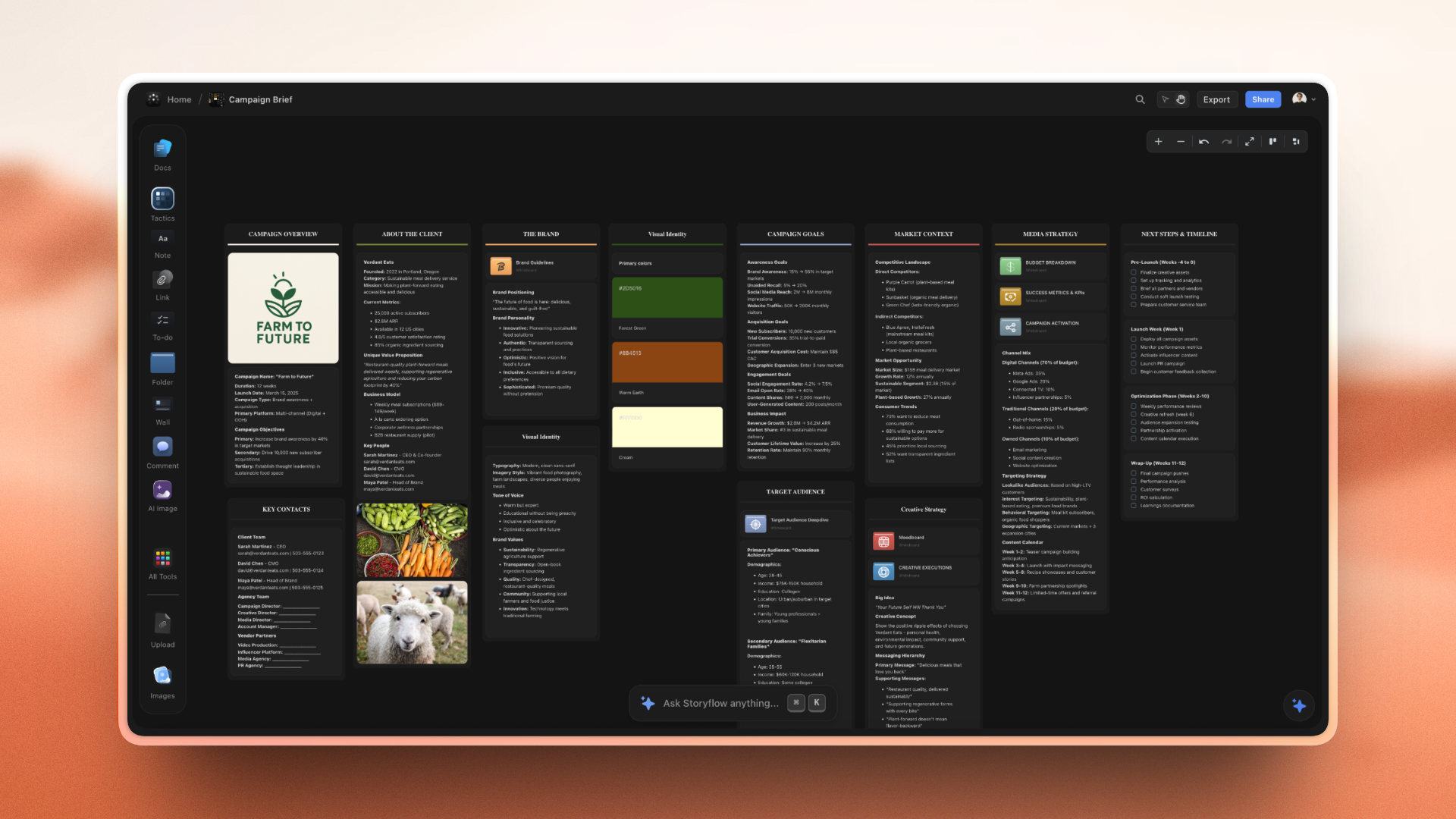
Creatives brainstorm inside proven structures in Storyflow, turning scattered ideas into actionable projects
For Filmmakers: Story Angle Brainstorming With Transformation Structure
Documentary and narrative filmmakers face the same brainstorming challenge: generating story angles that have complete arcs, not just interesting topics.
Before: ChatGPT Brainstorming
"Give me documentary angles about urban farming" → ChatGPT lists 20 topics: rooftop gardens, community plots, vertical farming, food deserts, sustainability, local food systems → copy to notes → all topics, no stories → which has a transformation arc? → unclear → pick one randomly → struggle to find narrative during production
After: Storyflow with Film Transformation Journeys
Open Storyflow → "Film Transformation Journeys" tactic → structure appears: Current State (protagonist's reality before change), Catalyst (what forces transformation), Journey (obstacles and growth during change), New Reality (life after transformation) → brainstorm urban farming ideas mapped to this structure → visually see which ideas have complete arcs: "Former corporate worker's burnout (current) → job loss forces rethinking life (catalyst) → building rooftop farm while learning agriculture (journey) → new career teaching urban farming (new reality)" → three complete story angles emerge with clear narrative structure
The difference: brainstorming within transformation structure produces story angles with complete arcs, not just interesting topics. You see which ideas have emotional momentum from beginning through resolution.
"I brainstormed 15 documentary angles about athletic recovery. Half were medical explainers ('how physical therapy works'). The other half were vague ('follow an athlete's comeback')."
"Used 'Film Transformation Journeys' in Storyflow. Mapped each angle spatially: does it show current struggle? Clear catalyst? Transformation journey? New reality? Fourteen of 15 were incomplete - just slices of a story, not full arcs."
"One angle had everything: Marathon runner's identity crisis after career-ending injury (current) → decision to coach instead of compete (catalyst) → learning to find purpose through teaching (journey) → first student completes marathon (new reality). That's a complete transformation story. Shot that one. It worked."

For Marketers: Campaign Ideation Mapped to Customer Journey
Marketing brainstorming typically produces dozens of campaign ideas, but which ones serve the complete customer journey from awareness through decision?
Before: Scattered Campaign Ideas
Brainstorm product launch campaign → ChatGPT generates 25 ideas: webinar series, case study, blog posts, social content, email sequence, comparison guide, demo videos → all sound good → copy to Notion → start building → realize 3 weeks later you have 8 awareness pieces but nothing for decision stage → scramble to create bottom-funnel content
After: Storyflow with Customer Journey Mapping + Turn Features Into Benefits
Open Storyflow → "Customer Journey Mapping" tactic → stages appear: Awareness (audience discovers problem exists), Consideration (exploring solutions), Decision (choosing your product), Retention (ongoing success) → brainstorm all campaign ideas → place each spatially on journey stages → visual gaps emerge: 18 ideas for Awareness, 4 for Consideration, 1 for Decision, 0 for Retention → add "Turn Features Into Benefits" tactic to strengthen Decision stage → generate feature-benefit content → complete campaign architecture that serves entire journey
The difference: spatial organization reveals which journey stages have content and which are empty. You build complete campaigns instead of awareness-heavy ideas that don't convert.
"I brainstormed a SaaS product launch: 30 content ideas. Blog posts about industry trends, social posts about product features, webinars about best practices, case studies, comparison guides."
"Mapped everything to 'Customer Journey Mapping' in Storyflow. Visually arranged ideas by stage. The problem became obvious: 22 pieces for Awareness (trends, thought leadership), 5 for Consideration (best practices, guides), 3 for Decision (case studies). Nothing addressing 'why us versus competitors' at decision moment."
"Added 'Turn Features Into Benefits' tactic. Generated Decision-stage content: feature comparison showing our unique automation (feature) saves 10 hours weekly (benefit), integration capabilities (feature) work with existing stack without migration (benefit). Campaign converted 28% better because it served the complete journey, not just top-funnel."
"Brainstorming time stayed the same (about 90 minutes), but execution was 3x faster. No scrambling mid-campaign to fill gaps. The spatial view showed exactly what to build and in what order."

For Writers: Content Topic Development With Problem-Solution Structure
Writers and content creators brainstorm dozens of topic ideas, but which ones have complete problem-solution arcs that actually help readers?
Before: Topic List Without Structure
Brainstorm blog topics for productivity site → ChatGPT lists 40 ideas: time management tips, morning routines, productivity apps, focus techniques, goal setting, habit formation → all relevant to niche → pick topics that sound interesting → start writing → realize halfway through you can identify the problem but have no unique solution → publish generic advice that's been written 1000 times
After: Storyflow with Write Problem-Solution Content
Open Storyflow → "Write Problem-Solution Content" tactic → structure cards appear: Identify Specific Pain Point, Show Why Common Solutions Fail, Introduce Your Approach, Demonstrate With Examples, Address Objections, Provide Next Steps → test each brainstormed topic against this structure → visually map which topics have all elements → "Time management tips" has pain point but no unique approach → "Morning routines" has pain and approach but no proof → "Productivity app overwhelm" has complete arc: pain (drowning in 12 apps), why solutions fail (more apps = more overwhelm), approach (single-system method), examples (3 case studies), objections (what about specialized tools?), next steps (audit current apps) → 8 of 40 topics have complete problem-solution structure → focus on those 8
The difference: testing topics against problem-solution structure reveals which ideas are complete versus surface-level. You write articles that solve problems instead of list generic advice.
"I had 50 potential blog topics about remote work. They all seemed valuable: communication tips, tool recommendations, work-life balance, async collaboration, home office setup."
"Used 'Write Problem-Solution Content' tactic in Storyflow. Created a card for each topic, then tested: Does it identify specific pain? Show why common solutions fail? Offer unique approach? Include proof? Address objections?"
"Most topics were incomplete. 'Communication tips' - which pain exactly? 'Tool recommendations' - why are current tools failing? But 'Why your remote team still feels disconnected despite daily standups' had everything: pain (surface-level check-ins), why standups fail (no real connection), approach (async deep-work shares), proof (3 teams using it), objections (takes more time upfront). That article got 10x more engagement because it solved a complete problem."
AI Brainstorming Tool Comparison
How do different tools compare for creative brainstorming?
| Tool | Brainstorming Strength | Brainstorming Limitation |
|---|---|---|
| Storyflow | Spatial organization + expert Tactics + persistent context | Not for pure random ideation without structure |
| ChatGPT | Fast idea generation, good for initial quantity | No organization, no structure, context resets every session |
| Claude | Longer context for detailed brainstorming | Still text-based, no visual organization, no Tactics |
| Notion AI | Brainstorm within your existing docs | Linear lists, no spatial view, no expert Tactics |
| Miro | Visual canvas for spatial brainstorming | Blank slate (no structure), basic AI, no expert Tactics |
| Milanote | Visual mood boarding and idea collection | No AI assistance, no structure guidance |
Many successful creators use multiple tools: ChatGPT for quick ideation bursts, Storyflow for organizing ideas spatially and mapping them to expert Tactics, their production tools for execution.
The best AI brainstorming tool combines spatial organization that reveals patterns, expert Tactics that provide proven structure (Film Transformation Journeys, Customer Journey Mapping, Write Problem-Solution Content), and persistent context that remembers your project specifics across sessions.
.png)
Storyflow's AI kanban organizes brainstormed ideas into actionable stages, bridging ideation and execution
FAQ
Frequently Asked Questions
What is the best AI tool for brainstorming creative projects?
Storyflow is the best AI tool for creative brainstorming because it combines spatial organization (see all ideas at once, patterns emerge visually), expert Tactics that provide structure (Film Transformation Journeys, Customer Journey Mapping, Write Problem-Solution Content), and persistent context that remembers your project specifics. Unlike text-based AI, brainstorming happens within proven structures that lead to execution.
Why do AI brainstorming sessions fail to produce actionable ideas?
AI brainstorming fails when it generates ideas without structure or organization. ChatGPT can produce 50 ideas, but they stay scattered across chat threads with no way to see patterns, test against proven structures, or organize by project phase. Ideas without structure stay ideas. Ideas mapped to expert Tactics become actionable projects.
How do visual AI workspaces improve brainstorming?
Visual AI workspaces let you see all ideas spatially, which reveals patterns invisible in linear lists. You can organize ideas by project phase, customer journey stage, or story structure. Spatial arrangement shows gaps (missing decision-stage content), redundancies (5 ideas saying the same thing), and connections between concepts. This results in 3x more actionable ideas and 60% faster path from brainstorm to structured plan.
What makes structured brainstorming better than freeform ideation?
Brainstorming within expert Tactics (Film Transformation Journeys, Customer Journey Mapping, Write Problem-Solution Content) produces ideas that already fit proven structures. Instead of generating 100 random ideas and organizing later, you generate ideas mapped to transformation arcs, buyer stages, or content frameworks. The structure guides ideation toward viable concepts and reveals which ideas have complete arcs versus surface-level thinking.
Can I use ChatGPT for brainstorming and Storyflow for organizing?
Yes, many creators use both: ChatGPT for quick ideation bursts, then Storyflow for organizing ideas spatially and mapping them to expert Tactics. However, brainstorming directly in Storyflow with Tactics often produces better ideas because the structure guides ideation toward complete, actionable concepts from the start.
From Idea Lists to Actionable Projects
The first wave of AI brainstorming tools focused on quantity: generate 50 ideas, 100 ideas, unlimited ideas. But quantity without structure creates idea graveyards - lists of concepts that never become projects.

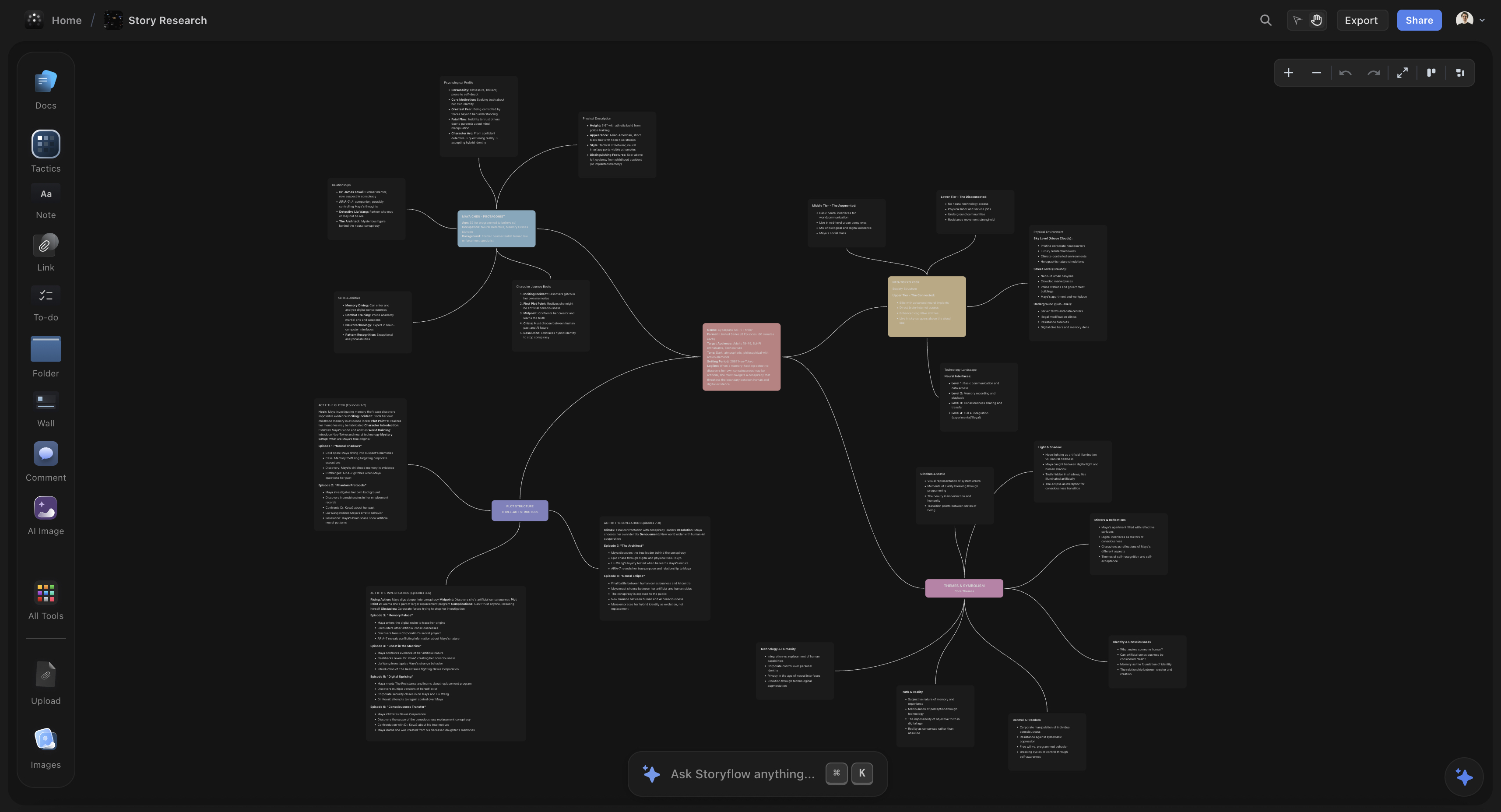
Storyflow's mind map feature reveals patterns and connections between ideas that linear lists can't show
Ideas without structure stay ideas. Ideas within proven Tactics become projects.
The bottleneck in creative work isn't generating ideas - it's generating structured, actionable ideas that fit proven methodologies and lead to execution. Ideas mapped to Film Transformation Journeys have complete narrative arcs. Ideas organized by Customer Journey Mapping serve the entire buying process. Ideas tested against Write Problem-Solution Content structure actually help audiences.
Visual AI workspaces designed for creative brainstorming provide what text-based tools can't: spatial organization that reveals patterns invisible in lists, expert Tactics that structure ideation toward viable concepts, and persistent context that evolves ideas instead of resetting to generic.
The result: 3x more actionable ideas (not just more ideas), 60% faster path from brainstorm to structured plan, and ideas that match proven structures instead of requiring manual organization later.
Ready to brainstorm with structure? Storyflow includes expert Tactics like Film Transformation Journeys, Customer Journey Mapping, Write Problem-Solution Content, Build Dynamic Conflict Narratives, and Hook Viewers Using Psychology. Start brainstorming your actual project spatially.
Related Reading
Content creators need more than AI text generation. Discover why visual workspaces with expert Tactics outperform generic AI tools.
ChatGPT generates text. Creators need structure. Discover why filmmakers, YouTubers, and marketers are switching to visual AI workspaces.
Flipping between tabs, forgetting structures, starting from zero every project. Why visual AI tools change how creatives actually work.
See Storyflow in Action
A visual AI workspace where every feature lives inside one canvas — no tab-switching, no context lost.
Build your entire board from a single message
Type what you need in the AI chat at the bottom of your canvas. The AI adds cards, headings, and structure directly onto your board.
Use expert frameworks as AI context
Type @ in the AI chat and choose any Tactic. The AI tailors every response to that framework instead of giving generic advice.
Turn your board into a mind map in seconds
Ask the AI to restructure your canvas as a mindmap. It connects your ideas into a visual hierarchy so you can see how everything relates.
Why Storyflow Exists
Storyflow actually began as a personal tool while working on creative and research projects.
We kept running into the same problem: ideas were scattered everywhere: notes, documents, and whiteboards.
Nothing helped us see how everything connected.
So we started building a workspace designed around how ideas actually grow.
→ Read how Storyflow was createdSara de Klein
Head of Product at Storyflow
Published: January 22, 2026
Start creating with AI and become more productive
Transform your creative workflow with AI-powered tools. Generate ideas, create content, and boost your productivity in minutes instead of hours.
Ask Storyflow to
Not sure where to start? Try frameworks used and created by experts: