Brainstorming Techniques That Work: Complete Guide (2025)
Master brainstorming with proven techniques for solo and team sessions. Learn science-backed methods, AI amplification strategies, quick sprints, deep dives, and how to turn ideas into action.

Category
Brainstorming
Author

Sara de Klein
Head of Product at Storyflow
Topics
December 12, 2025
•
20 min read
•
Brainstorming- brainstorming techniques
- creative thinking
- ideation
- AI brainstorming
How do you brainstorm smarter and faster?
Brainstorm smarter by separating generation from evaluation: define the problem, generate without judgment (brainwriting beats talking), organize ideas visually, use AI to expand thinking, then evaluate against explicit criteria and assign next steps. Storyflow's canvas plus board-reading AI makes the whole loop one workspace.

Most brainstorming fails because it's unstructured chaos. Someone says "let's brainstorm," and the team spends an hour generating random ideas that go nowhere. The quiet people stay silent. The loud people dominate. Good ideas get lost in Slack threads or buried in meeting notes no one reads again.
Effective brainstorming isn't about gathering people in a room and hoping for magic. It's a systematic process: define the problem clearly, generate ideas without judgment, build on each other's thinking, evaluate objectively, and turn the best concepts into action. Most teams skip half these steps, then wonder why brainstorming feels like wasted time.
Storyflow transforms brainstorming from a hit-or-miss activity into a repeatable process that consistently produces results. The visual canvas lets you see all ideas at once, making connections visible. AI helps you expand thinking when you're stuck. Tactics provide proven frameworks so you don't start from scratch. And everything stays organized, so good ideas don't disappear.
This guide covers everything: why traditional brainstorming fails, the science-backed techniques that work, step-by-step methods for different scenarios (solo vs. team, quick sprints vs. deep dives), and how to use Storyflow's tools to make every brainstorming session more productive.
What You'll Learn
Why traditional brainstorming fails (and how to fix it)
Science-backed brainstorming techniques that actually work
Solo brainstorming methods for individual creators
Team brainstorming workflows for remote and in-person collaboration
How to use AI to expand thinking without replacing creativity
Quick sprint techniques (15-30 minutes) for urgent decisions
Deep dive methods (2-4 hours) for complex problems
How to evaluate ideas objectively and move to execution
Table of Contents
1. Why Traditional Brainstorming Fails
2. What Science Says Actually Works
3. Storyflow's Brainstorming Tools
4. Solo Brainstorming: Methods for Individual Creators
5. Team Brainstorming: Remote & In-Person Workflows
6. Quick Sprint Techniques (15-30 Minutes)
7. Deep Dive Sessions (2-4 Hours)
8. Using AI to Expand Your Thinking
9. Evaluating and Prioritizing Ideas
10. From Ideas to Action
11. Frequently Asked Questions
Why Traditional Brainstorming Fails
The classic brainstorming session - gathering people in a room, writing ideas on a whiteboard, hoping for breakthrough thinking - fails more often than it succeeds. Research by organizational psychologists has identified specific reasons why:
Production blocking - In group settings, people have to wait their turn to speak. While waiting, they forget their ideas or self-censor them as "not good enough." The conversation moves on, and valuable thoughts vanish.
Social loafing - When working in groups, individuals contribute less than they would alone. The presence of others creates a diffusion of responsibility - "someone else will come up with good ideas."
Evaluation apprehension - Despite the "no bad ideas" mantra, people fear judgment. Hierarchy makes this worse - junior team members won't suggest bold ideas in front of senior leaders.
Anchoring - The first few ideas set the tone. If someone suggests something conservative, the rest of the session stays in that territory. Wild ideas get dismissed as "off-topic."
Personality dominance - Extroverted, senior, or louder people control the conversation. Introverted team members - who often have the most thoughtful ideas - remain silent.
Poor documentation - Ideas get written on whiteboards, captured in messy photos, or lost in meeting notes. When it's time to decide, no one remembers the full context.
These aren't minor annoyances - they fundamentally undermine the purpose of brainstorming. The good news: every problem has a solution, and most solutions involve changing the process, not the people.
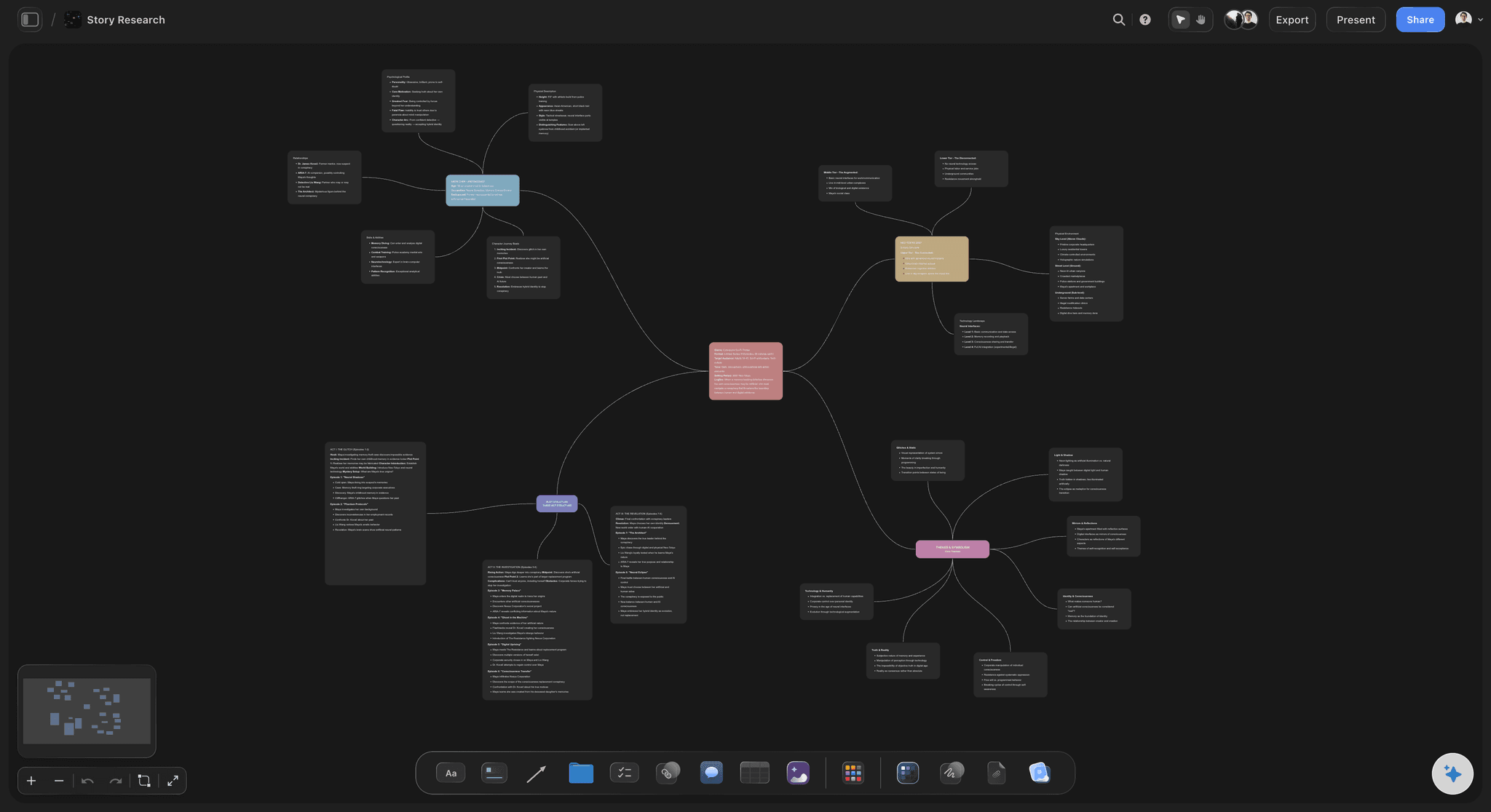
Storyflow's visual workspace gives brainstorming sessions a structured canvas where ideas stick around and build on each other
What Science Says Actually Works
Research on creativity and group dynamics has identified specific techniques that consistently produce better outcomes. Here's what actually works:
Brainwriting Over Brainstorming
Instead of speaking ideas aloud, team members write them down simultaneously. This eliminates production blocking - everyone generates ideas at the same time. Paulus and Yang's research on brainwriting (Organizational Behavior and Human Decision Processes, 2000) found that groups writing ideas in parallel generated substantially more ideas than groups taking turns out loud, because nobody waits and nobody self-censors mid-queue. The quietest person in the room writes just as fast as the loudest one talks.
Separate Divergent and Convergent Phases
Generate first, evaluate later. When teams mix idea generation with criticism, the criticism wins. People stop suggesting ideas. The most effective sessions have clear phases: expansive ideation with zero judgment, then structured evaluation afterward.
Use Constraints
Counterintuitively, constraints increase creativity. "Come up with marketing ideas" is too broad. "Come up with marketing ideas that cost under $1,000 and target Gen Z on TikTok" sparks more specific, actionable concepts. Constraints focus thinking without limiting it.
Build on Ideas
The "Yes, and..." principle from improv comedy. When someone suggests an idea, the next person builds on it rather than pivoting to something new. This creates chains of increasingly refined concepts instead of disconnected one-offs.
Visual Organization
When ideas exist spatially - arranged, grouped, color-coded - patterns emerge that you'd miss in linear lists. The visual layout itself becomes a thinking tool, revealing connections and gaps.
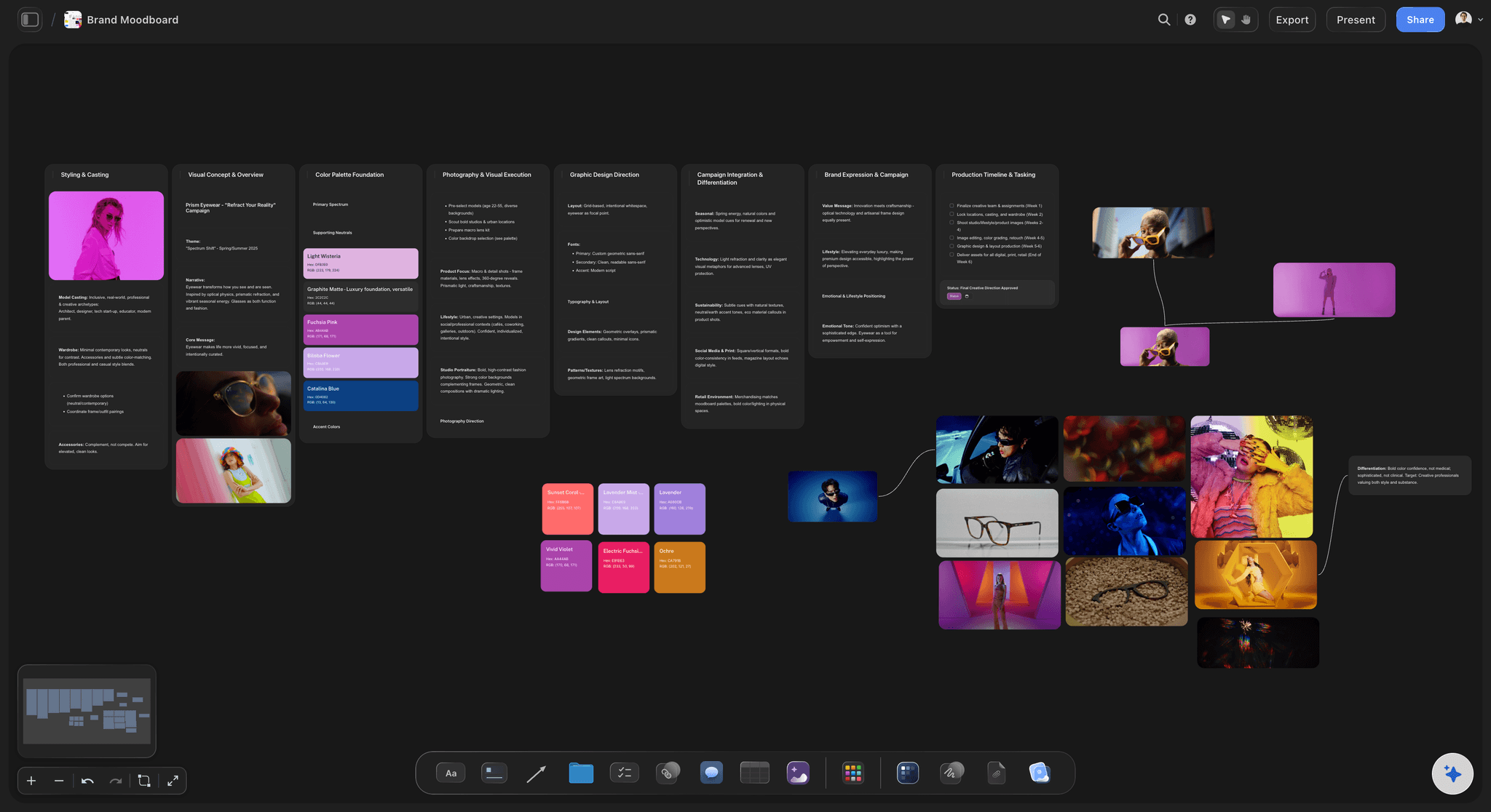
Storyflow's Brainstorming Tools
Storyflow provides specific tools designed to implement the techniques that actually work:
Infinite Canvas
No space constraints. Ideas can spread in any direction. Zoom out to see everything at once, zoom in for details. The spatial layout makes connections visible - related ideas cluster naturally, creating a visual map of your thinking.
Notes (N)
Quick idea capture. Press N and type - no friction. Color-code by category, theme, or priority. Resize to emphasize important concepts. Drag to reorganize as your thinking evolves.
Walls (W)
Group related ideas visually. Create sections for different themes, approaches, or evaluation criteria. Use colors to distinguish between "wild ideas," "safe bets," and "hybrid approaches."
AI Assistant
Not a replacement for thinking. An amplifier. Ask it to generate variations, identify patterns, suggest combinations, or challenge assumptions. The AI reads your full active canvas board by default, plus up to 1 Tactic and 3 Documents you @-mention, so its suggestions respond to the ideas already in front of you instead of starting from a blank prompt. The honest trade-off: that context lives on the current board, not across every board in your account, so a sprawling multi-board project needs you to point the AI at the right canvas first.
Comments (C)
Async feedback without interrupting flow. Team members can add thoughts, questions, or builds on ideas. Discussions stay attached to specific concepts, preserving context.
Links & Images
Embed reference material directly. Pull in examples, inspiration, research, or competitor work. Visual references often spark ideas that text alone wouldn't trigger.
Run your next brainstorm as three phases, not one scramble
Open an AI brainstorming board, dump ideas without judging, and let the AI expand the thin spots. The canvas keeps generation, evaluation, and action on one surface.

Solo Brainstorming: Methods for Individual Creators
Brainstorming alone eliminates social dynamics that limit group sessions. You don't wait your turn, fear judgment, or anchor to others' ideas. Here are proven solo methods:
Method 1: Rapid Idea Dumping
Goal: Generate 50-100 ideas in 15-30 minutes without filtering.
Set a timer for 20 minutes
Create notes as fast as you can think - one idea per card
Don't evaluate, edit, or organize - just dump
When stuck, ask: "What's the opposite?" "What would [person] suggest?" "What if I had unlimited budget?"
After time's up, take a break before organizing
Method 2: Mind Mapping
Goal: Explore branches from a central concept.
Put your main topic in the center of the canvas
Create 5-7 main branches (different angles or approaches)
For each branch, generate sub-ideas that explore that angle
Use different colors for each main branch
Look for connections between distant branches - these often become the best ideas
If you would rather not build the radial structure by hand, the Mindmap template opens with the center and first branches already laid out, so you start at the dump instead of the blank canvas.
Method 3: SCAMPER Technique
Goal: Generate variations by asking specific questions.
Substitute: What can I replace or swap?
Combine: What can I merge or blend?
Adapt: What else is like this? What can I copy?
Modify: What can I change or exaggerate?
Put to other uses: What else could this do?
Eliminate: What can I remove or simplify?
Reverse: What if I flip it or do the opposite?
Method 4: Constraint-Based Ideation
Goal: Use artificial constraints to spark creativity.
Generate ideas with constraint: "Must cost under $100"
Then with opposite constraint: "Unlimited budget"
Try: "Must be completed in 1 week" vs. "Have 6 months"
Try: "Only text" vs. "Only video" vs. "No screens at all"
Constraints force novel approaches you wouldn't otherwise consider
Team Brainstorming: Remote & In-Person Workflows
Team brainstorming requires explicit structure to work. Here's a complete workflow that prevents the common failures:
Pre-Session Setup (Before the Meeting)
Create a new Storyflow board and share with participants
Add a clear problem statement at the top
Include any relevant context: budget, timeline, audience, constraints
Create Walls for different sections: "Raw Ideas," "Grouped Themes," "Top Picks"
Ask team members to review context before the session
For recurring session types, start from a pre-structured board instead of a blank one: the Marketing Campaign template already has audience, message, and channel sections for campaign brainstorms, and the Brand Names Board template is built for naming sessions where you need volume before taste.
Phase 1: Silent Brainwriting (10-15 minutes)
Set a timer - everyone generates ideas simultaneously
Each person creates Note cards - no talking, no discussion
One idea per card - keeps things atomic and moveable
No judgment phase - wild ideas encouraged
Aim for quantity over quality - 50+ ideas as a team
Phase 2: Building and Combining (15 minutes)
Read through all ideas as a group
Use "Yes, and..." to build on promising concepts
Look for ideas that could combine into stronger hybrids
Group similar ideas with Walls or by proximity
Still no criticism - only expansion
Phase 3: Evaluation (20 minutes)
Define evaluation criteria: feasibility, impact, cost, timeline
Each person votes on their top 5-10 ideas
Discuss the most-voted ideas: pros, cons, requirements
Identify which need prototyping or validation
Move top concepts to "Top Picks" section
Phase 4: Action Planning (10 minutes)
For each top idea, define next steps
Add To-do cards with specific actions and owners
Set deadlines for validation or prototyping
Schedule follow-up to review progress
Keep the board active - add ideas between sessions

Quick Sprint Techniques (15-30 Minutes)
Sometimes you need ideas fast - a client needs options today, a deadline moved up, or a meeting needs a quick decision. These sprint techniques work under time pressure:
The Crazy 8s Method
Fold paper into 8 sections (or create 8 Note cards in Storyflow)
Set timer for 8 minutes - 1 minute per idea
Sketch or write one idea in each section
When timer ends, pick the strongest 2-3
Spend 5 minutes refining those
The First Principles Sprint
Ask: "What's the core problem we're solving?"
Strip away assumptions - what's actually true?
Generate solutions from those truths only
This cuts through conventional thinking fast
The AI Multiplication Method
Generate 3-5 seed ideas manually
Ask AI: "Give me 20 variations of these concepts"
Scan the AI output for unexpected angles
Pick the most promising and refine them
Result: 30+ ideas reviewed in 20 minutes

Storyflow's mind map lets you expand ideas spatially so connections and patterns emerge naturally
Deep Dive Sessions (2-4 Hours)
Complex problems deserve extended exploration. Deep dive sessions use multiple techniques sequentially to push beyond surface-level thinking:
Hour 1: Divergent Exploration
Start with rapid idea dumping (30 min)
Switch to mind mapping from top ideas (15 min)
Apply SCAMPER to most promising directions (15 min)
Goal: Generate 100+ concepts
Hour 2: Organization and Pattern Recognition
Group similar ideas into themes using Walls
Identify patterns: what approaches keep appearing?
Look for outliers - wild ideas that don't fit anywhere
Often the outliers contain the breakthrough
Hour 3: Deep Development
Pick top 5-7 concepts for deep exploration
For each: what would implementation look like?
What obstacles exist? How to overcome them?
What resources required? What's the timeline?
Use AI to stress-test: "What could go wrong with this?"
Hour 4: Synthesis and Decision
Evaluate against clear criteria
Can you combine the strongest elements?
Select 1-3 ideas for prototyping
Define specific next actions and owners
Archive promising ideas that didn't make the cut - revisit later
Using AI to Expand Your Thinking
AI isn't a replacement for human creativity - it's an amplifier. Use it to push past creative blocks, explore unexpected angles, and validate assumptions. Here's how:
When You're Stuck at Zero
"Generate 20 ways to [solve specific problem] for [specific audience]"
"What are unconventional approaches to [problem] that [industry] hasn't tried?"
"If [admired person/company] tackled this, what would they do?"
When You Have a Few Ideas
"Take @Idea1 and create 10 variations that explore different angles"
"Combine elements from @Idea2 and @Idea5 - suggest 5 hybrid approaches"
"What's missing from this list of ideas? What haven't we considered?"
When You Need to Challenge Assumptions
"What assumptions are we making about [problem]? Challenge each one"
"What would the opposite approach look like? Why might it work?"
"Devil's advocate: argue against @TopIdea as strongly as possible"
When You Need Industry Context
"What are successful examples of [approach] in [industry]?"
"Analyze @Idea3 from perspective of [specific audience] - what would they think?"
"What trends in [industry] make this idea more or less viable?"
Evaluating and Prioritizing Ideas
Evaluation is separate from generation - never mix them. Once you have ideas, systematic evaluation prevents both groupthink ("everyone likes it") and analysis paralysis ("we can't decide"). Here are proven frameworks:
Impact/Effort Matrix
Create a 2x2 grid with Walls: High Impact/Low Effort, High Impact/High Effort, etc.
Place each idea in the appropriate quadrant
Quick wins (high impact, low effort) go first
Big bets (high impact, high effort) require planning
Low priority items might never happen - archive for later
RICE Scoring
Reach: How many people affected? (1-10)
Impact: How much will it help? (1-5)
Confidence: How sure are we? (1-10)
Effort: How long will it take? (person-weeks)
Score = (Reach × Impact × Confidence) / Effort
Rank ideas by score
Assumption Testing
For top ideas, list all assumptions
Ask: Which assumptions, if wrong, kill the idea?
Design quick tests to validate risky assumptions
Don't commit to ideas with untested critical assumptions
From Ideas to Action
The best brainstorming sessions end with action, not just ideas. Here's how to bridge the gap:
Define the first step - "Build the product" isn't a next step. "Sketch wireframe for core user flow" is. Make it concrete and doable this week.
Assign ownership - Every action needs a name. "The team will handle it" means no one will. Use To-do cards in Storyflow with explicit owners.
Set deadlines - Without time pressure, ideas stagnate. Even placeholder deadlines create momentum.
Schedule follow-up - Book the next review before ending the session. Accountability drives action.
Keep the board active - The canvas isn't a one-time artifact. Update it as you learn. Add new ideas between sessions. It's a living workspace, not meeting minutes.
Teams often brainstorm well but execute poorly. The difference: treating the brainstorm output as the beginning of work, not the end.

Storyflow's AI planner bridges the gap between brainstorming and execution by building structured plans from your ideas
Frequently Asked Questions
Process Questions
How long should a brainstorming session be?
Quick sprints: 15-30 minutes for urgent decisions. Standard sessions: 60-90 minutes for most problems. Deep dives: 2-4 hours for complex challenges. Longer isn't better - attention drops after 90 minutes without breaks.
How many ideas should we generate?
Aim for quantity - research shows more ideas correlate with better final outcomes. Solo: 30-50 ideas. Small team (3-5 people): 50-100 ideas. Large team: 100+ ideas. The first 20 ideas are obvious; breakthrough thinking comes later.
What if the team goes silent?
Use structured prompts: "What would this look like with unlimited budget?" "What would a competitor do?" "What's the opposite approach?" Give people 2 minutes to write ideas before sharing. Silence often means people need more time to think.
Should we brainstorm synchronously or async?
Both. Async brainwriting eliminates production blocking - everyone contributes at their own pace. Sync sessions build on ideas in real-time. Best approach: async generation (everyone adds ideas over 2-3 days), then sync review and expansion session.
AI & Tools
When should I use AI for brainstorming?
Use AI when stuck (to break blocks), for expansion (variations on existing ideas), or for speed (need 100 concepts fast). Don't use AI for initial generation - your first thinking should be human. AI amplifies, not replaces.
What's better than a whiteboard for virtual teams?
Digital workspaces like Storyflow work better than physical whiteboards even for in-person teams. Everyone can contribute simultaneously (not waiting for the marker), ideas don't get erased, and the canvas becomes a permanent workspace that evolves with the project.
How do I organize ideas without losing the creative energy?
Organize after generating, not during. Let ideas flow chaotically at first. After the creative phase ends, spend 10-15 minutes grouping and arranging. The spatial layout makes patterns visible - you'll see connections you missed during generation.
Common Challenges
What if someone shoots down ideas during generation?
Call it out immediately: "We're in generation mode - evaluation comes later." If it continues, switch to silent brainwriting so criticism can't interrupt. Some people can't suppress judgment - the method should prevent them from derailing others.
How do I get participation from quiet team members?
Use written methods (brainwriting, not brainstorming). Let people contribute anonymously. Give preparation time - ask for ideas before the meeting. Call on people directly but respectfully: "Jamie, we haven't heard from you - what's your take?"
What if all the ideas feel mediocre?
You stopped too early. Push through - the best ideas come after the obvious ones are exhausted. Use constraint switching: if ideas feel safe, add constraint "must be controversial." If ideas feel wild, add constraint "must be doable this month." New constraints spark new thinking.
How do I prevent brainstorming from becoming unfocused?
Start with a clear problem statement and constraints. When ideas drift off-topic, redirect: "That's interesting for X, but right now we're solving Y." Create a "parking lot" section for good-but-off-topic ideas to revisit later.
Start Brainstorming Smarter Today
Brainstorming doesn't have to be a frustrating waste of time. With the right techniques - separating generation from evaluation, using constraints to spark creativity, building on ideas systematically - every session can produce results.
Storyflow provides the workspace these techniques need: a visual canvas where all ideas exist simultaneously, AI that amplifies human creativity, and tools that keep everything organized from first spark to final execution.
Your next breakthrough idea is waiting. Give it the structure it needs to emerge.
Pick the next real decision you have to brainstorm. Open one Storyflow board, run the four phases above (silent generation, building, evaluation, action), and keep the board open afterward. By the end you will know whether a structured visual canvas beats your usual whiteboard-and-Slack scramble.
Related Articles
How to Organize Your Ideas Better with Storyflow: The Complete Guide
Blueprint Tactics Tutorial: Turn Ideas into Action Plans (2025 Guide)
Best Visual Workspace for Creatives: Storyflow Complete Guide (2025)
Why Does ChatGPT Bury Important Information in Paragraphs?
Related Reading
Compare 12 AI brainstorming tools
Team collaboration tools
Turn ideas into action plans
Complete visual organization system
Templates to check out for this topic


Mind mapping and ideation templates you can use in Storyflow
Map ideas in space, then ask the AI to restructure, expand, or connect them. Open any of these boards and start thinking visually instead of in lists.


See Storyflow in Action
A visual AI workspace where every feature lives inside one canvas. No tab-switching, no context lost.
Build your entire board from a single message
Type what you need in the AI chat at the bottom of your canvas. The AI adds cards, headings, and structure directly onto your board.
Use expert frameworks as AI context
Type @ in the AI chat and choose any Tactic. The AI tailors every response to that framework instead of giving generic advice.
Turn your board into a mind map in seconds
Ask the AI to restructure your canvas as a mindmap. It connects your ideas into a visual hierarchy so you can see how everything relates.
Why Storyflow Exists
Storyflow actually began as a personal tool while working on creative and research projects.
We kept running into the same problem: ideas were scattered everywhere: notes, documents, and whiteboards.
Nothing helped us see how everything connected.
So we started building a workspace designed around how ideas actually grow.
→ Read how Storyflow was createdSara de Klein
Head of Product at Storyflow
Published: December 12, 2025
Extremely simple, seriously capable


See how easy it is to get started
Watch a real project come together, from a blank board to a finished plan, clicked through step by step.
Start creating with AI and become more productive
Transform your creative workflow with AI-powered tools. Generate ideas, create content, and boost your productivity in minutes instead of hours.